The ultimate gate installation guide for upscale LA homes
By BabyLoveGrowth
Installing a high-end gate at your Los Angeles property is one of the most impactful investments you can make, delivering enhanced security, dramatic curb appeal, and measurable property value gains all at once. But between local permit requirements, HOA architectural reviews, automation safety standards, and the sheer number of design options available, the path from concept to a finished, fully operational gate can feel overwhelming. This guide walks you through every critical stage, from your first permit inquiry to your final safety check, so you can move forward with confidence and avoid the costly mistakes that trip up even well-intentioned homeowners.
Table of Contents
- Essential prerequisites for gate installation in Los Angeles
- Selecting your gate: Types, materials, and design options
- Step-by-step installation workflow: From prep to final checks
- Automated gate safety: Devices, risk assessment, and compliance
- The truth most guides skip: Safety, liability, and luxury go hand-in-hand
- Need expert help with your Los Angeles gate installation?
- Frequently asked questions
Key Takeaways
| Point Details | |
| Check permits early | Securing local and HOA approvals upfront prevents costly setbacks. |
| Plan gate design carefully | Balancing aesthetics, materials, and HOA compliance delivers both beauty and peace of mind. |
| Automate with safety | Modern luxury gates need multiple safety devices and professional planning for code compliance. |
| Follow a tested workflow | A systematic installation process yields reliable, high-end results. |
| Rely on experts when needed | Complex installations in upscale neighborhoods benefit from specialist guidance and support. |
Essential prerequisites for gate installation in Los Angeles
With the context set, the next step is to ensure all your legal and design bases are covered before breaking ground.
Getting the permit and zoning details right is not optional in Los Angeles, and this step deserves more attention than most homeowners give it. Fence and gate permits in the city can be triggered by gate height, the wall type or material used (masonry walls almost always require permits), and whether your property falls within a special zone such as a hillside area or a historic preservation overlay. HOA approval is a separate process entirely and may be required even when the city does not mandate a permit.
Understanding the LA fence height guidelines for your specific zone is a practical first step. Front yard gates are typically held to a lower height threshold, often 42 inches, while side and rear yard structures may be permitted up to 6 or even 8 feet in certain residential zones. Masonry and solid panel designs face stricter scrutiny than open picket or wrought iron styles because they affect sightlines and neighbor privacy.
Before you contact a contractor, work through this checklist:
- Confirm your property’s zoning classification with the Los Angeles Department of Building and Safety (LADBS)
- Request a copy of your HOA’s Architectural Design Guidelines if applicable
- Identify whether your lot falls within a hillside, coastal, or historic overlay zone
- Determine the exact gate location and measure the opening width carefully
- Check whether your driveway slope requires a special swing clearance calculation
| Requirement City of LA Typical HOA | ||
| Permit trigger | Height over 42" (front), masonry, special zones | Any structural change, color, or material change |
| Review timeline | 1 to 6 weeks depending on complexity | 2 to 8 weeks for architectural committee |
| Appeal process | LADBS Board of Building and Safety Commissioners | HOA board meeting cycle |
| Fine for non-compliance | Stop work order, fines, forced removal | HOA fines, legal action |
The cost factors for LA fences are directly tied to permit complexity. A simple aluminum swing gate on a flat lot with no HOA oversight will cost significantly less in time and money than a custom masonry and steel sliding gate in a hillside neighborhood. Understanding this relationship early prevents budget surprises later.
Pro Tip: Schedule a pre-application meeting with LADBS before submitting plans. This one step can save you weeks by identifying potential issues before they become formal permit rejections.
Selecting your gate: Types, materials, and design options
Once legal and neighborhood requirements are clear, you can focus on choosing the perfect gate type for your home’s distinct needs.
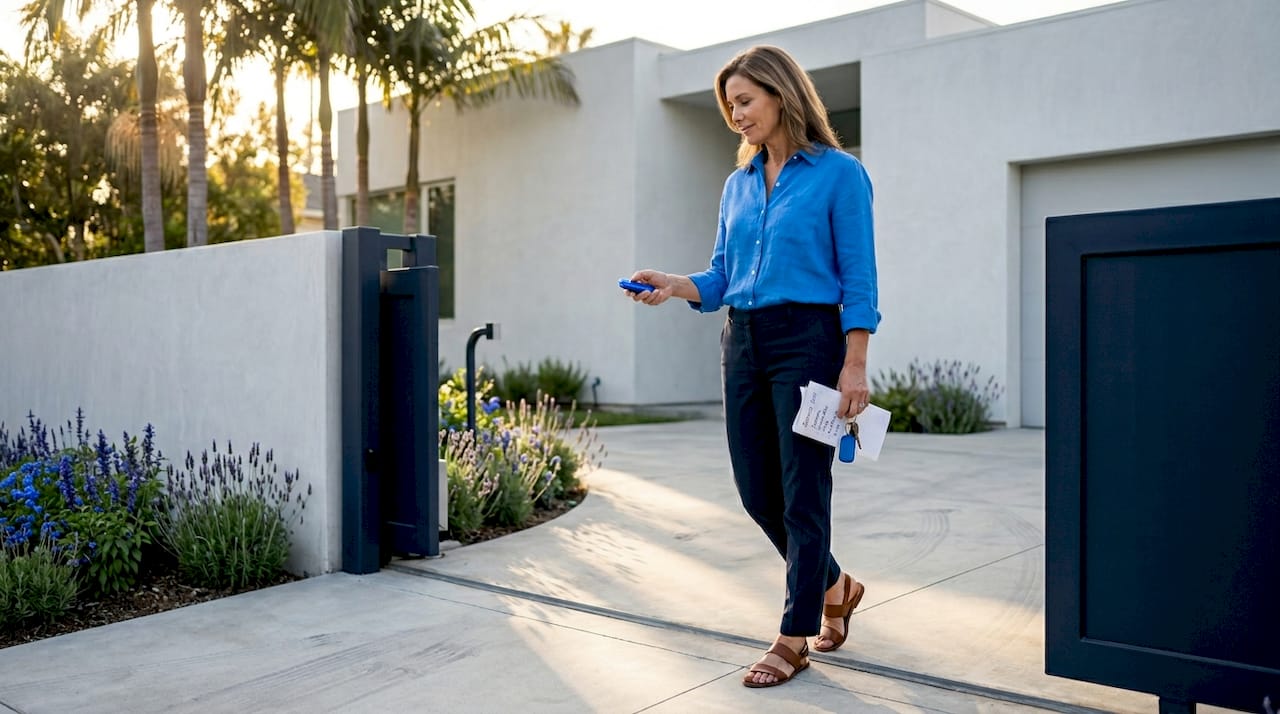
The choice between a manual and an automated gate is often the first major decision, and it carries real implications for your budget, your daily convenience, and your long-term maintenance costs. Manual gates are mechanically simpler, require less maintenance, and cost less upfront, but they sacrifice the seamless entry experience that many upscale LA homeowners prioritize. Automated gates, particularly sliding or swing models with keypad, remote, or smartphone integration, deliver a premium experience and add a measurable security layer, but they require proper safety device planning from the design phase onward.
| Feature Manual gate Automated gate | ||
| Upfront cost | Lower | Higher (motor, sensors, wiring) |
| Maintenance | Minimal, occasional lubrication | Annual motor and sensor servicing |
| Security | Basic, padlock or bolt | Keypads, intercoms, camera integration |
| Convenience | Requires physical operation | Remote, app, or vehicle sensor control |
| HOA acceptance | Generally straightforward | May require additional review for motor/enclosure |
| Best for | Secondary entries, pedestrian gates | Driveway entries, primary access points |
Material selection matters just as much as gate type. Here is how the most popular options perform in Los Angeles’ specific climate conditions:
- Aluminum is lightweight, corrosion-resistant, and holds powder coat finishes extremely well in the coastal air common in Santa Monica and Pacific Palisades. It fabricates into elegant ornamental profiles and suits both swing and sliding configurations. The aluminum fence guide covers the full range of profile styles available for upscale applications.
- Steel delivers superior strength and is ideal for wider driveway gates that must support their own weight over a large span. Galvanized or powder-coated steel resists rust, though it requires periodic inspection in high-humidity microclimates.
- Wood offers natural warmth and works beautifully with Spanish Colonial or Craftsman architecture, but it demands regular sealing and maintenance given LA’s sun exposure and occasional moisture swings.
Design choices should also be made with HOA approval in mind. Open picket or ornamental designs tend to pass architectural review more smoothly than solid panel configurations, which can provoke objections about privacy and scale. Review examples of premium security gate types to understand the full spectrum of design options before committing to a style.
Automation integrations worth planning for include vehicle loop detectors embedded in the driveway, video intercom systems with smartphone connectivity, solar-powered motor options, and integration with broader smart home platforms like Control4 or Lutron.
Step-by-step installation workflow: From prep to final checks
With your gate chosen, turning design into reality means following a proven process for lasting results.
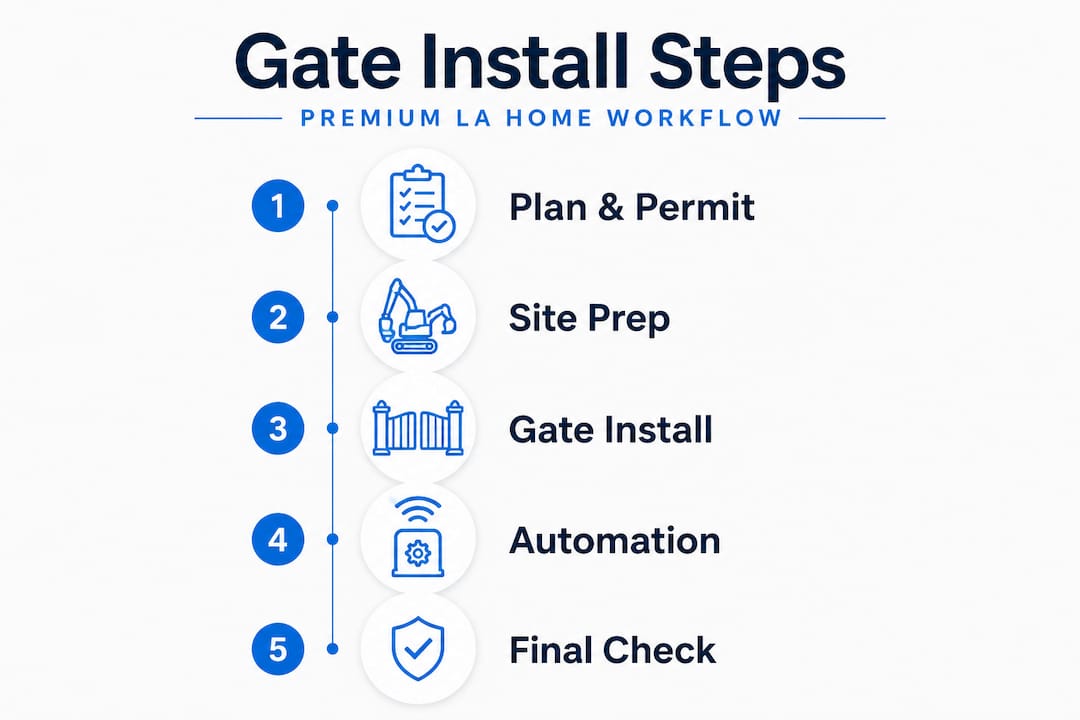
A structured workflow prevents the two most common on-site problems: posts that shift after backfill and automated hardware that fails alignment testing because hinge placement was not precisely calculated. Here is the sequence that professional installers follow for upscale residential projects:
- Site preparation. Clear vegetation, confirm underground utility locations through Dig Alert (811), and stake out post positions. Measure twice, mark once.
- Post hole excavation. Dig to a minimum depth of one third the post height plus 6 inches, deeper on hillside lots. Use tube forms for clean concrete pours.
- Concrete post setting. Set posts plumb using a level and temporary bracing. Allow at minimum 48 hours of cure time before hanging any gate weight.
- Gate measurement and pre-fit. Lay the gate flat and dry-fit hinges before installation. Confirm the gate panel clears the ground clearance required by your gate opener manufacturer.
- Hinge and latch alignment. Position hinges at no less than one quarter and three quarters of the gate height. Use adjustable hinges whenever possible to correct minor post movement over time.
- Motor and hardware installation. Mount the operator, limit switches, and control board according to manufacturer specifications. Route low-voltage wiring in conduit to protect against LA’s intense UV exposure.
- Safety device installation. Install photocells, pressure edges, and any additional sensors before any powered test cycles. This is not a step to defer.
- Function testing and adjustment. Run the gate through a minimum of 20 open and close cycles, checking for binding, limit switch accuracy, and safety device responsiveness.
“A professionally installed gate starts long before the first post goes in the ground. Verifying site clearances, compliance requirements, and precise layout measurements are what separate a gate that performs for decades from one that needs constant adjustment.” Based on the AFA installer checklist, this sequential verification approach is standard practice for both manual and automated systems.
For a detailed look at the smart home integration stage, the smart gate workflow resource provides granular guidance on wiring paths and network connectivity for automated systems. The quality of your fence post installation directly determines how well your gate operates over time, since post movement from soil conditions or vehicle impact is the leading cause of alignment failures in LA’s variable terrain.
Pro Tip: Always request that your contractor use galvanized post anchors or concrete-embedded sleeves rather than direct burial for ornamental metal posts. This makes future post replacement or adjustment far simpler without disturbing the surrounding concrete footing.
Automated gate safety: Devices, risk assessment, and compliance
As installation nears completion, upgrading to automation changes not just ease of entry but also makes safety and compliance non-negotiable.
Automated gates present a real physical hazard if safety devices are absent or improperly specified. A gate operator exerts substantial force during travel, enough to cause serious injury to a person, pet, or vehicle caught in its path. In an upscale Los Angeles setting, where pedestrian foot traffic near driveways is common and liability exposure is significant, a proper safety device strategy is essential from day one of design planning.
Automated gate safety best practice calls for using multiple safety devices rather than relying on a single force-limitation setting on the motor. The core safety layer typically includes:
- Photoelectric sensors (photocells): Beam-based sensors mounted on either side of the gate opening that halt or reverse movement when the beam is broken. These are effective for detecting people or vehicles in the gate path.
- Light curtains: An advanced version of photocell technology that creates a grid of detection beams, offering more precise coverage for complex gate geometries.
- Pressure-sensitive edges: Rubber or pneumatic strips mounted on the leading edge of the gate panel that trigger a stop-and-reverse response upon physical contact. These are critical for detecting obstacles that photocells may miss at close range.
- Safety loop detectors: Inductive loops embedded in the driveway surface that prevent the gate from closing while a vehicle occupies the loop zone.
- Warning signage and audible alerts: Required in many jurisdictions and always recommended as a supplemental safety layer.
The risk assessment approach, rather than simple trial-and-error adjustment of motor force settings, is the professional standard. A qualified installer evaluates gate weight, speed, travel distance, site geometry, and anticipated user traffic to specify the correct combination of devices.
“Relying solely on force limitation to make a gate ‘safe enough’ is a known risk factor. Safety devices must be selected and positioned based on a formal risk assessment, not added after problems arise.” This guidance from Gate Safe applies directly to any powered gate project in a residential LA setting.
For the full breakdown of automation steps and safety wiring diagrams, the luxury gate automation steps resource is the most relevant follow-up reading.
The truth most guides skip: Safety, liability, and luxury go hand-in-hand
Most DIY gate automation articles focus on how to wire a motor and set limit switches. Very few address what happens when something goes wrong and who bears the legal and financial consequences. In Los Angeles, that gap between installation confidence and real-world liability is where homeowners most frequently encounter expensive surprises.
Here is the perspective worth internalizing: a gate that looks safe and operates smoothly during your initial test runs is not necessarily compliant with safety standards. Safety device adequacy is evaluated against a risk assessment, not against personal observation. If a gate lacks the required sensors or pressure edges and an incident occurs, the homeowner faces direct liability exposure regardless of whether the gate seemed to be working fine for months beforehand.
In Beverly Hills, Bel Air, or Brentwood, where premium property values and high-visibility addresses are the norm, the reputational and financial stakes of a non-compliant installation are simply too high to rationalize away with cost savings. We consistently see that homeowners who invest in professional installation and proper safety device specification from the start spend less over a five-year period than those who pursue DIY solutions and face subsequent corrective work, HOA enforcement actions, or permit compliance retrofits.
The broader point is this: luxury gate projects in LA are not just aesthetic statements. They are regulated structures with real safety obligations. Choosing premium gate options that are designed for compliance from the start, and engaging professionals who understand both the design expectations of upscale neighborhoods and the regulatory nuance of LA’s permitting environment, is not an upsell. It is the most logical path to a gate that performs beautifully and keeps your household protected for years to come.
Need expert help with your Los Angeles gate installation?
If you are ready to move from planning to action, having the right support makes the entire process faster and more precise.
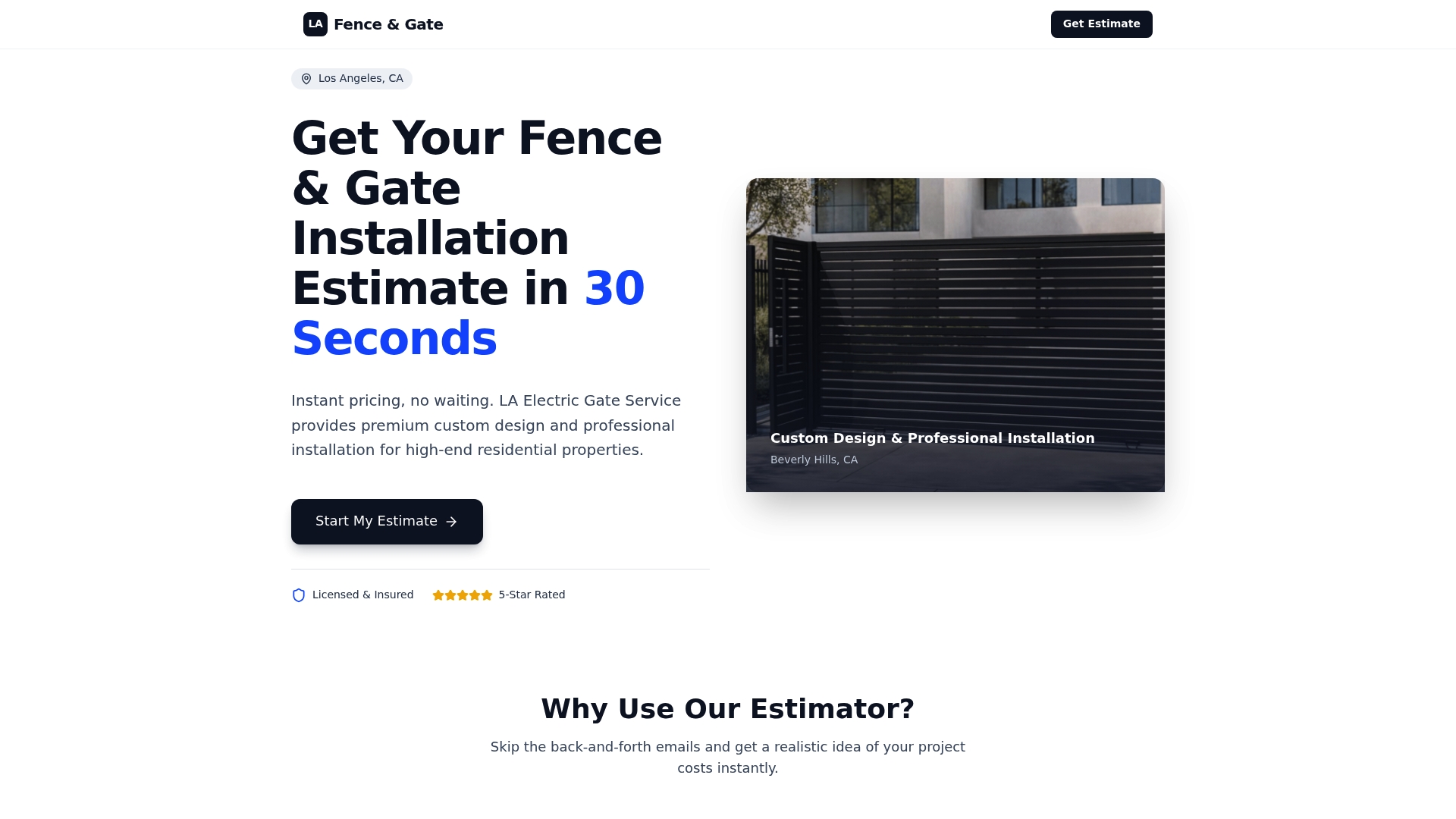
At fence-gate-estimator.com, you can use our gate automation calculator to instantly generate a realistic cost estimate based on your gate type, site conditions, and automation preferences, all using current LA labor and material rates. Explore our custom fencing solutions to see how design and compliance come together in a single streamlined process. Whether you are planning a grand driveway gate installation for a Beverly Hills estate or a secure pedestrian entry for a Santa Monica bungalow, our team is ready to deliver expert guidance and transparent pricing from the first click.
Frequently asked questions
When does my Los Angeles gate project need a permit?
Most gates above 42 inches in the front yard or constructed with masonry require permits; always verify with LADBS and your HOA before starting any work.
How do I choose between a manual and automated gate?
Automated gates offer superior security and daily convenience, but they require a higher budget and careful safety device planning before installation begins.
What safety devices are required for automatic gates in LA?
At least two complementary device types, such as photocells and pressure-sensitive edges, are recommended based on a professional risk assessment rather than force-setting adjustment alone.
Can I install an automatic gate myself?
DIY automation is technically possible, but safety organizations advise that high-traffic or luxury settings carry code and liability complexities that make professional installation the significantly safer and more reliable choice.