Estimate fence costs in Los Angeles: A homeowner's guide
By BabyLoveGrowth
Estimate fence costs in Los Angeles: A homeowner’s guide
Fence projects in Los Angeles have a reputation for running over budget, and for good reason. A Beverly Hills homeowner once budgeted $12,000 for a wrought iron perimeter fence, only to receive a final invoice closer to $28,000 after automation, slope adjustments, permits, and HOA-mandated finishes were added to the bill. That kind of surprise is avoidable. Wood fences cost $28 to $35 per linear foot in LA, while premium materials like wrought iron run $70 to $150 per linear foot, meaning a 145-linear-foot project in a luxury neighborhood can easily exceed $20,000 before extras. Getting your estimate right from the start is the difference between a project that fits your budget and one that derails it.
Table of Contents
- What affects fence cost in Los Angeles?
- Step-by-step: How to estimate your fence cost
- Permits, inspections, and HOA rules: The LA essentials
- Automation, gates, and finishing touches: Hidden costs revealed
- A seasoned take: What most fence cost guides miss about LA
- Smart fencing starts with the right estimate
- Frequently asked questions
Key Takeaways
| Point Details | |
| Material impacts cost | Your choice of wood, vinyl, or wrought iron sets the baseline fence price per foot. |
| Regulations apply | Permits and HOA rules in Los Angeles can affect total costs and allowed designs. |
| Extras add up fast | Automated gates and luxury details can double or triple your project budget. |
| Site inspection is key | No online estimate is final—on-site evaluation prevents costly surprises. |
What affects fence cost in Los Angeles?
Now that the scale of typical fence costs is clear, let’s break down the main elements that most affect your final price in LA.
Material choice is the single biggest cost lever. The material you select sets the floor for everything else, and in Los Angeles, the range is wide.
| Material Installed cost per linear foot Best for | ||
| Wood | $28 to $35 | Privacy, natural aesthetic |
| Vinyl | $35 to $65 | Low maintenance, clean look |
| Aluminum | $40 to $75 | Modern design, coastal areas |
| Steel | $40 to $75 | High security, industrial style |
| Wrought iron | $70 to $150 | Luxury curb appeal, estates |
Materials like vinyl, aluminum, and wrought iron command significantly higher prices per foot compared to standard wood, and that gap only widens when you add fabrication details, custom finishes, or decorative elements. Understanding these LA fence cost factors before you start shopping will help you set a realistic budget.
Beyond material, several other variables shape your total:
- Labor rates: Los Angeles labor costs are among the highest in the country. Expect to pay a premium for licensed, insured contractors in upscale neighborhoods.
- Property size and linear footage: The total perimeter of your lot directly determines how much material and labor you need.
- Design complexity: Straight runs cost less than curved layouts, multi-level terrain, or decorative post caps and panels. Custom fence components for luxury properties can add 20 to 40 percent to your base cost.
- Height: Standard 6-foot fencing is cheaper than 8-foot or taller installations, which may also trigger permit requirements.
- Terrain: Hillside lots in neighborhoods like Pacific Palisades or the Hollywood Hills require stepped or racked fencing, adding both labor time and material waste.
- Permits and HOA rules: These are non-negotiable add-ons covered in detail below.
- Automation and gates: Automated gates are a premium category on their own, addressed separately in this guide.
Statistic to know: A typical 200-linear-foot wrought iron fence with decorative elements in Beverly Hills can cost between $14,000 and $30,000 installed before any gate or automation work is included.
Step-by-step: How to estimate your fence cost
Understanding each cost driver helps you control your budget. Here is how to turn that knowledge into a concrete estimate.
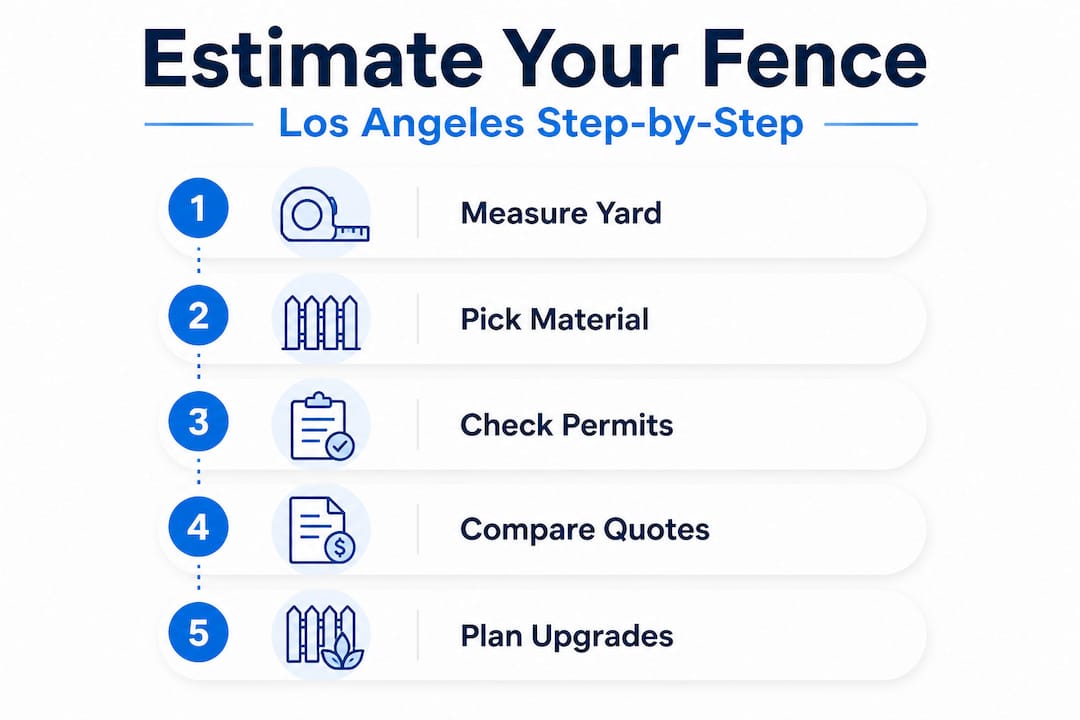
Follow these five steps to calculate an accurate starting budget for your project:
- Measure your linear footage. Walk your property boundary and measure the total distance you want fenced, in feet. For irregular lots, break the perimeter into straight segments and add them together. A typical residential lot in Santa Monica or Brentwood might run 150 to 250 linear feet.
- Select your material and height. Refer to the cost table above and choose the material that fits both your design goals and budget. Decide on height early, since this affects both material quantity and permit requirements.
- Multiply linear footage by installed cost. For example, 180 linear feet of aluminum fencing at $55 per foot installed comes to $9,900 as a base estimate. This is your starting number, not your final number.
- Add for gates, terrain, and site prep. Manual gates typically add $500 to $1,500 per unit. Automated gates add $3,000 to $10,000 or more. Terrain impact on cost is significant: hillside lots can add 15 to 30 percent to labor alone. Site prep (grubbing, grading, removing old fencing) adds $500 to $3,000 depending on the project.
- Include permits, HOA fees, and inspections. Budget $50 to $500 for permits and plan for HOA review timelines, which can add two to six weeks to your project start date. Smart gate installation projects also require electrical permits in most cases.
Pro Tip: Always get a site-specific quote from a licensed contractor before finalizing your budget. Online calculators give you a solid ballpark, but every lot has unique conditions that affect price. Aerial measurements from mapping tools are often 10 to 15 percent off from ground-level measurements.
Here is a practical comparison of how project scope affects total cost for a typical LA property:
| Scenario Linear footage Material Gate type Estimated total | ||||
| Basic privacy fence | 150 ft | Wood | Manual, 1 gate | $5,500 to $8,000 |
| Mid-range security fence | 180 ft | Aluminum | Manual, 2 gates | $11,000 to $16,500 |
| Luxury estate perimeter | 200 ft | Wrought iron | Automated, 1 gate | $22,000 to $38,000 |
| Premium smart home fence | 220 ft | Steel | Smart auto, 2 gates | $28,000 to $50,000+ |
These ranges reflect real LA project conditions. Your property’s specific terrain, HOA requirements, and design choices will move the needle in either direction.
Permits, inspections, and HOA rules: The LA essentials
With your estimate in hand, there is one more critical layer to address: local rules and permits that shape what you can actually build.
Los Angeles permit requirements for fences include the following key triggers:
- Rear or side yard fences taller than 6 feet require a building permit.
- Front yard fences taller than 3.5 feet also require permits.
- Any fence incorporating electrical wiring or automation needs an electrical permit in addition to a building permit.
- Masonry walls (block, brick, stone) require permits at virtually any height.
- Permit fees range from $50 to $500 depending on project scope and municipality.
- Inspections are required at specific construction phases, including post setting and final walkthrough.
- HOAs in communities like Bel Air, Hancock Park, and Marina del Rey often impose stricter rules than city code, including restrictions on materials, colors, post styles, and maximum heights.
- You must verify property lines before installation to avoid encroachment disputes. A survey typically costs $500 to $1,500 but can save far more in legal fees.
“Failing to pull permits for an automated gate in Los Angeles can result in stop-work orders, fines, and the cost of removing and reinstalling finished work. It is always cheaper to do it right the first time.” — Common guidance from LA building inspectors
Review the LA fence permit essentials early in your planning process. Knowing the LA fence height rules specific to your neighborhood prevents costly redesigns late in the project.
One often-overlooked issue: HOA architectural review committees can take weeks to respond, and some require full material samples, renderings, and contractor credentials. If you are in an HOA community, factor this into your timeline before signing any contractor agreement.
Automation, gates, and finishing touches: Hidden costs revealed
So far we have covered base costs and legal hurdles. Now let us look at the extras that catch most upscale homeowners off guard.
Automated gates are one of the most requested features on luxury LA properties, and their costs escalate quickly. A real LA project involving 100 linear feet of wrought iron fencing with an automated gate ran approximately $35,000 total. That figure is not unusual. Here is where the budget additions typically appear:
- Automated gate operator: $1,500 to $5,000 for the motor and control system alone, depending on gate weight and swing vs. slide mechanism.
- Electrical trenching and wiring: $1,000 to $3,500 to run power to the gate location, especially on larger properties.
- Intercom and access control: $500 to $3,000 for keypads, video intercoms, smartphone integration, and guest management systems.
- Custom gate fabrication: Designer or custom-built gates in wrought iron or steel can cost $4,000 to $15,000 depending on size and complexity.
- Premium post caps and decorative elements: Ornamental finials, powder-coated custom colors, and architectural post caps add $800 to $3,500 to most projects.
- Slope modifications: On hilly terrain, fabricators often need to step or rack panels individually, increasing fabrication time and cost significantly.
Understanding fence automation costs before you commit to a design keeps your project from spiraling. Many homeowners fall in love with the idea of a smartphone-controlled estate gate, then are surprised when the total comes in $10,000 over their initial estimate.
Pro Tip: When budgeting for automation, add a 20 percent contingency on top of quoted prices. Trenching for electrical conduit frequently encounters unexpected obstacles like tree roots, irrigation lines, or buried utility lines in older LA neighborhoods.
Aluminum fence installation offers a more cost-effective path to a premium look if wrought iron pricing is out of range. Modern aluminum systems closely mimic the look of traditional iron at roughly half the per-foot cost, and they require far less ongoing maintenance in coastal areas where salt air accelerates corrosion.
A few additional finishing costs worth knowing:
- Post installation: In-ground concrete footings add $30 to $80 per post.
- Concrete and masonry bases: Used for pillar-style entry gates; adds $2,000 to $8,000.
- Removal and disposal of old fencing: Budget $500 to $2,000 depending on existing material.
A seasoned take: What most fence cost guides miss about LA
Most online fence cost guides treat Los Angeles as if it were a flat suburb in the Midwest. They publish a cost-per-linear-foot table, tell you to multiply by your fence length, and call it a day. That approach fails the moment you are dealing with a hillside lot in Laurel Canyon, a 1940s property with unmapped utility lines in Los Feliz, or an HOA in Pacific Palisades that has a 47-page design standards document.
Here is the uncomfortable truth: for truly accurate budgeting on luxury or hilly LA properties, an online calculator is a starting point, not a finish line. We say this as people who build and maintain estimation tools. The calculator gives you a benchmark so you walk into contractor conversations informed, not uninformed. But it cannot account for that 8-foot retaining wall that turns a 3-hour post-setting job into a two-day excavation project.
Upgrades are where budgets come undone. It starts with “let’s add automation” and quickly becomes smart intercoms, backup battery systems, decorative pillars, and custom powder coating in a specific RAL color the HOA insists upon. Before you know it, a $15,000 fence project is a $40,000 one. Always price your “must-haves” and your “nice-to-haves” separately. Commit to the must-haves first, and treat automation and premium finishes as phase-two additions if the budget is tight.
The most underestimated cost in our experience? Property line verification. Homeowners skip the survey to save $700, then discover three months after installation that two fence posts are on a neighbor’s property. The resulting legal and reinstallation costs make that $700 survey look like the best money they never spent. Check out real fence cost examples from LA properties to see how these factors compound in practice.
The best LA fence projects we see are the ones where the homeowner did their homework first, got three licensed contractor bids, confirmed their HOA rules in writing, and secured a permit before breaking ground. That process takes two to four weeks longer than rushing in, but it is the only way to avoid surprises.
Smart fencing starts with the right estimate
You now have a solid foundation for planning your LA fence project, from material costs and permit requirements to automation pricing and hidden extras. Protecting that investment starts with an accurate, site-specific estimate before you commit to any design or contractor.
At fence-gate-estimator.com, we specialize in giving Los Angeles homeowners precise, instant cost estimates tailored to local material and labor rates. Whether you are exploring custom fencing estimates for a new perimeter, requesting gate automation quotes for a luxury entry, or comparing driveway gate options across materials and styles, our estimator tool gives you a clear budget starting point in minutes. Get your numbers right before you start, and your project will stay on track from the first post to the final panel.
Frequently asked questions
What is the average cost per foot for fencing in Los Angeles?
In Los Angeles, wood fences cost $28 to $35 per linear foot installed, vinyl runs $35 to $65, aluminum and steel range from $40 to $75, and wrought iron commands $70 to $150 per linear foot.
How do gates and automation affect fence cost?
Adding automated gates to a project can add $3,000 to $10,000 or more per gate, and top LA projects combining 100 linear feet of wrought iron with an automated gate have reached approximately $35,000 total.
Are permits or HOA approval needed for fences in Los Angeles?
Yes, permits are required for fences over 6 feet on rear and side yards, over 3.5 feet in the front yard, or any automated or masonry fence, and many HOAs impose additional approval requirements.
What extra costs should upscale homeowners expect?
Premium materials, complex terrain, designer finishes, and smart automation features commonly double or triple base fence costs, making a 20 percent contingency buffer a standard practice for luxury LA projects.
Recommended
- How terrain impacts fence costs in Los Angeles: smart choices | LA Electric Gate Service
- Fence & Gate Installation Cost Calculator Los Angeles
- Fence post installation in Los Angeles: 5 key essentials | LA Electric Gate Service
- Expert Gate & Fence Blog | LA Electric Gate Service
- Construire un mur de jardin esthétique et durable : guide