Gate openers: The key to secure, stylish LA homes
By BabyLoveGrowth
Most homeowners think of gates as static barriers, passive structures that simply mark a property boundary. But in Los Angeles’s most prestigious neighborhoods, from Beverly Hills to Bel Air to Pacific Palisades, automated gate openers have become essential smart home infrastructure. They blend advanced security technology with precision engineering and striking aesthetics, transforming a basic entry point into a sophisticated statement about your property. This guide breaks down everything you need to know about gate openers, from the core mechanics to selecting the right system for your specific driveway layout and lifestyle.
Table of Contents
- Understanding gate openers: The basics
- Modern safety and security features of premium gate openers
- Choosing the best gate opener for your Los Angeles home
- Installation and maintenance: What LA homeowners should know
- Why choosing the right gate opener matters more than you think
- Ready for a secure, stylish upgrade?
- Frequently asked questions
Key Takeaways
| Point Details | |
| Gate openers explained | A gate opener is an automated device that lets you open or close gates remotely, boosting both security and convenience. |
| Safety features are crucial | Premium gate openers include sensors and anti-entrapment tech to keep families safe. |
| Choose the right type | Select a gate opener style that suits your driveway, needs, and local regulations. |
| Proper care pays off | Regular sensor checks and professional maintenance ensure peak performance for years. |
| Expert help recommended | Work with local professionals to secure the best value and code compliance in Los Angeles. |
Understanding gate openers: The basics
A gate opener is an automated electromechanical device that controls the movement of driveway or pedestrian gates. It responds to inputs from remote controls, keypads, intercom systems, vehicle loop detectors, or smartphone apps. The motor drives the gate through one of three primary mechanisms: swing arm, sliding track, or vertical lift. The result is a hands-free, secure entry experience that replaces manual operation entirely.
Understanding gate automation basics starts with the three main mechanisms:
- Swing gate openers use articulated arms or underground actuators to push or pull gates open in an arc, much like a door hinge. They work well on properties with sufficient driveway clearance in front of the gate.
- Sliding gate openers move the gate laterally along a track, requiring minimal clearance in front. These are particularly well suited for sloped driveways or tight urban lots.
- Lift gate openers raise the gate vertically, common in commercial or high-security residential settings where lateral or swing space is extremely limited.
Modern openers also integrate with smart home platforms. Wi-Fi and Z-Wave connectivity allow you to monitor gate activity, grant temporary access, and receive real-time alerts directly on your phone. For a Beverly Hills or Bel Air property, this level of control is no longer a luxury upgrade. It’s an expectation.
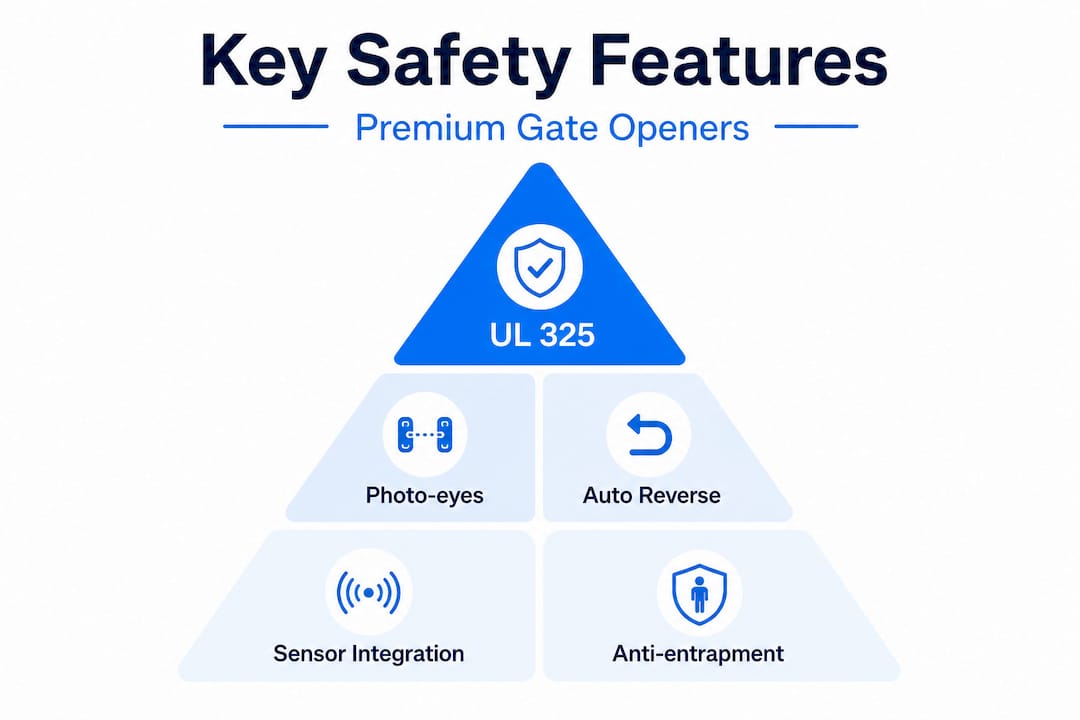
Safety is built into every quality system. Photo-eyes and anti-entrapment features are standard on premium openers, using infrared beam sensors to detect obstructions and automatically halt or reverse gate movement. This is not optional engineering. It’s the foundation of a safe automated entry.
With the basics in mind, it’s important to explore the safety and security aspects that set premium gate openers apart.
Modern safety and security features of premium gate openers
Safety is where today’s premium gate openers truly earn their price. The technology has advanced significantly over the past decade, and what was once only available in commercial security installations is now standard in high-end residential systems throughout Los Angeles.
Here are the most critical safety and security features to look for:
- Photo-eye beam sensors. These infrared sensors project a beam across the gate opening. Monitored safety sensors detect any object breaking the beam and immediately cause the closing gate to stop and reverse, preventing injury or property damage.
- Auto-reverse. Pressure-based auto-reverse kicks in if the gate meets unexpected physical resistance during closure, adding a secondary layer of protection beyond beam sensors.
- Manual override. In case of a power outage or mechanical failure, a manual release allows residents and emergency personnel to operate the gate by hand without damaging the motor or drive system.
- Anti-entrapment zones. Modern systems create designated safety zones around the gate perimeter, triggering the opener to halt if any person or object enters that space during operation.
- Customized access codes and remote monitoring. You can assign unique entry codes to housekeeping staff, vendors, or visitors and revoke them instantly. Many systems also log every entry and exit with timestamps.
Premium gate systems that sync with home security platforms can send real-time push notifications every time your gate opens or closes, giving you full visibility even when you’re traveling.
The most critical compliance standard you should know about is UL 325, a safety certification published by Underwriters Laboratories that governs automated gate operators in the United States. A UL 325-compliant system has been independently tested to confirm that its safety sensing, reversal mechanisms, and entrapment protection meet modern standards.
Pro Tip: Always ask your gate installer to confirm UL 325 compliance before any contract is signed. This single certification confirms that smart security value is genuinely built into the system, not just marketed as a feature.
Knowing how these features keep your home safe, let’s compare different types of gate openers and their suitability for various LA homes.
Choosing the best gate opener for your Los Angeles home
Selecting the right system is not just about picking a motor. Your driveway layout, gate material, usage frequency, aesthetic goals, and local ordinances all influence which opener will perform best long-term. Getting this choice wrong is expensive. Getting it right adds lasting value to your property.
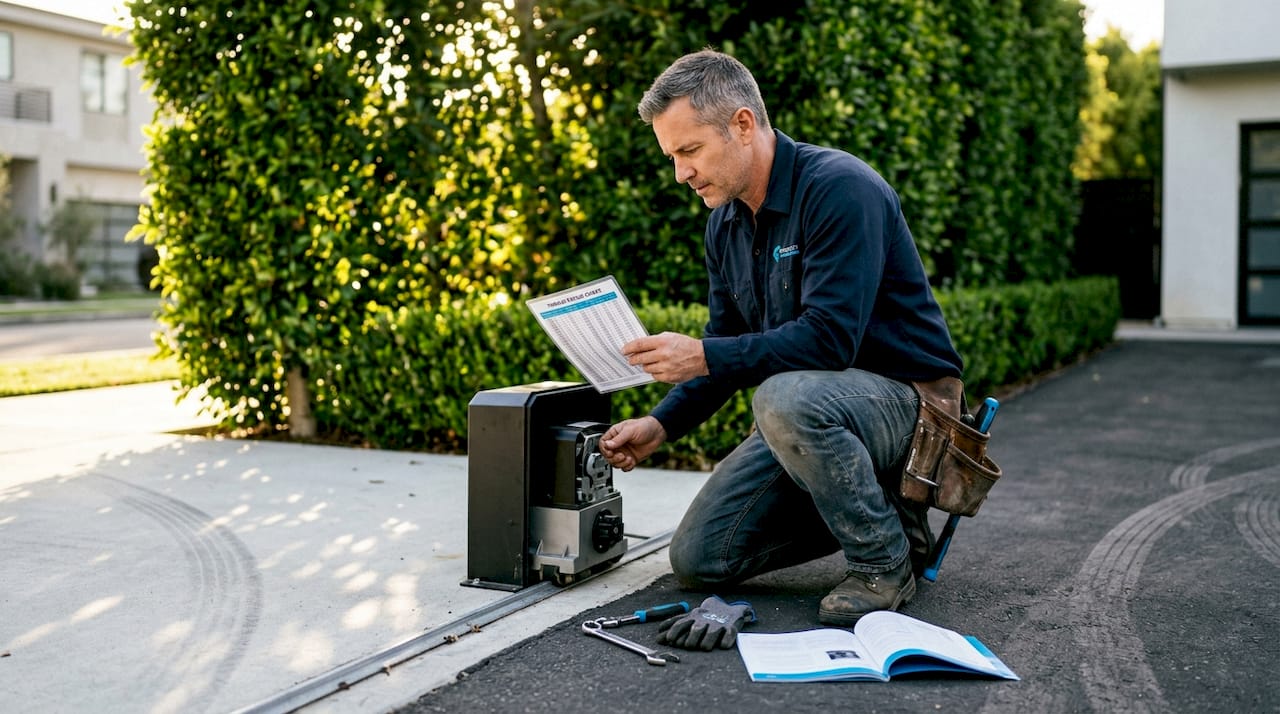
Gate opener types and applications vary considerably across swing, sliding, and lift mechanisms, and each serves different property configurations. Here’s a direct comparison:
| Feature Swing gate opener Sliding gate opener Lift gate opener | |||
| Space needed | Requires clearance arc | Minimal front clearance | Minimal lateral space |
| Best for | Flat, spacious driveways | Sloped or tight lots | High-security, limited space |
| Noise level | Low to moderate | Low | Moderate |
| Aesthetic appeal | Classic, elegant | Sleek, modern | Utilitarian |
| Typical cost range | $1,500 to $4,000 | $2,000 to $5,500 | $3,000 to $7,000+ |
| Maintenance needs | Moderate | Low to moderate | Low |
Premium Los Angeles homeowners increasingly favor sliding gate openers because they work well on the hillside driveways common in Bel Air and Hollywood Hills, and they deliver a clean, contemporary aesthetic that pairs naturally with modern architecture.
When you’re evaluating your options, consider these factors before making any decisions:
- Available space: Swing gates need room to arc open without striking vehicles or landscaping. If your driveway is short, a sliding system is the smarter choice.
- Usage frequency: High-traffic entries need commercial-grade motors rated for hundreds of cycles per day. Residential-rated motors are sufficient for most homes but will wear faster under heavy use.
- Gate material: Security gate options in wrought iron and steel add considerable weight, requiring higher-torque motors. Aluminum gates are lighter and easier on motors but may sacrifice some of the visual gravitas that wrought iron delivers.
- Code compliance: Before choosing a gate style or motor, review LA fence height rules and local permit requirements. Driveway gate installations in Los Angeles typically require a permit, and some HOA communities have specific restrictions on gate design and automation type.
- Smart home integration: If your home runs on a smart platform like Google Home, Apple HomeKit, or Amazon Alexa, confirm that your opener supports integration before purchasing.
When you’re browsing driveway gate choices, match your gate material to your opener’s motor torque rating. A mismatched pairing accelerates wear and increases long-term maintenance costs.
Now that you’ve compared your options, let’s look at the installation process, maintenance tips, and what to expect as a long-term owner.
Installation and maintenance: What LA homeowners should know
Even the best gate opener underperforms without correct installation. This is not a DIY project for most homeowners. The stakes include electrical wiring, concrete foundation work, safety sensor calibration, and permit compliance. A professional installer ensures that every component works together from day one.
Here’s a typical installation workflow for a residential gate opener in Los Angeles:
- Site assessment. A technician evaluates your driveway grade, gate dimensions, post condition, and available power supply. This step confirms which opener type suits your property.
- Permit application. Your installer files for the necessary City of Los Angeles or county permits. Skipping this step creates legal liability and can complicate future property sales.
- Foundation and post preparation. Depending on the gate type, concrete footings may need to be poured or reinforced to support motor housing and gate weight.
- Opener installation. The motor unit is mounted and connected to the gate drive mechanism, whether swing arm, rack-and-pinion track, or vertical lift system.
- Electrical connection. Low-voltage control wiring, transformer installation, and any intercom or keypad wiring are completed by a licensed electrician.
- Safety sensor calibration. Photo-eye sensors are aligned and tested. Proper installation ensures all safety sensing functions are set up correctly, which is critical for maximizing both lifespan and security.
- Final testing and walkthrough. The installer tests every function including auto-reverse, manual override, remote operation, and smart home sync, then walks you through the system.
Follow the installation workflow carefully with your installer to ensure nothing is overlooked.
Once installed, the system requires regular maintenance to stay reliable. Here’s how owner responsibilities break down:
| Task DIY or professional Frequency | ||
| Test photo-eye sensors | DIY | Monthly |
| Clean and lubricate tracks | DIY | Every 3 months |
| Check gate alignment | DIY | Every 6 months |
| Inspect wiring and connections | Professional | Annually |
| Full safety system check | Professional | Annually |
| Motor and drive mechanism service | Professional | Every 2 years |
Pro Tip: Test your safety sensors every month by placing a cardboard box in the gate’s path during closure. If the gate does not reverse, call your service technician immediately. This simple routine prevents accidents and catches sensor drift before it becomes a costly failure.
With these practical insights, let’s share a hard-won perspective on what really matters when selecting and owning a gate opener in Los Angeles.
Why choosing the right gate opener matters more than you think
Here’s the part most guides skip over: the biggest mistake LA homeowners make when buying a gate opener is treating it like a cosmetic upgrade. They spend weeks choosing between wrought iron scrollwork patterns and powder coat colors, then accept whatever motor the installer recommends without asking a single question about safety certifications or integration capabilities.
That approach is backwards.
The real value of a premium gate opener is not visible to anyone driving past your property. It lives inside the safety circuitry, the UL 325 compliance label, the quality of the motor drive gears, and the depth of smart home integration. These are the features that determine whether your system runs reliably for twelve years or starts causing problems in year three.
We’ve also seen homeowners underestimate installation quality. A gate opener is only as good as its mounting, its sensor alignment, and its electrical connections. A poorly installed $3,500 opener will cost you more in service calls over five years than a professionally installed $2,000 unit. The underestimated security value of a well-specified, correctly installed system compounds over time.
The other thing most homeowners wish they had known earlier is how quickly gate opener technology moves. Systems purchased just five years ago often lack Wi-Fi connectivity, app-based access logs, or compatibility with current smart home platforms. If you’re investing at the premium level, choose a system designed with software update capability and open API support. That futureproofing protects your investment as technology evolves.
Our honest advice: prioritize safety certifications and integration capabilities first, aesthetics second, and motor size third. Most residential gates in Los Angeles do not need a high-torque commercial motor. They need a reliable, well-calibrated, UL 325-compliant system that works every single time without fuss.
Ready for a secure, stylish upgrade?
If this guide has helped clarify your options, you’re already ahead of most homeowners who start the process without understanding what separates a reliable system from a frustrating one. The next step is getting a realistic picture of what your specific project will cost, factoring in your property size, gate material, opener type, and local permit requirements.
At fence-gate-estimator.com, you can access premium gate automation estimates instantly, without waiting for a sales call or a site visit. Our estimator uses current Los Angeles labor and material rates to generate accurate, itemized cost breakdowns for your exact specifications. Whether you’re exploring sliding gate systems for a hillside driveway or considering custom fencing solutions that complement your home’s architecture, our platform gives you the numbers you need to plan confidently and budget accurately. Start your estimate today and take the guesswork out of one of the most valuable upgrades you can make to your property.
Frequently asked questions
Are automated gate openers safe for families with children and pets?
Yes, modern openers include photo-eyes and auto-reverse features that detect obstructions and immediately halt or reverse gate movement, making today’s systems far safer than older manual gates.
How often do gate openers need maintenance?
Photo-eyes and safety sensors should be tested monthly, and a full professional service covering wiring, motor condition, and safety systems should be scheduled annually to ensure long-term reliability.
Can I automate my existing manual gate?
In most cases, yes. Many modern opener systems can be retrofitted onto existing gates as long as the gate’s structural condition, post stability, and alignment meet the motor manufacturer’s requirements.
What’s the most common type of gate opener for LA homes?
Sliding gate openers are the most popular choice in Los Angeles because they work well on sloped or space-restricted driveways and offer a sleek, modern aesthetic that suits the region’s contemporary architecture.