LA fence height rules: a homeowner's complete guide
By BabyLoveGrowth
LA fence height rules: a homeowner’s complete guide
Many Los Angeles homeowners are surprised to learn they’ve installed a fence that violates local code, sometimes in properties worth millions of dollars in upscale neighborhoods like Beverly Hills or the Hollywood Hills. The City of LA, LA County, and individual incorporated cities each enforce their own fence regulations, and the differences between them can catch even careful property owners off guard. This guide cuts through that confusion with clear, current rules so you can plan your fencing project with full confidence and zero costly surprises.
Table of Contents
- Understanding core fence height limits in Los Angeles
- Permits, exceptions, and special zones
- Material restrictions and safety considerations
- Jurisdiction differences: upscale neighborhoods, counties, and edge cases
- The overlooked traps and real risks of LA fence laws
- Estimate your project with confidence
- Frequently asked questions
Key Takeaways
| Point Details | |
| City fence height basics | Front yard fences max out at 3.5 feet, side/rear can reach up to 8 feet depending on lot width. |
| Permit requirements clarified | Most short fences need no permit, but taller or masonry/concrete fences often do. |
| Material and safety rules | Only certain materials allowed; fire-prone areas have new noncombustible fencing rules. |
| Know your jurisdiction | Upscale, hillside, or county areas may have stricter and different rules than main LA city limits. |
| Common pitfalls | Hedges/shrubs may count as fences and jurisdiction mistakes can cause costly violations. |
Understanding core fence height limits in Los Angeles
Now that you know confusion is common, let’s clarify the actual legal limits that apply across Los Angeles homes.
The City of Los Angeles sets distinct height maximums depending on where the fence sits on your property. These aren’t suggestions. They are enforced zoning regulations that apply to all residential ® zones throughout the city.
Here are the key limits you need to know:
- Front yard fences: Maximum height of 3.5 feet (42 inches) in most residential zones. This applies to any fence between your home’s front setback line and the street.
- Side and rear yard fences: Up to 8 feet if lot width is 40 feet or more; limited to 6 feet on narrower lots, per LAMC §12.22.C.20(f).
- Material: These height limits apply regardless of the material used in most standard cases, though exceptions exist (covered below).
Understanding your fence post installation requirements before you begin is critical, because post depth and placement affect overall fence height as measured by the city.
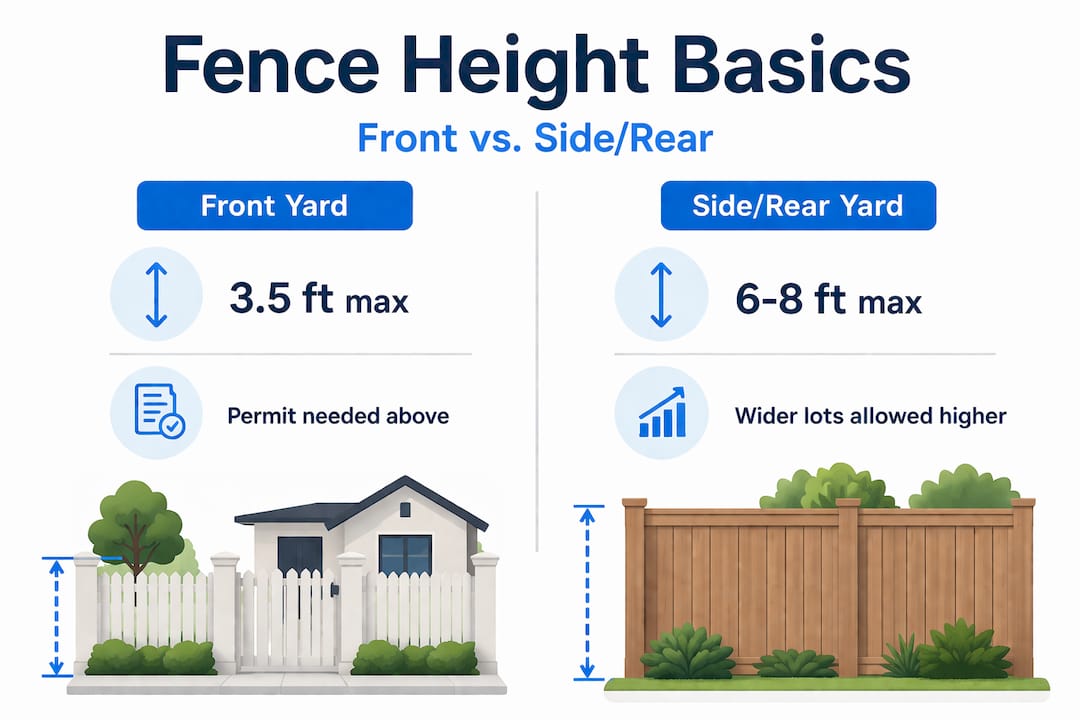
Quick reference: fence height by yard type and lot size
| Yard Location Lot Width Under 40 ft Lot Width 40 ft or More | ||
| Front yard | 3.5 ft max | 3.5 ft max |
| Side yard | 6 ft max | 8 ft max |
| Rear yard | 6 ft max | 8 ft max |
A common mistake is assuming the rear yard allows unlimited height because it’s “out of sight.” It doesn’t. And if your lot sits on a slope, the effective height calculation can change significantly. Your local terrain impact on fence height may shift how the city measures your fence from the uphill versus downhill grade.
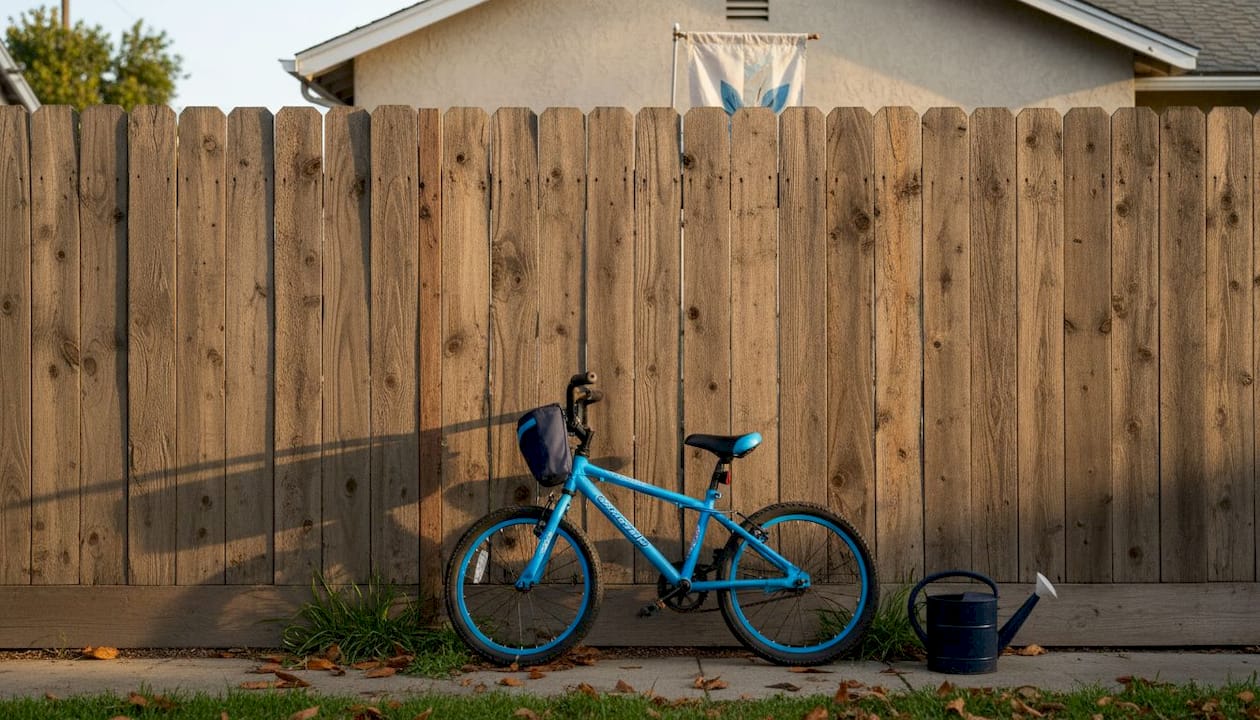
One more thing worth noting: these rules apply specifically to the City of Los Angeles. If your address falls within Beverly Hills, Culver City, or another separately incorporated municipality, different rules apply entirely, and we’ll cover those in detail later.
Permits, exceptions, and special zones
Once you know the standard heights, it’s important to understand where exceptions kick in and how to avoid common permit pitfalls.
Not every fence project in LA requires a building permit, but the rules about when you do and don’t need one are more specific than most people expect.
When is a permit required?
No building permit is required for fences under 6 feet in side and rear yards, and under 3.5 feet in front yards. However, masonry or concrete fences over 3.5 feet require a permit under LAMC Section 91.106, regardless of where they’re located on your property.
Here’s a practical step-by-step breakdown for figuring out if your project needs a permit:
- Identify the fence’s location: front, side, or rear yard.
- Measure or plan the final height of the fence from grade.
- Determine the fence material: wood, metal, vinyl, masonry, or concrete.
- Check if your lot width is above or below 40 feet.
- Confirm whether your property is inside a Fence Height District (see below).
- Contact the Los Angeles Department of Building and Safety (LADBS) if any factor is unclear.
What are Fence Height Districts?
Fence Height Districts are a specific zoning overlay in the City of LA. They allow for a notable exception to the standard 3.5-foot front yard rule. In Fence Height Districts under LAMC Section 13.10, taller front yard fences are permitted, but only if they are open wrought iron meeting precise specifications: vertical bars no more than 5/8 inch in diameter with at least 4 inches of spacing, horizontal bars no more than 1 inch in diameter with at least 18 inches of spacing, and pilasters no wider than 24 inches and spaced at least 8 feet apart.
This matters a lot in upscale neighborhoods. Many properties in areas like Hancock Park and Los Feliz fall within Fence Height Districts, which is why you sometimes see impressively tall wrought iron gates and fences on front yards that would otherwise be illegal. If you’re considering custom fence component options for your front yard, confirming your district status is the first step.
Pro Tip: You can verify whether your property is inside a Fence Height District by checking the official LADBS zoning map or calling your local planning department. Don’t rely on what your neighbor did. Their property may be zoned differently from yours.
| Scenario Permit Required? | |
| 5-ft wood rear fence, lot 45 ft wide | No |
| 4-ft masonry front fence | Yes |
| 6-ft chain-link side fence, 35-ft lot | No |
| 7-ft wrought iron front in Height District | Yes |
| 3-ft vinyl front fence | No |
Material restrictions and safety considerations
Setting the right fence height is only half the story. The material you choose may affect legality and safety, especially in premium or hillside districts.
Allowed and prohibited materials
The city is clear about which materials are acceptable in residential zones:
- Allowed: Wood, vinyl, wrought iron, masonry, and chain-link
- Prohibited: Barbed wire is prohibited in residential zones except at industrial or commercial property boundaries
Razor wire, electrified fencing, and similar security-grade materials are equally off limits in standard residential areas. These restrictions exist for obvious safety reasons, particularly in denser neighborhoods where children and pedestrians are nearby.
If you’re exploring aluminum fence installation as a wrought iron alternative, aluminum is allowed in residential zones and offers significant advantages in coastal neighborhoods where salt air corrodes iron quickly. It’s also notably lighter, which can reduce installation costs per linear foot.
Wildfire code changes in 2026
This is where things get especially important for hillside homeowners. 2026 state wildfire rules may require noncombustible fencing near homes in fire-prone upscale hillside areas. Properties in Very High Fire Hazard Severity Zones (VHFHSZ) may face additional material requirements, meaning wood fencing that was perfectly legal a few years ago could now be subject to new scrutiny during a permit review or property inspection.
Important: If your home is in a hillside neighborhood like Bel Air, Laurel Canyon, or Topanga, confirm your current fire zone designation before choosing any fencing material. Selecting fire-resistant materials now saves you from forced replacement later.
Pro Tip: Powder-coated steel and aluminum both qualify as noncombustible materials and are widely used in upscale LA fencing. If you’re in a hillside zone, these materials combine regulatory compliance with a high-end appearance that enhances your property’s curb appeal. Explore vinyl alternatives for fencing if you’re looking for non-wood options that work in lower-risk zones.
Jurisdiction differences: upscale neighborhoods, counties, and edge cases
Even with city rules explained, locals in Beverly Hills, hillsides, or near the coast often face an extra layer of restrictions. Understanding jurisdiction is essential before any installation begins.
This is where many well-intentioned homeowners make their biggest mistake: assuming that the City of Los Angeles rules apply to their upscale neighborhood when their address is actually inside a separate municipality.
Beverly Hills and incorporated cities
Beverly Hills is a separately incorporated city with its own zoning code. In Beverly Hills, front yard fences are often limited to 3 feet near the street before transitioning to a maximum of 6 feet for open-style fencing. Side and rear fences can go up to 7 to 10 feet depending on the zone and slope. Permits are required for any front yard fence or any fence exceeding 6 feet. View protection ordinances on slopes add another layer of restriction.
Here’s a comparison of key differences across jurisdictions:
| Jurisdiction Front Yard Max Side/Rear Max Permit Threshold | |||
| City of Los Angeles | 3.5 ft | 6 or 8 ft | Masonry over 3.5 ft |
| Beverly Hills | ~3 ft (open to 6 ft) | 7 to 10 ft | Over 6 ft or any front |
| LA County (unincorporated) | 3.5 ft | 6 ft | Varies by material |
LA County unincorporated and coastal areas
If your property is in an unincorporated part of LA County, including many coastal zones, the rules come from Los Angeles County rather than any city. LA County coastal areas allow front yard fences up to 3.5 feet, corner side fences up to 3.5 feet near the street and 6 feet farther from the street, interior side and rear yard fences up to 6 feet, and retaining walls up to 6 feet. Some zones also require wildlife permeable fencing, meaning your fence must allow animals to pass through.
Real-world jurisdiction scenarios
Consider these practical scenarios:
- A homeowner in the Hollywood Hills builds an 8-foot rear fence, believing City of LA rules apply. But their address falls under a hillside overlay zone limiting rear fences to 6 feet. They face a code violation.
- A property owner in Bel Air installs a wood fence assuming no permit is needed. Because the structure is in a VHFHSZ under new 2026 fire codes, the wood fence requires replacement with noncombustible material.
- A Beverly Hills homeowner builds a 5-foot concrete front yard wall without a permit. In Beverly Hills, that requires a permit and likely exceeds the front yard maximum.
As many upscale LA homeowners discover, the City of LA allows taller side and rear fences but keeps front yards strict. Hillside properties may face limits even in the rear. Confirming your exact jurisdiction and zone before planning is non-negotiable.
Understanding these variables also affects your budget planning. The top cost factors for LA fences include not just materials and linear footage but also permit fees and site-specific compliance requirements that vary by jurisdiction.
The overlooked traps and real risks of LA fence laws
Having learned the regulatory landscape, it’s vital to understand where even experienced homeowners and designers get tripped up.
Here’s a risk that catches almost everyone off guard: hedges and shrubs legally count as fences in Los Angeles. Under LAMC 12.22 C.20(f), a row of shrubs that grows above the permitted height limit can be treated as a non-compliant fence. Spite fences, meaning structures built over 10 feet specifically to annoy a neighbor, are also prohibited under California Civil Code 841.4.
We’ve seen homeowners invest heavily in fast-growing privacy hedges, only to receive a code complaint because the hedge exceeded the front yard limit. The city doesn’t care that it’s a plant instead of a panel. If it functions as a fence, it’s subject to fence rules.
The second biggest trap is jurisdictional assumption. Many residents of prestigious LA neighborhoods like Bel Air or West Hollywood have mailing addresses that read “Los Angeles” but are technically inside different zoning jurisdictions with stricter or different rules. Always verify with LADBS: confirm your lot width, your exact R zone, any slope or hillside overlay, and whether pool fencing safety rules apply to your property.
The third trap is failing to account for emerging building codes. The 2026 wildfire rules are not hypothetical. They represent a real shift in what materials are acceptable in hillside and fire-adjacent zones. If you plan now without accounting for these updates, you may find yourself replacing a brand-new fence within a few years.
Our view is that the most valuable thing you can do before any fencing project is spend 30 minutes confirming your jurisdiction, zone, and district status. It’s not glamorous, but it prevents the kind of expensive, stressful retrofits we see in our more LA fence law insights coverage time and again.
Estimate your project with confidence
The right knowledge helps, but the right tools and guidance ensure success.
Now that you understand the regulations, materials, and jurisdictional nuances, the next step is building a realistic budget that accounts for all these variables.
At fence-gate-estimator.com, our estimator tools are built specifically for the Los Angeles market, factoring in local labor rates, permit costs, material pricing, and terrain considerations that generic national tools simply miss. Whether you’re planning custom fencing for your property or exploring pedestrian gate options for a secure yet elegant entry, our platform gives you an immediate, accurate cost breakdown. You can input your lot dimensions, preferred materials, and automation features to receive a detailed estimate in minutes. Our team also provides professional consultation to ensure your project meets every applicable code requirement from day one.
Frequently asked questions
Does my front yard fence need a permit in Los Angeles?
Front yard fences under 3.5 feet generally don’t require a building permit, but any masonry or concrete fence over that height does require approval under LAMC Section 91.106.
Can I build an 8-foot side fence in the City of Los Angeles?
Yes, 8-foot side fences are allowed in City of LA residential zones, but only if your lot is at least 40 feet wide. Narrower lots are capped at 6 feet per LAMC §12.22.C.20(f).
What fencing materials are allowed in residential zones?
Wood, vinyl, iron, masonry, and chain-link are all permitted in residential areas, while barbed wire is banned except at commercial or industrial property boundaries.
Are retaining walls counted in fence height calculations?
Yes. Retaining walls over 3 to 4 feet require a permit, and the combined height of a retaining wall plus fence on top cannot exceed 6 feet in most residential areas, with additional rules applying to hillside locations.
Do hedges or shrubs count as a fence under LA law?
Yes. Under LAMC 12.22 C.20(f), hedges and shrubs are treated the same as fences and are subject to the same height restrictions in residential zones.
Recommended
- How terrain impacts fence costs in Los Angeles: smart choices | LA Electric Gate Service
- Fence post installation in Los Angeles: 5 key essentials | LA Electric Gate Service
- Expert aluminum fence installation guide for upscale LA homes | LA Electric Gate Service
- Custom fence components: build luxury, security, and style in LA | LA Electric Gate Service