Types of security gates: premium options for LA homes
By BabyLoveGrowth
Choosing the right security gate for an upscale Los Angeles home means balancing three competing priorities at once: robust physical security, seamless automation, and a design that complements your property’s architecture. Most homeowners discover quickly that a gate which looks stunning on paper can fall short when it comes to code compliance, smart home compatibility, or long-term safety. The U.S. safety standard for gate operators, UL 325, recognizes six distinct gate operator types, each with its own security profile and aesthetic potential. This guide walks you through everything you need to make a confident, informed decision.
Table of Contents
- Key factors in choosing a security gate
- Main types of security gates for homes
- Comparison of security gate types
- Which security gate is right for your Los Angeles home?
- Expert perspective: What most homeowners overlook about luxury security gates
- Next steps: Secure your Los Angeles home with premium gates
- Frequently asked questions
Key Takeaways
| Point Details | |
| UL 325 compliance matters | A gate’s safety depends on having both the correct operator type and full entrapment protection. |
| Variety of gate types | Slide, swing, bifold, and other gate types offer different blends of security, style, and automation. |
| Aesthetics and layout influence choice | Your property’s design and space constraints shape which gate styles are practical and appealing. |
| Automation compatibility varies | Most premium gate types support smart automation, with some more upgrade-friendly than others. |
| Expert advice streamlines selection | Consulting a local expert ensures your investment is beautiful, secure, and compliant. |
Key factors in choosing a security gate
With the selection challenge laid out, let’s break down the essentials every premium homeowner should evaluate before picking a gate.
The first thing to understand is that gate selection isn’t purely a design conversation. Your gate is a system, and every component matters. Before you fall in love with a particular style, work through the following criteria:
- UL 325 compliance and entrapment protection. A gate that looks the part is not automatically safe or legal. UL 325 compliance is system-level, meaning a gate that is the correct mechanical style can still be unsafe or non-compliant if entrapment protection is misaligned, missing, disconnected, or not monitored. Entrapment zones are the areas where a person could be caught or crushed by a moving gate, and they must be protected with sensors or contact-sensitive edges.
- Architectural fit and materials. Beverly Hills Craftsman estates, modern Santa Monica residences, and Mediterranean-style Bel Air homes all call for different gate profiles. Wrought iron suits traditional styles; powder-coated steel or brushed aluminum works well for contemporary facades. The finish should coordinate with exterior hardware and fencing materials already on the property.
- Automation and smart integration. High-end buyers expect gates to connect with existing smart home ecosystems. Review your access control options early in the planning process so your operator, keypad, intercom, and camera systems are compatible from day one.
- Property layout constraints. Driveway width, slope, available clearance for swing arc, and proximity to the street all affect which gate type will actually function properly on your lot.
- HOA rules and city codes. Many Los Angeles neighborhoods have specific requirements around gate height, setback distance, and design approval. Reviewing LA fence height rules ahead of your purchase prevents costly redesigns later.
- Lock and latch security. Gate automation doesn’t replace the need for quality hardware. Understanding high-security lock considerations helps you specify a lock that matches the physical security level of your gate material and operator.
Pro Tip: Always ask your installer to provide documentation confirming entrapment protection is active and monitored, not just installed. A sensor that isn’t wired correctly offers zero protection.
Main types of security gates for homes
Equipped with selection criteria, now review each major security gate type upscale homes consider.
UL 325 recognizes multiple gate operator types, including slide, swing, pivot, vertical lift, barrier arms, and bifold. Each type has a distinct operating mechanism, and each serves different property configurations and design priorities.
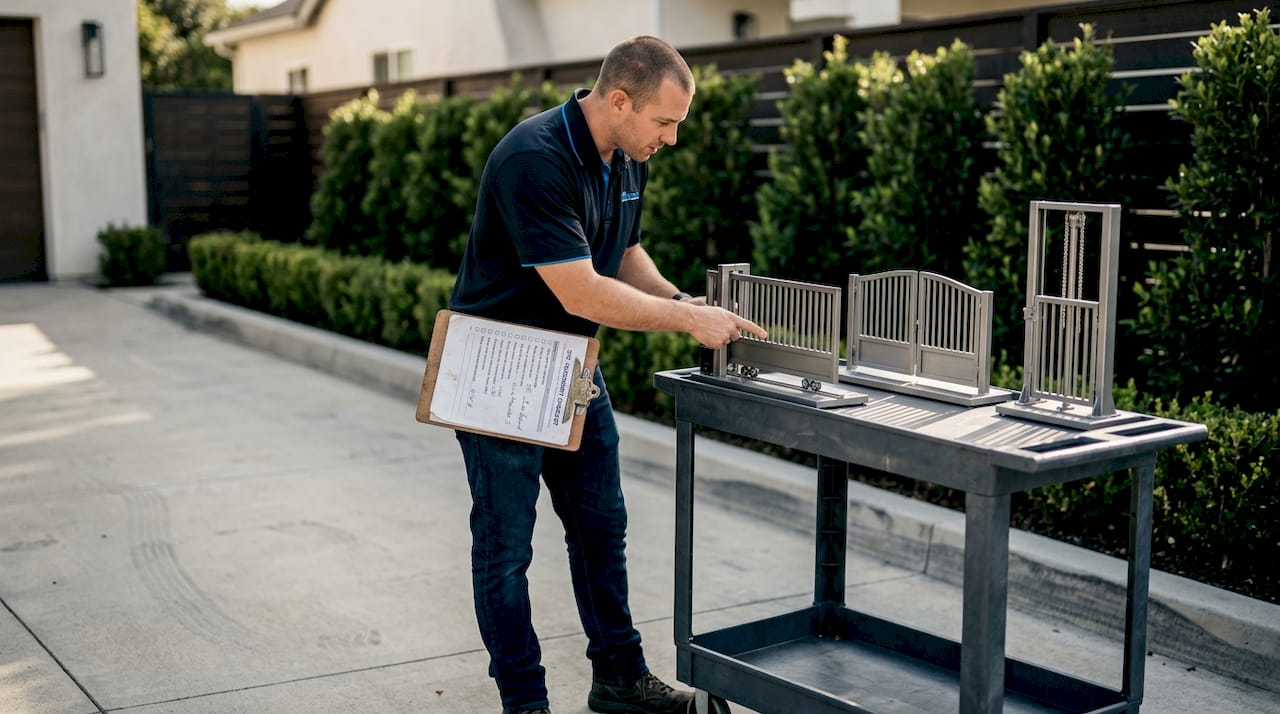
Slide gates are the most common choice for residential driveways in Los Angeles. The gate panel rides along a track parallel to the fence line, requiring no swing arc clearance in front of or behind the gate. This makes them ideal for properties close to a public sidewalk or street. Slide gates pair well with steel or aluminum fabrication and support virtually all automation systems. Browse premium driveway gates to see how slide configurations translate into finished designs.
Swing gates are the classic residential choice and consistently rank highest for curb appeal in luxury markets. A pair of swing gates opening inward from a central point creates a formal, symmetrical entrance that suits estates with generous driveways and level terrain. Single-leaf swing gates work for tighter openings. Both configurations need adequate clearance for the gate leaf to travel without obstruction.
Pivot gates are a statement option favored by architects and homeowners pursuing ultra-modern aesthetics. Rather than hinging at one edge, a pivot gate rotates on a central axis, allowing for oversized, dramatic panels that would be structurally impractical as traditional swing gates. They require precise counterbalancing and specialized operators, but the visual impact is unmatched.
Vertical lift gates solve a specific problem: steep driveways or lots where horizontal space is at a premium. The panel rises straight up, so no horizontal clearance is needed at all. They’re common in hillside properties throughout the Hollywood Hills and Silver Lake neighborhoods. Automation is standard with vertical lift systems.
Barrier arms are the retractable horizontal bars you typically see at parking structures and gated community entrances. While they control vehicle access effectively, they offer little in the way of physical security against determined intruders and are rarely specified for private residential use. They can, however, be appropriate for estate motor courts managing high vehicle volumes.
Bifold gates fold in half as they open, dramatically reducing the clearance needed compared to standard swing gates. They operate quickly and suit shorter driveways or properties where a swing gate would create safety issues. For a detailed look at pedestrian access points that can complement your primary gate, explore pedestrian gate solutions as a secondary entry option.
“Selecting a gate type without accounting for your specific driveway geometry is one of the most common and costly mistakes in premium residential gate projects.” — Installation planning insight
Understanding residential gate security distinctions also matters here. Commercial-grade hardware is sometimes marketed to homeowners, but the operating cycles, certification standards, and integration requirements differ meaningfully.
Comparison of security gate types
After describing each gate, compare them side-by-side for fast decision-making.
UL 325 is commonly used to certify automatic gates and lists operator types including slide gates, swing gates, pivot gates, vertical lift gates, barrier arms, and bifold gates. Here’s how they stack up across the criteria that matter most to upscale LA homeowners:
| Gate type Security rating Curb appeal (luxury) Automation compatibility Avg. installation range Maintenance level | |||||
| Slide | High | Moderate to high | Excellent | $4,500–$12,000 | Low |
| Swing (dual) | High | Very high | Excellent | $5,000–$15,000 | Low to moderate |
| Pivot | Moderate to high | Exceptional | Moderate | $8,000–$25,000+ | Moderate |
| Vertical lift | High | Moderate | Excellent | $6,000–$18,000 | Moderate |
| Barrier arm | Low | Low | Excellent | $1,500–$5,000 | Low |
| Bifold | High | High | Good | $5,500–$14,000 | Moderate |
These ranges reflect typical cost factors for gates in the Los Angeles market, including material, labor, operator hardware, and basic access control. Custom fabrication, premium finishes, and advanced gate automation systems such as video intercoms, license plate recognition, and app-based control will add to the base figures.
A few observations worth noting from this comparison. Pivot gates deliver the highest visual impact but come with the highest complexity and cost. Slide gates offer the best balance of security, automation compatibility, and value for most standard residential lots. Bifold gates are underutilized in the luxury market despite being an excellent fit for properties with constrained driveways.
Pro Tip: When specifying your gate system, build in conduit and wiring for future upgrades even if you’re not installing a full smart system today. Adding that infrastructure during initial installation costs a fraction of what retrofitting requires later.
Which security gate is right for your Los Angeles home?
With all options and comparisons laid out, the final step is narrowing the choice to your specific property and priorities.
The U.S. safety standard for gate operators, UL 325, should be the baseline for any automated gate you specify. Beyond that baseline, the right gate for your home depends on four variables working together.
Step-by-step decision process:
- Assess your driveway geometry. Measure available width and depth. Note slope grade and whether the driveway runs parallel or perpendicular to the street. Short, narrow driveways favor slide or bifold configurations. Spacious, level approaches allow swing or pivot options.
- Define your security priority level. If physical deterrence is paramount, choose a heavier gauge steel construction regardless of gate type. If access management is the primary goal, prioritize automation sophistication over material weight.
- Match the gate style to your architecture. A pivot gate on a traditional Mediterranean villa will look out of place. A dual swing wrought iron gate on a glass-and-steel contemporary build creates the same dissonance. The gate should feel native to the home’s design language.
- Plan for technology integration from day one. Review an access control setup guide before finalizing your operator choice to ensure the system supports your preferred smart home platform.
- Confirm permit and HOA requirements. Los Angeles permitting for automated gates varies by neighborhood and sometimes by gate height. Your installer should handle this, but verify it upfront.
Recommended gate types for common LA scenarios:
| Scenario Recommended gate type Reason | ||
| Hillside property, steep driveway | Vertical lift | No horizontal clearance needed |
| Standard suburban lot, level drive | Slide gate | Space-efficient, reliable automation |
| Grand estate, formal entrance | Dual swing or pivot | Maximum curb appeal |
| Short city driveway, tight clearance | Bifold | Fast operation, minimal footprint |
| Motor court, multiple vehicles | Slide or barrier arm | High cycle capacity |
Understanding fence cost estimates alongside gate costs helps you budget the full perimeter project accurately. And if you’re planning full integration, the smart gate installation workflow details exactly how automation, access control, and structural installation come together on a luxury LA project.
Expert perspective: What most homeowners overlook about luxury security gates
Here’s a reality we see repeatedly in premium gate installations across Los Angeles: homeowners invest heavily in the visual design of their gate and significantly underinvest in the safety system behind it. A custom-fabricated pivot gate with a hand-applied patina finish is genuinely beautiful. But if the entrapment protection isn’t properly installed and actively monitored, that gate is a liability, not an asset.
The UL 325 standard is explicit about this. Entrapment protection must be monitored as part of the operating system, not merely present. We’ve seen luxury installs where sensors were physically mounted but not wired into the operator’s safety circuit. The gate looked perfect and passed a visual inspection. But any malfunction would have caused the operator to run through the safety zone without stopping. That outcome is dangerous and creates significant legal exposure for the homeowner.
The second issue is future-proofing. Many homeowners in Beverly Hills and Bel Air are upgrading gates that were installed 10 to 15 years ago with operators that have no path to smart home integration. The mechanical gate itself may be structurally sound, but replacing the entire electrical and control system to add app-based access or video intercom costs nearly as much as a full replacement. Planning for future upgrades with automation at the initial installation stage is a straightforward decision that pays off consistently.
Our perspective is direct: don’t let the gate’s appearance become the primary selection criterion. Specify the safety system first. Confirm UL 325 compliance at the system level, not just the product level. Then design around those requirements. The best luxury gates in Los Angeles are the ones that are equally impressive to look at and equally rigorous in their safety and automation architecture. Those two qualities should never be in competition.
Next steps: Secure your Los Angeles home with premium gates
Once you’ve identified the gate type that fits your property, the next step is getting accurate numbers tied to your specific design requirements.
At fence-gate-estimator.com, we work exclusively with Los Angeles homeowners on premium residential gate and fence projects. Whether you’re starting with a custom security gate design or need detailed driveway gate estimates for budget planning, our instant estimator tool gives you real, local pricing based on current material and labor rates. If automation is part of your plan, explore our fully automated gate solutions for a complete picture of what your system will include. Our team is ready to guide you from first estimate to final installation.
Frequently asked questions
What is the safest type of security gate for residential use?
Slide and swing gates, when UL 325-compliant and equipped with monitored entrapment protection, are among the safest and most reliable options for upscale homes. The key is verified, active safety monitoring, not just the presence of sensors.
Are automated gates allowed in Los Angeles neighborhoods?
Automated gates are permitted throughout Los Angeles, but they must comply with local HOA rules, city codes, and the UL 325 safety standard for gate operators. Always confirm zoning and HOA approval before ordering your system.
How can I automate an existing manual gate?
Most slide, swing, and bifold gate types can be retrofitted with automation operators if the gate’s structural integrity is sound and entrapment protection can be properly installed and monitored. A professional assessment is the essential first step.
Do all high-end gate types support smart home integration?
Most premium residential gate types can be paired with smart home access systems, provided the operator and control hardware are compatible with your preferred platform, such as Control4, Crestron, or app-based systems. Confirming compatibility at the specification stage prevents integration problems later.
What’s the best way to ensure my gate is UL 325 compliant?
Request written certification from your installer and verify that entrapment protection devices are present, wired correctly, and actively monitored. UL 325 compliance is system-level, meaning every component of the operating system must meet the standard, not just the gate panel or operator unit in isolation.