Top cost factors for fences in Los Angeles homes
By BabyLoveGrowth
Choosing the right fence for a Beverly Hills or Santa Monica property isn’t simply about picking a style you like. Security expectations are high, HOA rules are strict, and material costs in Los Angeles run well above national averages. Permit and engineering fees can add $100 to $2,000 or more to your project depending on local regulations, and that’s before a single post goes into the ground. This guide walks you through every major cost driver, from permits and materials to design upgrades and site conditions, so you can plan your project with confidence and avoid the surprises that derail so many luxury fence installations.
Table of Contents
- Understanding local permits and regulations
- Materials: From classic wood to luxury composites
- Design, gates, and custom upgrades
- Neighborhood, site, and installation variables
- Our take: Why smart planning beats sticker shock
- Get transparent pricing for your LA fence project
- Frequently asked questions
Key Takeaways
| Point Details | |
| Permit and regulation impact | Permitting and strict neighborhood rules can add thousands and shape fence design options. |
| Material drives price | Premium materials like composite or iron cost more but offer superior security and curb appeal. |
| Upgrades add value—and cost | Custom design features and gate automation significantly boost both aesthetics and final price. |
| Site and neighborhood premiums | Challenging terrain or exclusive LA zip codes often mean higher bids and installation needs. |
Understanding local permits and regulations
After outlining the many influences on LA fence project budgets, let’s start with what sets the legal and technical foundation for your options: local regulations.
Los Angeles has some of the most layered fencing regulations in California. Height limits, setback rules, and material restrictions vary not just by city, but by zone, neighborhood, and even individual street. Before you finalize any design, you need to know exactly what the law allows on your parcel.
Here’s what typically governs fence projects in LA:
- Front yard fences are usually capped at 3.5 to 4 feet in most residential zones
- Side and rear yard fences can typically reach 6 feet without a permit
- Fences over 6 feet require an official building permit in LA County and the City of Los Angeles
- Pool enclosures must meet specific safety code requirements regardless of height
- HOA communities in Beverly Hills and Santa Monica often impose stricter rules than city code
Permits in LA County and the City of Los Angeles for standard fences cost $100 to $800 or more, while combination walls with structural components can require engineering review adding $1,000 to $2,000 to your budget.
In Beverly Hills specifically, the design review process for fences visible from the street can take four to eight weeks longer than a standard city permit. Santa Monica similarly requires architectural review for anything considered a prominent visual feature. These timelines affect your project schedule and can delay contractor start dates, which sometimes triggers rescheduling fees.
Engineering costs arise when your fence exceeds height thresholds, attaches to a retaining wall, or sits on unstable or sloped terrain. A licensed structural engineer must stamp those plans, and that service alone can run $500 to $1,500 depending on complexity.
Pro Tip: Pull your parcel’s zoning details from the LA City Planning portal before you contact any contractor. Knowing your height limits and setback requirements in advance lets you avoid redesigning a project mid-bid, which wastes both time and money.
Understanding LA fence post essentials is also critical here, because post depth and concrete footing requirements are often tied directly to permit conditions in LA. A fence that isn’t anchored to code may fail inspection, adding re-work costs that no homeowner wants to absorb.
Materials: From classic wood to luxury composites
Once you’ve navigated the regulatory maze, your choice of material becomes the next biggest influence on total cost.
The material you select affects not just price per linear foot, but long-term maintenance, security performance, and how well your fence complies with HOA aesthetic standards. In premium LA neighborhoods, material choice is also a direct signal of property quality.
| Material Cost per linear foot (LA) Maintenance level Best use case | |||
| Wood | $28 to $52 | Moderate to high | Privacy, natural aesthetics |
| Vinyl | $35 to $65 | Low | Clean lines, low upkeep |
| Composite | $55 to $100 | Very low | Premium look, durability |
| Wrought iron | $70 to $155 | Low to moderate | Security, curb appeal |
Wood fences in LA average $28 to $52 per linear foot, while vinyl, iron, and composites can reach $70 to $155 per linear foot depending on fabrication complexity and finish quality.
For Beverly Hills and Santa Monica homeowners, wrought iron and custom composite panels are the most popular choices. Wrought iron delivers the classic estate look while providing serious security. Composite materials offer the visual warmth of wood without the rot, warping, or repainting cycle that LA’s climate can accelerate.
Key factors that push material costs higher in luxury projects:
- Custom color matching to existing architecture or HOA-specified palettes
- Specialty finishes such as powder coating, antiqued bronze, or brushed steel
- Decorative fabrication including laser-cut panels or ornamental ironwork
- Extended lead times for custom orders, sometimes four to eight weeks
Exploring vinyl fencing alternatives can open up options you may not have considered, particularly newer composite and aluminum systems that outperform vinyl in both aesthetics and structural integrity. For full design inspiration, reviewing custom luxury fence components can help you visualize what’s possible before you commit to a material.
Pro Tip: Ask your contractor for material samples from the actual manufacturer, not just a catalog. Color and texture can look very different in direct Southern California sunlight versus indoor showroom lighting.
Design, gates, and custom upgrades
With your material selected, it’s the design flourishes and security choices that often set luxury fences apart and reshape the budget.
Gates are where costs can climb quickly. A basic pedestrian gate in a standard material might add $150 to $400 to your project. A custom driveway gate in powder-coated steel with automation hardware is a different conversation entirely.
| Gate type Typical added cost Notes | ||
| Pedestrian gate, manual | $150 to $500 | Basic entry point |
| Driveway gate, manual | $600 to $1,200 | Larger panel, heavier hardware |
| Driveway gate, automated | $1,500 to $5,000+ | Motor, controller, safety sensors |
| Dual swing or sliding gate | $2,500 to $8,000+ | Premium fabrication and mechanism |
Driveway and pedestrian gates can add $150 to $1,500 or more per opening, and premium automation features significantly increase the total. Smart access systems, video intercoms, and app-controlled openers are now standard expectations in Beverly Hills and Santa Monica.
Popular design upgrades that elevate both security and curb appeal:
- Integrated lighting along posts or fence caps for ambiance and visibility
- Decorative post caps in cast iron, copper, or custom stone
- Privacy screens combined with ornamental iron for dual function
- Custom powder coat finishes coordinated with your home’s exterior palette
Learn how smart gate installation works in practice before you commit to an automation package. Understanding the workflow helps you ask the right questions and avoid being upsold on features you won’t use. Reviewing LA fence automation value can also clarify which smart features genuinely add resale value and which are simply trendy add-ons.
From a return-on-investment standpoint, automated gates and premium materials consistently rank among the top exterior upgrades in high-value LA neighborhoods. Buyers in Beverly Hills expect a certain level of finish, and a well-designed gate system signals exactly that.
Neighborhood, site, and installation variables
Finally, where your home is and the conditions on your lot play a subtle but decisive role in fence project cost and execution.
Two properties with identical fence designs can receive bids that differ by 30% or more simply because of site conditions. Sloped terrain, rocky soil, existing concrete to remove, or limited truck access all add labor hours. And labor in LA’s premium neighborhoods already runs at a premium.
Site factors that commonly increase project costs:
- Sloped or uneven terrain requires stepped or raked fence panels, adding fabrication and install time
- Rocky or clay-heavy soil slows post setting and may require specialized drilling equipment
- Existing fence removal adds demolition and disposal costs, typically $3 to $8 per linear foot
- Pool surrounds or retaining walls require precise measurements and sometimes engineering sign-off
- Restricted access such as narrow side yards limits equipment use and forces hand-digging
“Affluent neighborhoods like Beverly Hills carry additional setback, aesthetic, and HOA requirements that routinely increase both the design phase and installation costs compared to standard LA residential projects.”
Affluent neighborhoods like Beverly Hills have extra setback and HOA requirements that increase cost beyond what standard permitting alone would suggest. These requirements often mandate specific materials, colors, or fence profiles that are only available from specialty fabricators.
Understanding terrain impacts on fence costs in Los Angeles gives you a realistic picture of what a challenging lot can add to your total. Hillside properties in Bel Air or Pacific Palisades, for example, routinely see site premiums of 20% to 40% above flatland estimates.
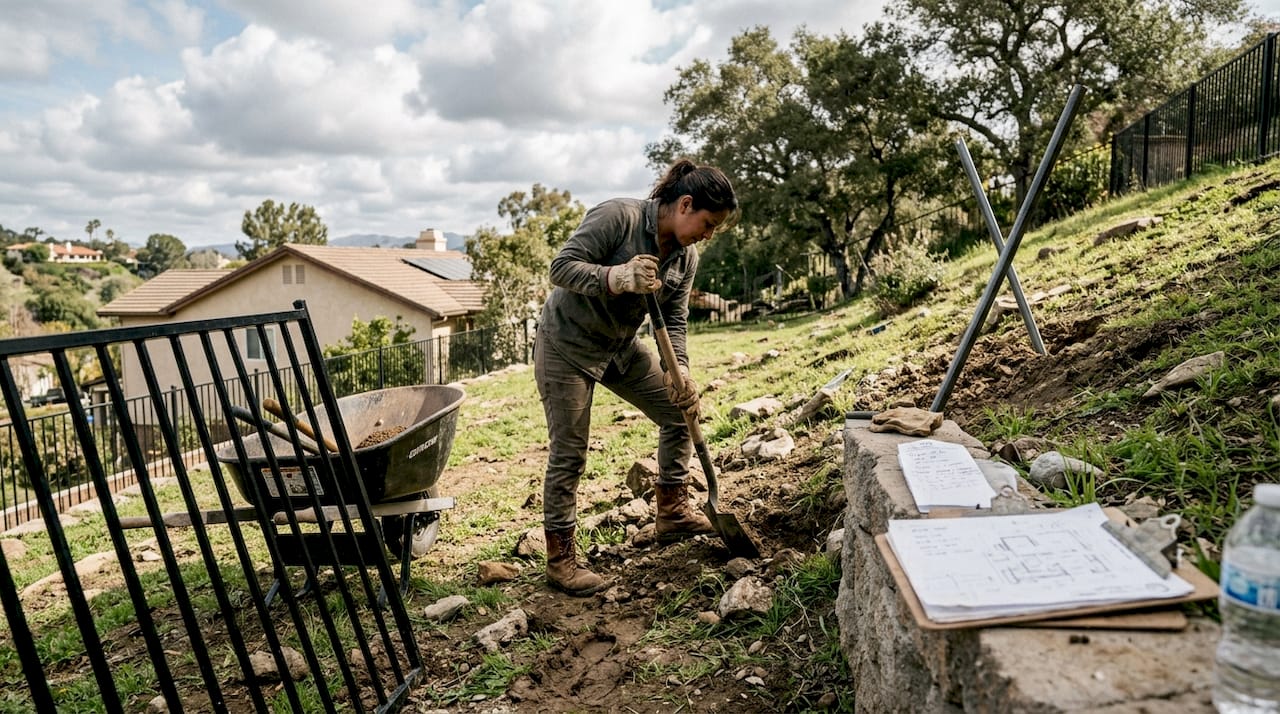
Experienced crews who know local soil types, permit offices, and HOA review boards are worth the higher labor rate. Cutting corners here often leads to failed inspections or re-work that costs far more than the savings.
Our take: Why smart planning beats sticker shock
Here’s something most fence contractors won’t tell you: the homeowners who end up unhappy with their fence projects almost never chose the wrong material. They skipped the planning phase.
We’ve seen this pattern repeatedly in luxury LA neighborhoods. A homeowner rushes to get bids, locks in a contractor, and then discovers mid-project that their HOA requires a specific gate finish, or that a permit triggers an engineering review that nobody budgeted for. Change orders follow. The budget climbs. The timeline extends.
The fix is simpler than it sounds. Before you collect a single bid, write down your three non-negotiable priorities: security, privacy, or aesthetics. That clarity shapes every decision that follows, from material selection to gate type to finish color. It also helps contractors give you accurate bids rather than low-ball estimates that balloon later.
Reviewing luxury fence planning tips before your first contractor meeting puts you in a much stronger position to evaluate proposals and ask the right questions. In LA’s premium neighborhoods, a well-planned fence project isn’t just a security upgrade. It’s a long-term investment in your property’s value and visual identity.
Get transparent pricing for your LA fence project
Now that you know the major cost drivers and how they impact your home’s fence investment, it’s time to make your project vision concrete.
Our custom fencing calculator generates instant, itemized estimates based on your property size, preferred materials, and design features. No guesswork, no vague ranges. If automation is part of your plan, our gate automation estimates tool gives you a realistic breakdown of hardware and installation costs before you meet with a contractor. Ready to see real numbers for your specific project? Get accurate estimates today and take the first step toward a fence that looks exactly right and fits your budget.
Frequently asked questions
How much does a 100-foot luxury fence cost in Beverly Hills?
Expect to pay $7,000 to $15,000 or more for 100 feet, depending on material, gates, and design in Beverly Hills. Beverly Hills iron runs $60 to $110 per linear foot, with composite options reaching even higher.
Do I need a permit to build a fence over 6 feet tall in Los Angeles?
Yes, an official permit is required for fences over 6 feet tall in LA, with extra review for front yards and pool areas. Front yard fences are capped at 3.5 to 4 feet in most residential zones, even without a permit.
How do gates and automation affect fencing costs?
Adding gates and automation can increase costs by $150 to $1,500 or more per opening, especially with high-end security features. Premium automation adds significantly beyond the base gate cost, particularly for dual-swing or sliding driveway systems.
Are there ways to save money on a luxury fence in LA?
Careful planning, prioritizing must-have features, and getting expert site assessments can help avoid costly overruns. Knowing your HOA requirements and permit triggers before the bidding phase is the single most effective way to keep your project on budget.
Recommended
- How terrain impacts fence costs in Los Angeles: smart choices | LA Electric Gate Service
- Fence & Gate Installation Cost Calculator Los Angeles
- Custom fence components: build luxury, security, and style in LA | LA Electric Gate Service
- Fence post installation in Los Angeles: 5 key essentials | LA Electric Gate Service
- Estimate residential painting costs in Los Angeles: step-by-step