Block Wall vs Fence in Los Angeles: Cost, Rules and Which to Choose
By BabyLoveGrowth AI

For most Los Angeles homeowners, a fence in wrought iron, steel, aluminum or composite is the better choice over a block wall. It gives you security, privacy and design control, and it avoids the structural permit that masonry needs once it passes 3.5 feet. A block wall is a solid, heavy, permanent structure. A fence is a lighter system of posts and panels that you can shape around your lot, your view and your gate.
This guide compares the two on cost, city rules, privacy, security, noise, upkeep and fit for hillside and high-end properties in Beverly Hills, Santa Monica, Brentwood, Bel Air, Studio City and the rest of the Los Angeles area.
TL;DR
- A fence is built from posts connected by boards, rails, wire or panels. A wall has a solid foundation along its whole length (Utah model ordinance). That difference drives most of the cost and permit gap.
- In Los Angeles, masonry or concrete fences over 3.5 feet need a permit under LADBS bulletin P/ZC 2023-002.
- National price guides put masonry fences at up to $480 per linear foot installed, against $15 to $40 for wood or vinyl.
- Choose a fence when you want design flexibility, gates, automation and access control. Choose a wall only when mass and sound blocking outrank everything else.
- Check front-yard height limits, HOA rules and slope before you pick a material.
Table of Contents
- What is the difference between a block wall and a fence?
- What each option costs in Los Angeles
- Los Angeles rules that decide the choice
- Privacy, security and noise
- Maintenance and lifespan
- Which one fits your property
- How to compare quotes
- Our perspective
- Get a Los Angeles fence and gate estimate
- FAQ
- Sources
What is the difference between a block wall and a fence?
People call a concrete block boundary a “cinder block fence,” but builders and code writers treat it as a wall. A fence is typically made of posts joined by boards, wire, rails or netting. A wall has a solid foundation along its entire length, and a retaining wall also holds back soil at a different level (Utah model ordinance).
The terms “cinder block” and “concrete block” describe essentially the same product: water, cement and aggregate. Cinders were once used as a lightweight aggregate, and block used in construction must meet building-code minimums (CMHA). In Los Angeles, the practical question is how the block wall is reinforced and footed, because that is what the city and your neighbors will care about.
This matters because the two options behave differently in four ways:
- Structure: a wall needs a continuous footing. A fence uses posts set at intervals.
- Look: a wall is a solid plane. A fence can be open, semi-open or solid, with visible detail.
- Gates: a wall needs pilasters or reinforced openings at a gate. A fence and gate are designed as one system.
- Permits: masonry triggers a structural review at a lower height than most fences do.
What each option costs in Los Angeles
No national guide prices a Los Angeles property exactly, and local labor, access and soil change the number. Published ranges still show the shape of the gap.
| Option | Published installed range | Source |
|---|---|---|
| Masonry fence (brick, stone, block) | $3,000 to $9,000 on average, up to $480 per linear foot | This Old House |
| Wood fence | $3,500 to $6,500, or $15 to $35 per linear foot | This Old House |
| Vinyl fence | $4,000 to $7,300, or $15 to $40 per linear foot | This Old House |
| Basic cinder block fence, 6 ft | $9 to $12 per square foot, or $54 to $72 per linear foot | Family Handyman |
A 200-foot vinyl fence runs about $2,118 to $5,028 nationally, and the typical professionally installed fence costs $15 to $25 per linear foot (NerdWallet).
What moves the price on a Los Angeles lot
The sticker price per foot is only the start. These factors change a real quote:
- Length and height. Cost scales with linear feet, so a long side-yard run costs far more than a short front stretch.
- Footing and reinforcement. A wall needs a continuous concrete footing and rebar, which is where much of the labor sits.
- Slope. Hillside lots in Bel Air, Sherman Oaks and Studio City need stepped sections or retaining elements, which raise the price for either option.
- Finish. Stucco, stone veneer, a cap and paint on a block wall add cost. On a fence, the finish is part of the material you choose.
- Gates. A gate opening adds hardware, posts or pilasters and, if you automate it, power and controls.
If a gate is part of the plan, our listed prices give a starting point: a manual driveway gate runs $1,500 to $4,000 one-off, and an automatic gate retrofit runs $1,500 to $4,500 one-off.
Los Angeles rules that decide the choice
Cost is not the only gap. The city regulates masonry more tightly than most people expect, and the rules differ by zone.
Under LADBS bulletin P/ZC 2023-002:
- Front-yard fences are limited to 6 feet in A and RA zones (8 feet with Department of City Planning approval) and 3.5 feet in R and RW zones.
- Side and rear fences can reach 8 feet on lots at least 40 feet wide outside hillside areas, and 6 feet on narrower or hillside lots.
- Masonry or concrete fences over 3.5 feet require a permit.
The source for all of this is the city’s own bulletin: LADBS fence height bulletin. Always confirm your zone and lot width against it, since cities within Los Angeles County, including Beverly Hills, Santa Monica, Culver City, Burbank, Glendale and Pasadena, run their own rules.
The practical effect is simple. A 6-foot block wall in a side or rear yard involves a structural permit and a footing design. Many fence designs, such as a typical 6-foot privacy fence, do not carry the same masonry trigger. If you are planning a front boundary, read our front yard fence rules for Los Angeles before you draw anything, because the 3.5-foot limit in R zones shapes the whole design.
City-specific guides help when your property sits outside the city of Los Angeles itself:
- Beverly Hills fence permit checklist
- Santa Monica fence regulations
- West Hollywood fence permit steps
- Historic district fence rules
If part of your boundary also holds back soil, the retaining wall adds its own review. Our LADBS and BOE checklist for retaining walls and fences walks through it.
HOAs add another layer. Cities may cap fence height, and HOAs can forbid certain types (This Old House). Check both before you commit to a material.
Privacy, security and noise
Both options can give you a private yard. They get there differently.
Privacy. A block wall is solid by nature, so it blocks sight lines completely. A fence can match that with a solid-panel design, or it can be semi-open, with slats or spacing that give you privacy while keeping light and airflow. On a property with a view, that choice matters. A solid wall can shut out the canyon or ocean outlook you paid for, while a steel or aluminum fence with a tighter infill can frame it.
Security. Mass is a real advantage of masonry: a block wall is hard to climb and hard to see through. A well-designed metal fence closes much of that gap. Vertical pickets, a tall profile, and a gate tied to access control address the actual risks at a driveway, which is where most unwanted entry happens. A wall with a weak gate is only as secure as the gate. That is why we design the fence and gate together, and why our privacy vs security fence guide starts from the 42-inch front rule and the zone map.
Noise. If you live beside a busy street such as Sunset, Ventura or Pico, sound matters. Dense, heavy masonry generally blocks more sound than a light fence, and a solid timber fence only takes the edge off. If sound is your top priority, a wall earns serious consideration at the rear or side of the lot, while the front, driveway and entry still call for a gate-centered design.

Maintenance and lifespan
Brick and stone walls can last up to 100 years, and upkeep includes pressure washing, crack repair and fixing tilting panels (This Old House). In earthquake country, reinforcement is what keeps masonry sound. Masonry walls can be less seismically resilient if not properly reinforced (EPA Building America Solution Center), which is why the city requires a structural permit above 3.5 feet.
Powder-coated steel, aluminum and composite fences are chosen for their low upkeep and their ability to be repaired or extended in sections. A fence run that needs a change later, such as a new gate opening or an added pedestrian gate, can be modified without demolishing a continuous wall. That flexibility is useful when your plans change, for example when you add automation after a few years.
Which one fits your property
Use this as a starting point and confirm with a site visit.
| Your situation | Better fit |
|---|---|
| Front or entry boundary with a driveway gate | Fence and gate designed as one system |
| Hillside lot with a view | Open or semi-open metal fence |
| Front yard in an R zone with a 3.5-foot limit | Low decorative fence with pedestrian gate |
| Long rear boundary next to a loud street | Block wall at the rear, fence and gates at the front |
| Smart-home goals such as keypads, cameras and remote opening | Fence and gate with automation and access control |
| Historic district or HOA oversight | Fence designed to the review rules, checked first |
Many premium properties combine the two. A rear wall handles sound and mass, while a custom fence and gate handle the street face, where design and security count most. If you want to see what that front face can look like, our custom fencing and driveway gates pages show the options.
A worked example
Take a 100-foot street-facing boundary on a flat Brentwood lot. At the published masonry ceiling of up to $480 per linear foot, the wall alone could reach $48,000. At the Family Handyman basic block range of $54 to $72 per linear foot, it would be $5,400 to $7,200 before stucco, cap, gates and engineering. A fence at the national $15 to $40 per linear foot range would be $1,500 to $4,000 before premium metals and custom detail. Premium wrought iron, steel or aluminum with a gate costs more than those national averages, which is exactly why a site-specific estimate matters. The point of the example is the spread: the material and the finish decide the number, so price your actual design, not an average.

How to compare quotes
Get at least three estimates before you choose (This Old House). Make each quote state the same things so you can compare them fairly:
- Total linear feet and finished height.
- Footing or post depth and reinforcement.
- Who pulls the permit and who handles HOA or historic review.
- Gate type, hardware and any automation.
- Finish, color and warranty terms.
Permit handling is the item that goes wrong most often. Our guide to five questions that reveal permit risks when hiring a fence contractor in Los Angeles covers what to ask.
Our perspective
We design fences and gates for Los Angeles homes where the boundary is part of the architecture: the driveway gate, the pedestrian entry, the keypad, the camera and the fence line all have to work together.
That is why we start from a fence. It lets us choose the material, wrought iron, steel, aluminum or composite, to match the house, the slope and the view, and then build the gate and automation into the same design instead of cutting an opening into a finished wall.
Permits and HOA rules are part of that design, not an afterthought. We plan for them from the first estimate, so the height, the material and the gate type all fit the rules that apply to your lot.
Moin
Get a Los Angeles fence and gate estimate
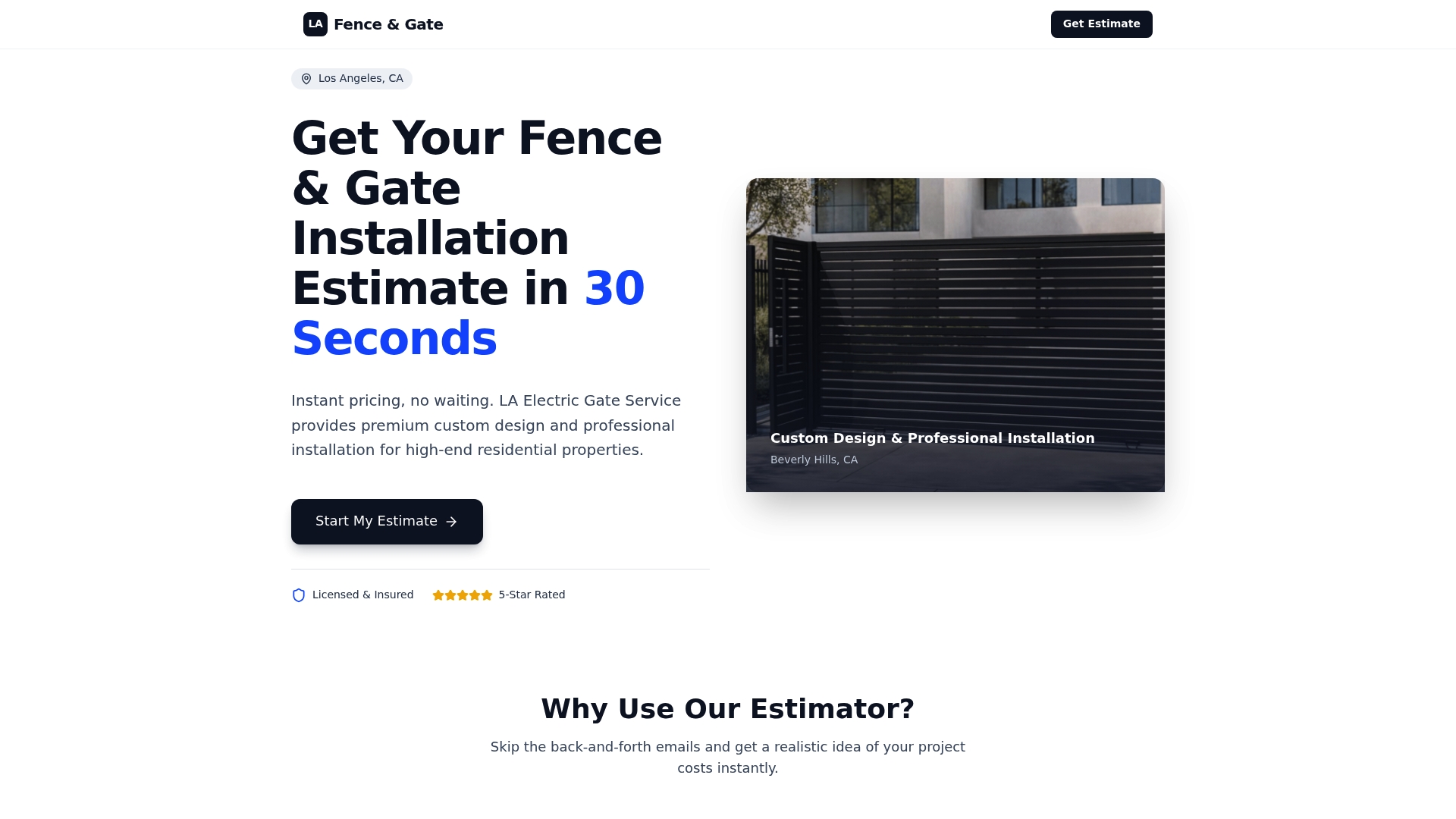
Our online estimator gives you a budget range for fence and gate installation using Los Angeles material and labor rates, with your property size, design preferences and automation choices as inputs. From there, a site visit confirms the details, and we handle professional installation with permit and HOA compliance in mind. Start at fence-gate-estimator.com or look at gate automation if you already have a gate in mind.
FAQ
Is a block wall cheaper than a fence?
Usually not. Published guides put masonry fences at up to $480 per linear foot installed, against $15 to $35 for wood and $15 to $40 for vinyl (This Old House). A basic cinder block wall can land at $54 to $72 per linear foot at 6 feet (Family Handyman), but finishes, gates and engineering add to that.
Do I need a permit for a block wall in Los Angeles?
Masonry or concrete fences over 3.5 feet require a permit under LADBS bulletin P/ZC 2023-002 (LADBS). Beverly Hills, Santa Monica and other cities run their own permit processes, so confirm with your city before you build.
How tall can a fence or wall be in a Los Angeles yard?
In the city of Los Angeles, side and rear fences can reach 8 feet on lots at least 40 feet wide outside hillside areas, and 6 feet on narrower or hillside lots. Front-yard limits are 3.5 feet in R and RW zones and 6 feet in A and RA zones (LADBS).
Can I automate a gate on a fence?
Yes. A driveway gate set in a fence line can be fitted with an opener, keypad and access control. If you already have a gate, retrofitting automation is listed from $1,500 to $4,500 one-off in our offers, and our gate automation and access control pages explain the options.
Sources
- Chapter 19.95 Fencing, Walls, and Retaining Walls (Utah)
- This Old House: A Comprehensive Guide to Fencing Options for Your Yard
- Family Handyman: Cinder Block Fence Costs
- NerdWallet: How Much Does It Cost to Install a Fence
- CMHA: Cinder Block vs Concrete Block
- EPA Building America Solution Center: High-Thermal-Mass Construction