Los Angeles Fence Contractors: 5 Questions That Reveal Permit Risks
By BabyLoveGrowth AI
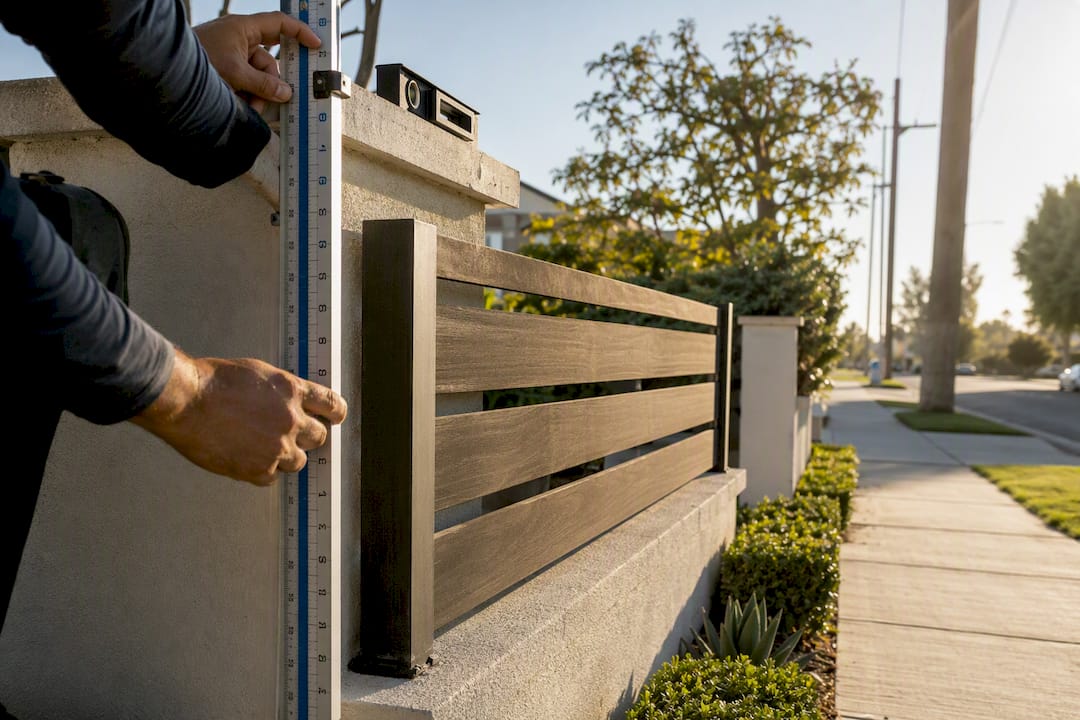
Hire a licensed, insured contractor who handles your LADBS permits and hands you an itemized written estimate before any work starts. Run the Fence & Gate Estimator first so you know a realistic local budget. Then verify the contractor’s CSLB license, request two insurance certificates, and confirm in writing who is pulling permits.
TL;DR:
- Confirm that the contractor’s license is active, matches the company name, and is verified through the CSLB website before proceeding.
- Ensure the contractor provides current insurance certificates, including general liability and workers’ compensation, to limit your liability.
- Obtain at least two to three detailed, written estimates that itemize materials, labor, permit fees, and warranties for accurate comparison.
- Know that fences up to 42 inches in the front yard generally do not need a permit; taller fences or corner lot restrictions may require additional approvals.
- Use the Fence & Gate Estimator to get an accurate Los Angeles-specific budget prior to contractor selection, accounting for material, size, and features.
Table of Contents
- How to Choose a Fence Contractor in Los Angeles: The Vetting Checklist
- Los Angeles Fence Permit and Code Essentials Every Homeowner Must Confirm
- Choosing Materials and Designs for Los Angeles Properties
- Questions to Ask and Red Flags That Should Stop the Hire
- Moin’s Take: Why Permit-Aware Installers Protect Your Investment
- Get an Accurate Los Angeles Fence Budget Before You Call a Single Contractor
- Authoritative Los Angeles Permit and License Links
- Sources
- FAQ
How to Choose a Fence Contractor in Los Angeles: The Vetting Checklist
Narrowing a long list of names to two or three reliable installers starts with paperwork, not personality. Homeowners searching for how to hire a fence contractor in Los Angeles often skip straight to price, but the sequence that actually protects you runs license, insurance, portfolio, estimate, then cost.
Every legitimate contractor carries a license number they can recite without hesitation. Look it up yourself at cslb.ca.gov rather than trusting a business card. A mismatched name, an expired status, or a license held under a different company entirely is a dealbreaker, not a technicality.
Insurance matters just as much. Ask for a certificate of insurance (COI) showing general liability and workers’ compensation, and confirm the policy is active, not expired last spring. Without workers’ comp, you become personally liable if a crew member gets hurt on your property.
A strong portfolio shows finished gates and fences on Los Angeles properties, not stock photography. Ask to see post-depth details or a recent local reference you can actually call.
The written estimate is where good contractors separate themselves. It should itemize:
- Materials and linear footage pricing
- Post footing depth and concrete specs
- Permit fees and who is filing them
- Labor timeline with start and completion windows
- Warranty terms in writing, not a verbal promise
Pro Tip: Ask for a single point of contact for the entire job. A contractor who routes every question through three different crew leads is one who loses track of change orders.
Los Angeles Fence Permit and Code Essentials Every Homeowner Must Confirm
Permit rules drive both your budget and your timeline, and they trip up more homeowners than material choice ever does. In the City of Los Angeles, front-yard fences up to 42 inches generally don’t need a building permit. Go taller in the front yard and you likely need a plan check, possibly a variance.
Side and rear yards are more forgiving. Many non-masonry fences can reach up to 8 feet without plan-level permitting, though LADBS bulletins cap freestanding masonry walls lower and require engineered plans for anything block-built.
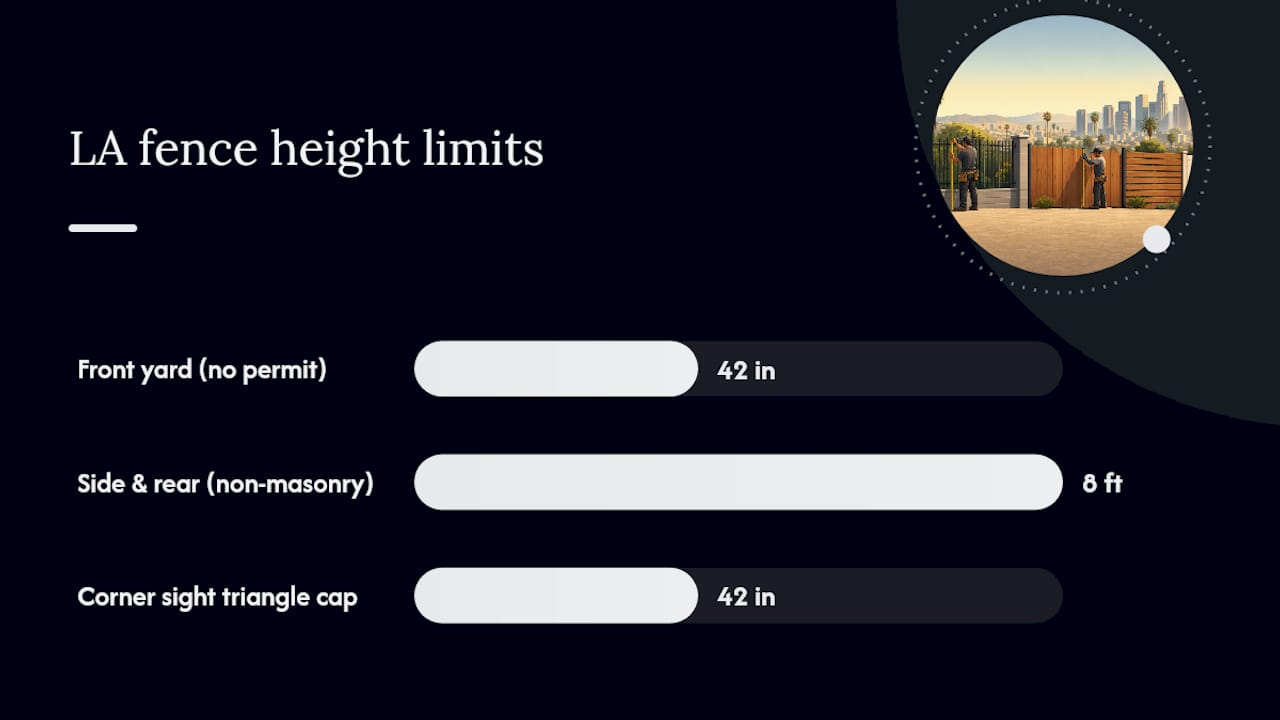
Corner lots carry an extra restriction most homeowners never hear about until it stalls a project: the sight-distance triangle. Nothing over 42 inches is allowed inside that triangle near an intersection, no exceptions for style or material.
Key thresholds to confirm before you sign anything:
- Front yard: 42 inches without a permit
- Side/rear yard: up to 8 feet for many non-masonry fences
- Corner lots: 42-inch cap inside the sight-distance triangle
- Masonry walls: lower height limits, engineered plans required
Properties in Historic Preservation Overlay Zones or Fence Height Districts face additional review. BOE’s revocable-permit procedures spell out when City Planning approval or a variance kicks in, so ask your contractor directly whether they’ve navigated one before.
Choosing Materials and Designs for Los Angeles Properties
Material choice in Los Angeles has to answer to three things: sun, salt air near the coast, and the hard, dry gusts of Santa Ana wind season. What looks right in a catalog photo doesn’t always hold up on a Brentwood hillside or a block from the Santa Monica shoreline.
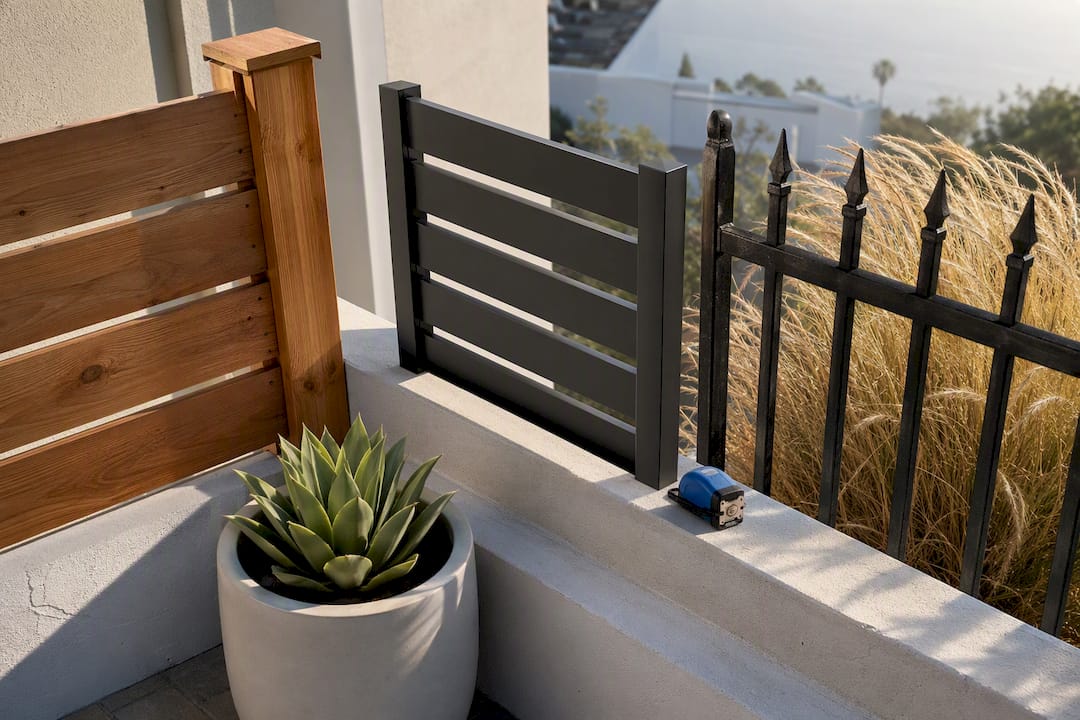
Wood delivers warmth and classic curb appeal but demands ongoing sealing and repainting, especially under direct sun exposure common in Sherman Oaks and Encino. Vinyl and composite trade some of that character for near-zero maintenance, a smart swap for homeowners who want to set it and forget it. Aluminum and wrought iron read as upscale and offer real security value, which is why they dominate in Beverly Hills and Pasadena estates. Masonry adds privacy but brings engineering review and permit complexity most homeowners underestimate.
Coastal exposure corrodes cheap fasteners fast, so ask specifically about stainless or galvanized hardware if you’re within a few miles of the water. Inland, Santa Ana winds put real lateral stress on tall panels and gates, which makes post depth and concrete footing specs non negotiable rather than optional upgrades.
Security and design features worth requesting outright:
- Anti-lift gate hardware and reinforced hinges
- Deep concrete footings rated for wind exposure
- Automation-ready wiring if you might add a gate opener later
- Custom ironwork fabrication for architectural matching
Premium upgrades like custom fabrication or automation extend both timeline and documentation needs, since automated gates often require electrical permits on top of the fence permit itself.
Questions to Ask and Red Flags That Should Stop the Hire
A short, consistent script during the first call or site visit tells you more than any online review. Ask these five questions of every contractor, in this order:
- What is your CSLB license number, and can you send a current insurance COI today?
- Who pulls the permit, and have you worked with LADBS or BOE on a project like mine?
- What’s the realistic installation timeline, including material lead time?
- What warranty do you provide, and is it in writing?
- What is the payment schedule, and can I see two recent local references?
Refusal to produce a written estimate, a license number that doesn’t check out, or an insurance certificate that’s “on the way” for the third time are all reasons to walk. So is a demand for full payment upfront. A reasonable deposit is normal; paying in full before work starts is not.
When you follow up with references, ask about more than friendliness. Did the crew show up when promised? Did they clean the site? Has the fence settled evenly, or is a gate already sagging a year later?
Moin’s Take: Why Permit-Aware Installers Protect Your Investment
The single most common mistake I see isn’t bad craftsmanship. It’s contractors who skip the sight-distance triangle rule or pour shallow footings to save an afternoon, then leave the homeowner to explain it to a city inspector months later.
Premium neighborhoods make this worse, not better. A custom iron gate in Bel Air or a tall privacy wall in Studio City often needs stronger documentation for planning approval than a standard vinyl fence in a less scrutinized zone. The homeowners who come out ahead are the ones who treat the permit conversation as part of the design conversation, not an afterthought handled after the crew arrives.
Good collaboration looks like this: you bring the aesthetic vision, the contractor brings code fluency, and neither side treats compliance as optional.
— Moin
Get an Accurate Los Angeles Fence Budget Before You Call a Single Contractor
Estimation tools give you the one thing most homeowners walk into bids without: a real number to compare against. Instead of guessing whether a quote is fair, you get an instant, Los Angeles-specific cost breakdown built on current local material and labor rates, before a single contractor sets foot on your property.
The Fence & Gate Estimator factors in material choice, property size, and features like automation, so you walk into every conversation with a benchmark instead of a blind guess. Beyond the estimate itself, Fence-gate-estimator connects homeowners to permit guidance, custom fencing design, and professional installation coordination for driveway gates and gate automation. If your project also touches interior access points, a partner like One Day Doors & Closets handles related door replacement work across the Los Angeles area.
Run your numbers through the estimator now, then request a written onsite estimate to confirm the details against real site conditions. It’s the fastest way to walk into your first contractor call already knowing what a fair Los Angeles bid looks like.
Authoritative Los Angeles Permit and License Links
- LADBS fence permit guidance for building permit thresholds
- BOE revocable-permit procedures for front-yard fence approvals
- CSLB license lookup to verify any contractor’s status before hiring
- LA County Public Works fence FAQ for unincorporated-area rules
Sources
- Los Angeles Department of Building and Safety — Fence permit guidance
- 04 - Front yard fences, walls (non-retaining), and gates | Bureau of Engineering
- FenceFind — listings and hiring guidance for Los Angeles fence contractors
FAQ
Do I need a permit for a front-yard fence in Los Angeles?
Front-yard fences up to 42 inches don’t require a building permit in most of the City of Los Angeles, but taller fences or corner lots may need plan review or a variance.
How many written estimates should I get before hiring?
Get at least two to three written, itemized estimates so you can compare materials, labor, and permit handling side by side, a practice widely recommended by local fence-hiring guides.
How long does a residential fence installation take in Los Angeles?
Standard installations often run just a few days once materials arrive, though lead times and permit review can add weeks to the total project timeline.
What’s the fastest way to get a realistic fence budget?
Run your project details through the Fence & Gate Estimator, which builds an instant cost breakdown using current Los Angeles material and labor rates.
What should I do if a contractor won’t show me their license number?
Treat it as a red flag and move on. A legitimate contractor can recite their CSLB license number immediately and won’t hesitate to let you verify it independently.