West Hollywood Fence Permit: Rules, Fees and Steps
By BabyLoveGrowth AI

In West Hollywood, a fence or wall no taller than 6 feet does not need a Building and Safety permit, but it still needs Planning Division approval before you build. Anything over 6 feet needs a building permit. On top of that, height limits in your front and street-side yard are much tighter than 6 feet, which is where most homeowners get caught. This guide walks you through the rules, the fees, the application and the mistakes that cause delays, so your fence or driveway gate goes in once and passes review.
TL;DR
- Fences and walls up to 6 feet are exempt from a Building and Safety permit, but Planning Division approval is still required before installation. Over 6 feet, you need a building permit.
- In a required front or street-side setback, a solid fence is limited to 42 inches. Up to 6 feet is allowed only if the part above 42 inches is at least 50 percent transparent.
- Every permit type carries a $38.60 processing fee, and building permit fees are based on the construction valuation.
- A gate with an electric operator involves wiring, and the city’s electrical code requires a permit for most new electrical work. Describe the whole project, gate and opener included, when you apply.
- Building without approval can lead to warning notices, citations and legal action from the city’s Code Compliance Division.
Table of Contents
- Do you need a permit for a fence in West Hollywood?
- West Hollywood fence height limits by yard
- Driveway gates, pedestrian gates and automation
- How to apply: step by step
- What a West Hollywood fence permit costs
- Local factors that change the answer
- What happens if you build without approval
- Our perspective
- Get your West Hollywood fence or gate priced
- FAQ
- Sources
Do you need a permit for a fence in West Hollywood?
There are two separate questions, and homeowners often answer only one of them.
The first is whether you need a building permit. The city’s Building and Safety FAQ explains that its building code requires a permit before anyone erects, constructs, alters, repairs or removes a structure. The same code exempts fences and walls not over 6 feet in height. So a standard 5-foot side-yard fence has no building permit.
The second is whether you need Planning approval. The city is explicit that exempt items still require approval from the Planning Division before installation or construction. Planning checks your design against the zoning ordinance: height, location on the lot, setbacks, and whether the fence blocks views or creates a traffic hazard.
In practice, that gives you three situations:
| Your project | Building permit | Planning approval |
|---|---|---|
| Fence or wall 6 feet or less | Not required | Required before you build |
| Fence or wall over 6 feet | Required | Required |
| Gate with an electric operator | Electrical permit generally required | Required |
The city’s development permit chapter adds that fences and yard improvements that comply with the zoning rules in Article 19-3 are exempt from a development permit. That is helpful: if your design fits the standard limits, you are not asking for a special exception. If it does not fit, you move into discretionary review, which takes longer.
What about repairs and replacements?
The city’s building code covers altering, repairing and removing a structure, not only building a new one. A tall fence being replaced is still a fence over 6 feet. If you are swapping panels or rebuilding a section, confirm with the Planning Division and Building and Safety before work starts, especially if you are changing height, material or location. It takes one call or email to the city’s building and planning counters, and it costs far less than correcting a mistake.
West Hollywood fence height limits by yard
West Hollywood’s zoning ordinance, Section 19.20.050, sets the height rules for residential fences. Here is what it says, in plain terms, based on the city’s published code:
| Location on your lot | Maximum height |
|---|---|
| Required front setback | 42 inches solid; up to 6 feet if the portion above 42 inches is at least 50% transparent |
| Required street-side setback (corner lots) | 42 inches solid; up to 6 feet if the portion above 42 inches is at least 50% transparent |
| Interior side setback | 6 feet |
| Rear setback | 6 feet |
| Outside required setbacks | 6 feet |
A few details decide whether your plan passes.
Setback. A setback is the strip of your lot between the property line and the building, where the zoning code limits what you can place. Your lot’s required setbacks depend on its zone, so check them with Planning rather than assuming the whole front yard counts.
Transparency. A “50 percent transparent” upper section is what makes a 6-foot front fence possible. Think of vertical bars or horizontal slats with real gaps, in wrought iron, steel or aluminum, rather than solid panels. A solid stucco wall or privacy board fence can be only 42 inches high at the front.
How height is measured. Height is measured from the highest ground within two feet of the fence. If your lot slopes, or you have raised planters or fill on one side, the legal height may be less than what you see from the street. Terrain is a common reason that a fence “measured at 6 feet” fails review.
Special cases. The code allows solid fences up to 6 feet facing a secondary highway or commercial site, and up to 10 feet where residential property abuts a commercial zone or use. Both require the review authority to find that the fence will not obstruct views or create a traffic-safety hazard. These are judgment calls, so plan for extra time.
For a deeper look at the same 42-inch logic across the rest of the county, see our guide to the 42-inch front yard fence rule in Los Angeles. If you own in a neighboring city, our pages on Beverly Hills fence permits and Santa Monica fence permit rules show how different each city’s process is, which is why you should never reuse another city’s answer for a West Hollywood lot.
Driveway gates, pedestrian gates and automation
A gate is part of the fence line, so it follows the same height limits. A solid gate across your driveway in the front setback faces the same 42-inch limit as a solid fence, which is why most front-yard driveway gates are designed as open ironwork, with bars or pickets that meet the transparency requirement. Sightlines matter too: the review authority looks at whether a fence or gate blocks drivers’ views of the street or sidewalk.
Automation adds a second layer. A gate operator, keypad, intercom or access control system is electrical equipment. The city’s electrical code says that no one may install, alter or repair electrical wiring or equipment without first getting a permit, with listed exceptions such as minor repairs like replacing switches, and low-voltage equipment under 25 volts that cannot supply more than 50 watts. Because the exceptions are narrow and specific, ask the Building and Safety counter how your operator and its power supply are classified before you buy.
The practical lesson is to describe the full scope of the project in your application: fence, gate, operator, power run and access control. A permit covering one component does not automatically cover the others, and requirements can differ for each part.
If you already have a manual gate and want to add an operator, that is a retrofit, and the electrical side is the part that needs review. Our automatic gate retrofit work is listed at $1,500 to $4,500, one-off. A new manual driveway gate is listed at $1,500 to $4,000, one-off.
How to apply: step by step
Here is the sequence that gets a typical West Hollywood residential fence through review.
- Confirm your lot’s zoning and setbacks. Ask the Planning Division which zone you are in, where the required front and street-side setbacks fall, and whether any overlay applies. The Planning counter is at 8300 Santa Monica Blvd, West Hollywood, CA 90069, and the city lists building@weho.org and planning@weho.org for questions.
- Draw a site plan. Show property lines, the house, the fence or gate location, its length and height, the material, and the distance from the sidewalk or street. For sloped lots, show grade on both sides. Reviewers cannot approve what they cannot measure.
- Add elevation drawings. A simple side view showing the height, the transparent section and the post spacing lets the reviewer verify the 42-inch and 50 percent transparency tests quickly.
- Decide whether you need a building permit. Over 6 feet, yes. Include structural details for tall or heavy walls.
- Include the gate and electrical scope. List the operator, the power source, safety sensors and any keypad or intercom.
- Submit electronically. According to a 2026 summary of the city’s process, applications go through the city’s Permit & License Portal, where you register, upload the document set and pay initial fees. Confirm the current steps on the city’s own site.
- Answer corrections promptly. If the reviewer asks for changes, resubmit through the portal. Slow responses are one of the most common sources of delay.
- Schedule inspections where required. Where a permit is issued, inspections happen before work is covered.
At each step, the work is detail: a missing dimension, an unmeasured slope or an unlisted operator sends a submittal back. Our team prepares fence and gate projects with permit guidance and compliance with local codes and HOA requirements in mind, so the drawings answer reviewers’ questions before they ask them.
What a West Hollywood fence permit costs
Fees depend on what your project triggers.
- Processing fee: the city’s FAQ states each permit type carries a $38.60 processing fee.
- Building permit fee: based on the valuation, meaning the estimated construction cost. A taller wall with a larger budget costs more to permit than a short one.
- Planning review: the Planning Division reviews even exempt fences, so ask what the current fee schedule says for your project type.
- Plan check extensions: a 2026 permit guide reports that extension fees can reach 25 percent of the original plan check fee. Getting your drawings complete the first time is the simplest way to avoid that.
Fees change, so treat any published figure as a starting point and confirm it on the city’s official fee schedule before you budget. Permit fees are also only part of the total. Materials, fabrication, grading, footings and automation make up most of a project’s cost, and a written estimate before you commit tells you where you stand.
Local factors that change the answer
West Hollywood is compact and densely built, so many lots are small, corner lots are common and street frontage is tight. That has three consequences.
Corner lots. The street-side yard gets the same 42-inch treatment as the front. Owners who assume a corner side yard is a “side yard” for 6-foot purposes are often surprised.
Hillside and sloped lots. Because height is measured from the highest ground within two feet, retaining walls and fill can push your fence over a limit. If your fence sits on top of a retaining wall, the combined height matters. Our guide to LADBS and BOE checklists for retaining walls and fences explains the logic in neighboring Los Angeles, and the same question of combined height applies on your lot.
HOAs and condominium buildings. Property managers of multi-unit and gated properties often need association approval in addition to city approval. A city approval does not replace it. Our HOA fence packet guide covers how to assemble a submission that gets approved the first time.
Code year. Projects submitted on or after January 1, 2026 fall under the 2025 California Building Codes and 2026 Los Angeles County amendments, so older plans or a neighbor’s approval from several years ago are not a reliable template.
A permit also does not exempt you from the building-permit exemption’s limits: the exemption from a building permit does not waive zoning or planning requirements. Always treat Planning approval as its own checkpoint.

What happens if you build without approval
The city’s Code Compliance Division investigates violations, including zoning problems and illegal construction. Its stated approach is to seek voluntary compliance through education, and it can escalate to warning notices, administrative citations, office conferences and legal action.
The consequences for a fence are practical as much as financial. If a 6-foot solid front fence is built over the 42-inch limit, the fix is usually to cut it down or replace it with a transparent design, so you pay for the fence twice. Unpermitted work can also complicate a sale, because a buyer’s inspector or title review may flag it. A statewide guide notes that California allows penalties of up to 10 times the original permit fee for unpermitted work, with stop-work orders possible. Getting the approval first is cheaper than every one of those outcomes.
Our perspective
Most of the permit problems we see on premium residential properties come from the same place: the design was chosen before the rules were checked. A solid 6-foot front wall looks like the safe, private choice, and then the 42-inch limit sends the owner back to the drawing board.
We start from the opposite end. Know the height limits and setbacks for your lot, then choose the material and style that fit inside them. Wrought iron, steel and aluminum with open sections can give you security and a clean modern look while meeting the transparency requirements, and they pair naturally with a motorized driveway gate and access control.
That is why we pair instant estimating with permit guidance and compliance with local codes and HOA requirements. You see a realistic budget for your linear footage, gate type and automation before you commit, and you hire one team to handle design, installation and the paperwork conversation with the city.
Moin
Get your West Hollywood fence or gate priced
If your plan fits the rules, the next question is cost. Our estimator gives you an instant budget for fences and gates in the Los Angeles area, using current local material and labor rates, and covers wrought iron, steel, aluminum and composite fences, plus swing, sliding and automated gates.
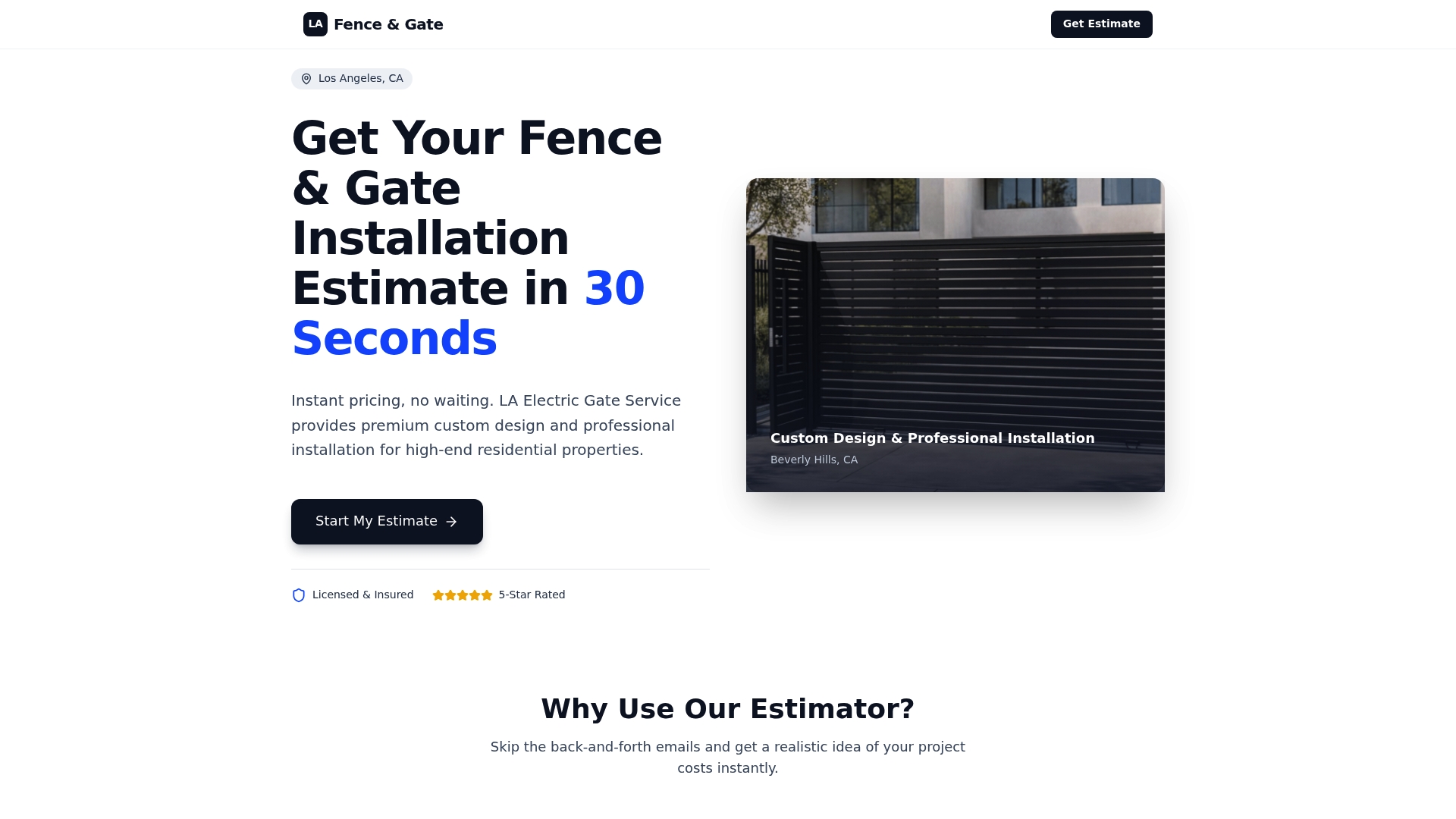
From there, we handle professional installation for homeowners and property managers, with permit guidance built in. Start with the instant fence and gate estimate, or look at our pages on driveway gates, gate automation and custom fencing to see what suits your lot.
FAQ
Do I need a permit for a 6-foot fence in West Hollywood?
You do not need a Building and Safety permit for a fence 6 feet or lower, but you do need Planning Division approval before you build. If the fence is in a front or street-side setback, it must also meet the 42-inch solid limit, or the transparency rule that allows up to 6 feet.
How tall can a front yard fence be in West Hollywood?
A solid fence in a required front setback can be 42 inches tall. It can reach 6 feet if the portion above 42 inches is at least 50 percent transparent, such as open bar or picket ironwork. Height is measured from the highest ground within two feet of the fence.
Do I need a permit for an electric driveway gate?
The gate itself follows the fence rules, and the electrical operator and wiring fall under the city’s electrical code, which requires a permit for most installations, with narrow exceptions. Describe the gate, operator and power supply to the city when you apply, and confirm how your equipment is classified with Building and Safety.
How much does a West Hollywood fence permit cost?
The city lists a $38.60 processing fee per permit type, and building permit fees depend on the estimated construction cost. Planning review fees and any plan check charges are on top, so confirm the current schedule with the city before you set a budget.
What if my fence was built without approval?
The Code Compliance Division can respond with warning notices, administrative citations, conferences or legal action. Contact the Planning Division and Building and Safety to learn how to bring the fence into compliance before an enforcement notice arrives.
Sources
- Frequently Asked Questions, City of West Hollywood Building and Safety
- Chapter 19.20: General Property Development and Use Standards, West Hollywood Municipal Code
- Chapter 19.48: Development Permits, West Hollywood Municipal Code
- Code Enforcement, City of West Hollywood
- Building and Safety, City of West Hollywood
- West Hollywood, CA 2026 Building Permit Guide
- Fence Permit Requirements: LA Rules You Need to Know
- Building Without a Permit: Penalties and Fines by State