Gate Opener Noise Levels: What's Normal and What's Not
By BabyLoveGrowth AI
Gate Opener Noise Levels: What’s Normal and What’s Not

A well-installed residential gate opener typically runs at about 40 to 60 dB, somewhere between a quiet conversation and a normal one. DC-motor and worm-gear models sit at the low end of that range. AC-motor models with chain or belt drives sit at the high end. If your gate is louder than that, or the sound has changed, the cause is usually the gate hardware or the installation, not the motor alone. For Los Angeles homeowners in Beverly Hills, Brentwood, Santa Monica or Sherman Oaks, where lots are close together and neighbors notice, that difference matters.
This guide covers what the numbers mean, what drives the noise, how to read a noise rating on a spec sheet, what Los Angeles noise rules say, and how to choose or fix a gate so it stays quiet for years.
TL;DR
- A properly installed single electric gate opener averages roughly 40 to 60 dB, with DC motors and worm gears at the quiet end.
- Most of the sound you hear comes from the drive type, the rollers, the track or hinges, and gate alignment. Not just the motor.
- A new grinding, squeal or rattle is a sign to schedule service, not to keep running the gate.
- Los Angeles limits how much louder than ambient noise equipment can be at an adjacent occupied property, and restricts loud devices at night.
- Choosing the drive system and having the gate installed and aligned correctly is the most reliable way to get a quiet gate.
Table of Contents
- What decibel levels to expect from a gate opener
- How to read a noise rating on a spec sheet
- What makes a gate loud
- Decoding the sounds your gate makes
- When noise means something is wrong
- Simple habits that keep a gate quiet
- Los Angeles noise rules and your gate
- Choosing a quieter gate system
- Upgrading the opener on an existing gate
- Our perspective: quiet is designed in
- Get a quiet gate planned from the start
- FAQ
- Sources
What decibel levels to expect from a gate opener
For orientation, a quiet residential street at night is often described as around 40 dB, and ordinary conversation around 60 dB. A gate opener rated in the 40s will be close to background noise from the street. One in the high 50s will be clearly audible when you stand near it, but not intrusive at a neighbor’s window.
Published figures vary by drive type and motor:
| Opener type | Typical published noise figure | What it means in practice |
|---|---|---|
| DC motor with worm gear | 40 to 45 dB | Barely audible over ambient sound |
| AC motor with chain or belt drive | 50 to 60 dB | Audible near the gate, with a mechanical tone |
| Heavy-duty single swing opener | Under 50 dB listed | Quiet for a swing gate up to 18 ft |
| Chain-drive sliding opener, 3,300 lb class | Under 60 dB listed | Audible, especially on a long slide |
| Sliding gate opener, 1,300 lb class | Under 56 dB listed | Moderate, steady hum |
These are manufacturer or retailer statements, so treat them as a guide to where a class of opener sits, not a promise for your property. The gate it moves, how it is mounted and where you stand all change what you hear.
How to read a noise rating on a spec sheet
A single dB number can mean different things. Sound pressure level is what a microphone reads at a particular spot, so it changes with distance and surroundings. Sound power level describes the source itself. The American Industrial Hygiene Association’s training material separates the two and notes that outdoor measurements involve attenuation effects.
So when you see “under 50 dB,” ask three practical questions:
- At what distance was it measured? A reading at one meter is not what your neighbor hears at 30 feet.
- Was the gate moving, or was the motor on a bench? The gate adds its own rolling, hinge and latch noise.
- Is that the sound at the motor or at the property line? Walls, planting and hardscape lower what reaches the next lot.
If you want a plain-language walk-through of the same issue in another kind of home equipment, this explanation of heat pump noise ratings shows why a rating only makes sense with its measurement conditions.
What makes a gate loud
The opener is one part of a system. When a gate is noisy, the sound usually comes from one of these places.
Drive type
Sliding gates use either a chain or a rack-and-pinion drive. A chain drive is the source of more mechanical sound, since links engage sprockets. Rack-and-pinion systems are described by one manufacturer as giving smooth, controlled movement with noise reduction, and the same page lists noise as a drawback of chain-driven models. For swing gates, articulated arms, linear actuators and underground operators all sound different, and the right one depends on the gate’s weight, width and hinge setup.
Motor type
DC motors usually run quieter than AC motors and ramp up and down more gently, which cuts the sudden clunk at the start and end of travel. The published ranges above reflect this.
Rollers, track and hinges
On sliding gates, the rolling hardware is often louder than the motor. Worn or corroded rollers produce a rough grinding that gets louder over time, and a track with debris or damage adds scraping. On swing gates, dry or misaligned hinges squeak and groan under load.

Gate weight and alignment
A heavy ornamental gate in wrought iron or steel needs a properly sized opener. An undersized motor strains, hums harder and wears faster. A gate that has sagged or shifted out of plumb binds against posts or its track, and the opener turns that friction into noise.
Mounting and ground conditions
The manufacturer’s manual for one common opener says to use it only with compatible gates on firm, level ground. Settling soil or loose post footings shift the geometry and bring on rattles. On Los Angeles hillside lots in Bel Air or Studio City, slope and soil movement make this a real design consideration.
Decoding the sounds your gate makes
Different sounds point to different causes. This table is a starting point for describing the problem to a technician.
| Sound | Common cause | What to do |
|---|---|---|
| Grinding or scraping | Worn rollers, debris or damage in the track, gear wear | Stop using the gate for heavy cycles and schedule service |
| Squeaking | Dry hinges, wheels or pivot points | Request lubrication and a hardware check |
| Rattling | Loose bolts, brackets or panels, worn mounts | Have fasteners and mounts inspected |
| Steady hum under load | Gate binding, undersized motor, misalignment | Have alignment and motor sizing checked |
| Loud clunk at start or stop | Limit settings, stiff gate, soft-start not configured | Ask for a travel and force adjustment |
| Whistle with no movement | Often an electrical or control issue | Disconnect power and call a technician |
A loud whistle when a remote is pressed, with a gate that does not move, is a common owner complaint on repair forums. It is a symptom to report to a technician, not something to force.
For general troubleshooting thinking, the same logic applies to other equipment. This piece on diagnosing rattling equipment noise shows how isolating loose parts, vibration and mounting points narrows down a source quickly.
When noise means something is wrong
A gate that has always hummed softly is behaving normally. A change is the signal. Pay attention when:
- The sound has become louder over weeks.
- You hear metal-on-metal scraping or a repeated knock.
- The gate stutters, slows or reverses.
- A bracket, bolt or component looks loose, worn or damaged. The manual cited above says not to use the unit if any component is loose, worn or damaged.
Before anyone adjusts anything, power must be disconnected. The same manual says to disconnect power and unlock the gate before tightening, repairing or replacing parts. Automatic gates can move with real force, and the safety sensors and force settings are part of what keeps people and vehicles safe. For a premium property, we recommend a trained technician handle diagnosis and adjustment.
Simple habits that keep a gate quiet
Routine care is what separates a gate that sounds new at year five from one that has been loud since year two.
- Keep tracks and gear paths clean. The manual guidance is to keep the gear and guide tracks clean and lubricate wheels and rollers as needed.
- Check that the gate moves smoothly by hand with power off and the gate released. A gate that is stiff by hand will be loud under power.
- Look at hinges, posts and footings after heavy rain or if you notice settling.
- Schedule periodic professional service, especially for heavy custom gates and sliding systems.
We have written a full schedule in our homeowner’s gate maintenance guide, and a breakdown with local pricing in weekly, monthly and annual sliding gate maintenance.
Los Angeles noise rules and your gate
The Los Angeles Municipal Code regulates noise from equipment, and an automatic gate is machinery that runs repeatedly. Three provisions are worth knowing for homeowners in the city:
- Under LAMC 112.04(b), operating machinery or equipment so the noise on an adjacent occupied property exceeds the ambient level by more than 5 decibels is unlawful.
- Section 112.04(a) prohibits operating machinery or devices that create loud, raucous or impulsive sound from 10:00 p.m. to 7:00 a.m. in a residential zone or within 500 feet of a residence.
- Section 112.05 sets 65 dB(A) as the limit for powered equipment intended for repetitive use in residential areas, such as lawn mowers and small garden tools, between 7:00 a.m. and 10:00 p.m.
Section 112.05 names lawn and garden equipment, not gate openers, so do not assume it applies to a gate the same way. The ambient-plus-5 dB rule and the nighttime restriction are the ones to keep in mind. In practice, a gate rated in the 40s to low 50s, properly aligned, is a comfortable fit in a quiet neighborhood. Note that Santa Monica, Culver City, Burbank, Glendale and Pasadena have their own municipal codes, so check with your city if your property is outside Los Angeles proper. Quiet operation also helps for homes with an HOA, where noise complaints often reach the board first.
If you are planning a new driveway gate, noise is one of several things to settle with the permit and setbacks. Our guides on the driveway gate permit process and the Los Angeles driveway gate setback rules cover those pieces.
Choosing a quieter gate system
When you are specifying a new gate or upgrading an old one, these decisions have the biggest effect on sound.
- Match the opener to the gate’s weight and size. An opener working near its limit is louder and wears faster.
- Choose the drive for your gate type. On sliding gates, discuss rack-and-pinion versus chain. On swing gates, discuss arm, linear and underground operators.
- Prefer DC motors with soft start and soft stop where the design allows. They are generally the quieter class.
- Think about where the operator sits. Placing it away from a bedroom wall, or behind planting or a masonry pier, lowers what reaches living space.
- Get the gate fabricated and hung square. A rigid, well-built frame in wrought iron, steel or aluminum on solid footings lets any opener run smoothly.
- Plan for access control and automation together. Keypads, intercoms and remote receivers should be set up so the gate does not cycle unnecessarily.
If you want a broader view of which gate styles suit which properties, see our overview of security gate types for LA homes and our look at how gate openers shape secure, stylish homes. If power is a concern at the driveway, solar-powered gates are another option to consider.
Upgrading the opener on an existing gate
Many homeowners in Encino, Sherman Oaks and Pasadena have a handsome gate that works but sounds tired. In that case a retrofit can be the answer. Our automatic gate retrofit service is listed at $1,500 to $4,500 one-off, and a manual driveway gate is listed at $1,500 to $4,000 one-off. The actual figure depends on gate size, weight, the operator selected and site conditions, which is why we confirm scope on site.

A retrofit is a good time to inspect the rollers, hinges, posts and track at the same time, so the new opener is not asked to overcome old friction.
Our perspective: quiet is designed in
We see noise as a design and installation outcome, not a lucky draw. The same opener can sound refined on one property and harsh on another, and the difference is almost always the gate it moves, how it is mounted and how it was set up.
That is why we start with the whole system: gate weight, material, drive type, automation features and the way the property is used. Our estimator is built on current Los Angeles material and labor rates, so you see a realistic budget before an onsite visit, and you can compare options such as swing, sliding and automated gates with access control in mind.
Our approach is premium custom design with professional installation, and we aim for permit and HOA compliance on every project. For a home in Beverly Hills, Bel Air or Brentwood, a gate that opens quietly at 6 a.m. is part of the quality you are paying for, and we plan for it from the first estimate.
Moin
Get a quiet gate planned from the start
If you are comparing options or want to replace a noisy opener, start with a realistic number. Use our instant estimator on the Fence-gate-estimator home page to price your gate by size, material and automation, then we confirm details on site. If your gate is already installed and you want a smoother, quieter operator, see our gate automation service, and for a new entry, our driveway gates.
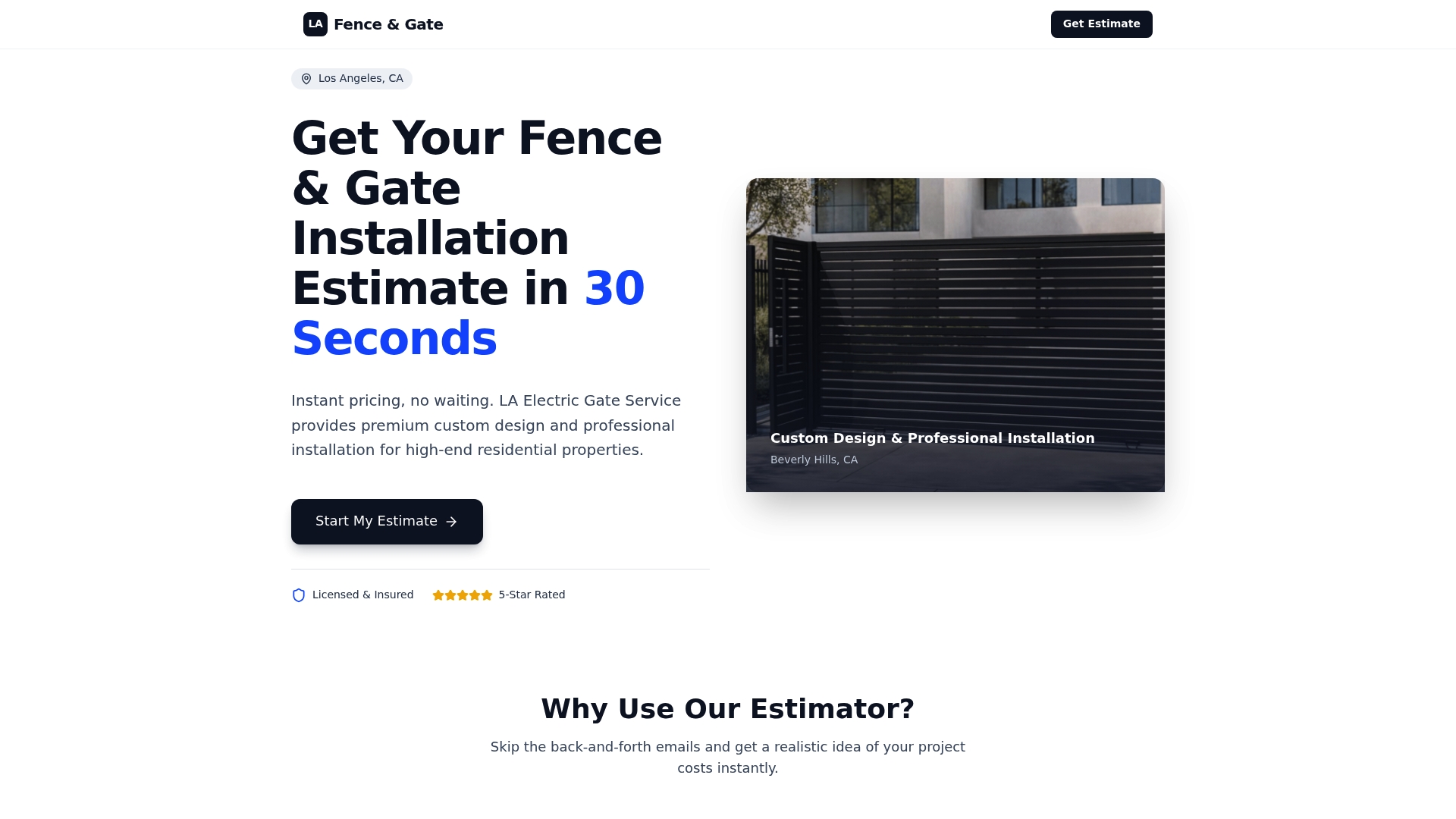
We handle design, fabrication, installation, permit guidance and access control integration, so noise, safety and appearance are settled together.
FAQ
How loud is a normal gate opener?
A properly installed single electric opener averages about 40 to 60 dB. DC-motor and worm-gear types can be at 40 to 45 dB, while AC models with chain or belt drives tend toward 50 to 60 dB. Gate hardware adds to what you hear.
Why is my gate opener suddenly louder?
A change in sound usually points to wear or alignment: dirty or damaged tracks, worn rollers, dry hinges or loose mounts. Disconnect power before anyone touches the mechanism, and have a technician inspect it. Continuing to run a gate with worn or loose parts can damage the opener.
Are sliding or swing gates quieter?
It depends on the drive and the hardware more than the gate style. Sliding openers add track and roller noise, and chain drives are louder than rack-and-pinion. Swing operators can be very quiet when hinges are aligned and the opener is matched to the gate weight.
Does Los Angeles limit how loud a gate opener can be?
The city code bars machinery noise that exceeds ambient levels by more than 5 dB at an adjacent occupied property, and it restricts loud or impulsive devices from 10 p.m. to 7 a.m. in residential zones, as quoted in LAMC 112.04. Other cities such as Santa Monica or Pasadena have their own codes, so confirm locally.
Sources
- What is the noise level of a single electric gate opener?
- Heavy Duty Single Gate Opener, A8131 listing
- Sliding Gate Opener 3,300 lb listing
- Automatic Gate Opener 1,300 lb product page
- AIHA noise training manual
- Rack and pinion versus chain-driven slide gate openers
- Gate opener user manual, 1,400 lb model
- Automatic gate grinding or scraping noises
- LAMC Chapter XI Noise Regulation
- LAMC Sec. 112.04
- LAMC Sec. 112.05