20 Foot Rule: LA Homeowners' Map to Driveway Gate Setback Rules
By BabyLoveGrowth AI
Most Los Angeles homeowners on an arterial street need to set a driveway gate back 20 feet from the curb face, per the LADOT Driveway Design Manual, so a car can stop clear of traffic while it opens. That figure shifts based on your street classification and intersection proximity, and it interacts with separate rules from the Bureau of Engineering and the Los Angeles Fire Department. Before you buy a gate, measure your queuing space and confirm the applicable rule with LADOT, BOE, or LAFD directly.
TL;DR:
- The 20-foot setback guideline for driveways on arterial streets in Los Angeles is based on vehicle queuing needs and can vary depending on street classification and intersection proximity.
- Permits for driveway gates often include building, electrical, and right-of-way permits, with tighter regulations near hillside zones and historic districts requiring additional approval steps.
- Fire department access rules demand a minimum unobstructed width of 20 feet for fire trucks, influencing gate placement more than LADOT's queuing requirements in narrow or hillside areas.
- Proper planning involves precise measurements of curb-to-garage distance, slope, and utility locations, and checking all relevant agency rules beforehand to avoid costly redesigns or permit delays.
- Using a cost estimator early helps predict expenses, plan for permit fees, and select gate types compatible with driveway geometry and local codes.
Where the Driveway Gate Setback Numbers Come From in LA
The 20-foot figure isn't arbitrary. LADOT's driveway design guidance ties it to how long a typical vehicle needs to idle off the roadway while a gate cycles open, and the Bureau of Engineering's revocable-permit guidance echoes that same 20-foot benchmark for structures fronting arterial streets. Collector and local streets sometimes allow a shorter setback, but LADOT still expects enough queuing depth to keep a stopped car from blocking a travel lane.
Intersection adjacency matters just as much as raw distance. LADOT's manual recommends keeping driveways as far as feasible from intersections, with recommended minimum distances on arterials and collector or local streets. A gate placed too close to a corner can trigger a redesign even if the straight-line setback looks fine on paper.
You'll also see some sources cite roughly 30 feet instead of 20. That gap usually comes from confusing LADOT's queuing-based setback with fire-code positioning language, which addresses apparatus access rather than curbside stacking. Treat LADOT's number as the baseline for queuing and check LAFD separately for access-width compliance.
Before assuming a number, confirm which rule governs your lot:
- Pull your street's classification (arterial, collector, or local) from city records, since it changes the required distance.
- Check for a Fence Height District or Historic Preservation Overlay Zone, both of which can override standard setback assumptions.
- Measure from the actual curb face, not the property line. Those two points rarely line up on older Los Angeles lots.
Permits You'll Likely Need for a Driveway Gate in LA
A single "gate permit" almost never covers everything. Depending on your design, you're typically looking at some combination of the following:
- Building permit. Required for pilasters exceeding 6 feet, masonry or concrete over 3.5 feet, or new footings. LADBS plan check usually wants a site plan showing dimensions, materials, and structural details for anything beyond a simple swing gate on light posts.
- Electrical permit. Any new branch circuit run to power a gate operator needs its own permit and inspection, covering conduit routing, disconnects, and the connection back to your panel.
- Revocable permit (R-permit). If any part of the gate, pilaster, or hardware encroaches into the public right-of-way, BOE requires this permit, and it can come with conditions like widening the roadway to maintain clearance.
Ask your installer up front which of these three they're pulling and which ones fall to you. A contractor who assumes "the gate company handles permits" without naming which ones is a red flag, especially on properties near Bel Air or Brentwood hillside lots where right-of-way lines get complicated fast. For a broader sense of how these approvals affect your budget, typical fence and gate cost drivers in Los Angeles usually track permit complexity closely — see top cost factors for fences in Los Angeles homes.
Fire Department Rules That Control Where Your Gate Can Go
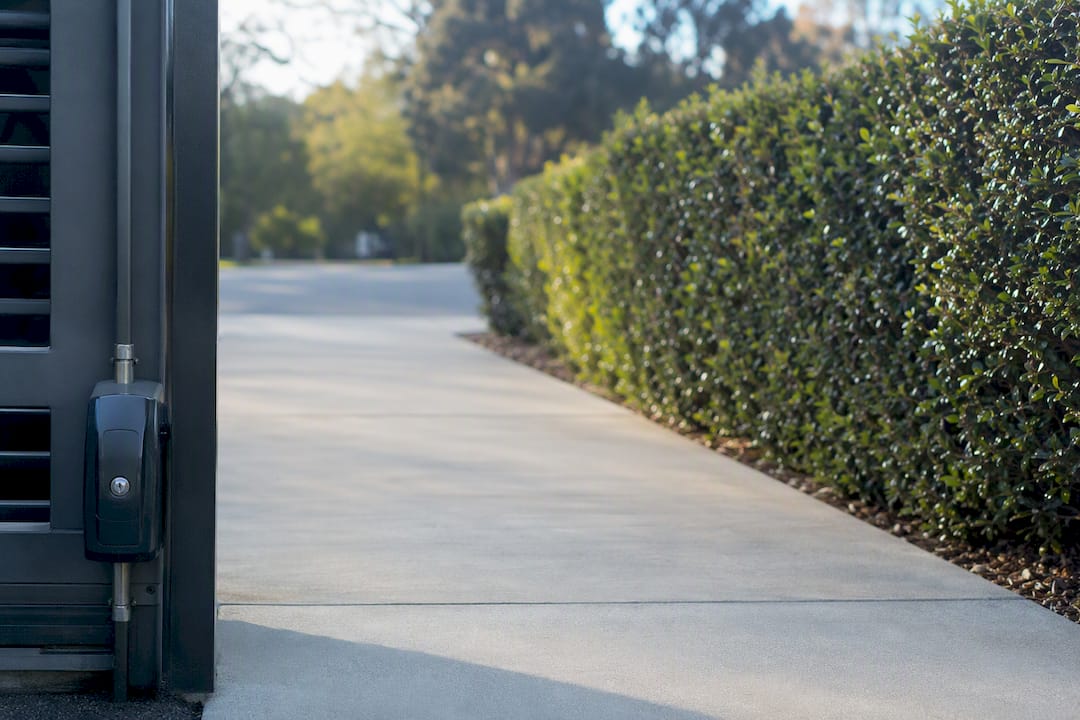
The Los Angeles Fire Department doesn't care about your curb appeal. It cares about whether an engine can get down your driveway. LAFD's security gate access requirements state plainly that a gate cannot reduce a required fire apparatus access width, and every powered gate needs an approved method of emergency operation.
Fire apparatus access roads need a minimum unobstructed width of 20 feet, according to the Los Angeles Fire Code's Chapter 5 provisions on fire service features. That width requirement often does more to dictate final gate placement than the LADOT queuing setback does, particularly on narrow hillside driveways in Encino or Sherman Oaks.
Plan for these fire-code essentials from day one:
- A fire-department-approved access box or override device so firefighters can open the gate without waiting on a homeowner.
- A manual, hand-operated release that works even during a power outage.
- Operators listed to UL 325 and gate assemblies compliant with ASTM F2200, the recognized standards for automated gate safety.
- Ongoing maintenance, since LAFD can order a gate locked open or removed entirely if it stops functioning as installed.
That last point catches people off guard. A gate that passed inspection the day it was installed can still become a code violation years later if the manual release fails or the operator gets swapped for a non-listed model.
LADOT Driveway Geometry and Queuing Rules That Shape Setback
Setback distance is really a byproduct of geometry, and LADOT's driveway design guide spells out several rules that determine how much room your gate actually needs. The manual calls for a minimum continuous curb space between driveways serving the same lot, plus spacing guidelines to prevent neighboring curb cuts from crowding each other.
Queuing capacity is the practical concern behind all of it. If your driveway is short, a car waiting for the gate to open can end up sitting in the street, which is exactly what the setback rule tries to prevent. That's why LADOT sometimes requires an Approved Driveway Approach Data Sheet before BOE will issue certain construction permits, particularly on avenues and boulevards where deviations from standard spacing are common.
Before you call a contractor, gather:
- A recent property survey showing the curb-to-garage distance.
- Driveway slope, measured in percent grade, not just "steep" or "flat."
- Sidewalk and parkway width, since narrow parkways limit where posts and operators can sit.
- Distance to the nearest intersection, cross-checked against LADOT's intersection spacing guidance.
How Setback Rules Shape Your Gate Design Choices
Once you know your real queuing space, the physical layout of your lot usually decides the gate type for you. A swing gate needs an open arc equal to its leaf length, and an inward swing eats into your driveway depth exactly where you need queuing room most. Outward-swinging gates solve that but require enough sidewalk clearance to avoid blocking pedestrians, which many narrow LA lots simply don't have.
Steep or short driveways, common in Silver Lake, the Hollywood Hills, and parts of Glendale, often rule out swing gates entirely in favor of sliding or cantilever systems. Those need lateral run space of roughly 1.5 times the gate's width for the tail and counterbalance, so a 16-foot opening requires roughly 24 feet of clear fence line to slide against.
Electrical routing matters here too. Installer surveys in Los Angeles consistently prioritize three measurements: driveway clearance, slope, and distance to the electrical panel, because those three numbers settle most of the cost and design decisions before anyone talks about finishes.
Before finalizing a design, confirm:
- Exact leaf length versus available swing arc.
- Slope percentage at the gate line, not just at the street.
- Clear opening width matched to your widest vehicle, not your smallest.
- Available side run for a slide gate, measured to the actual fence line.
Pro Tip: Measure your driveway's slope at the exact point where the gate will sit, not at the street.
For a deeper technical breakdown of clearance and slope math, see this guide on driveway gate clearance and slope rules.
Getting Your Gate Approved: A Step-by-Step Los Angeles Checklist
Approvals move faster when you sequence them correctly instead of discovering requirements one at a time.
- Site survey first. Get a current survey covering curb distance, slope, utility locations, and confirmed property lines before designing anything.
- Identify your agencies. LADOT handles driveway geometry and access data sheets, BOE issues revocable permits for right-of-way encroachment, LADBS handles building and electrical permit plan check, and LAFD reviews fire access. Add Planning if you're in an HPOZ or Fence Height District.
- Assemble your paperwork. Plan check typically wants the survey, a site plan, and elevation details; if your design doesn't fit standard spacing, submit a written deviation request to LADOT or a variance request through BOE.
- Coordinate installation specs. Lock in a UL 325 listed operator, ASTM F2200 compliant gate, fire-department access box placement, and manual-release location before your electrician pulls wire.
- Verify before you pay. Confirm final inspection sign-off from LADBS, that the manual release actually works, and that the access box is mounted where LAFD expects it.
| Step | Who to Contact | What to Bring |
|---|---|---|
| Site survey | Licensed surveyor | Property deed, prior survey if available |
| Driveway/queuing review | LADOT | Site plan, street classification |
| Right-of-way encroachment | BOE (R-permit) | Survey, site plan |
| Building/electrical plan check | LADBS | Structural details, electrical load calcs |
| Fire access review | LAFD | Gate width, override/lock box plan |
Common Setback and Permit Mistakes Los Angeles Homeowners Make
The costliest mistake isn't picking the wrong gate style. It's assuming the property line and the public right-of-way are the same thing. They frequently aren't, and a gate or pilaster that encroaches even a foot into the right-of-way can trigger a revocable permit and, occasionally, a requirement to widen the roadway as a condition of approval.
The second recurring error is underestimating trenching and conduit costs for the electrical run, especially on lots where the panel sits far from the gate location. The third is skipping an HPOZ or Fence Height District check until after design work is done, which can force a full redesign and extend the timeline.
Running your numbers early helps you scope your survey correctly and budget for the LADOT, BOE, and LAFD reviews described above before they become surprises mid-project.
How Fence-Gate-Estimator Helps You Plan a Compliant Gate
This tool provides a cost breakdown based on neighborhood factors before you call a contractor, helping you negotiate from a position of knowledge rather than guessing what to expect for pricing.
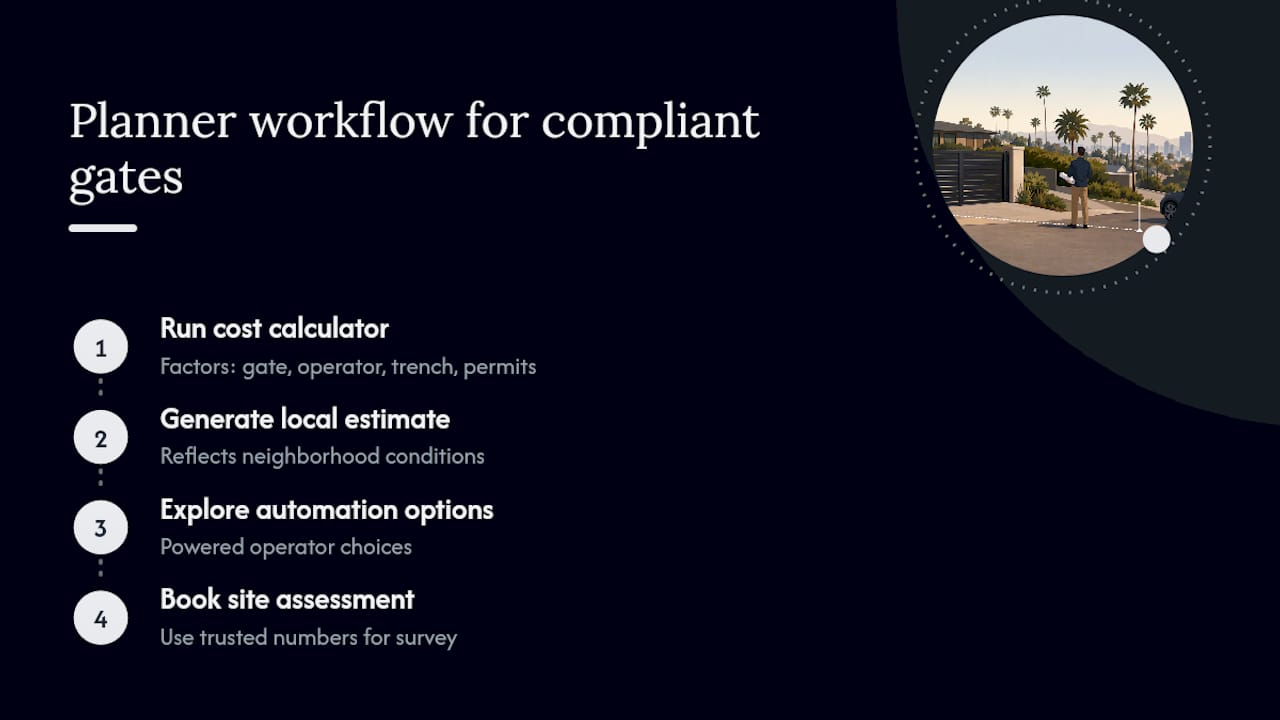
Running the numbers early also helps you scope your survey correctly and budget for the LADOT, BOE, and LAFD reviews described above before they become surprises mid-project. Start with the fence and gate cost calculator to generate your budget, then explore gate automation options if you're planning a powered operator, and book a site assessment once you have numbers you trust.
Sources
Confirm every measurement against the primary source before you order materials. The LADOT Driveway Design Manual covers setback and queuing rules; the BOE revocable-permit page covers right-of-way encroachment; LAFD's gate access requirements and the Fire Code Chapter 5 text on UpCodes cover apparatus access and operator standards.
This article is general information, not a substitute for advice from a qualified lawyer. Consult a qualified legal professional about your own circumstances before acting on anything here.
- 04 - Front Yard Fences, Walls (non-retaining), and Gates | Bureau of Engineering
- LAFD security gate access requirements | Los Angeles Fire Department
- Driveway design guide | LADOT
- Los Angeles Fire Code 2020 — Chapter 5: Fire service features | UpCodes
FAQ
How Far Off the Road Should a Driveway Gate Be?
On arterial-fronting properties, LADOT's guidance calls for 20 feet from the curb face so a vehicle can wait clear of traffic while the gate opens; collector and local streets sometimes allow less, but always verify with LADOT directly.
How Far Can My Driveway Be From My Property Line?
Your driveway itself typically sits within your property line, but the gate or any pilaster encroaching into the public right-of-way requires a revocable permit from BOE, and a survey is the only reliable way to confirm exactly where that line falls.
What Are the Residential Setback Requirements in LA County?
Requirements vary by street classification and jurisdiction, but LA Fire Prevention guidance for unincorporated areas emphasizes maintaining driveway width for emergency vehicle access, supplementing rather than replacing city-specific rules like LADOT's 20-foot queuing setback.
Do I Need a Permit to Build a Driveway Gate?
Almost always, yes, and often more than one: a building permit for structures over 6 feet or with new footings, an electrical permit for any powered operator, and a revocable permit if the gate encroaches on the public right-of-way. Fence-Gate-Estimator's cost calculator factors typical permit allowances into your estimate so you're not blindsided by the total.