Gate Automation Permit Requirements: What LA Homeowners Need to Know
By BabyLoveGrowth AI
Yes — most automated driveway and security gates require one or more local permits before installation begins. This applies across the United States, and Los Angeles County is no exception. Whether you’re adding a sliding gate to a Brentwood estate or automating an existing swing gate in Pasadena, you’ll typically need to secure permits before a single post goes in the ground.
Quick compliance checklist before you start:
- Building permit (required when gate or fence exceeds 6 feet)
- Electrical permit (required whenever a motor or wiring is involved)
- Encroachment or right-of-way permit (required when the gate or driveway accesses a public road)
- Fire department approval (required in many gated communities and fire-access zones)
- HOA approval letter (required when your property falls under a homeowners association)
California regulations under 14 CCR §1273.09 specify a setback from public roads for gates to allow vehicles to stop without blocking traffic. That single setback rule catches many homeowners off guard and can delay a project by weeks if it isn’t addressed during plan review.
Table of Contents
- What permits do you actually need for gate automation?
- Which gate types and site conditions almost always trigger permits?
- What does UL 325 require, and what will inspectors check?
- What documents do you need to submit with a permit application?
- Who performs the work, and what do inspectors check at each stage?
- How long does the permit process take, and what does it cost?
- What are the real consequences of skipping permits or cutting corners?
- Los Angeles County example: a real permit checklist for automated gates
- Key Takeaways
- Why permit compliance matters more than most homeowners realize
- Get a permit-ready estimate before you apply
- Useful sources for permit research
- FAQ
What permits do you actually need for gate automation?
Most homeowners encounter four distinct permit types when planning an automated gate installation. Understanding what each one covers helps you identify which permit office to contact first and avoids the frustration of submitting an incomplete application.
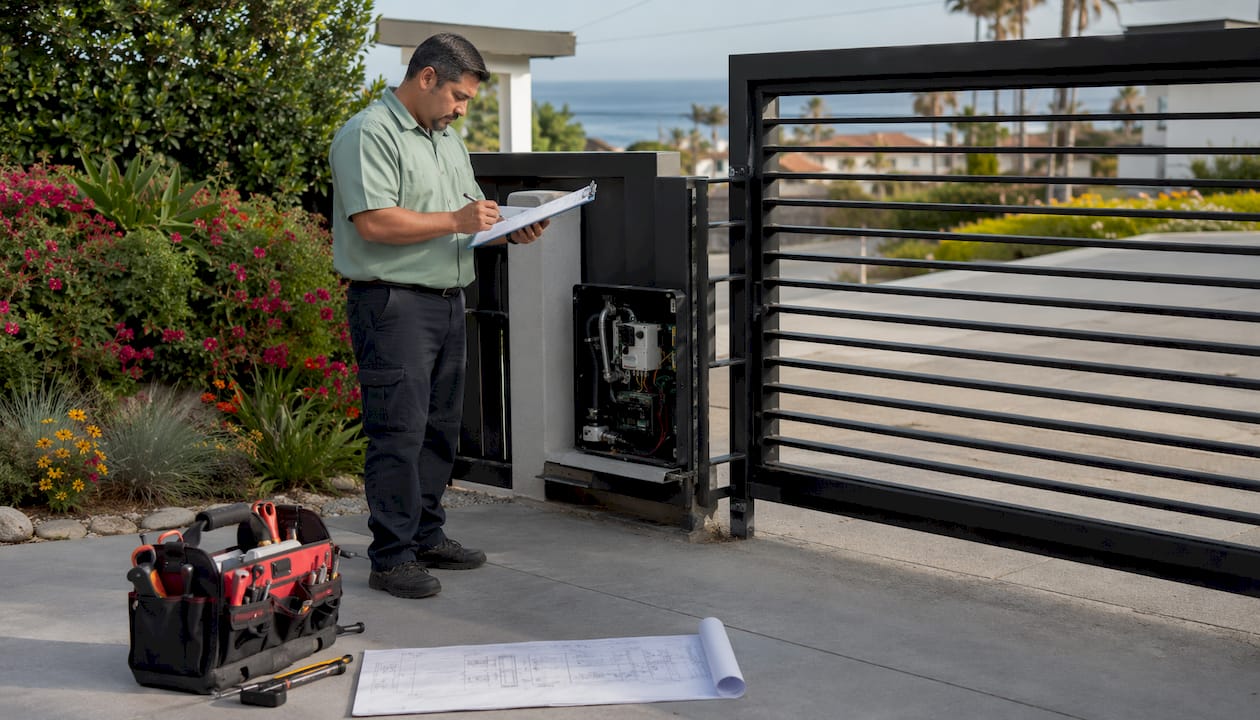
Building permit. Issued by your local building department, this permit covers the structural installation of the gate, posts, columns, and any new concrete footings. Los Angeles County requires a building permit for fences or gates that exceed typical residential height limits, and the same threshold applies in most California jurisdictions. Even a gate under 6 feet may trigger a building permit if it involves new structural columns or foundation work.
Electrical permit. Any gate operator connected to a power source requires a separate electrical permit, issued by the building or electrical inspection division. This covers the wiring from the panel to the operator, the disconnect switch, and any low-voltage control wiring. A licensed electrician must pull this permit in most jurisdictions.
Encroachment or right-of-way permit. When a gate or its swing arc crosses into a public sidewalk, easement, or roadway, you need an encroachment permit from the public works department. This is commonly overlooked for driveway gates that open outward toward a street. In Los Angeles County, Public Works handles encroachment permits separately from building permits.
Fire department approval. Gated communities, multi-family properties, and any gate that controls emergency vehicle access typically require fire marshal review. The City of Hayward’s fire permit process, for example, requires scaled plans and equipment specification sheets submitted directly to the fire department. Many LA County jurisdictions follow a similar process.
HOA approval is not a government permit, but it functions like one in practice. If your property in Beverly Hills, Bel Air, or a gated community in Encino falls under CC&Rs, you’ll need written HOA approval before submitting to the building department. Some plan reviewers require the approval letter as part of the submittal package.
Which gate types and site conditions almost always trigger permits?
Not every gate situation is identical, but certain combinations of gate type, height, and location make permits essentially unavoidable. Use this as a quick self-screen before you contact a contractor or permit office.
- Gate or fence height exceeds 6 feet. A building permit is required in Los Angeles County and most California cities. This applies to the gate panel itself, not just the surrounding fence.
- Gate operator requires electrical wiring. Any motorized gate connected to a hardwired power source triggers an electrical permit. Battery-only or solar-powered gate systems may have different requirements, but you should confirm with your local building department before assuming they’re exempt.
- Gate accesses a public road or driveway. If the gate sits within 30 feet of a public roadway, a right-of-way or encroachment review is likely required. California’s 30-foot setback rule under 14 CCR §1273.09 is enforced in many jurisdictions across the state.
- Sliding or cantilever gate on a new track system. These gate types commonly require permits because they involve concrete footings, structural posts, and operator mounting hardware. See the full breakdown of gate types that trigger permits for sliding, cantilever, and swing configurations.
- New concrete footings or structural columns. Any time you pour new concrete for gate posts or columns, a building permit and potentially stamped structural plans are required.
- Gate integrated with security cameras, intercoms, or app-based access. These features don’t always trigger additional permits on their own, but they affect control placement requirements under UL 325 and may require additional plan detail.
- Heavy gate panels or long spans exceeding standard dimensions. Gates over a certain weight or span often require a licensed structural engineer to review and stamp the plans before the building department will accept the application.
Electric gate installations almost universally require permits when motors, wiring, sensors, or new footings are involved. If your project includes any two items from the list above, plan for multiple permits.
What does UL 325 require, and what will inspectors check?
UL 325 is the ANSI/CAN/UL standard for vehicular gate operators, and it defines the safety requirements that inspectors verify when they approve an automated gate installation. It isn’t a permit itself, but compliance with UL 325 is a condition of passing inspection in most jurisdictions that have adopted the International Building Code or International Fire Code.
The standard’s core requirement is straightforward: each entrapment zone must have at least two independent entrapment protection means. In practice, this means a gate operator cannot rely on a single sensor or a single contact edge. Common combinations include a photo-eye sensor paired with a monitored contact edge, or a loop detector paired with an external entrapment device. Both devices must be monitored, meaning the system detects and responds to a failure in either device.
Inspectors also check control placement. The operator’s primary control must be positioned so the gate is in full view of the operator at all times, typically at a minimum height of 6 feet from the ground to prevent children from reaching activation controls. Warning signs must be posted at specific locations per the UL 325 standards update, which also introduced updated requirements for manual operation marking, battery-backup behavior, and warning sign placard placement.
Common failures inspectors flag include missing monitored sensors (a sensor is present but not wired to trigger a fault condition), insufficient guarding on sliding gate tracks, and warning signs that are either absent or placed where they can’t be seen from the gate’s operating zone.
UL 325 is referenced by the IBC, IFC, and IRC and enforced by building and fire inspectors in many jurisdictions. There is no blanket retroactive upgrade requirement for existing operators, but any newly motorized gate must meet current UL 325 requirements at the time of installation.
Pro Tip: Before your final inspection, run the gate through five complete open-and-close cycles with an inspector or a knowledgeable installer present. Verify that each entrapment protection device triggers a reversal independently, and confirm that the system logs or responds to a simulated sensor failure. Inspectors in LA County increasingly ask for this demonstration during the functional safety inspection.
What documents do you need to submit with a permit application?
A complete permit submittal package prevents the most common cause of delay: plan review corrections. Assembling these documents before you apply saves two to four weeks in most jurisdictions.
- Scaled site plan showing the property boundary, gate location, driveway geometry, distance from the gate to the public roadway (the 30-foot setback measurement), utility easements, nearby sidewalks, and street names
- Gate elevations and details showing panel dimensions, height, material, and hardware
- Column and footing details with dimensions and reinforcement specifications; if columns are new or structural, stamped engineering plans are required
- Electrical diagram showing the power source, panel location, disconnect switch, conduit routing, and operator wiring
- Manufacturer cut sheets for the gate operator, including the UL 325 compliance statement and model number
- Entrapment protection device specifications for each sensor or contact edge, with monitoring documentation
- Contractor’s license number and proof of insurance for the gate installer and electrician
- HOA approval letter if the property is subject to CC&Rs
Plan reviewers commonly require a scaled site plan that shows how the gate interacts with the public right-of-way and whether a vehicle can pull fully off the roadway before the gate closes. Automating an older gate can also trigger structural upgrades to meet ASTM F2200 requirements for the gate panel itself, so include the existing gate’s specifications if you’re adding an operator to a gate that’s already in place.
A licensed engineer or architect stamp is required on structural plans whenever new columns are poured, spans exceed standard dimensions, or the gate is unusually heavy. The modern gate design process for custom wrought iron or steel gates in neighborhoods like Bel Air or Sherman Oaks almost always involves engineered plans.
Who performs the work, and what do inspectors check at each stage?
Permit compliance isn’t just about paperwork. It also determines who is legally allowed to perform each part of the installation and what documentation must be on-site during each inspection.
Licensed gate contractor or general contractor. The structural installation, including post setting, column construction, gate hanging, and operator mounting, is typically performed by a licensed contractor or a gate specialist with a C-13 (fencing) or B (general building) license in California. Verify contractor licenses through the California Contractors State License Board or the equivalent state portal.
Licensed electrician. All hardwired electrical connections, including the circuit from the panel to the operator, the disconnect switch, and any conduit work, must be performed by a licensed electrician. The electrician typically pulls the electrical permit separately from the building permit.
Licensed structural engineer. When new gate columns, deep footings, or long-span gates are involved, a structural engineer must review and stamp the plans before submittal. The engineer may also be required on-site during the footing inspection.
The inspection sequence typically follows this order:
- Footing or structural inspection. Before concrete is poured, the inspector verifies that excavation depth, rebar placement, and footing dimensions match the approved plans.
- Electrical rough inspection. After conduit and wiring are run but before walls or covers are closed, the electrical inspector verifies the circuit, disconnect, and conduit installation.
- Functional and safety final inspection. After the operator, sensors, and all safety devices are installed, the inspector verifies UL 325 compliance, entrapment protection, control placement, warning signage, and gate operation.
Inspectors will want to see the stamped plans, operator manual, sensor documentation, and warning sign placards on-site during the final inspection. Missing any of these items typically results in a failed inspection and a re-inspection fee.
How long does the permit process take, and what does it cost?
The permit process for an automated gate follows a predictable sequence, though timelines vary significantly between jurisdictions. Los Angeles County and the City of Los Angeles tend to run longer than smaller suburban cities like Burbank or Glendale.
| Stage | Typical elapsed time (suburban) | Typical elapsed time (LA County/City) |
|---|---|---|
| Pre-check and plan preparation | 1–2 weeks | 2–4 weeks |
| Application submittal and intake | 1–3 days | 3–7 days |
| Initial plan review | 2–3 weeks | 4–8 weeks |
| Corrections and resubmittal | 1–2 weeks | 2–4 weeks |
| Rough inspections (footing, electrical) | 3–7 days after request | 5 days after request |
| Final safety inspection | 3–7 days after request | 5 days after request |
Permit fees vary by jurisdiction and project scope. Building permit fees are typically calculated based on the project’s valuation, while electrical permits carry a flat or tiered fee. Projects requiring encroachment permits, fire marshal review, or stamped engineering plans add separate fees for each agency. For a realistic picture of total project costs including permit fees, the homeowner’s guide to fence costs in Los Angeles provides useful context on how permit costs fit into the overall budget.
Expedited plan review is available in some LA County jurisdictions for an additional fee. If your project requires fire marshal approval or a public works encroachment review, budget for those agencies’ independent timelines, which do not run concurrently with building department review in most cases.
What are the real consequences of skipping permits or cutting corners?
Unpermitted gate installations are one of the most common and costly mistakes homeowners make in California. The risks extend well beyond a fine.
- Municipal fines and stop-work orders. Code enforcement officers can issue stop-work orders and fines for unpermitted construction. In some jurisdictions, daily fines accrue until the violation is corrected.
- Forced removal or rework. A municipality can require you to remove or modify a non-compliant gate at your own expense, even if the installation is otherwise functional.
- Insurance claim complications. Unpermitted installations can complicate property insurance claims and future home sales. If a gate causes an injury and it was installed without permits, your insurer may deny the claim.
- Title and resale problems. Municipal permit searches conducted during escrow will reveal unpermitted structures. Buyers, lenders, and title companies routinely flag these, and resolving them mid-escrow is expensive and time-consuming.
- DIY electrical without a permit. Homeowners who wire their own gate operators without an electrical permit face the same consequences as any other unpermitted work, plus the added liability of unlicensed electrical work.
Practical steps to avoid these outcomes: hire a licensed electrician for all wiring, get stamped plans when structural work is involved, confirm encroachment approval before any gate that opens toward a public road, and never assume an operator is plug-and-play simply because the manufacturer’s instructions don’t mention permits.
Los Angeles County example: a real permit checklist for automated gates
Los Angeles County provides a clear model for what the permitting process looks like in practice. Here’s how a typical residential automated gate project in an unincorporated LA County area, or a city like Culver City or West Hollywood, moves through the system.
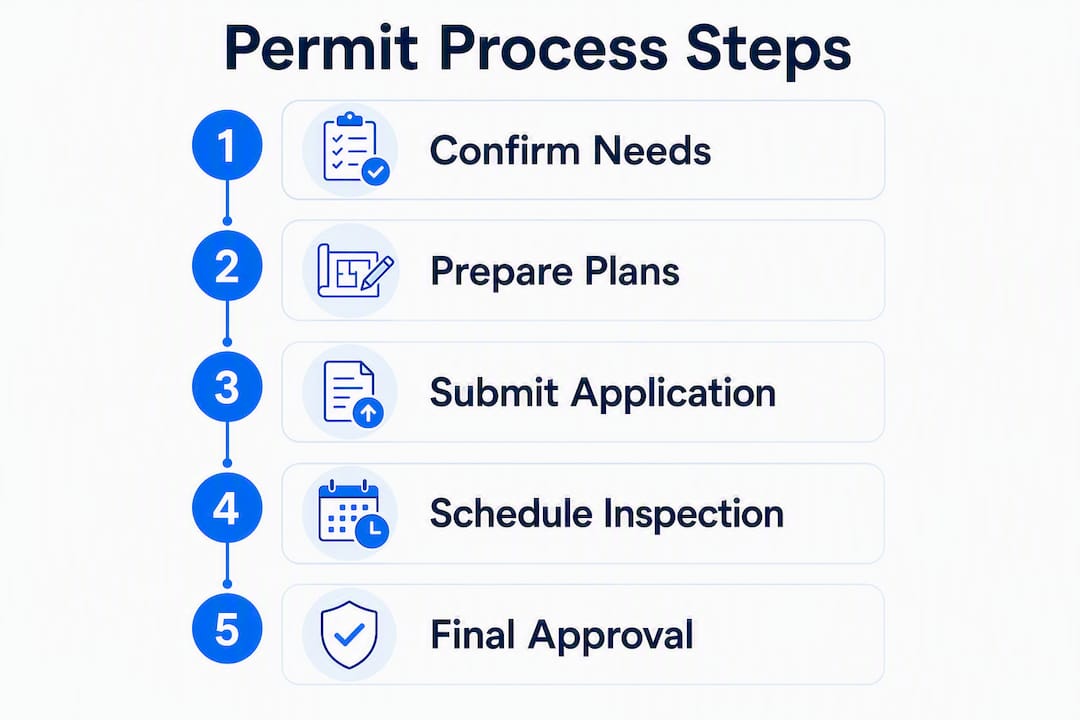
Step 1: Confirm height and setback. Check whether your gate exceeds 6 feet. If it does, a building permit is required. Measure the distance from your gate to the public roadway. If it’s less than 30 feet, you’ll need to address the setback requirement under 14 CCR §1273.09 before the application will be accepted.
Step 2: Check planning and zoning. Contact the LA County Department of Regional Planning (or your city’s planning department) to confirm front-yard setback rules and visibility triangle requirements. Gates in front yards often face additional restrictions in residential zones.
Step 3: Prepare your submittal package. Assemble the scaled site plan, gate elevations, electrical diagram, manufacturer cut sheets, UL 325 compliance statement, and contractor licensing documentation. If new columns are involved, include stamped structural plans.
Step 4: Submit to the building department. Submit the building permit application and electrical permit application simultaneously when possible. LA County’s building department accepts over-the-counter submittals for straightforward projects; more complex projects go into the plan check queue.
Step 5: Consult fire and public works if applicable. If your driveway accesses a public road, contact LA County Public Works for an encroachment permit. If the property is in a fire hazard severity zone or a gated community with emergency vehicle access requirements, contact the LA County Fire Department for a separate review.
Step 6: Schedule inspections. After permits are issued, schedule the footing inspection before pouring concrete, the electrical rough inspection before closing conduit, and the final safety inspection after all operator and safety devices are installed.
The LA fence height rules guide covers the specific height thresholds and setback rules that apply across different LA neighborhoods, which is useful context before you submit.
Fence-gate-estimator’s gate automation estimator can help you collect the site measurements, gate dimensions, and material specifications you’ll need to populate your site plan and permit application before your first visit to the building department.
Key Takeaways
Most automated gate installations in the United States require a building permit, an electrical permit, and often an encroachment or fire department approval, with Los Angeles County enforcing a 6-foot height threshold and a 30-foot driveway setback as key triggers.
| Point | Details |
|---|---|
| Confirm permit types early | Identify whether you need a building, electrical, encroachment, or fire permit before hiring a contractor. |
| Height and setback thresholds matter | LA County requires a building permit for gates over 6 feet; California law requires a 30-foot setback from public roadways. |
| UL 325 compliance is inspected | Each entrapment zone needs multiple independent protection means; inspectors verify sensors, signage, and control placement. |
| Licensed trades are required | A licensed electrician must perform all hardwired connections; stamped engineering plans are required for structural columns or heavy gates. |
| Fence-gate-estimator supports permit prep | The gate automation estimator collects site measurements and specifications useful for building a permit-ready submittal package in Los Angeles. |
Why permit compliance matters more than most homeowners realize
The conventional wisdom is that permits are bureaucratic friction. Pay the fee, wait for approval, get the stamp. But the real value of the permit process for automated gates is the safety review it forces, not the paperwork.
Gate operators are not plug-and-play appliances. They are mechanical systems that move heavy panels at speed, and entrapment injuries from non-compliant installations are well-documented. The UL 325 inspection process exists specifically because a gate operator installed without proper entrapment protection is a genuine hazard, particularly for children and pets. When an inspector verifies that two independent entrapment devices are monitored and functional, that check protects the people who live on your property.
The resale and insurance implications are equally concrete. A gate installed without permits in Beverly Hills or Santa Monica will surface in a title search. Resolving it before closing typically means retroactive permitting, which is more expensive and time-consuming than doing it right the first time. Insurance carriers are increasingly scrutinizing unpermitted structures when processing liability claims.
My recommendation: if your project involves new structural columns, a gate over 6 feet, or any hardwired electrical connection, hire a licensed contractor and electrician from the start. A qualified gate dealer who handles the full permit process, from plan preparation through final inspection, is worth the coordination cost. If the project is straightforward, a licensed gate specialist with experience in your specific jurisdiction can often manage the entire permit process without requiring a separate general contractor.
Get a permit-ready estimate before you apply
Pulling together a permit application takes more than a contractor quote. You need site measurements, gate dimensions, material specifications, and sometimes a preliminary cost breakdown to justify the project valuation on the permit application itself.
Fence-gate-estimator’s gate automation cost estimator is built for exactly this stage of the process. Enter your property details, gate type, and automation preferences, and you’ll get an instant, location-specific cost estimate based on current Los Angeles material and labor rates. The estimate includes the measurements and specifications that go directly into your site plan and permit submittal package, saving you a separate site visit before you’ve even chosen a contractor.
Beyond the estimate, Fence-gate-estimator connects you with licensed installation professionals who handle permit guidance, plan preparation, licensed electrician coordination, and on-site inspection support for residential projects across Los Angeles, including Beverly Hills, Brentwood, Pasadena, and Studio City. For custom wrought iron or steel gate projects that require stamped engineering plans, the team can coordinate that review as part of the installation process. Start your estimate and have your permit-ready details in hand before your first call to the building department.
Useful sources for permit research
Use these primary sources to verify requirements for your specific jurisdiction before submitting any application.
- DASMA TDS353: Vehicular Gate Operators and ANSI/CAN/UL 325 — the primary technical reference for UL 325 entrapment protection requirements
- DASMA TDS356: UL 325 FAQ for gate installations — covers enforcement, retroactivity, and inspector expectations
- Intertek Standards Update Notice for UL 325 — recent revisions including manual operation marking and battery-backup requirements
- California Code of Regulations, Title 14, §1273.09 — the 30-foot setback rule for gate entrances from public roadways
- Los Angeles County Public Works permit FAQ — building and electrical permit requirements for gates and fences
- 2025 California Residential Code, Appendix BH: Automatic Vehicular Gates — the state residential code appendix governing automatic gate construction standards
Next steps: Contact your local building department for a pre-application meeting or planner check before submitting. Download the operator manual and UL 325 compliance statement from your chosen manufacturer. If structural work is involved, engage a licensed structural engineer early so stamped plans are ready when you submit.
FAQ
Do I need a permit for an electric gate?
Yes, in most U.S. jurisdictions. Electric gate installations that involve a motor, hardwired wiring, sensors, or new concrete footings almost always require at least a building permit and a separate electrical permit.
What are the UL 325 requirements for gate operators?
UL 325 requires a minimum of two independent entrapment protection means for each entrapment zone, monitored external protection devices, warning signage at specified locations, and controls positioned so the gate is in full view of the operator. Recent updates also address manual operation marking and battery-backup behavior.
Can any existing gate be automated?
Not automatically. Older gates may need structural upgrades to meet ASTM F2200 requirements for the gate panel before a modern operator can be legally and safely fitted. A licensed gate specialist should assess the existing gate before you purchase an operator.
What is the standard setback requirement for automated driveway gates in California?
California regulations under 14 CCR §1273.09 require that gates providing access from a public road sit at least 30 feet from the roadway so vehicles can stop clear of traffic before the gate opens.
How long does the gate permit process take in Los Angeles?
In Los Angeles County and the City of Los Angeles, the full process from plan preparation through final inspection typically takes several weeks for projects requiring plan review, corrections, and multiple inspections. Smaller suburban jurisdictions like Burbank or Glendale often move faster.
Recommended
- Gate Automation Process: A Homeowner’s Practical Guide | LA Electric Gate Service
- The Role of App-Based Gate Control for LA Homeowners | LA Electric Gate Service
- Modern Gate Design Process: A Los Angeles Homeowner’s Guide | LA Electric Gate Service
- Gate openers: The key to secure, stylish LA homes | LA Electric Gate Service