Home Security Gate Guide for Los Angeles Homeowners
By BabyLoveGrowth
Your front door is your home’s most exploited vulnerability. 34% of burglars enter through the front door, and they typically make their decision to attempt a break-in within 60 seconds of assessing your property. This home security gate guide walks you through everything you need to protect that entry point effectively: gate types, materials, installation steps, automation options, and ongoing maintenance. Whether you own a single-family home in Sherman Oaks or manage multiple properties in Brentwood, the right gate is the most visible and physically decisive deterrent you can install.
Table of Contents
- Key takeaways
- Home security gate guide: choosing the right gate type
- What to do before installing a security gate
- How to install a security gate with automation
- Testing, safety checks, and ongoing maintenance
- My honest take on security gates in the LA market
- Get an accurate estimate for your gate project
- FAQ
Key takeaways
| Point Details | |
| Gate type determines viability | Your driveway layout and available clearance dictate whether a sliding, swing, or bi-folding gate is practical. |
| Permits are required in LA | Los Angeles has specific permit requirements for powered gates. Skipping this step creates legal and liability risks. |
| UL 325 compliance is non-negotiable | Automated gates must meet UL 325 safety standards to prevent entrapment injuries and legal exposure. |
| Maintenance extends gate lifespan | Quarterly lubrication, sensor checks, and annual professional inspections prevent costly operator failures. |
| Visible gates deter opportunists | A well-maintained gate signals active ownership, which directly discourages break-in attempts. |
Home security gate guide: choosing the right gate type
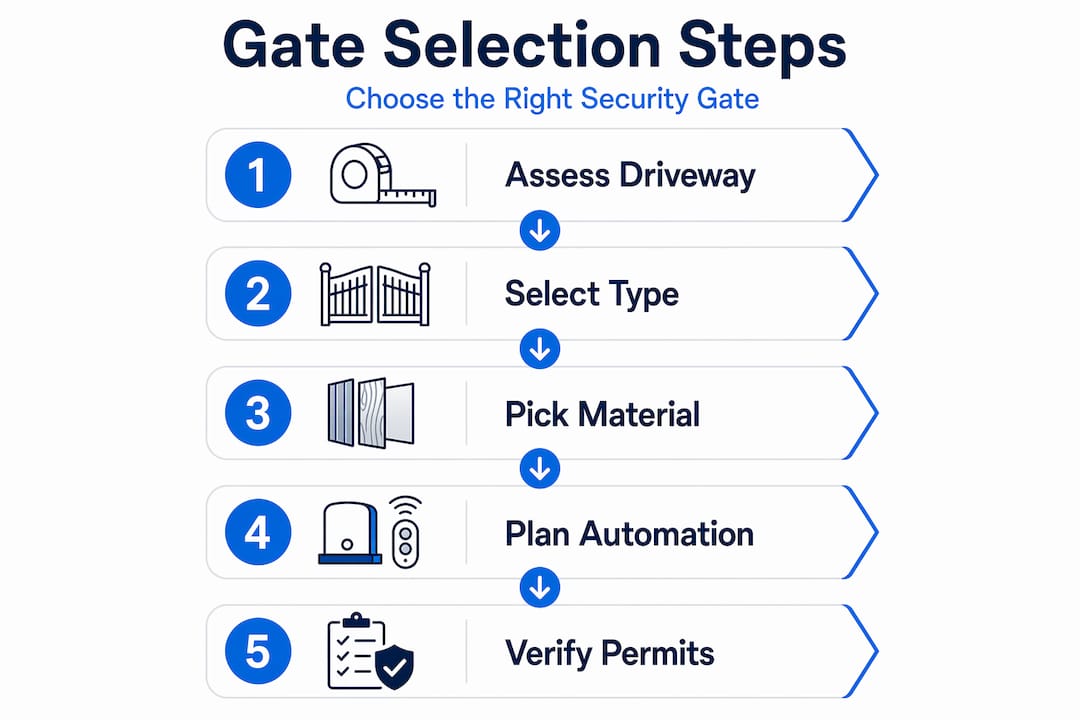
Not all security gates are built for the same property. The gate that works perfectly for a wide, flat driveway in Encino may be completely impractical for a sloped entry in Bel Air. Before you spend a dollar, you need to match the gate style to your specific site conditions.
Sliding gates
Sliding gates roll horizontally along a track parallel to your fence or wall. They are the most common choice for Los Angeles driveways because they require no swing clearance in front of or behind the gate. If your driveway is short or your entry opens directly onto a street, a sliding gate is almost always the right call. They handle automation particularly well and hold up reliably in high-use settings like multi-unit properties.
Swing gates
Swing gates open inward or outward on hinges, similar to a door. Single-leaf swing gates work well for narrower entries, while dual-leaf configurations suit wider driveways common in Beverly Hills and Pasadena estates. The critical constraint here is clearance. A swing gate requires several feet of open space in the direction it opens. On sloped driveways, you also need to verify the gate arc clears the ground surface at all points.
Vertical lift and bi-folding gates
Vertical lift gates rise straight up, making them ideal for very tight spaces where neither sliding nor swinging is possible. Bi-folding gates fold back on themselves, reducing the footprint needed for operation. Both styles tend to cost more to fabricate and automate, but they solve specific site problems that no other gate type can.
Material comparison
The material you choose affects durability, maintenance frequency, visual style, and cost per linear foot. Here’s how the most common options stack up:
| Material Strength Maintenance Typical cost range Best for | ||||
| Wrought iron | Very high | Moderate (rust prevention) | $$$$ | High-end residential, custom designs |
| Steel | High | Moderate (paint/coating upkeep) | $$$ | Security-focused properties |
| Aluminum | Medium | Low (no rust) | $$ | Coastal areas, low-maintenance preference |
| Wood | Low-medium | High (warping, rot) | $ to $$ | Privacy-focused, traditional aesthetics |
For most Los Angeles homeowners prioritizing security, wrought iron and steel offer the best resistance to forced entry. Aluminum is a smart call for properties near the coast in Santa Monica or Culver City, where salt air accelerates rust on ferrous metals.
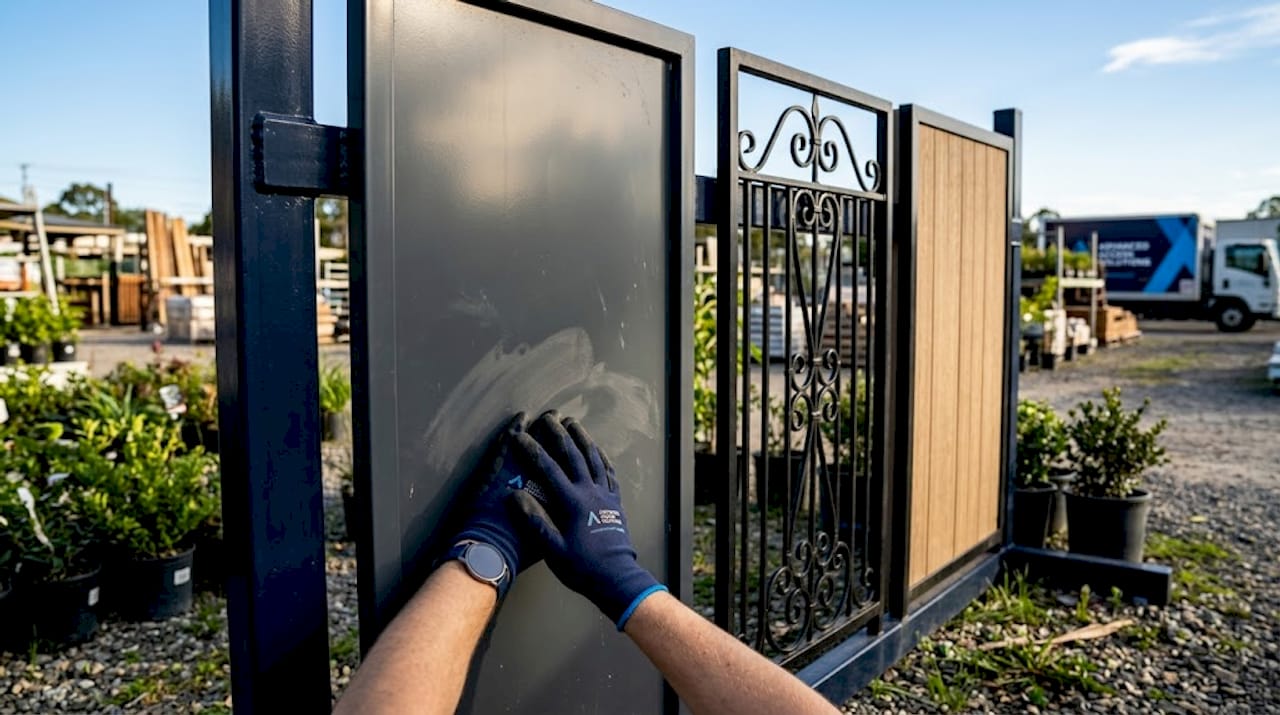
Pro Tip: If you want the strength of steel with reduced maintenance, ask your fabricator about powder-coated steel gates. The coating significantly extends the finish life compared to painted options.
Homes without security systems are 300% more likely to be burglarized, which puts a well-chosen gate in direct context: it is both a physical barrier and a visible deterrent that shifts criminal attention to easier targets. Explore the full range of security gate types available for Los Angeles properties to narrow your options before committing to a material or style.
What to do before installing a security gate
Installation day goes smoothly or it goes badly based almost entirely on how well you prepared. Skipping this phase is the most common and costly mistake homeowners make.
Start by physically inspecting your gate site. Walk the full path the gate will travel, whether that’s a sliding track or a swing arc. Check for:
- Level ground. Uneven surfaces cause binding, which wears out gate operators prematurely and triggers sensor errors.
- Adequate clearance. Measure actual swing or slide space, not estimated space. Account for vehicles parked on or near the entry.
- Post condition. Existing posts must be structurally sound to bear the gate’s weight, especially for heavier iron or steel fabrications.
- Utility lines. Confirm no underground electrical, gas, or water lines run through your planned installation zone. Call 811 before you dig.
Permits and HOA requirements
In Los Angeles, powered gates typically require a building permit. The City of Los Angeles Department of Building and Safety reviews gate projects for structural and electrical compliance. If you live in a neighborhood with a homeowner association in areas like Brentwood or West Hollywood, you may also need written HOA approval before fabrication begins. Review LA’s local fence height rules to confirm your gate design stays within code.
Electrical preparation
Automatic gates need a dedicated power circuit run to the operator location. This typically means coordinating with a licensed electrician before the gate installer arrives. Cellular-based gate control systems require weather-protected control box enclosures to prevent moisture damage, which is a detail many homeowners overlook during rough-in planning.
Your guide to gate locks and access control hardware should also happen at this stage. Decide whether you want a keypad, remote fob, mobile app control, or intercom system before installation. Retrofitting these components later costs significantly more than specifying them upfront.
How to install a security gate with automation
Whether you are installing security gates yourself or supervising a professional crew, understanding the sequence prevents errors that are expensive to fix after the fact.
- Set and verify posts. Gate posts must be set in concrete footings deep enough to handle the gate’s weight and wind load. For heavier wrought iron gates, 36-inch deep footings are standard in LA’s soil conditions.
- Hang the gate and test manual operation. Before attaching any operator, confirm the gate swings or slides freely with no binding. Pre-installation inspection is critical here. Misalignment at this stage causes limit switch failures and sensor errors in the operator later.
- Mount the gate operator. Position the operator according to the manufacturer’s bracket specifications. Swing gate operators typically mount on the post or directly on the gate leaf. Sliding gate operators mount on a pad adjacent to the track.
- Install safety sensors. UL 325 compliance requires two independent entrapment protection methods on every automated gate. Photo eye sensors on both sides of the gate opening are the most common solution. Non-compliance creates injury risk and exposes you to legal liability.
- Wire the access control system. Connect your chosen entry device, whether that’s a keypad, remote receiver, or intercom. Route all wiring through conduit to protect it from UV exposure and pests.
- Program limits and test. Set the operator’s open and close travel limits, then run 10 to 15 complete cycles while observing the gate’s motion. Confirm the safety sensors reverse the gate when interrupted.
Installing an automatic swing gate opener DIY typically takes 5 to 8 hours when preparation is done properly. Common errors include skipping safety sensors, installing on unlevel surfaces, and using indoor-rated connectors in outdoor environments.
Pro Tip: If you plan to integrate your gate with a smart home system, choose a gate operator that supports Z-Wave, Wi-Fi, or a dedicated mobile app from the start. Swapping operators for smart home compatibility later is a significant additional expense.
Automatic home gates also pair well with video doorbells and surveillance cameras. Homes with video doorbells experience 53% fewer break-ins. Combining a motorized gate with a visible camera system at the entry point creates layered deterrence that opportunistic burglars consistently avoid.
For more detail on operator selection, the gate openers guide from Fence-gate-estimator covers the major brands and feature sets relevant to LA installations.
Testing, safety checks, and ongoing maintenance
A gate that was installed correctly but never maintained will fail. In Los Angeles’s climate, the specific threats are UV exposure, occasional heavy rain, and the fine particulate dust that settles into tracks and hinges during dry months.
After installation, verify the following before calling the project complete:
- Gate travels the full open and close cycle without hesitation or grinding
- Safety sensors reverse the gate immediately when the beam is interrupted
- All access control devices (remote, keypad, app) trigger the gate reliably from the intended distance
- Safety signage is posted near the gate as required by UL 325
Maintenance schedule
| Task Frequency Notes | ||
| Lubricate hinges, rollers, and chain | Quarterly | Use weather-rated lubricant, not WD-40 |
| Clean track or hinge area | Monthly | Remove debris that causes binding |
| Test safety sensor alignment | Monthly | Sensors can shift due to vibration |
| Inspect wiring and control box | Biannually | Look for corrosion, pest damage |
| Professional inspection | Annually | Catches wear before failure occurs |
Neglecting the track on a sliding gate is the single fastest way to burn out an operator motor. Debris accumulation forces the motor to work harder on every cycle, and motors do not give you much warning before they fail completely. Quarterly cleaning takes five minutes and prevents a $400 to $800 service call.
For properties with smart gate integrations, also confirm firmware updates are applied to the controller and that the mobile app connection is still active and responsive. Technology components need software maintenance just as the mechanical components need physical maintenance.
My honest take on security gates in the LA market
I’ve worked with enough Los Angeles homeowners to recognize a pattern that costs people money and frustration. Most of them research gate aesthetics thoroughly and barely research gate security function at all. They spend hours choosing a wrought iron design that matches their exterior and then pick the cheapest operator available, or they skip the safety sensors because they seem unnecessary for a residential property.
In my experience, burglars are opportunistic. They scan a property in under a minute looking for the path of least resistance. A visible, well-maintained gate signals active ownership. It tells a would-be intruder that someone is paying attention to this property. That psychological signal matters more than most homeowners realize.
What I’ve also learned is that the LA market has specific conditions other guides don’t account for. The combination of earthquake activity, seasonal Santa Ana winds, and the dry heat creates accelerated wear on gate hardware, particularly on swing gate hinges and sliding gate tracks. Annual professional inspections aren’t a luxury here. They are genuinely necessary.
My advice on budget: don’t cut costs on the operator or the safety compliance. Spend less on decorative elements if you need to. A gate that looks beautiful but binds after two years, or one that lacks proper entrapment protection, is a liability rather than an asset.
— Moin
Get an accurate estimate for your gate project
Planning a security gate project in Los Angeles means navigating material costs, labor rates, permit fees, and automation add-ons that vary significantly by neighborhood and property type.
Fence-gate-estimator offers an instant cost calculator for LA homeowners that generates realistic budget breakdowns based on your specific inputs: property dimensions, gate style, material preference, and automation features. No guesswork, no waiting for a callback. The tool uses current local labor and material rates for Los Angeles, covering everything from a basic manual pedestrian gate to a fully automated custom iron driveway gate.
If you’re ready to go further, the gate automation service page covers operator options, access control integrations, and professional installation details. For properties needing foot traffic solutions alongside a vehicle gate, the pedestrian gate services page outlines your options. Get your estimate today and move forward with confidence.
FAQ
What is the best gate type for a short Los Angeles driveway?
A sliding gate is typically the best choice for short driveways because it requires no swing clearance in front of or behind the gate opening. It also automates reliably and handles high daily use without structural stress.
Do I need a permit for an automatic gate in Los Angeles?
Yes. Powered gates in Los Angeles generally require a building permit through the Department of Building and Safety, and some neighborhoods require additional HOA approval before installation begins.
What does UL 325 compliance mean for my automated gate?
UL 325 is the safety standard for automated gate operators. It requires two independent entrapment protection methods, typically photo eye sensors, to prevent the gate from closing on a person or vehicle. Non-compliance creates both physical injury risk and legal liability for the property owner.
How often should I service my security gate?
Lubricate hinges, rollers, and chains quarterly, clean tracks monthly, and schedule a professional inspection annually. Consistent maintenance prevents operator motor failures and extends the life of your gate hardware significantly.
What material is best for a security gate near the coast?
Aluminum is the lowest-maintenance option for coastal properties in areas like Santa Monica or Culver City because it does not rust. If you prefer the stronger security profile of steel or wrought iron, specify a powder-coated finish to slow salt air corrosion.