Within 1 km: Specify 316 Stainless for Coastal Gates in LA
By BabyLoveGrowth AI
For gates within about a kilometer of the Pacific, specify 316 marine-grade stainless with matching 316 fasteners and a marine-rated operator enclosure. Between roughly 1 and 5 kilometers, powder-coated or anodized marine-grade aluminum usually wins on value, and 304 stainless holds up fine in most cases. Beyond 5 kilometers, aluminum remains the default, though coated steel works if you commit to a real refresh schedule. None of this matters if the hinges, fasteners, and operator box are the wrong grade.
TL;DR:
- Within one kilometer of the coast, 316 stainless steel with matching fasteners and marine-rated enclosures is essential for durability and corrosion resistance.
- Aluminum, especially powder-coated or anodized, provides a cost-effective and lightweight option for sites between one and five kilometers from the shoreline.
- Fasteners and hinges must match the gate material grade to prevent galvanic corrosion, with stainless steel or bronze recommended for high-exposure areas.
- Regular inspection and maintenance of finishes, including immediate touch-ups and full re-coating every five to eight years, are critical for long-term gate performance.
- Site-specific wind loads determine the necessary gate size, post reinforcement, and hardware, with unobstructed sites facing the highest structural demands.
Table of Contents
- Choosing Coastal Gate Materials by Exposure Zone
- What Hardware and Fasteners Should You Specify?
- How Long Do Protective Finishes Actually Last?
- Do Wind Loads Change Your Material Choice?
- How Often Should You Inspect a Coastal Gate?
- Applying This to Los Angeles Coastal Properties
- The Bottom Line on Coastal Gate Materials
- What Homeowners Get Wrong About Coastal Gates
- Get an Instant Estimate for Marine-Grade Gate Upgrades
- Sources
- FAQ
Choosing Coastal Gate Materials by Exposure Zone
Site exposure, not personal taste, should drive your material decision. Homes in Malibu, Pacific Palisades, or bluff-top lots in Palos Verdes sit in a different corrosion category than a property in Sherman Oaks or Encino that’s technically “coastal” only on a map. Atmospheric corrosivity standards like ISO 9223 classify sites within about a mile of open water as C5 or CX, the harshest categories, where anything short of true marine hardware fails within a few seasons.
Aluminum forms a natural oxide layer that resists rust, and its light weight makes it the easiest metal to automate without oversizing motors and hinges. Powder-coated or anodized aluminum performs well from coastal-adjacent zones outward, but it isn’t invincible. Scratches through the coating expose bare metal to salt-laden air, and cheap extruded aluminum with thin walls will flex and fatigue at welds over time.
316 stainless steel contains molybdenum, roughly 2 to 3 percent, which is what actually stops chloride ions from pitting the surface. Standard 304 stainless lacks that molybdenum and will eventually pit under direct salt spray, even though it looks identical when new. Expect to pay a moderate to significant price premium for 316 over 304, a cost justified within about a kilometer of the shoreline but often unnecessary further inland.
Galvanized steel works when hot-dip galvanizing is paired with a topcoat, essentially a duplex system. Duplex coatings are the accepted answer for steel gates in C5 exposure, since galvanizing alone sacrifices itself to protect the base metal and eventually depletes.
Timber and composite gates bring warmth to a design but carry real tradeoffs: wood rots and splits under UV and moisture cycling, and composite can fade or delaminate at fastener points. Timber-look aluminum profiles are increasingly the practical substitute for owners who want the aesthetic without the sanding and resealing schedule.
- Aluminum: low maintenance, best for automation, moderate cost
- 316 stainless: highest corrosion resistance, premium cost, required within 1 km
- 304 stainless: fine for coastal-adjacent sites, will pit closer to the water
- Galvanized + duplex coating: cost-effective for steel, needs a topcoat plan
- Timber/composite: highest upkeep, shortest realistic lifespan on the coast
What Hardware and Fasteners Should You Specify?
A gate is only as strong as its weakest fastener. Mixing a stainless leaf with mild-steel hardware creates galvanic corrosion at every contact point, and it’s one of the most common mistakes in coastal installs.
- Match fastener grade to the leaf: 316 stainless fasteners within a kilometer of the coast, silicon bronze as an alternative for direct-spray sites.
- Use three-hinge sets for moderate exposure and four-hinge assemblies for high-wind coastal sites; a quality three-hinge set supports substantial dynamic loads, while four hinges can carry heavier loads suitable for high-wind coastal sites of dynamic load.
- Specify NEMA 4X enclosures at minimum for any coastal operator, stepping up to NEMA 6P when the gate takes direct salt spray.
- Confirm the enclosure material itself. A painted mild-steel box labeled NEMA 4X still fails once the coating chips; 316L stainless or marine-rated aluminum enclosures don’t have that weakness.
Pro Tip: Ask your installer whether they use anti-seize on stainless threads. Without it, stainless-to-stainless fasteners can gall and seize during future maintenance, turning a simple hinge swap into a cut-and-replace job.
How Long Do Protective Finishes Actually Last?
Powder coating is a barrier, not a permanent seal. It’s a common misunderstanding among homeowners who assume a coated gate needs zero attention for a decade.
- Powder coat resists corrosion well when intact, but chips from a dropped tool or a car door expose bare metal, and salt gets trapped under the finish and spreads corrosion outward from that point.
- Duplex systems, hot-dip galvanizing under an epoxy or polyurethane topcoat, give steel gates a meaningful second layer of defense and are the standard for harsher exposure bands.
- Marine-grade paints and shop-applied coatings outperform field touch-ups because factory application achieves better adhesion and cure conditions than a brush-on repair at the jobsite.
- Refresh timeline: inspect finishes quarterly within roughly 2 miles of the ocean, touch up chips immediately, and plan a full recoat every 5 to 8 years depending on exposure severity.
Do Wind Loads Change Your Material Choice?
Structural design often decides whether a coastal gate survives its first winter storm, regardless of what it’s made from. FEMA’s guidance on coastal construction treats wind, wave, and site exposure as inseparable from material selection, and gate design should follow the same logic.
- Exposure B (sheltered, surrounded by buildings or terrain) allows lighter posts and standard footings.
- Exposure C (open terrain, moderate coastal proximity) calls for reinforced posts and deeper embedment.
- Exposure D (unobstructed coastline, bluffs, open beach) needs the largest post sections and the deepest anchorage.
- Solid gate panels catch wind like a wall; picket or perforated infill cuts that sail effect and reduces the load your posts and hinges have to absorb.
- Operators need mechanical stops and enough allowance for gate deflection so gusts don’t slam the leaf against its hardware.
How Often Should You Inspect a Coastal Gate?
A maintenance schedule tied to your actual exposure band beats a generic annual checkup.
- Every 3 months for homes within about 2 miles of the shoreline: rinse the gate with fresh water, focusing on hinge pockets, weld seams, and fastener heads where salt collects.
- After every significant storm, check for loosened hardware, coating damage, and debris buildup around the operator housing.
- Annually, have a professional service the gate operator, including seals, desiccant packs, and enclosure gaskets.
- Replace, don’t patch, any fastener or hinge showing rust bloom. Painting over corrosion just hides the problem until it fails.
If your gate was installed years ago in 304 stainless and now sits closer to direct spray than it once did (shoreline erosion and new construction change exposure over time), budget for an upgrade to 316 rather than continuing to patch pitted surfaces. Our maintenance guide for gates walks through the rinsing and inspection routine in more detail.
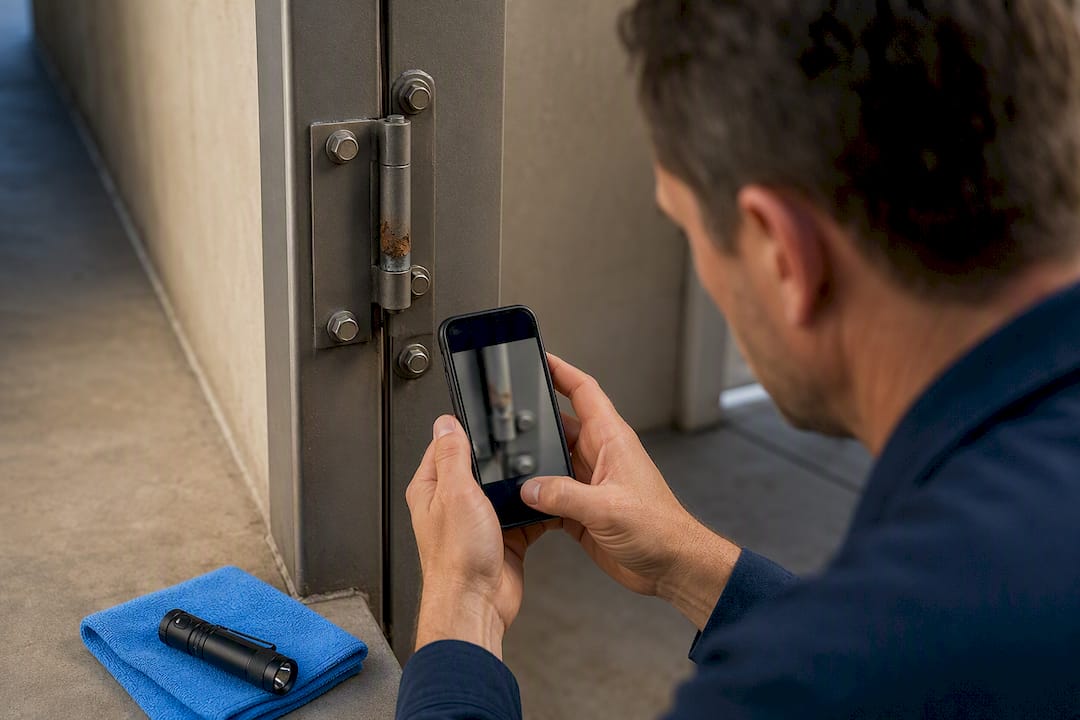
Pro Tip: Keep a phone photo log of your gate’s hardware every quarter. Side-by-side comparisons make early pitting or coating breaches obvious long before they’re visible during a quick glance.
Applying This to Los Angeles Coastal Properties
Measuring your straight-line distance to the shoreline takes thirty seconds on any mapping tool, and it should be the first thing you do before requesting quotes. A bluff-top home in Malibu or Palos Verdes Estates sits in true C5 territory and needs the full 316 and duplex-coating package. A property in Santa Monica or Marina del Rey a few blocks back from the sand often does well with anodized aluminum and 304 hardware. Inland pockets of Culver City or Brentwood rarely need marine-grade specs at all.
- Beachfront bluff: 316 stainless leaf, 316 fasteners, NEMA 6P operator enclosure
- Coastal-adjacent (1 to 5 km): powder-coated aluminum, 304 hardware acceptable
- Sheltered harbor or inland pocket: standard aluminum or duplex-coated steel
Fence-gate-estimator’s tool itemizes these upgrades, marine-grade fasteners, duplex coatings, higher-rated operator enclosures as line items in a budget, and it flags permit-relevant details for coastal zones like Malibu’s gate height and setback rules before you commit to a design.
The Bottom Line on Coastal Gate Materials
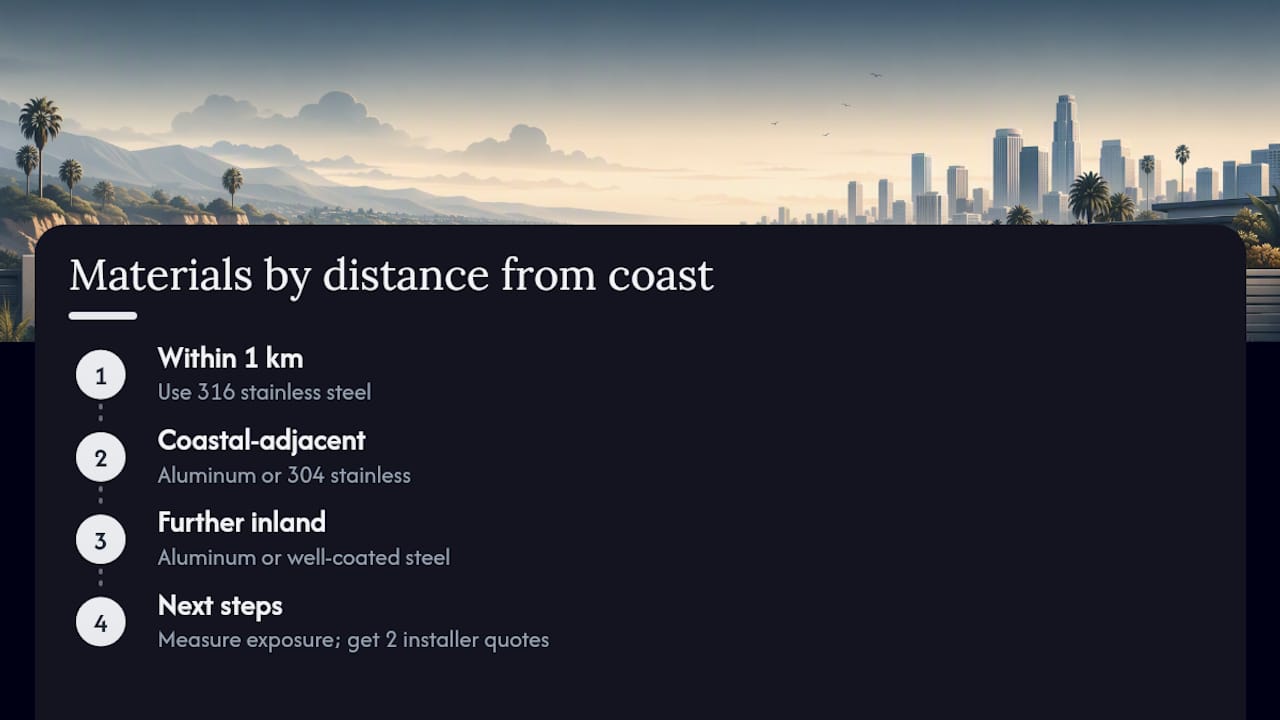
Match the metal to the mile marker: 316 stainless within a kilometer of the water, aluminum or 304 stainless in the coastal-adjacent band, and aluminum or well-coated steel further inland. From there, measure your exposure, run an estimate, and get quotes from two installers before signing anything.
What Homeowners Get Wrong About Coastal Gates
Most budgeting mistakes come from focusing on the gate panel and forgetting the parts that fail first. Fasteners, hinges, and operator enclosures see the worst salt exposure yet get the smallest line item in a quote.
Owners also assume a powder-coated finish is a one-time expense rather than a system that needs periodic inspection. Total cost of ownership, not the sticker price on installation day, is what actually separates a gate that lasts 20 years from one that needs replacing in five.
— Moin
Get an Instant Estimate for Marine-Grade Gate Upgrades
Online tools can provide itemized material and labor costs for marine-grade upgrades, including corrosion-resistant fasteners, upgraded operator enclosures, and coating systems, offering pricing estimates for Los Angeles before scheduling a site visit.
Whether you’re specifying a bluff-top gate in Malibu or a coastal-adjacent driveway entrance in Santa Monica, start with our driveway gate estimator to see itemized costs for marine-grade materials, or explore gate automation options built around corrosion-resistant operators. For ornamental or high-end designs, our custom fencing service covers duplex coatings and premium finishes. Our estimates account for Los Angeles permit requirements, so coastal-zone approvals don’t catch you off guard. Run your numbers now at Fence-gate-estimator and request a quote built around the specs your property actually needs.
Sources
- 304 vs 316 stainless steel corrosion resistance, properties, applications — Rolled Alloys
- Local Officials Guide for Coastal Construction — FEMA P-762
- DIY gate maintenance: what you can do yourself and what needs professional help — Creative Door
FAQ
What Is the Best Material for a Coastal Gate?
For direct salt spray within about a kilometer of the shore, 316 marine-grade stainless steel with matching fasteners performs best. Further from the water, powder-coated or anodized aluminum is usually the better value.
What Are the Best Building Materials for Coastal Areas?
316 stainless steel, marine-grade aluminum, and duplex-coated (galvanized plus topcoat) steel hold up best against salt air, humidity, and UV exposure. Timber and standard mild steel require far more frequent upkeep in the same conditions.
What Materials Are Commonly Used in Gates?
Residential gates are typically built from aluminum, wrought iron or steel, stainless steel, wood, or composite. Coastal properties should favor aluminum or stainless over untreated steel or wood due to corrosion and rot risk.
How Much Does a Coastal-Ready Gate Cost in Los Angeles?
Pricing depends on material grade, size, and automation, so Fence-gate-estimator’s current rates are available through the instant estimator rather than a fixed quote here.