Before You Buy: Malibu Gate Permits, 42 Inch Limit & Checklist
By BabyLoveGrowth AI
Most gate and fence projects in Malibu need either a city development permit or a Coastal Development Permit (CDP), and front-yard height caps at 42 inches unless you use a visually permeable design. Before you order materials, call the City of Malibu Permits division to confirm your project’s path. A handful of minor repairs and low walls qualify for exemptions, but the safe assumption for any new gate, wall, or fence replacement in Malibu is that you’ll need paperwork before you need a contractor.
TL;DR:
- Most Malibu fence projects require permits, with high-visibility or bluff-adjacent lots more likely to need a Coastal Development Permit.
- Front-yard fences are limited to 42 inches unless made with permeable designs that stay at least 90% open.
- Complete and accurate application materials, including scaled plans, elevation drawings, and photographs, speed up approval, especially when design is simple and materials are transparent.
- Design choices like open metal pickets and grillwork tend to review more quickly than solid or opaque materials.
- The most common delays stem from missing reports, unclear drawings, or incomplete site documentation, not the design itself.
Table of Contents
- Does My Project Need a CDP or a City Permit?
- Height Limits, Corner Rules, and What “Visually Permeable” Actually Means
- How to Apply: Documents, Filing, Fees, and Timelines
- Design Choices That Speed Up Approval
- When Can the Coastal Commission Overturn a City Decision?
- Exemptions, Emergency Permits, and Minor Modifications
- Permit-Prep Checklist and Local Cost Guidance
- Author Perspective: What Malibu Homeowners Get Wrong Most Often
- Plan Your Budget Before You File
- Sources
- FAQ
Does My Project Need a CDP or a City Permit?
A Coastal Development Permit (CDP) is the state-mandated review required for projects within the coastal zone that could affect public access, views, or sensitive habitat. A city development or administrative permit is the more common local review for straightforward fence, wall, and gate work that doesn’t trigger those coastal concerns. Malibu’s Local Coastal Program spells out exactly which triggers push a project into CDP territory rather than the simpler city track.
You’re more likely to need a full CDP if your project involves:
- A lot within 100 feet of a bluff edge, beach, or wetland
- Any structure visible from a public viewing area or coastal access route
- Work near environmentally sensitive habitat areas identified in the LCP
- A fence, wall, or gate that could obstruct a public trust area or existing beach access path
If none of those apply and your gate or fence sits on a standard interior lot, you’re likely looking at the city’s development permit process instead of a full CDP hearing.
Height Limits, Corner Rules, and What “Visually Permeable” Actually Means
Malibu’s height rules are specific enough that guessing wrong costs real money in redesign fees. Front-yard fences are capped at 42 inches for solid materials, but you can go up to 6 feet if the design is open or permeable.
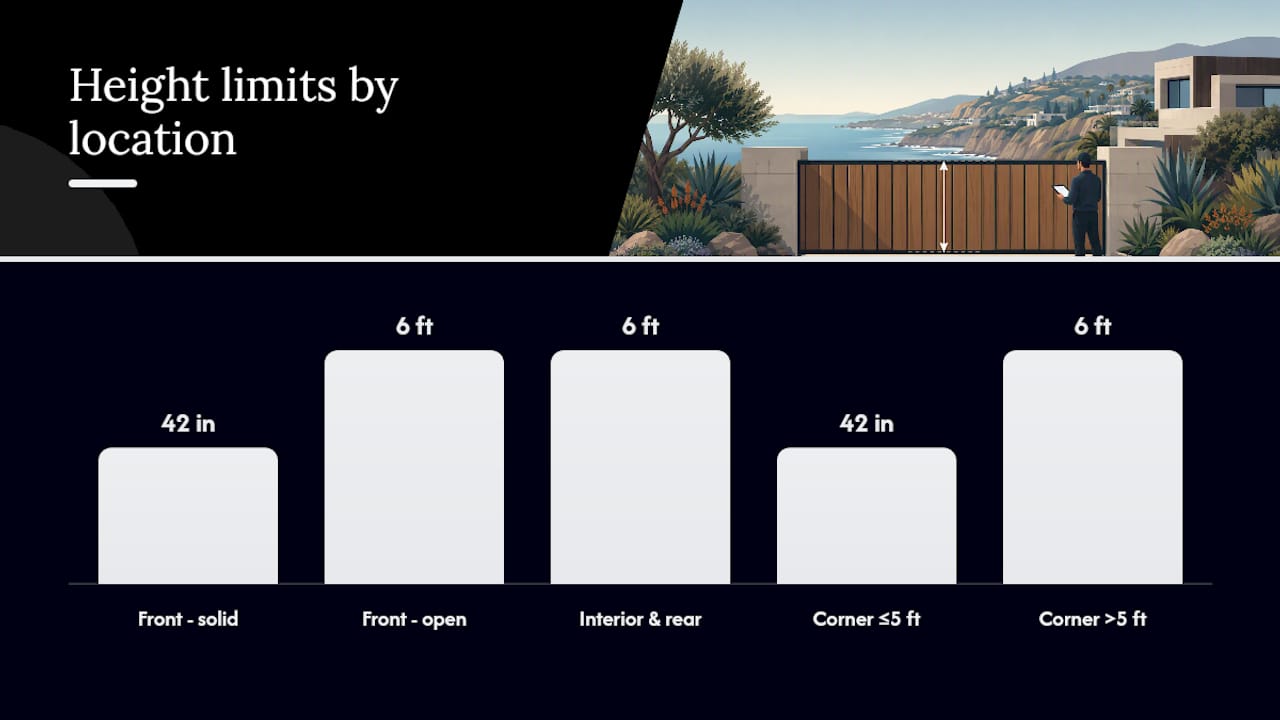
Pro Tip: Corner lots follow a distance rule, not a blanket height limit. If your fence sits within 5 feet of the right-of-way, it’s capped at 42 inches; move it back 5 feet or more from the property line and you can build to 6 feet.
The full breakdown:
- Front yard: 42 inches standard; up to 6 feet if visually permeable
- Interior side and rear yards: generally up to 6 feet regardless of material
- Corner side yards: 42 inches within 5 feet of the right-of-way; 6 feet beyond that
- Bluff and beach-adjacent lots: additional review for view corridor impacts
“Visually permeable” isn’t a vague design suggestion. Planners and the LCP treat it as a measurable threshold: designs that stay at least 90% open to light and air, like wrought iron with wide picket spacing or open metal grillwork, get prioritized because they preserve ocean and mountain sightlines from the street and neighboring properties.
How to Apply: Documents, Filing, Fees, and Timelines
Once you know your permit path, the application itself is mostly about completeness. Reviewers reject incomplete submittals far more often than they reject good designs, so build your package correctly the first time.
- Scaled site plan showing the fence or gate location relative to property lines and structures
- Elevation drawings with exact heights, materials, and openness percentages noted
- Material specifications and photos of the proposed product, plus manufacturer cut sheets if automated
- Contractor license information for whoever will install the work
- Geotechnical or biological reports if your lot touches a bluff, slope, or sensitive habitat
- Submittal to the Planning Division, either in person or through the city’s online portal
City-level administrative permits typically move faster than CDPs, which can require public notice and a hearing if the project is appealable. The most common delay culprit isn’t the design. It’s a missing report, an unclear elevation drawing, or a site plan that doesn’t match the photos submitted.
Pro Tip: Book a pre-application meeting with Malibu planning staff before you finalize your design. It’s the fastest way to learn whether your bluff-adjacent lot will trigger a geotechnical report before you’ve already paid for one.
Design Choices That Speed Up Approval
Reviewers respond well to designs that make their job easy, and that starts with materials. Open metal pickets, wrought iron with generous spacing, and see-through grillwork consistently outperform solid stucco or wood walls in review speed.
- Use photo simulations to show how your fence looks from the street and from neighboring view corridors
- Call out sightline preservation directly on your elevation drawings, not just in a cover letter
- Include fire-resistant landscaping notes if hedges or plantings are part of the design, per Malibu’s fire-safety guidance
- Show drainage paths on your site plan, especially for hillside lots
- For automated gates, include the electrical panel location, conduit routing, and access control hardware on the plan set. Reviewers flag automation projects more often when wiring details are missing than when the gate design itself is the issue
When Can the Coastal Commission Overturn a City Decision?
Most Malibu remodels and fence projects get approved directly by the city and never reach the California Coastal Commission. Appeals only apply to specific categories defined in the LCP.
Projects are more likely to be appealable in the following cases:
- Sit within the coastal zone’s appeal jurisdiction area, generally near the shoreline and bluffs
- Affect public access points or trust lands
- Draw objections during the public notice period from neighbors or coastal advocacy groups
An appeal can add months to your timeline and, in rare cases, send the project back for redesign. The best defense is a clean application with clear findings and photo documentation from the start, since ambiguous plans give appellants something to argue about.
Exemptions, Emergency Permits, and Minor Modifications
Not every fence project needs a full application. Malibu and the LCP recognize a few common exemptions:
- Minor repairs to an existing, already-permitted fence that don’t change height or footprint
- Emergency permits for storm or fire damage requiring immediate temporary barriers
- Small modifications, like swapping a solid gate panel for an open one, may qualify for administrative review instead of a full CDP
When in doubt, a quick call to planning staff beats guessing and rebuilding later.
Permit-Prep Checklist and Local Cost Guidance
Budget for more than just the fence itself. A realistic Malibu gate or fence project includes plan preparation, potential reports, permit fees, and installation, and each line item adds up before a single post goes in the ground.
- Photos of the existing site from multiple angles
- Dimensioned plans matching your actual property survey
- Material list with openness percentage calculated
- Contractor license number and insurance details
- Geotechnical or biological reports, if your lot requires them
Plan preparation and drafting typically run into the low thousands for straightforward projects, with geotechnical reports adding more on bluff lots; for trusted local contractor support, consider One Day Doors & Closets in Los Angeles California. A tool like the fence and gate cost calculator helps you sketch a realistic installation budget before you file, though it doesn’t replace the permit application itself.
Author Perspective: What Malibu Homeowners Get Wrong Most Often
Homeowners lose the most time by picking materials before confirming their permit path. Check the rules first, hire licensed pros for anything bluff-adjacent, and run cost numbers early so surprises don’t derail the project mid-review.
— Moin
Plan Your Budget Before You File
Some online resources give Malibu and greater Los Angeles homeowners something most permit guides skip entirely: a realistic cost picture before you commit to a design direction. That matters because reviewers move faster on complete, well-documented applications, and knowing your material and automation costs upfront keeps your plan set consistent from sketch to submittal.
Run the numbers on your project with the fence and gate cost calculator, whether you’re pricing out a custom wrought-iron fence for a bluff-adjacent lot or specifying automated gate hardware that needs to appear on your electrical plans. The estimator isn’t a permit and won’t replace your city submittal, but it gives you contractor-ready numbers before your first planning meeting. For neighboring jurisdictions, our guide to Santa Monica fence permit rules covers a comparable coastal review process if you own property in both cities. Start with an estimate, then walk into your pre-application meeting with numbers instead of guesses.
Sources
- Permits | Malibu, CA - Official Website
- Malibu Fence and Hedge Height Rules & Coastal Permits
- City of Malibu Local Coastal Program Local Implementation Plan
- Chapter 17.62: DEVELOPMENT PERMITS - City of Malibu, CA
FAQ
Is Malibu Colony Road Private?
Malibu Colony Road is a private road, but the beach itself remains public below the mean high tide line, and several marked access points nearby allow public entry to the shoreline.
Where Are the Public Access Points for Malibu Beaches?
Public access points are scattered along the Pacific Coast Highway corridor and are marked with signage; the California Coastal Commission maintains listings of accessways, and homeowners near these points face stricter review for any fence or gate that could obstruct them.
What Can a Homeowner Do Without a Permit in California?
Minor repairs that don’t change a structure’s height, footprint, or material, along with certain emergency measures after storm or fire damage, generally qualify for exemption from full permit review, though Malibu’s coastal zone rules narrow this list compared to inland areas.
What Is the Current Building Code in Malibu?
Malibu applies the city’s municipal code, including Chapter 17.62 on development permits, alongside the Local Coastal Program, which together govern fence, wall, and gate height, permeability, and coastal review requirements.
How Long Does a Malibu Gate Permit Take to Approve?
City-level administrative permits typically move faster than a full CDP, which can require public notice and a hearing; a complete application with photo simulations and required reports meaningfully shortens the review timeline.