What Is Estate Fencing? A Guide for LA Homeowners
By BabyLoveGrowth
Estate fencing is defined as a premium, open-style metal perimeter system designed to secure property boundaries while preserving sightlines and enhancing curb appeal. The industry term you will hear from fabricators and installers is “estate railing,” though “estate fencing” is the widely accepted residential term. Constructed from galvanized, powder-coated steel that mimics traditional wrought iron, this fence style delivers the elegance of historic ironwork without the rust and repainting cycles. For homeowners in Beverly Hills, Brentwood, and Bel Air, estate fencing is the go-to perimeter solution when security and architectural beauty must coexist on the same linear foot.
What is estate fencing and why does it matter?
Estate fencing is a premium open-style perimeter system that defines property boundaries without blocking views or creating a fortress appearance. It differs from privacy fencing, which uses solid panels to block sightlines entirely. Estate fencing uses vertical pickets or rails with deliberate spacing, allowing the surrounding landscape to remain visible from the street and from inside the property.
The modern version of this fence style is built from galvanized steel with a factory-applied powder coat finish. That manufacturing process matters because factory-controlled finishes outlast traditional wrought iron and require fewer on-site welds, which means fewer points of failure over time. For Los Angeles properties, where coastal salt air in Santa Monica and Malibu accelerates corrosion on lesser materials, that durability advantage is significant.
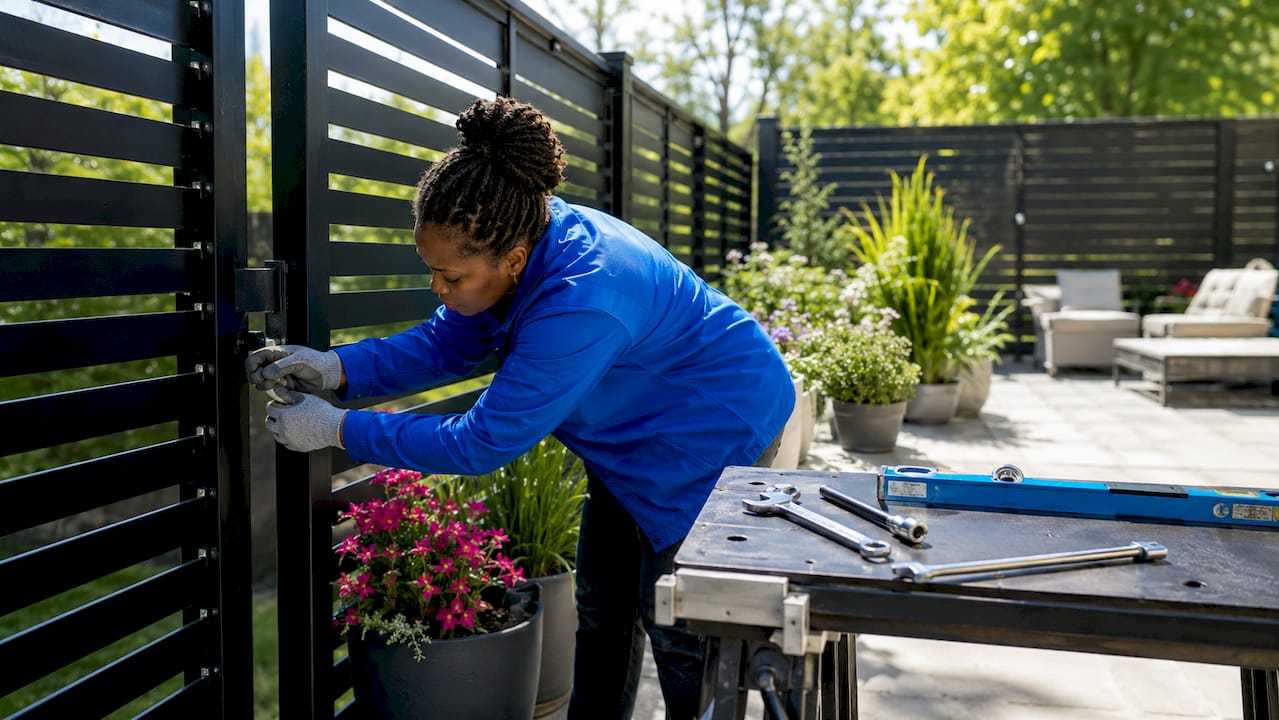
Estate fencing signals quality and orderly land management while preserving the openness that makes upscale residential properties feel welcoming rather than guarded. That balance is exactly what property managers and homeowners in high-value neighborhoods are looking for.
What are the main benefits of estate fencing?
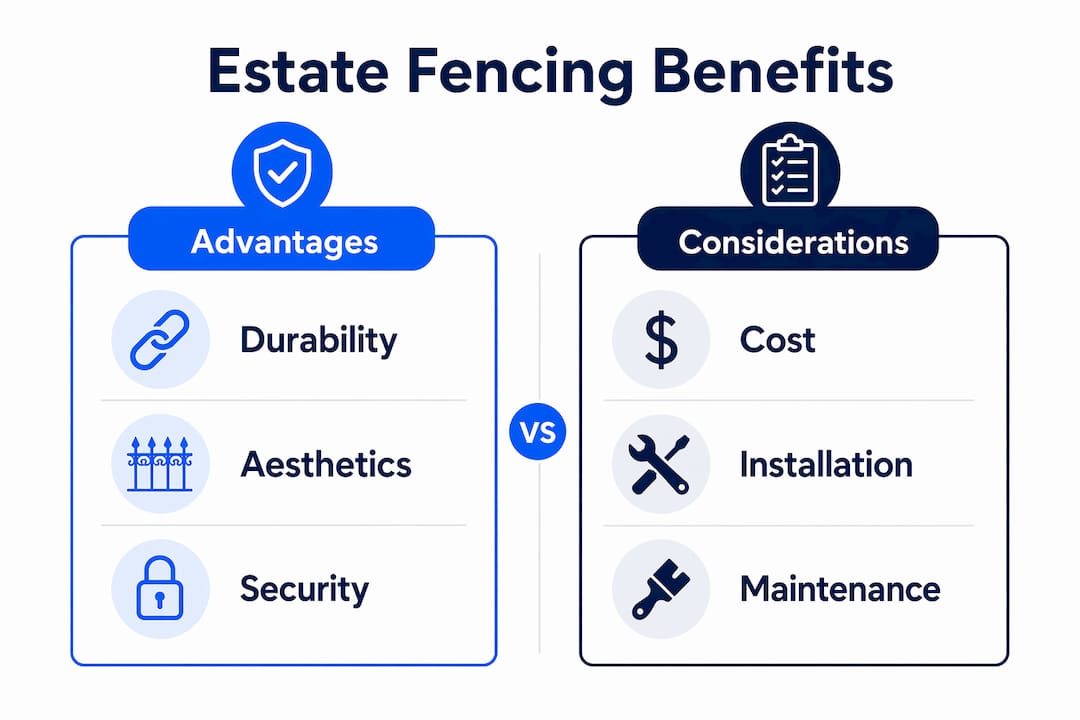
Estate fencing improves curb appeal, increases resale value, and deters trespassers on high-value properties without sacrificing the visual openness that defines premium residential design. These benefits work together rather than in isolation.
- Security without a harsh look. The vertical picket design defines your boundary clearly. Trespassers recognize a defined perimeter and move on. You get the deterrent effect without the cold, institutional appearance of chain-link or solid concrete walls.
- Low maintenance over decades. Wood fences typically need repairs within 5–10 years due to warping, rot, and pest damage. Modern metal estate fencing resists all three, often lasting several decades with only occasional cleaning.
- Architectural harmony. Estate fencing complements the stone, stucco, and tile materials common in Los Angeles architecture. A powder-coated black or bronze finish ties together a property’s exterior palette far better than timber or vinyl alternatives.
- Preserved landscape views. The open design lets your landscaping investment remain visible. A mature olive grove or a sculpted hedge line behind estate fencing adds to the property’s visual value rather than being hidden behind a solid wall.
- Property resale value. Premium fencing is a recognized value-add for upscale residential properties. Buyers in Pasadena and Encino factor perimeter quality into their assessments of a home’s overall condition and maintenance history.
Pro Tip: Choose a powder-coat color that matches your front door or gate hardware. That small design decision creates visual continuity across your entire property frontage and reads as intentional, high-end design to prospective buyers.
Upgrading your perimeter is one of the highest-return exterior improvements you can make. Read more about why residential fencing upgrades deliver lasting value for LA homeowners.
How is estate fencing installed?
Estate fencing installation follows two primary methods, and choosing the right one depends almost entirely on your terrain. Getting this decision wrong adds cost and creates visible gaps or uneven fence lines that undermine the premium appearance you paid for.
- Panel-based systems are prefabricated in fixed lengths and arrive on-site ready to mount between posts. They install faster and cost less in labor on flat ground. Most properties in Studio City and Sherman Oaks with level lots are good candidates for panel systems.
- Continuous rail systems use 5-meter rails threaded through posts with steel clips. They are assembled on-site to follow terrain contours precisely, avoiding the gaps that panel fencing creates on slopes. Properties in the Hollywood Hills or Bel Air with undulating terrain almost always require this method.
- Post anchoring is the most critical installation decision after choosing your system type. Thrust plate feet work in soil, while flat plate mountings are used for concrete foundations. Incorrect anchoring is the leading cause of fence instability after heavy rain or frost heave, both of which occur in Los Angeles during winter storm events.
- Spacing and alignment require professional layout before any post is set. Posts are typically installed every 1 meter with spade foot plates on continuous systems. Misaligned posts are visible from the street and expensive to correct after concrete sets.
- Finishing and sealing complete the installation. Check all welds, touch up any powder-coat damage from transport, and confirm gate hardware alignment before signing off on the job.
Pro Tip: Before installation begins, walk your property line with your installer and mark any grade changes greater than 6 inches. Those transition points determine whether you need panel or continuous rail sections and prevent costly mid-project changes.
For properties with complex terrain or custom gate integration, professional fence installation makes a measurable difference in the final result. A professional crew brings the right anchoring hardware for your specific soil type and handles permit requirements, which in Los Angeles can vary by neighborhood and fence height.
What estate fencing options exist in design and materials?
The design and material choices in estate fencing directly affect lifespan, maintenance cost, and how well the fence complements your property’s architecture. Here is how the main options compare.
| Material Lifespan Maintenance Relative Cost Appearance | ||||
| Galvanized powder-coated steel | 30+ years | Very low | Moderate to high | Clean, modern, traditional |
| Traditional wrought iron | 20–30 years | High (repainting) | High | Ornate, classic |
| Aluminum | 20–25 years | Low | Moderate | Lightweight, contemporary |
| Timber rail | 5–10 years | High | Low to moderate | Rustic, natural |
Galvanized steel with powder-coat finishes is the current industry standard for good reason. The factory-controlled process produces a consistent finish that outlasts traditional wrought iron and requires no on-site welding or repainting cycles. For Los Angeles homeowners managing large perimeters in Brentwood or Pacific Palisades, that maintenance reduction translates directly into lower long-term cost.
Design styles break into two broad categories. Ornate estate fencing uses decorative finials, scrollwork, and varied picket heights to create a formal, historic appearance suited to traditional architecture. Minimalist estate fencing uses uniform picket heights and clean post caps for a contemporary look that suits modern homes in Culver City or West Hollywood.
Some homeowners integrate wood or composite infill panels into sections of their estate fencing. This creates privacy in specific zones, such as near a pool or outdoor dining area, while maintaining the open estate fence aesthetic along the street frontage. That combination gives you layered perimeter protection without committing to a fully solid fence line.
- Ornate styles suit Spanish Colonial, Tudor, and traditional Mediterranean architecture common in Pasadena and San Marino.
- Minimalist styles complement modern and mid-century homes in Silver Lake and Culver City.
- Mixed infill designs work well for properties where pool codes or privacy needs require solid sections in specific zones.
Explore premium fencing options for upscale LA homes to see how estate fencing compares to other high-end perimeter systems available in 2026.
How does estate fencing fit into a layered security strategy?
Estate fencing works best as one component of a planned perimeter security system, not as a standalone solution. The most effective approach for high-value Los Angeles properties is a layered perimeter strategy that combines open estate fencing for extended boundaries with taller privacy fencing around primary living zones.
This approach is standard practice in Beverly Hills and Bel Air, where properties often span half an acre or more. The estate fence defines the outer boundary and signals ownership. A taller privacy fence or hedge line around the pool, guest house, or main residence adds a second layer of protection without making the entire property feel closed off.
- Automated driveway gates are the natural entry point in any layered system. A powder-coated steel gate that matches your estate fencing creates a unified aesthetic while controlling vehicle access. Fence-gate-estimator covers gate automation services for Los Angeles properties, including sliding and swing gate options.
- Pedestrian gates at secondary entry points complete the perimeter. A well-placed pedestrian gate near a side yard or garden path maintains controlled access without requiring visitors to use the main driveway.
- Strategic landscaping amplifies the deterrent effect. Dense plantings like bougainvillea or natal plum along the fence line create a natural barrier that discourages climbing without adding visual weight to the fence itself.
- Lighting integration along the fence line is a low-cost addition that dramatically increases nighttime security and highlights the fence’s architectural quality after dark.
Estate fencing combined with landscaping and gate automation deters trespassers naturally without creating a harsh appearance. That balance is what separates a well-designed perimeter from one that simply looks like a barrier.
Pro Tip: In Los Angeles, fence height regulations vary by zone and neighborhood. Properties in hillside areas or historic districts may face additional restrictions. Confirm height limits with your local planning department before finalizing your design.
Learn more about how fencing improves property security and integrates with your overall landscaping plan.
Key takeaways
Estate fencing is the most effective perimeter solution for high-value properties because it combines durable galvanized steel construction with an open design that preserves sightlines, deters trespassers, and enhances architectural appeal.
| Point Details | |
| Definition and material | Estate fencing is an open-style metal perimeter system built from galvanized, powder-coated steel. |
| Installation method matters | Choose panel systems for flat terrain and continuous rail systems for sloped or curved land. |
| Anchoring is critical | Use thrust plate feet in soil and flat plate mounts on concrete to prevent post instability. |
| Layered security works best | Combine estate fencing with privacy sections, automated gates, and landscaping for full perimeter control. |
| Design affects long-term value | Matching fence style and finish to your home’s architecture increases resale appeal and buyer confidence. |
What i’ve learned installing estate fencing across los angeles properties
The most common mistake I see homeowners make is treating estate fencing as a purely aesthetic decision. They choose a style based on photos, skip the terrain assessment, and end up with a panel system on a sloped lot that gaps at the base within two years. The installation method is not a secondary detail. It is the primary decision.
The second misconception is about cost. Homeowners often assume estate fencing is prohibitively expensive compared to timber or vinyl. When you factor in the 5–10 year repair cycle on wood fences versus 30-plus years on galvanized steel, the math shifts considerably. The upfront cost is higher. The lifetime cost is lower.
What I find most interesting about Los Angeles properties specifically is how much the coastal and urban environment accelerates material degradation. A timber fence in Glendale behaves very differently from one in Santa Monica, where salt air is a constant factor. Galvanized steel with a quality powder coat handles both environments without adjustment.
The properties I have seen get the most value from estate fencing are those that treat it as part of a complete perimeter plan. The fence, the gate, the lighting, and the landscaping are designed together. When those elements align, the result is a property that reads as intentional and well-managed from the street. That perception has real monetary value in Los Angeles real estate.
— Moin
Plan your estate fencing project with Fence-gate-estimator
If you are ready to move from research to real numbers, Fence-gate-estimator makes that step straightforward. The platform provides instant cost estimates for custom estate fencing in Los Angeles, using current local material and labor rates to generate accurate per-linear-foot breakdowns for galvanized steel, wrought iron style, and aluminum options.
You can also explore driveway gate options and pedestrian gate configurations that integrate with your estate fencing design. Fence-gate-estimator serves homeowners across Beverly Hills, Brentwood, Pasadena, and the wider Los Angeles area with professional installation, permit guidance, and warranty-backed workmanship. Get your estimate today at fence-gate-estimator.com and know your budget before the first post goes in the ground.
Recommended
- Types of Premium Fencing for Upscale LA Homes in 2026 | LA Electric Gate Service
- Why Fence Installation Matters for Your Property | LA Electric Gate Service
- Why Upgrade Residential Fences: A Homeowner’s Guide | LA Electric Gate Service
- Expert aluminum fence installation guide for upscale LA homes | LA Electric Gate Service