How Terrain Affects Fence Installation: 2026 Guide
By BabyLoveGrowth
Terrain is the single biggest variable in fence installation, determining which methods work, which materials hold up, and how much the project costs. On a flat lot in Culver City, a standard post-and-panel setup goes in quickly. On a sloped property in Bel Air or the hills above Pasadena, the same approach fails within a few years. How terrain affects fence installation comes down to three factors: slope grade, soil type, and water drainage. Get those three right, and your fence stands for decades. Ignore them, and you are looking at leaning posts, eroded footings, and a fence that needs replacing far sooner than it should.
How slope grade dictates fence installation methods
Slope grade is the first thing any experienced installer evaluates on site. The industry uses two primary techniques to handle it: racking and stair-stepping.
Racking means the fence panels angle continuously to follow the slope of the ground. This works well on gentle grades. Racking suits slopes up to 5–10 degrees, and advanced panel systems can handle angles up to 30 degrees before the material warps or the manufacturer’s warranty becomes void. Beyond 30 degrees, racking is no longer a viable option.
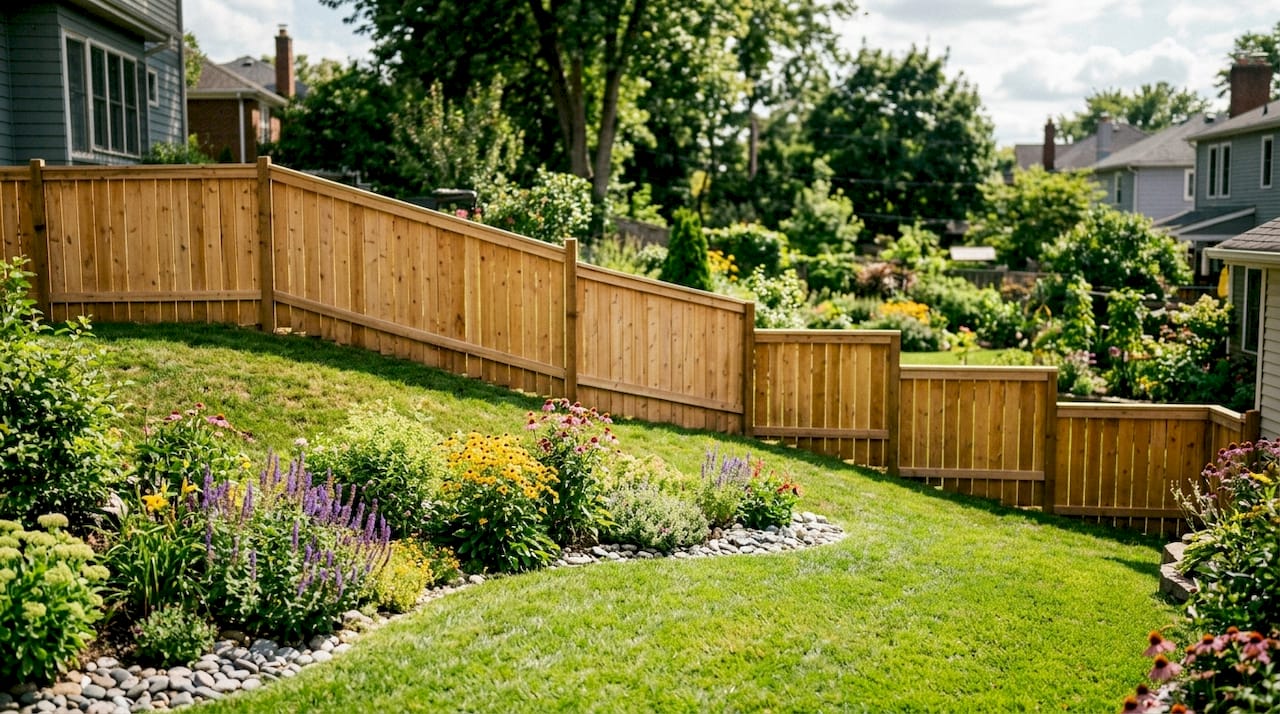
Stair-stepping means the panels stay level but drop in uniform increments from post to post, creating a stepped silhouette. This method is standard for slopes above 10–15 degrees. It works on virtually any grade, but it creates triangular gaps at the base of each panel where the ground and the fence bottom do not meet.
Those gaps matter more than most homeowners realize. Local building codes often restrict gap sizes, particularly near pools. The Ontario Building Code, for example, limits gaps under pool fences to 100mm. Los Angeles County has its own pool barrier requirements, and a stepped fence that leaves large openings at the base may require custom gap fillers or lattice infill to pass inspection.
| Method Best for Aesthetic result Gap issue | |||
| Racking | Slopes up to 30 degrees | Smooth, continuous line | Minimal |
| Stair-stepping | Slopes above 10–15 degrees | Stepped, angular look | Triangular gaps at base |
Pro Tip: Always check with your local building department before choosing a method. In Los Angeles, pool enclosure rules and HOA guidelines in communities like Beverly Hills and Santa Monica can override your preferred installation style.
The choice between racking and stair-stepping also depends on material. Aluminum panels rack easily. Wood and vinyl panels are more rigid and typically require stair-stepping on steeper grades. You can read more about post installation methods for different slope grades in Los Angeles.
How do soil type and drainage affect fence stability?
Soil conditions determine how well your fence posts hold over time. Soft, sandy, or expansive clay soils common in parts of the San Fernando Valley and coastal Los Angeles shift with moisture changes. Rocky ground in hillside neighborhoods like Brentwood or Studio City makes post drilling difficult and expensive.
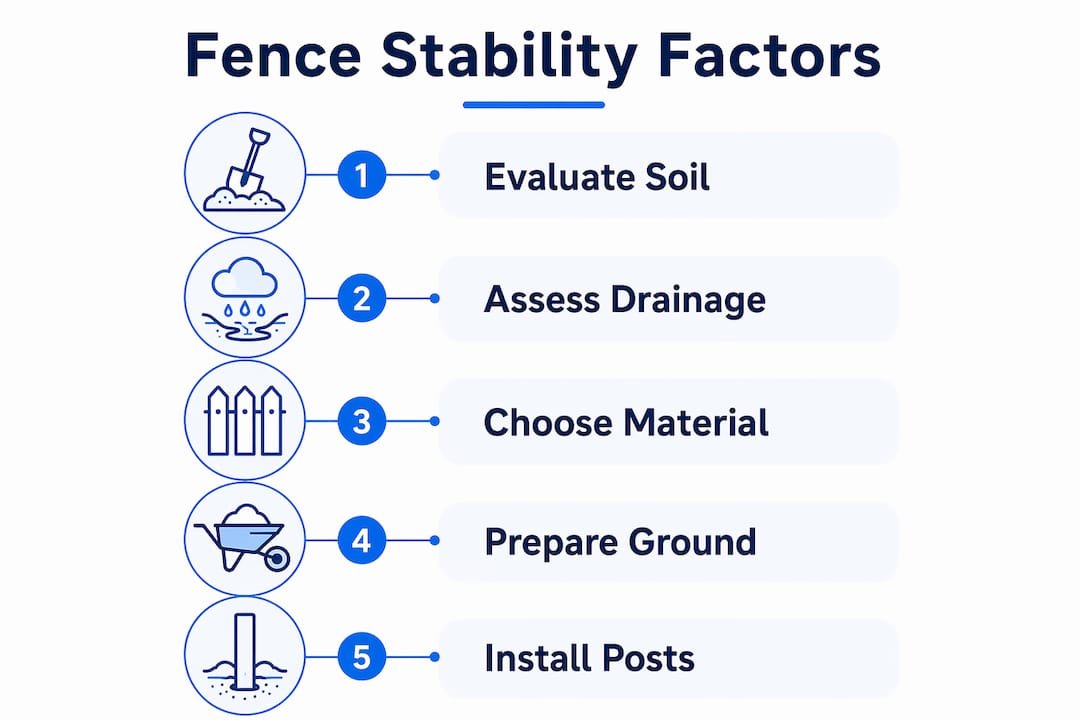
Experienced professionals emphasize the need to read the land carefully before a single post goes in. Buried roots, rock shelves, and varying soil density all change how deep posts need to go and how much concrete is required. A post that feels solid on installation day can shift within one to three years if the surrounding soil erodes.
Water drainage is the silent destroyer of fence longevity on slopes. Runoff accelerates erosion at post bases, and soil erosion causes post shifting within one to three years without proper erosion control. Fences on slopes also act as landscape modifiers, redirecting water flow in ways that can cause pooling against your foundation or your neighbor’s property.
Practical strategies to protect your fence on uneven terrain include:
- Deeper post embedment. Posts on the downhill side of a slope need to be measured from the lowest point of the ground, not the average. This often means posts 25–30% longer than standard.
- Increased concrete volume. Posts on slopes require more concrete because the downhill side ground drops away, reducing natural embedment support.
- Steel posts over wood. Steel resists rot and moisture damage far better in wet or shifting soils.
- French drains. Installing a French drain system alongside the fence line redirects runoff away from post bases, preserving footing integrity.
- Gravel backfill. Packing gravel around post bases improves drainage and reduces soil contact with wood or metal.
Pro Tip: If your property has a noticeable slope toward the house, install the fence uphill of any drainage channels and plan the grade so water flows away from post footings.
What does sloped terrain cost in Los Angeles?
Terrain complexity adds real money to a fence project. Moderate slopes add a 10–20% cost premium over a standard flat-ground installation. On a $6,000 baseline project, that translates to $600–$1,200 in additional costs. Steeper grades, rocky soil, or sites requiring terracing push that premium higher.
The cost increase comes from three sources: labor, materials, and site preparation.
| Cost driver Why it increases on slopes Typical impact | ||
| Labor | More time per linear foot; complex post alignment | Significant |
| Post length | Downhill posts must be longer to maintain consistent height | Moderate |
| Concrete volume | Slopes require more concrete per post for stable embedment | Moderate |
| Custom fittings | Racked panels or gap fillers add fabrication costs | Variable |
The number one mistake homeowners make is applying flat-ground material estimates to sloped terrain. This leads to underestimated budgets and structural problems that show up within the first year. A Beverly Hills or Encino property with a 15-degree slope is not a standard fence job. It requires a site-specific estimate that accounts for actual grade, soil conditions, and the chosen installation method.
For a detailed breakdown of how terrain drives costs in the Los Angeles market, Fence-gate-estimator covers terrain-related cost factors with local material and labor rates.
How to prepare an uneven site before installation
Site preparation prevents the majority of problems that show up after a fence is built. Skipping these steps is how homeowners end up with fences that lean, gap, or fail inspection.
- Get a professional land survey. A survey before installation prevents legal disputes caused by guessing property lines on irregular terrain. In Los Angeles, irregular lot shapes are common in hillside neighborhoods, and a fence placed even a few inches over the line can require forced removal.
- Map underground obstacles. Roots from mature trees, irrigation lines, and rock formations all affect post placement. Call 811 (Dig Safe) before any digging to locate utility lines.
- Plan gate placement carefully. Gates on slopes scrape the ground if not positioned and hung correctly. The gate swing arc must clear the slope at every point in its travel. For automated gates on sloped driveways, this is especially critical.
- Assess whether terracing is needed. Very steep sections, typically above 30 degrees, often require a retaining wall or terraced landscaping before a fence can be installed. Trying to fence a near-vertical slope without terracing produces a fence that looks wrong and fails quickly.
- Mark post locations and check alignment. On sloped ground, string lines and laser levels replace the eye-check that works on flat lots. Posts must be set plumb (perfectly vertical), not angled to match the slope. Panel racking handles the terrain angle; the posts themselves stay straight.
- Check local permit requirements. Los Angeles requires permits for most fences over six feet. Hillside properties in areas like Bel Air or West Hollywood may have additional grading or erosion control requirements tied to the fence permit.
How to choose fencing solutions for your terrain type
Matching the fence material and style to your specific terrain is where the project either succeeds or struggles. The right choice depends on slope steepness, soil conditions, and the visual result you want.
- Aluminum panels on gentle to moderate slopes. Racked aluminum is the most flexible option for slopes up to 30 degrees. It maintains clean, continuous lines and resists corrosion in the wet soils common near the coast in Santa Monica or Culver City. Aluminum also racks without voiding most manufacturer warranties when installed within the specified angle range.
- Stepped vinyl or wood on steep or rocky sites. Vinyl and wood panels are rigid and do not rack well. Stair-stepping these materials on steep or uneven ground produces a clean result when done correctly, but requires custom gap fillers at the base to meet code and close off security gaps.
- Wrought iron and steel for hillside security fencing. Properties in Bel Air, Brentwood, and the hills above Glendale often use steel or wrought iron for both security and aesthetics. These materials handle stepped installations well and can be custom fabricated to match complex grade changes.
- Custom gap fillers and lattice infill. Stepped fences always create gaps. Custom fence components like lattice panels, decorative infill, or terraced planting beds solve both the visual and code compliance issues at the base of stepped sections.
- HOA and building code review. Many Los Angeles communities, particularly in gated neighborhoods and hillside zones, have strict rules on fence height, material, and style. Confirm HOA guidelines and city codes before finalizing your material choice.
Key takeaways
Terrain-aware fence installation is the difference between a fence that lasts 20 years and one that needs repair within three.
| Point Details | |
| Slope grade determines method | Use racking for slopes up to 30 degrees; use stair-stepping for steeper grades. |
| Drainage protects post footings | French drains and gravel backfill prevent erosion-driven post movement within 1–3 years. |
| Slopes add 10–20% to project cost | Budget an extra $600–$1,200 on a $6,000 baseline for moderate slope complexity. |
| Site prep prevents legal and structural problems | A professional land survey and utility check before installation avoids forced removals and post failures. |
| Material choice must match terrain | Aluminum racks well; vinyl and wood require stepping; steel suits steep, security-focused hillside sites. |
Why terrain-aware installation is the only kind worth doing
I have reviewed hundreds of fence projects across Los Angeles, and the pattern is consistent. The jobs that fail within three years almost always share one trait: the installer treated the site like flat ground. They used standard post depths, standard concrete volumes, and standard panel angles. The fence looked fine on day one. By year two, the downhill posts had shifted, the panels had racked beyond their tolerance, and water was pooling against the foundation.
The uncomfortable truth is that reading terrain is a skill, not a checklist. You can follow every step in a guide and still miss the clay shelf two feet below the surface that will hold water against your posts all winter. That is why I always recommend pairing homeowner research with a professional site assessment before committing to a method or material.
The other mistake I see regularly is treating the cost premium as optional. Homeowners in Sherman Oaks or Encino get a flat-ground quote, see the slope surcharge, and ask if it can be skipped. It cannot. The extra concrete, the longer posts, the custom fittings: those are not upsells. They are what makes the fence stand. Skipping them saves money once and costs far more in repairs.
Terrain-adapted fencing also protects your property value. A fence that leans or gaps reads as deferred maintenance to any buyer or appraiser. A well-executed stepped or racked fence on a hillside lot, done with quality materials and proper drainage, adds genuine curb appeal and security. That is worth planning for.
— Moin
Fence-gate-estimator: built for Los Angeles terrain
Los Angeles properties rarely come with flat, simple lots. From the hillside estates of Bel Air to the sloped yards of Pasadena and Studio City, terrain complexity is the norm, not the exception.
Fence-gate-estimator is built specifically for this market. The custom fencing cost calculator accounts for slope grade, material type, post depth requirements, and local labor rates, giving you a realistic budget before a single post goes in. Whether you are planning a wrought iron perimeter fence on a hillside lot or a stepped vinyl fence on an uneven backyard, Fence-gate-estimator delivers transparent, site-specific estimates. Visit fence-gate-estimator.com to get your instant cost estimate today.
Recommended
- Expert aluminum fence installation guide for upscale LA homes | LA Electric Gate Service
- Why Upgrade Residential Fences: A Homeowner’s Guide | LA Electric Gate Service
- Expert Gate & Fence Blog | LA Electric Gate Service
- How terrain impacts fence costs in Los Angeles: smart choices | LA Electric Gate Service