Exterior Aesthetics vs. Security Fencing: LA Guide
By BabyLoveGrowth
Exterior aesthetics vs. security fencing is the practice of selecting and designing fences that simultaneously enhance property appearance and provide credible protection against intrusion. For homeowners in Beverly Hills, Brentwood, and Santa Monica, these two goals can feel like a direct conflict. A tall solid fence keeps intruders out but can look institutional. An open ornamental fence looks refined but raises questions about real deterrence. The good news is that the industry term for the solution is perimeter security design, and it proves you do not have to choose. The right material, height, and layered configuration can satisfy your HOA, impress your neighbors, and genuinely protect your property.
What factors drive the aesthetics vs. security fencing decision?
Material choice is the single most influential factor in any fencing decision. Wood, ornamental aluminum, vinyl, and wire mesh each carry different trade-offs between visual weight, maintenance, and security performance. Ornamental aluminum with spear-top picket designs delivers rust resistance, structural integrity, and clear sightlines. Wood privacy fences cost $17–$45 per linear foot and provide solid privacy, but tall solid panels can create concealment pockets that work against you. Vinyl and composite materials sit in the middle: good for low maintenance and privacy, though they lack the visual authority of ornamental metal on upscale properties.
Regulatory constraints shape your options before you ever pick a material. In Los Angeles and surrounding communities, HOA rules and local zoning codes commonly limit front yard fences to 3–4 ft and allow 6–7 ft in side and rear yards. California Civil Code requires HOAs to publish written standards for fence height, materials, and colors, and vague aesthetic objections without published standards are legally invalid. That means you have more flexibility than many homeowners assume. Reviewing your CC&Rs before selecting a design saves you from costly revisions later.
Visibility and natural surveillance are security factors that most homeowners underestimate. A fence that blocks all sightlines from the street removes the passive deterrence that comes from neighbors and passersby being able to see your property. Physical barriers that support natural surveillance consistently reduce property crime, according to a 2026 meta-analysis of 31 studies. Open or semi-open fence designs preserve that surveillance benefit while still defining your perimeter clearly.
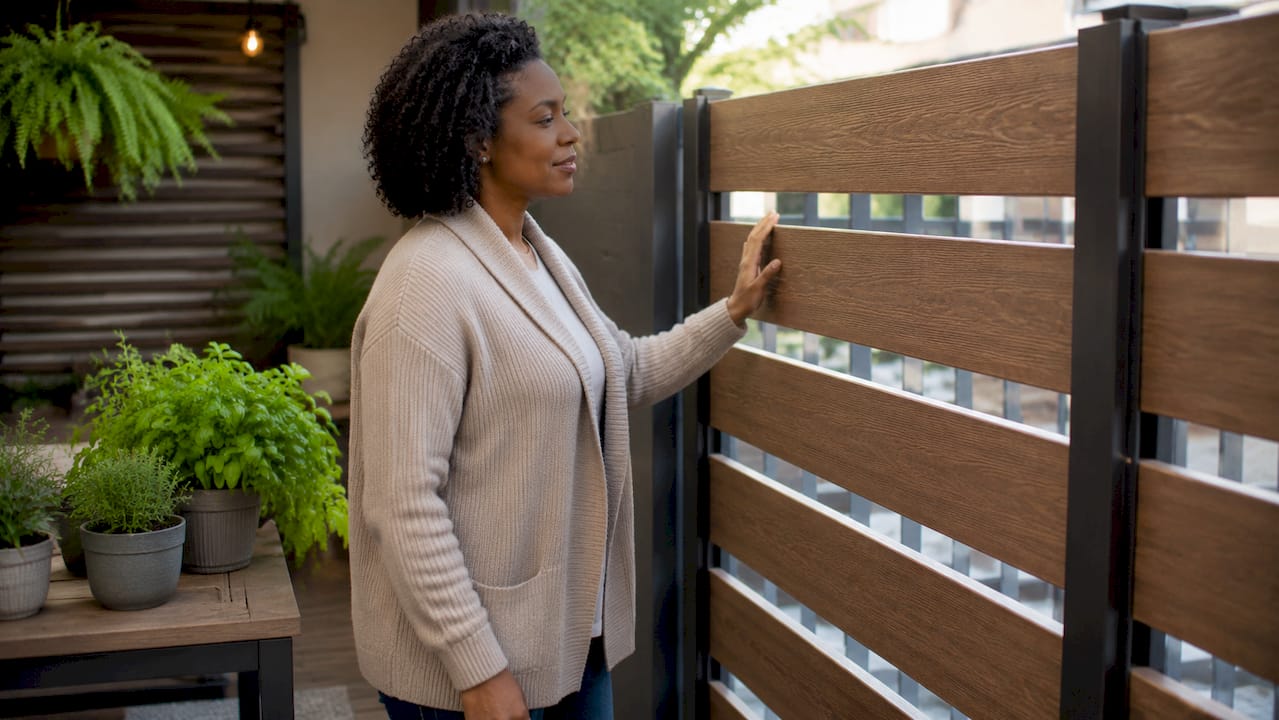
Here is how the key factors compare across common fence configurations:
| Factor Open Ornamental (Aluminum) Solid Privacy (Wood/Vinyl) Semi-Open (Composite/Lattice) | |||
| Natural surveillance | High | Low | Moderate |
| Curb appeal | High | Moderate | Moderate |
| Intrusion deterrence | Moderate to high | High (rear/side) | Low to moderate |
| HOA front yard approval | Likely | Unlikely | Possible |
| Maintenance demand | Low | High | Moderate |
How does a layered perimeter design reconcile curb appeal with security?
A layered perimeter design assigns different fence styles to different zones of your property based on visibility needs and risk level. This is the most practical approach for upscale Los Angeles homes, and it is how professional perimeter security designers think about residential properties. The front yard faces the street and benefits from open, ornamental fencing that defines the boundary without blocking sightlines. The rear and side yards, where intrusion risk is higher and privacy matters more, call for solid or semi-solid panels.
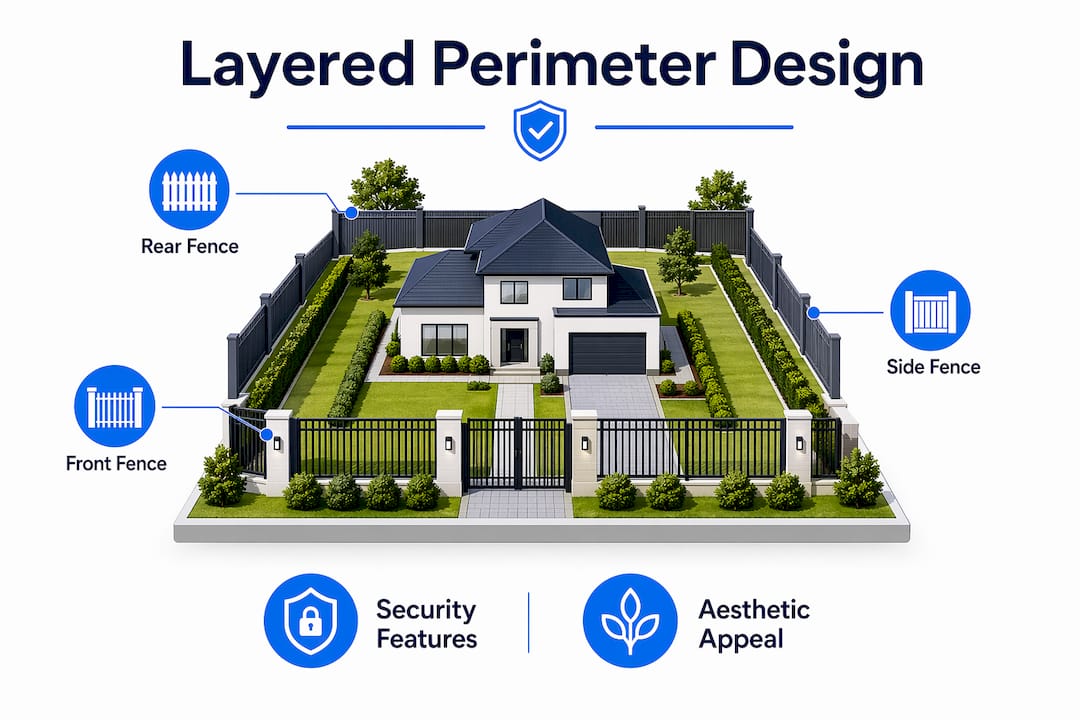
The most common configuration in neighborhoods like Bel Air and Encino is a 4-ft ornamental aluminum fence at the front combined with a 6-ft solid privacy fence in the rear and side yards. This setup gives you curb appeal at the street and genuine security where it counts. The transition points between open and solid sections require careful planning. Expert fence designers plan those transitions deliberately to eliminate concealment pockets that create security blind spots.
The numbered steps below outline how to plan a layered perimeter for a typical upscale LA property:
- Map your perimeter zones. Identify which sections face public streets, neighbor properties, and rear access points. Each zone carries a different risk profile and visibility requirement.
- Assign fence styles by zone. Front yard gets open ornamental fencing at the code-permitted height. Rear and side yards get solid or semi-solid fencing at the maximum permitted height.
- Plan transition points. Where open fencing meets solid fencing, design the transition to avoid creating a hidden corner or concealment pocket inside the perimeter.
- Select complementary materials. Ornamental aluminum at the front and cedar or vinyl at the rear can look cohesive when colors and post styles are coordinated.
- Integrate landscaping. Low shrubs along the front fence and climbing plants on rear panels soften the visual weight of solid fencing while controlling approach routes and sightlines.
Pro Tip: When transitioning from an open front fence to a solid rear fence, use the same post cap style and color on both sections. That single detail ties the whole perimeter together visually and signals intentional design rather than a patchwork installation.
What are the security and aesthetic trade-offs among popular fencing materials?
Ornamental aluminum is the top choice for front-facing perimeter security on upscale properties in Los Angeles. Spear-top aluminum designs provide rust resistance, structural integrity, and a visual deterrent without the heavy industrial look of chain link or welded wire. The open picket spacing preserves sightlines, which supports natural surveillance. Aluminum also requires minimal maintenance compared to wrought iron, which needs periodic repainting to prevent rust in coastal areas like Santa Monica and Culver City.
Wood privacy fences remain popular for rear yards in neighborhoods like Studio City and Sherman Oaks. They deliver solid privacy and a warm, residential appearance. The trade-off is maintenance: wood requires sealing or painting every few years, and untreated panels can warp or crack in LA’s dry heat. Tall solid wood fences also create concealment pockets if not positioned carefully. A 6-ft cedar fence in a rear yard is a strong security choice when paired with good lighting and no interior blind spots.
Vinyl and composite materials offer a middle path. They resist moisture and require almost no maintenance, which appeals to property managers overseeing multiple units. However, vinyl lacks the visual authority of ornamental metal on high-end properties, and composite panels can look uniform in a way that reads as generic rather than custom. Security-specific features like anti-climb picket spacing and fence toppers are harder to fabricate cleanly in vinyl than in aluminum or steel.
| Material Aesthetic Grade Security Grade Maintenance Approx. Cost per Linear Foot | ||||
| Ornamental aluminum | High | High (front yards) | Low | $30–$60 |
| Cedar wood privacy | Moderate | High (rear yards) | High | $17–$45 |
| Vinyl privacy | Moderate | Moderate | Very low | $20–$40 |
| Composite/lattice | Moderate | Low to moderate | Low | $25–$50 |
| Wrought iron | Very high | Very high | Moderate | $40–$80 |
Pro Tip: In coastal Los Angeles neighborhoods, choose powder-coated aluminum over wrought iron for front fencing. Both look similar from the street, but aluminum will not rust from salt air exposure, saving you repainting costs every few years.
What best practices maximize both aesthetics and security during installation?
Installation quality determines whether a fence performs as designed or develops vulnerabilities over time. A fence that looks perfect on paper can fail if posts are set too shallow, picket spacing is inconsistent, or gate hardware is undersized. Professional installation that accounts for local soil conditions, grade changes, and HOA specifications is not optional on upscale properties. It is the difference between a fence that lasts 20 years and one that needs repairs within five.
Anti-climb engineering is a specific installation discipline that most homeowners overlook. Anti-climb design focuses on removing footholds and purchase points rather than relying solely on material strength. Picket spacing of 4 inches or less prevents a foothold. Spear tops or rotating finials on aluminum fences discourage grip. These features add minimal cost during fabrication but significantly raise the effort required for an intruder to scale the fence.
Key installation practices that protect both security and appearance include:
- Set posts at the correct depth. In Los Angeles, posts should be set at least one-third of their total length into the ground, with concrete footings in sandy or expansive soil areas.
- Maintain consistent picket spacing. Inconsistent gaps are both an aesthetic flaw and a security vulnerability. Specify tolerances in your installation contract.
- Avoid interior concealment zones. Position solid fence sections so that no area inside the perimeter is hidden from the house or from street sightlines.
- Submit HOA documentation early. CC&R review and architectural committee approval in communities like Brentwood or Pasadena can take 30–60 days. Starting early prevents project delays.
- Integrate lighting at fence lines. Low-voltage path lights along ornamental fencing and motion-activated fixtures at rear fence gates extend security coverage after dark without disrupting the aesthetic.
Key takeaways
The most effective approach to balancing security and aesthetics is a layered perimeter design that assigns open ornamental fencing to front yards and solid privacy fencing to rear and side yards, matched to local HOA requirements.
| Point Details | |
| Layered perimeter design works | Use open ornamental fencing at the front and solid fencing at the rear for both curb appeal and protection. |
| Material choice drives trade-offs | Ornamental aluminum leads for front yards; cedar or vinyl works best for rear privacy and security. |
| HOA rules shape your options | California Civil Code requires written HOA standards, giving you legal standing to push back on vague objections. |
| Anti-climb features matter | Picket spacing under 4 inches and spear-top finials significantly raise the difficulty of scaling a fence. |
| Installation quality is non-negotiable | Correct post depth, consistent spacing, and no concealment pockets determine long-term fence performance. |
What i’ve learned from watching homeowners get this wrong
Most homeowners in upscale LA neighborhoods approach fencing as a purely visual decision. They pick a style they like, get a quote, and only discover the HOA restrictions or security gaps after installation. I have seen beautiful wrought iron fences in West Hollywood that looked stunning but had picket spacing wide enough for a child to climb through. I have also seen solid wood privacy fences in Encino that created a perfect concealment zone right next to the back gate.
The insight that changes how you think about this is simple. Effective security fencing is less about bulk and more about credible barriers and controlled access. A 4-ft ornamental aluminum fence with tight picket spacing and spear tops is a more credible deterrent than a 6-ft wood fence with a loose gate latch. The wood fence looks more imposing, but the aluminum fence is harder to defeat quickly and quietly.
My recommendation for any property in Beverly Hills, Bel Air, or Santa Monica is to start with the HOA documentation before you talk to a single contractor. Know your height limits, approved materials, and color palette. Then design your perimeter in zones. Spend your budget on ornamental aluminum at the front where it is visible and on quality hardware at every gate. The rear fence can be cedar or vinyl at a lower cost per linear foot without sacrificing security. That allocation gives you the best return on both aesthetics and protection.
One more thing: do not skip the landscaping integration. Low ornamental shrubs along a front aluminum fence soften the visual line and make the whole perimeter look intentional. Climbing plants on a rear cedar fence reduce its institutional appearance. These are low-cost additions that support security by controlling approach routes while making your property look like it was designed by someone who cared about every detail.
— Moin
Plan your fence budget before you talk to a contractor
Knowing your numbers before the first contractor conversation puts you in control of the entire project. Fence-gate-estimator.com gives Los Angeles homeowners an instant, itemized cost estimate based on your property size, preferred materials, and gate requirements. The tool uses current local labor and material rates, so the numbers reflect what you will actually pay in Beverly Hills, Pasadena, or Culver City, not national averages.
Whether you are planning a full perimeter with ornamental aluminum at the front and cedar privacy panels at the rear, or exploring custom fencing options for a high-end estate, Fence-gate-estimator.com gives you a clear starting point. Use the cost calculator to generate your estimate in minutes, then connect with a local installation professional who understands HOA requirements and Los Angeles permit processes.
Recommended
- Why Upgrade Residential Fences: A Homeowner’s Guide | LA Electric Gate Service
- Security Fence Features List for LA Homeowners | LA Electric Gate Service
- Custom fence components: build luxury, security, and style in LA | LA Electric Gate Service
- Why Fence Installation Matters for Your Property | LA Electric Gate Service