Driveway Gate Clearance: Widths, Bottom Gaps, and Slope Rules
By BabyLoveGrowth AI
Most driveway gates need 3 to 6 inches of bottom clearance, and the surface under the gate decides exactly where in that range you land. Single gates typically span a standard residential width suitable for most cars, with double gates or truck and RV access being wider. If your driveway is shallow, the swing arc is blocked, or the grade climbs sharply near the street, a sliding gate almost always wins over a swing gate.
Here’s the fast version before you get into measuring:
- Bottom clearance: 3 to 6 inches, tighter on concrete and wider on gravel.
- Opening width: typical single gates provide comfortable clearance for one vehicle; wider gates accommodate two vehicles or larger rigs.
- Gate type: choose slide when depth or slope is tight; choose swing when you have room and a gentle grade.
Everything past this point is the how and why, so you can hand a contractor numbers instead of guesses.
Key Takeaways
Bottom clearance runs 3 to 6 inches depending on surface and site geometry, not preference, should decide between a swing and a sliding gate.
| Point | Details |
|---|---|
| Measure the clear opening | Record post-to-post width at the narrowest point, not the outer post spacing. |
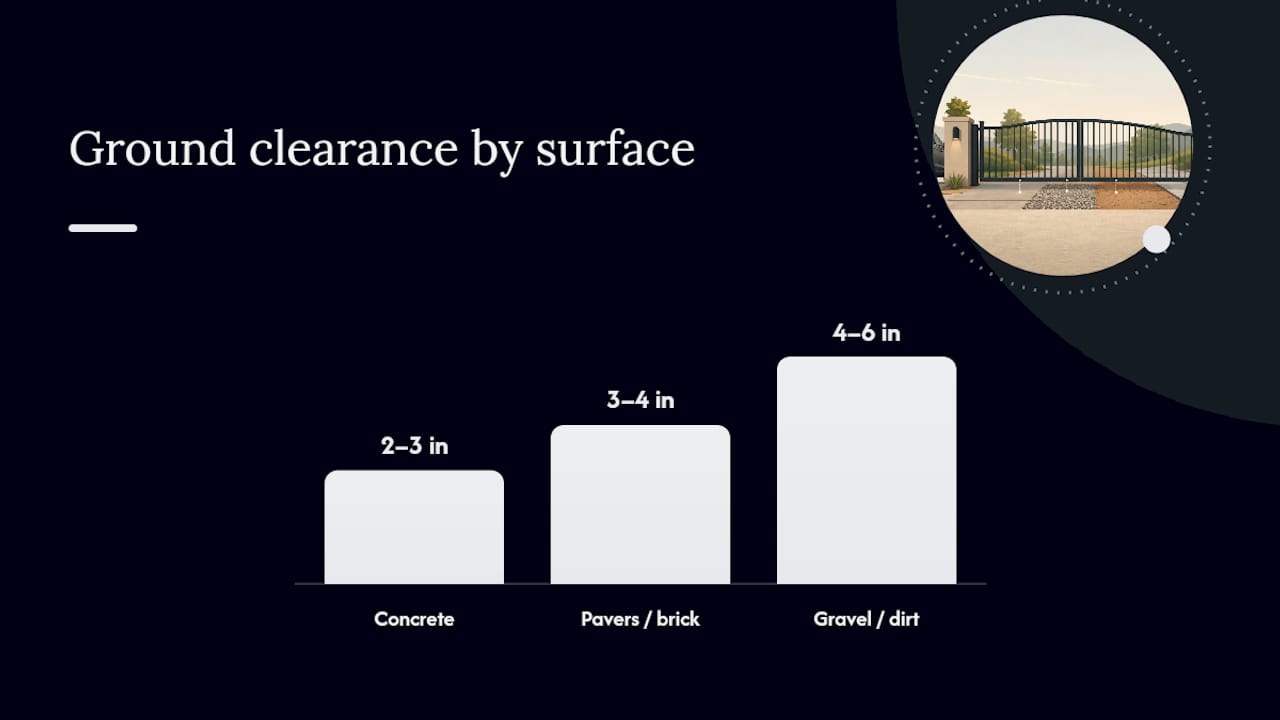
| Match clearance to surface | Use 2 to 3 inches on concrete, 3 to 4 on pavers, and 4 to 6 on gravel or dirt. |
| Pick gate type by geometry | Choose slide when depth is under 1.1x leaf length or slope is steep; choose swing when depth and grade allow it. |
| Respect hinge and latch tolerances | Keep hinge gaps at 3/4 to 1 inch and latch gaps at 3/4 to 1.5 inches to prevent binding. |
| Get a site-specific number | Fence-gate-estimator turns your measurements and photos into a cost breakdown with a suggested gate type and automation notes. |
Table of Contents
- How to Measure Driveway Gate Clearance Correctly
- What Ground Clearance Do You Need by Surface Type
- Swing vs Slide: Which Gate Fits Your Driveway Geometry
- Hinge, Latch, and Operator Clearances Installers Check
- Solving Clearance Problems on Slopes and Uneven Ground
- Getting Your Site Ready for an Automated Gate
- Your Pre-Quote Checklist for an Accurate Gate Estimate
- Sources
- FAQ
How to Measure Driveway Gate Clearance Correctly
The clear opening is the distance between the inside faces of your gate posts, not the distance between the outside edges. That difference sounds small until a contractor orders a gate 4 inches too wide for the actual gap, and it sits on order for another two weeks while the shop remakes it.
Here’s the sequence installers actually follow on-site:
- Measure the clear opening post-to-post at the narrowest point, since posts aren’t always perfectly parallel.
- Measure your widest vehicle, mirrors included, and add at least 12 inches of side clearance per side for comfortable entry.
- Measure driveway depth from the gate line back to the first real obstruction, whether that’s a parked car, a curb cut, or a retaining wall.
- Check the grade through the gate line and note the highest and lowest points across the opening width.
Pro Tip: Take these measurements at the end of the day when your car is parked in its usual spot. Daytime measurements without the car in place miss the exact clearance you’ll actually use every day.
What Ground Clearance Do You Need by Surface Type
Concrete needs less clearance than gravel, and the reason is physical, not aesthetic. See the details about different driveway brick and paving surfaces that affect clearance requirements. A flat, stable concrete apron holds its elevation for decades, while gravel and dirt shift with rain, frost, and traffic.
The TX Fence and Deck breakdown by surface looks like this:
- Concrete: 2 to 3 inches is typically enough.
- Pavers or brick: 3 to 4 inches, since individual units can settle unevenly over time.
- Gravel or dirt: 4 to 6 inches, because loose material piles up and soil movement changes the grade season to season.
Ground movement on unpaved surfaces isn’t cosmetic. Soil composition directly affects how much a driveway surface rises and falls with moisture, which is exactly why gravel driveways get the widest clearance range.
A gate set too low scrapes, drags debris, and puts constant strain on hinges and the motor. A gate set too high looks sloppy and creates a gap a determined pet, or worse, a small child, can slip under. If you’re gating a driveway for a full size pickup, RV, or trailer, add another inch or two beyond the surface recommendation, since heavier vehicles compress gravel and paver bases more over time.
Swing vs Slide: Which Gate Fits Your Driveway Geometry
The decision between a swing gate and a sliding gate comes down to site geometry, not personal preference. Jeff & Simon’s driveway gate guide lays out the rules installers use to make the call before a single quote gets written.
- Depth rule: a swing gate needs driveway depth of roughly 1.1 times the leaf length to open without fouling a parked car. Fall short of that, and slide becomes the practical answer.
- Side-runway rule: a sliding gate needs about one leaf length of clear runway on the receiving side for a V-track system, or roughly 1.5 times that for a cantilever slide.
- Slope rule: V-track systems need a level track. Cantilever slides tolerate modest slope. Swing gates handle cross-slope reasonably well but struggle with steep grade right at the hinge line.
- Weather: slide tracks need regular clearing in snow country, while swing gates shrug off snow but can catch wind like a sail when standing open.
| Factor | Swing Gate | Sliding Gate |
|---|---|---|
| Driveway depth needed | ~1.1x leaf length | Minimal (opens sideways) |
| Side runway needed | None | ~1x leaf length (V-track), ~1.5x (cantilever) |
| Slope tolerance | Handles cross-slope | V-track needs level; cantilever handles modest slope |
| Snow/debris exposure | Low maintenance | Track needs regular clearing |
Cantilever slides cost more to install but solve problems a V-track simply cannot, including uneven ground and gravel debris fouling the track. If your driveway is short and steep, that added cost often buys you the only configuration that will actually work.
Hinge, Latch, and Operator Clearances Installers Check
The gaps around your gate’s hardware are measured in fractions of an inch, but getting them wrong is where most callback repairs come from. Inline Security Fence’s clearance guide sets the standard tolerances most residential installers follow.
- Hinge-side gap: typically 3/4 to 1 inch, tight enough to block gaps but loose enough to prevent binding.
- Latch-side gap: usually 3/4 to 1.5 inches, since the latch mechanism needs a bit more play to engage cleanly.
- Operator mount clearance: the arm needs unobstructed travel through its full swing or slide path, with no fence post, planter, or utility box in the way.
- Bottom rail reinforcement: automated gates need a stiffer bottom rail than manual ones, since sagging changes the ground gap over time and strains the motor.
Miss these tolerances by even a half inch and you get binding, chain wear, or a motor working harder than it should on every cycle. Our types of security gates guide covers how these tolerances shift across different gate styles common in Los Angeles installations.
Solving Clearance Problems on Slopes and Uneven Ground
A driveway that slopes toward the street doesn’t rule out a swing gate, but it does change which hardware you need.
- Rising or pivot hinges lift the gate slightly as it swings, clearing a moderate grade. They work well up to a point, but steep slopes still push a gate edge into the pavement partway through the arc.
- Angled or stepped bottoms are a common fix on hillside properties, cutting the gate’s bottom edge to follow the slope rather than sitting flat.
- Cantilever slides are usually the cleanest answer for genuinely uneven ground, since the gate never touches the surface at all. You trade a longer runway requirement and a higher price tag for that flexibility.
Pro Tip: If your driveway drops more than a few inches across the gate’s width, ask your installer to grade-check both ends before quoting, not just the middle. Explore driveway gate solutions for sloped lots built for hillside properties across the Los Angeles hills.
Getting Your Site Ready for an Automated Gate
Automation changes your clearance math before the gate ever moves. An operator adds mechanical load, so the bottom rail needs reinforcement to resist sagging under repeated cycles, and the mount itself needs a clear, obstruction-free zone for the arm or track hardware.
- Reinforce the bottom rail on any gate paired with an operator, even a lightweight aluminum gate.
- Confirm operator mount clearance against nearby posts, planters, or low walls before ordering hardware.
- Plan sensor zones for safety photo-eyes and loop detectors, which need a clear line of sight that can effectively narrow your usable clearance near the gate’s travel path.
Get this right up front through our gate automation service and you avoid the common surprise of a motor straining against a gap that was never quite right.
Your Pre-Quote Checklist for an Accurate Gate Estimate
- Photograph the full opening from three angles, including both posts and the surface underneath.
- Record clear opening width, driveway depth, and grade at three points across the opening.
- Check your city’s permit and setback rules and any HOA restrictions before ordering hardware.
- Ask your installer about operator type, warranty terms, and how the design handles local wind or snow history.
An Installer’s View on What Site Visits Actually Reveal
Plans on paper rarely match the ground. Installers routinely find undocumented curbs, root heave under old pavers, and paver courses that sit an inch off from one edge to the other. A proper site visit tapes out the swing arc, tests clearance against the tallest vehicle the household owns, and rechecks slope right at the gate line, not just from the street. Expect higher costs when a cantilever slide, heavy steel gate, or complex automation package enters the picture.
Get a Clearance-Ready Estimate Before You Call a Contractor
Fence-gate-estimator gives you a real cost breakdown and a suggested gate type based on your actual driveway geometry, not a generic average pulled from a national price guide. Upload photos and the measurements from the checklist above, including opening width, depth, and grade, and the tool returns a cost range, a swing or slide recommendation, and notes on automation compatibility specific to your site.
That level of detail matters most for Los Angeles-area properties, where hillside lots in Bel Air, Encino, and Pasadena often force a cantilever slide decision that a flat quote would never catch. Homeowners in Beverly Hills, Santa Monica, and Studio City dealing with custom steel or automated gates get the same benefit: a number grounded in local material and labor rates instead of a rough guess. Run your numbers now through the driveway gate installation calculator and book a site visit once you have a figure you trust.
Sources
- What Size Driveway Gate Do I Need? — Driveway Planner
- Automatic Driveway Gate Size Guide: Width, Height and Clearance | TX Fence and Deck
- Swing vs slide — Jeff & Simon driveway gate guide
- What Clearance Is Required For Proper Gate Installation? | Inline Security Fence
FAQ
How Far Off the Ground Should a Driveway Gate Be?
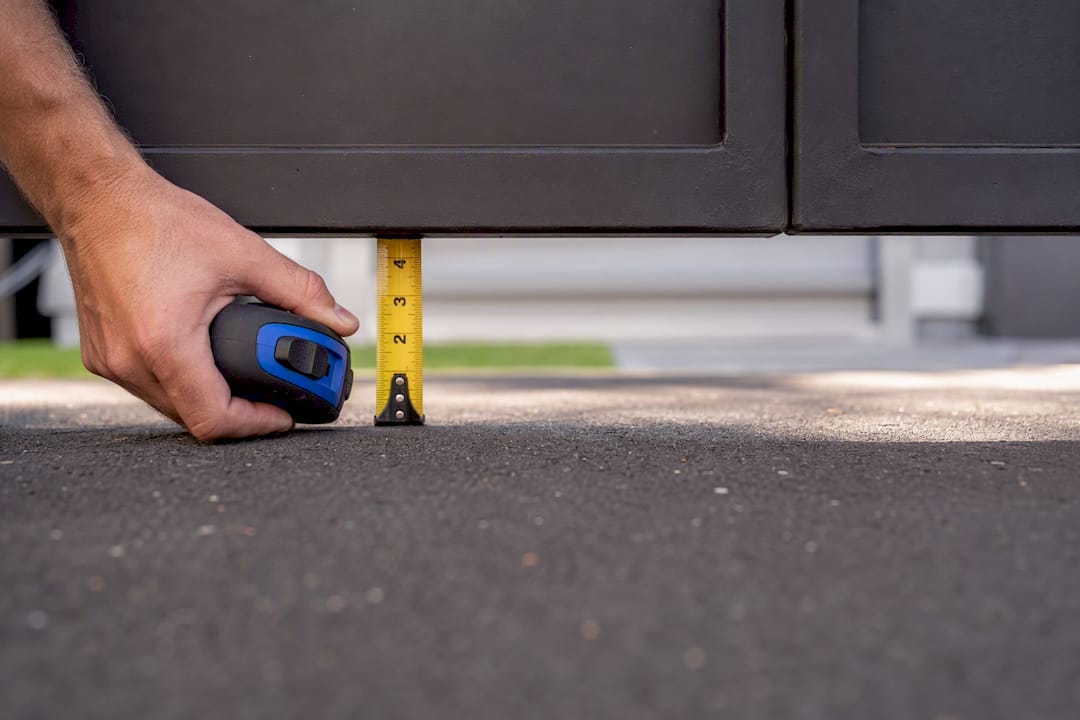
Most driveway gates sit 3 to 6 inches off the ground, with concrete surfaces at the lower end and gravel or dirt driveways needing the higher end of that range.
What Is the Standard Height of a Driveway Gate?
There’s no single required height, but most residential driveway gates run 4 to 6 feet tall, with taller options common where privacy or security is a priority.
How Tall Can Driveway Gates Be?
Maximum height depends entirely on local municipal code and any HOA rules, which override general guidance, so always verify your specific limit before ordering a gate.
How Much Clearance Does a Gate Need?
Beyond the 3 to 6 inch bottom gap, plan for a 3/4 to 1 inch hinge-side gap, a 3/4 to 1.5 inch latch-side gap, and enough side clearance for your widest vehicle plus mirrors.