What Is Weather-Resistant Fencing? A Homeowner's Guide
By BabyLoveGrowth
What Is Weather-Resistant Fencing? A Homeowner’s Guide
Weather-resistant fencing is fencing built from materials engineered to endure moisture, UV exposure, fungal and insect decay, temperature shifts, and high winds without losing structural integrity or appearance. For homeowners in Los Angeles, that definition carries real weight. A coastal property in Santa Monica faces salt air and marine humidity, while an inland home in Burbank or Sherman Oaks deals with dry heat, Santa Ana winds, and occasional frost. Choosing the right weatherproof fencing from the start determines whether your fence lasts 5 years or 40.
What is weather-resistant fencing and how does it differ from standard fencing?
Weather-resistant fencing is defined by materials and construction systems designed to resist the five core environmental stressors: moisture, UV light, biological decay, freeze-thaw cycles, and wind load. Standard untreated wood fencing addresses none of these by design. Untreated wood loses roughly half its structural strength in wet climates within five years. That rate of degradation makes untreated wood a poor long-term investment for any outdoor boundary.
The industry term for this category is “climate-adapted fencing,” though “weather-resistant fencing” is the phrase most homeowners search for and use. Both terms refer to the same principle: matching material chemistry and construction method to the specific weather stressors your property faces. The leading materials in this category are aluminum, composite, vinyl, and pressure-treated or naturally rot-resistant wood such as cedar. Each performs differently against the five stressors, which is why material selection matters as much as budget.
How do common fencing materials perform in various weather conditions?
Aluminum is the strongest all-around performer for weather resistance. Its natural oxide layer forms a permanent barrier against corrosion, and aluminum resists salt air far better than galvanized steel, whose zinc coating degrades when exposed to coastal conditions. For homeowners in Santa Monica, Malibu, or Brentwood, aluminum is the clear first choice. It does not rust, rot, warp, or absorb moisture.
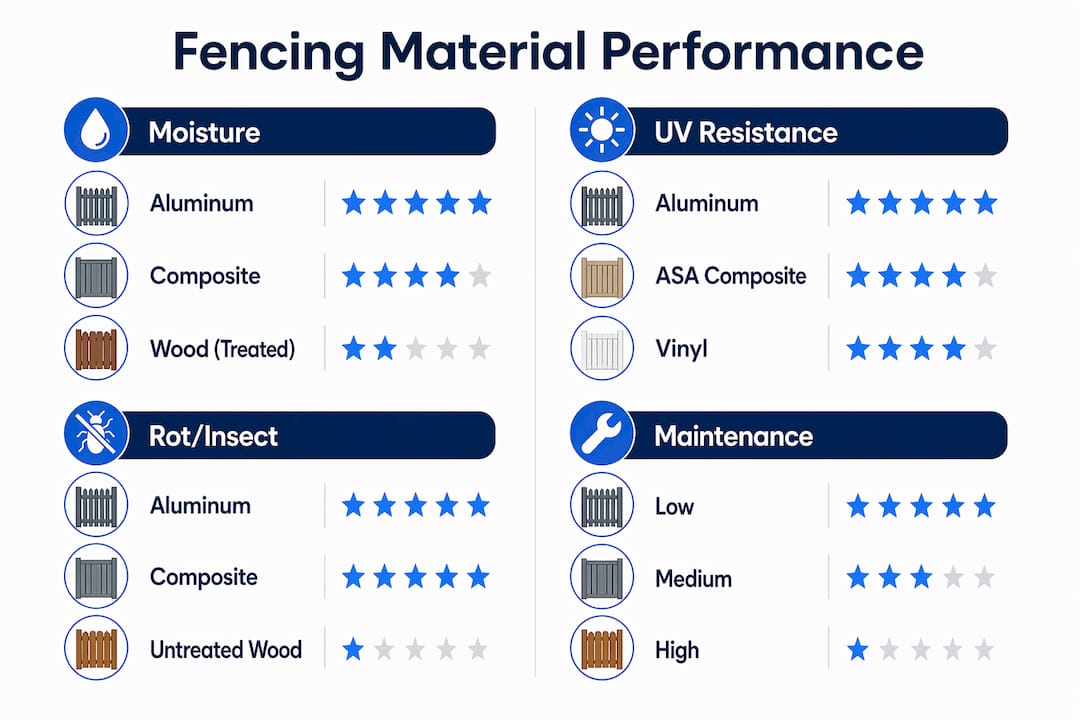
Composite fencing, such as products using an ASA-enhanced exterior layer, ranks second. The ASA (acrylonitrile styrene acrylate) surface resists UV fading and moisture penetration at the material level, not just through a surface coating. Weather resistance built into core chemistry outlasts surface treatments by years. Vinyl performs well against moisture and UV but becomes brittle in freeze-thaw conditions when water infiltrates micro-cracks. Cedar and pressure-treated wood offer natural resistance to rot and insects but require sealing every one to three years to maintain that protection.
Pro Tip: When comparing composite products, ask whether the UV and moisture resistance comes from the core material or a surface coating. Core-level protection lasts significantly longer and does not peel or wear away.
| Material Moisture resistance UV resistance Rot/insect resistance Maintenance frequency | ||||
| Aluminum | Excellent | Good | Immune | Minimal |
| Composite (ASA) | Excellent | Excellent | Immune | Minimal |
| Vinyl | Good | Good | Immune | Low |
| Pressure-treated wood | Moderate | Poor | Moderate | Every 1–3 years |
| Cedar | Moderate | Poor | Good | Every 1–3 years |
What are the benefits of weather-resistant fencing?
The most direct benefit is lifespan. Climate-appropriate materials last 20–40 years compared to untreated wood, which may need full replacement within five years. That difference represents thousands of dollars in avoided replacement costs over the life of your property.
The practical advantages for Los Angeles homeowners include:
- Lower maintenance costs. Aluminum and composite fences need no staining, sealing, or painting. Cedar requires sealing every one to three years, and selecting the right material can reduce maintenance costs by 60–70% over the fence’s lifespan.
- Consistent appearance. UV-stable materials hold their color through years of Southern California sun. Fences that fade, crack, or warp reduce curb appeal and property value.
- Structural reliability. Non-porous materials like aluminum and composite do not absorb water. Water inside porous materials freezes and expands during cold snaps, causing internal cracking even in mild climates like Pasadena or Glendale.
- Environmental value. A fence that lasts 40 years instead of 10 means three fewer manufacturing and disposal cycles. Durable material choices reduce the total environmental footprint of your property boundary.
- Property value protection. A well-maintained, visually consistent fence signals quality to buyers and appraisers alike.
How does proper installation impact the durability of weather-resistant fencing?
The best material fails without correct installation. Expert installation accounting for soil and freeze-thaw cycles is as important as the material itself. In Los Angeles, frost is rare but not impossible in higher-elevation neighborhoods like La Cañada Flintridge or parts of Pasadena. Setting posts at least 42 inches deep prevents frost heave from shifting your fence line over time.
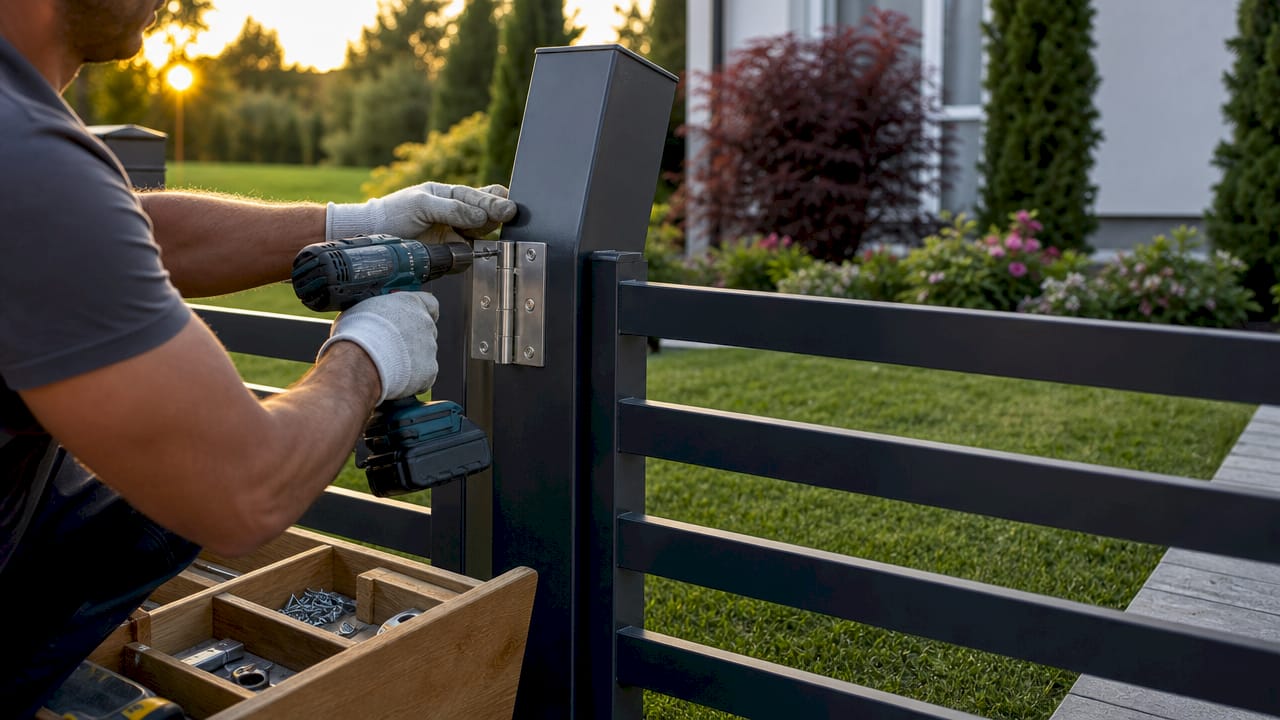
Hardware selection matters just as much as post depth. Hinges, brackets, and fasteners must be stainless steel or powder-coated aluminum to avoid rust staining and corrosion at connection points. Wood expands and contracts with temperature and humidity, so pressure-treated wood requires seasoning before installation and joinery designed to accommodate that movement. Skipping this step causes cupping, splitting, and loose panels within the first few seasons.
Wind load is a serious consideration in the San Fernando Valley, where Santa Ana winds regularly exceed 50 mph. Open-slat or slatted designs reduce wind pressure on the fence structure compared to solid panels. Concrete-set posts are standard practice in high-wind zones and add meaningful resistance to lateral force. For fence post installation in Los Angeles, the depth and concrete mix both affect long-term stability.
Pro Tip: Always seal the cut ends of wood boards before installation. Cut ends expose raw grain that absorbs water far faster than the face of the board, and that moisture entry point is where rot begins.
What types of weatherproof fencing suit different Los Angeles microclimates?
Los Angeles is not one climate. It is a collection of microclimates with distinct weather profiles, and the right fence type varies by location. Evaluating local climate zones using USDA and ASCE standards helps match material to the specific risks your property faces.
Aluminum is the top recommendation for coastal zones including Santa Monica, Malibu, Venice, and Playa del Rey. Aluminum’s oxide layer provides permanent, maintenance-free protection against salt air corrosion, outperforming galvanized steel in every coastal test. For a detailed breakdown of aluminum options, the aluminum fence installation guide covers specifications suited to upscale LA properties.
Composite and vinyl fencing work well in moderate urban zones like Culver City, West Hollywood, and Downtown LA, where UV exposure is the primary stressor and salt air is minimal. Treated cedar suits shaded, lower-humidity pockets where regular maintenance is feasible. In windy corridors like Sherman Oaks and Encino, slatted aluminum or open-panel designs reduce structural stress during Santa Ana events.
| LA microclimate Primary stressor Recommended material Design note | |||
| Coastal (Santa Monica, Malibu) | Salt air, moisture | Aluminum | Solid or slatted panels |
| Urban moderate (Culver City, West Hollywood) | UV, heat | Composite or vinyl | Any standard design |
| Inland valley (Sherman Oaks, Encino) | Wind, heat | Aluminum or composite | Open-slat design preferred |
| Elevated/foothill (Pasadena, Glendale) | Freeze-thaw, wind | Aluminum or composite | Deep-set concrete posts |
| Shaded/humid pockets | Moisture, decay | Treated cedar | Seal every 1–2 years |
For homeowners comparing options across these zones, the types of premium fencing guide covers material specifications for upscale LA properties in 2026.
Key Takeaways
Weather-resistant fencing requires matching material chemistry, installation depth, and design to your specific Los Angeles microclimate to achieve a 20–40 year lifespan.
| Point Details | |
| Material selection is climate-specific | Aluminum suits coastal zones; composite and vinyl work best in moderate urban areas. |
| Core chemistry beats surface coatings | UV and moisture resistance built into the material lasts longer than applied treatments. |
| Installation determines lifespan | Deep-set posts, quality hardware, and proper joinery are as critical as the material itself. |
| Maintenance costs drop significantly | Aluminum and composite reduce upkeep costs by 60–70% compared to untreated wood over the fence’s life. |
| Design affects wind performance | Open-slat fences reduce wind load in high-wind zones like Sherman Oaks and Encino. |
What I’ve learned from watching LA fences fail prematurely
The most common mistake I see Los Angeles homeowners make is buying a quality material and then cutting corners on installation. A composite fence set in shallow posts with standard hardware will fail in three to five years regardless of how good the boards are. The material gets the credit, but the installation does the actual work.
The second mistake is ignoring microclimate. A homeowner in Venice who installs galvanized steel because it looked good in a showroom will be dealing with rust staining within two seasons. Aluminum costs more per linear foot, but the total cost of ownership over 20 years is lower once you factor in zero repainting and no rust remediation. That math is straightforward once you run it.
My honest advice: spend the first part of your budget decision on understanding your specific site conditions, not on comparing price per linear foot. Factor in your proximity to the coast, your prevailing wind direction, and how much time you realistically want to spend on maintenance. Then choose your material. The fence that fits your site will always outperform the fence that fits your initial budget. And if you are in a high-wind zone like the San Fernando Valley, talk to your installer specifically about post depth and panel design before signing anything.
— Moin
Plan your weather-resistant fence with accurate LA pricing
Choosing the right material is only half the decision. Knowing what it will cost per linear foot, including labor, hardware, and permits specific to Los Angeles, is what turns a good choice into a confident one.
Fence-gate-estimator provides instant cost estimates for custom fencing installations across Los Angeles, from coastal aluminum fencing in Santa Monica to composite installations in Culver City and Pasadena. The estimator uses current local material and labor rates to generate a detailed breakdown based on your property size and design preferences. You can also explore gate automation options to complement your durable fence installation. Get a realistic number before you talk to a contractor, and go into that conversation prepared.