Terrain Considerations for Gates: A Los Angeles Guide
By BabyLoveGrowth
Terrain considerations for gates are defined as the site-specific factors, including slope, soil type, drainage, and ground stability, that determine which gate design will function reliably and last for years. Ignoring these factors is the leading cause of gate sagging, binding, and premature hardware failure. Los Angeles properties, from hillside homes in Bel Air to flat driveways in Santa Monica, each present unique site conditions that directly shape every installation decision. Getting this assessment right before you buy a single hinge or pour a single footing saves you thousands in repairs.
1. How does slope affect which gate type you should choose?
Sliding and cantilever gates outperform swing gates on sloped driveways because their horizontal movement eliminates the clearance problem entirely. A swing gate on a slope either drags on the ground at the low end or leaves a large gap at the high end. Neither outcome is acceptable for security or appearance.
Swing gates can still work on gentle slopes, typically under 5 degrees, when paired with custom hinges that allow vertical adjustment. Beyond that grade, the physics work against you. The gate arc intersects the ground before the gate fully opens, and the hinge stress increases with every cycle.
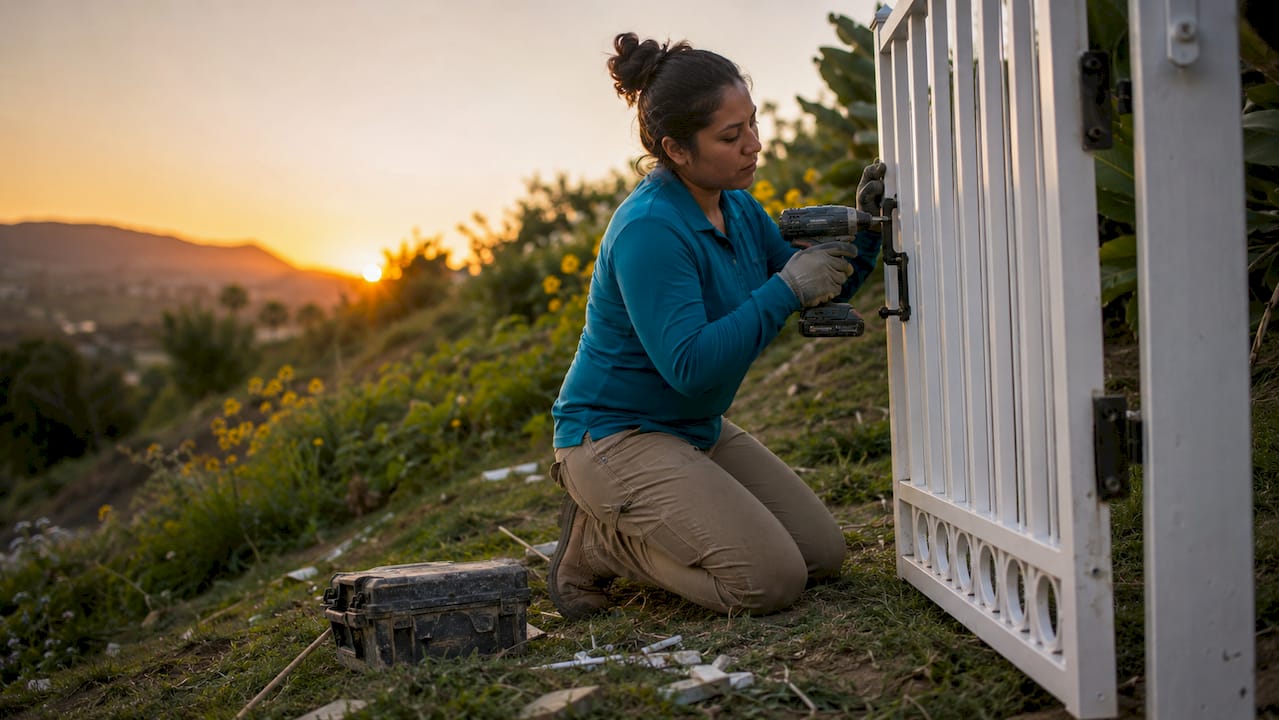
Cantilever gates are the preferred choice for steep hillside driveways in neighborhoods like Brentwood or Encino. They hang from a track mounted above the opening, so the ground condition below is irrelevant to their movement. This makes them especially reliable on properties where the driveway grade changes across the gate width.
Pro Tip: Before committing to a gate type, stake a string line across your opening at the planned gate height and measure the gap to the ground at three points. If the gap varies by more than 2 inches across the width, a swing gate will require significant custom work.
2. What installation adjustments are necessary for sloped or uneven ground?
Proper installation on uneven terrain requires adjustments at every stage, from footing depth to hinge placement. Skipping any one of these steps creates a failure point that compounds over time.
- Set ground clearance correctly. Standard ground clearance for residential driveway gates is 2–4 inches. On a slope, this clearance must be measured and maintained consistently across the full width of the opening, not just at one post.
- Dig posts to the right depth. Heavy-duty gate posts require footings set 36–60 inches deep, below the local frost line. In Los Angeles, frost heave is not a concern, but soil stability and drainage still dictate a minimum depth of 36 inches for most residential gates.
- Build in a frame gap. A 1.5 to 2-inch gap between the gate frame and each post prevents binding caused by seasonal expansion and contraction. This gap is especially critical for wider driveway gates where thermal movement is more pronounced.
- Use adjustable hinges. Adjustable hinges and larger gaps allow the gate to adapt to minor ground shifts without requiring a full reinstallation. This is particularly valuable on properties with clay-heavy soil, which expands and contracts with moisture.
- Slope your concrete footings. Pour concrete footings so the surface slopes away from the post base at a slight angle. This directs water away from the footing and prevents the freeze-thaw cycle from lifting the post over time.
Pro Tip: After pouring footings, wait the full concrete cure time, typically 28 days for full strength, before hanging the gate. Hanging a gate on a partially cured footing is one of the most common causes of post lean in the first year.
3. How drainage and soil conditions influence gate placement
Proper drainage is as critical as slope when choosing where to place a gate. A gate installed at the low point of a driveway sits in standing water after every rain. That water corrodes hardware, softens soil around footings, and accelerates post movement.
The best gate placement positions the posts on higher, stable ground where water naturally flows away from the foundation. On Los Angeles properties with clay soil, which is common in areas like Sherman Oaks and Studio City, water retention is a serious concern. Clay expands when wet and contracts when dry, creating constant movement around post footings.
- Choose elevated placement. Position gate posts at the highest practical point in the opening to keep footings out of water flow paths.
- Grade the surrounding area. Slope the ground around each post footing away from the base at a minimum 2% grade to direct runoff.
- Install French drains when needed. Drainage solutions like French drains keep gate posts stable and hardware lasting longer in water-prone areas. A French drain running parallel to the gate line intercepts subsurface water before it reaches the footings.
- Use larger footings in poor soil. In loose gravel or sandy soil, increase footing diameter beyond the standard 6 inches wider than the post base to distribute load across more ground.
| Soil type Risk level Recommended footing adjustment | ||
| Clay | High | Deeper footing, French drain, sloped cap |
| Sandy or loose gravel | Medium | Wider footing diameter, compacted base |
| Compacted decomposed granite | Low | Standard depth, standard diameter |
| Rocky ground | Low | Anchor bolts into rock, reduced depth |
4. Common mistakes when accounting for terrain in gate installations
The most expensive gate mistakes are not design errors. They are site evaluation errors made before the first post is set.
- Skipping multi-point slope measurement. Assuming an opening is level without measuring at multiple points leads directly to installation failures. Measure slope at the left post, center, and right post before ordering any gate.
- Insufficient post depth. Posts set too shallow shift with soil movement. In Los Angeles, even without frost, seasonal rain and dry cycles move clay soil enough to tilt a shallow post within two years.
- Ignoring drainage. Gates installed where water accumulates face hardware corrosion and footing instability within a few seasons. This is the most common cause of premature gate failure on hillside properties in areas like Pasadena and West Hollywood.
- Skipping the diagonal brace check. The diagonal brace on a gate must run from the bottom hinge-side corner to the top latch-side corner. An incorrectly installed brace causes rapid sagging, especially on wide or heavy gates.
- Ordering a standard gate for a non-standard site. Flat-terrain gate designs do not accommodate uneven openings. Custom or articulated gate designs exist specifically for sites where the ground is not level across the full opening width.
5. How to choose gate designs and materials for challenging terrain
Material selection and gate design are not purely aesthetic decisions on difficult terrain. The site conditions should drive the choice as much as the style preference.
Aluminum is the preferred material for sloped or drainage-challenged sites. It is lightweight, which reduces stress on posts and hinges, and it does not rust when exposed to standing water or wet soil. Wrought iron and steel offer superior strength and visual presence, but they require more rigorous drainage management and protective coatings to perform well in wet conditions. For driveway gates on sloped terrain, aluminum sliding or cantilever designs consistently deliver the best long-term performance.
| Gate design Best terrain Key advantage | ||
| Cantilever slide | Steep slope, uneven ground | No ground contact during operation |
| Horizontal slide | Moderate slope, flat but wet | Simple mechanism, low maintenance |
| Swing (custom hinges) | Gentle slope, stable soil | Traditional appearance, lower cost |
| Articulated swing | Severely uneven terrain | Adapts to grade changes across opening |
Tapered gate profiles, where the bottom rail follows the slope of the ground rather than running level, are a practical design solution for sites where a standard gate would leave a large gap at one end. This approach maintains security without requiring extensive grading. For pedestrian gate options on properties with complex landscape features, articulated designs offer the most flexibility.
Pro Tip: Request a site visit from your installer before finalizing any gate design. A 30-minute on-site evaluation catches terrain issues that photos and measurements alone will miss.
Key takeaways
Terrain directly determines gate type, post depth, drainage design, and material choice. Every installation decision flows from a thorough site evaluation.
| Point Details | |
| Slope drives gate type | Sliding and cantilever gates are the reliable choice on driveways with more than a gentle grade. |
| Post depth matters | Set posts 36–60 inches deep with sloped concrete caps to prevent shifting and water damage. |
| Drainage protects longevity | Place gates on higher ground and use French drains to keep footings stable in wet or clay soil. |
| Multi-point measurement is non-negotiable | Measure slope at three or more points before ordering any gate to avoid binding and clearance failures. |
| Material should match site conditions | Aluminum performs best on wet or sloped sites; steel and iron require stronger drainage management. |
What I’ve learned from hillside gate projects in Los Angeles
The most consistent mistake I see on Los Angeles hillside properties is treating terrain as a secondary concern. Homeowners spend weeks choosing a gate style and then hand the installer a site that has never been properly evaluated. The gate looks great for six months and then starts dragging, leaning, or refusing to latch.
The properties that give installers the most trouble are not the steepest ones. They are the ones with subtle, uneven terrain that nobody measured carefully. A driveway in Bel Air or Brentwood might look flat but drop two inches across a 12-foot opening. That two-inch variance is enough to cause a swing gate to bind on one side and gap on the other.
Drainage is the factor that gets ignored most often in Los Angeles because the climate feels dry. But the rainy season hits clay-heavy hillside soils hard, and a gate post sitting in saturated ground for three months a year will move. I have seen well-built gates on beautiful properties fail within two years because nobody addressed the water management around the footings.
My strongest recommendation for any property with a slope, clay soil, or drainage concerns: get a sliding or cantilever gate, set posts to at least 36 inches, and grade the surrounding area before the concrete is poured. Consult your local building department about setback and right-of-way requirements before finalizing gate placement. In Los Angeles, gate placement near the street often triggers permit requirements that affect how far back the posts must sit. Skipping that step creates problems that no amount of good installation work can fix after the fact.
— Moin
Planning your gate project with Fence-gate-estimator
Terrain complexity directly affects your installation cost, and knowing your budget before you start planning saves time and prevents surprises.
Fence-gate-estimator provides instant cost estimates for custom gate and fence installations across Los Angeles, including Beverly Hills, Pasadena, and Santa Monica. The estimator accounts for terrain factors, gate type, material, and automation features to give you a realistic budget based on current local labor and material rates. Whether you are evaluating a sliding driveway gate for a hillside property or a pedestrian gate on uneven ground, you can get a detailed cost breakdown in minutes. Use the estimator as your first step before contacting an installer, so you arrive at that conversation already informed.