Role of Fencing Contractors: What LA Homeowners Must Know
By BabyLoveGrowth
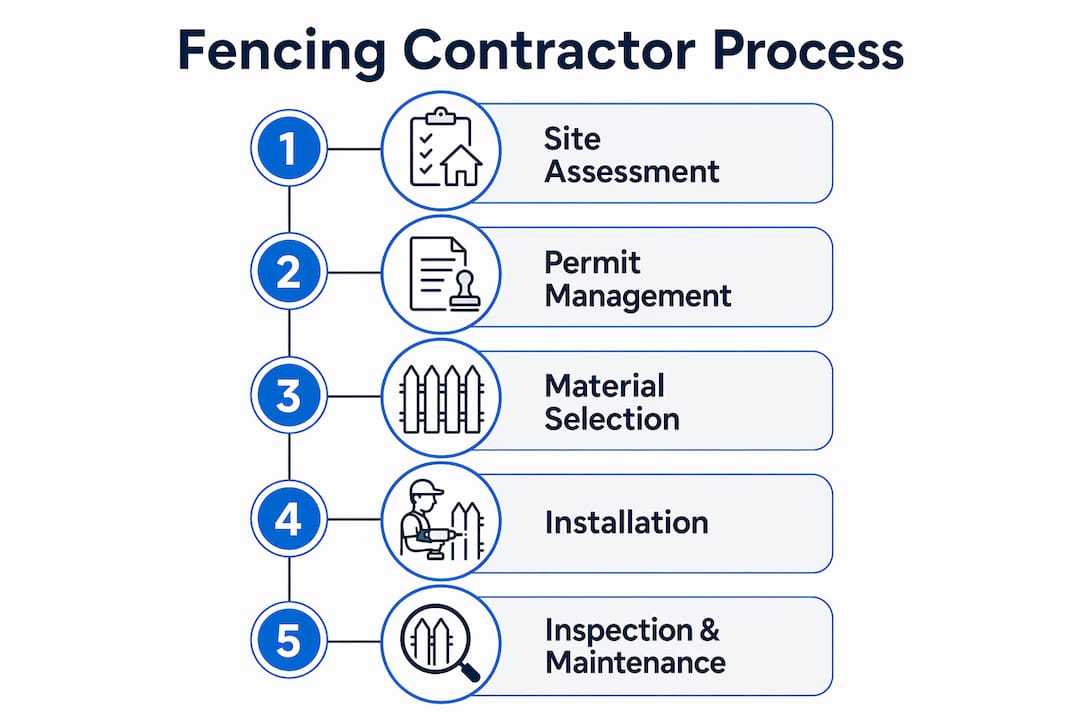
A fencing contractor is a licensed professional who manages the full lifecycle of a residential fencing project, from initial site assessment through final inspection. The role of fencing contractors goes far beyond building a fence. They coordinate permits, source materials, manage subcontractors, handle inspections, and keep your project on budget and on schedule. For homeowners in Los Angeles, Beverly Hills, or Santa Monica, understanding what a contractor actually does helps you hire the right person and avoid costly surprises.
What services do fencing contractors provide?
A fencing contractor handles planning, permits, materials sourcing, and installation as a project manager, not just a builder. That distinction matters. A fence builder focuses on construction. A fencing contractor owns the entire process.
Here is what you can expect from a full-service fencing contractor:
- Property assessment: The contractor walks your site, measures linear footage, identifies grade changes, and notes underground utilities or irrigation lines that could affect post placement.
- Material and style recommendations: Based on your goals, whether security, privacy, or curb appeal, they recommend materials like wrought iron, aluminum, wood, or vinyl, along with appropriate post spacing and panel heights.
- Permit acquisition: They submit site plans, material specifications, and any required engineered drawings to your local building department.
- Site preparation and demolition: Existing fence removal, grading adjustments, and layout marking all happen before a single post goes in the ground.
- Installation: Posts, panels, gates, and all associated hardware are installed to code and to the specifications in your contract.
- Post-installation guidance: A professional contractor walks you through maintenance requirements, warranty terms, and any follow-up inspection steps.
Pro Tip: Ask your contractor to provide a written maintenance schedule at project completion. Wrought iron and steel fences in coastal areas like Santa Monica require more frequent inspection for rust than aluminum fences in drier inland neighborhoods like Pasadena.
The breadth of fencing contractor services is what separates a qualified professional from a handyman with a post-hole digger. When you hire a contractor, you are paying for project management expertise, not just labor.

How do fencing contractors manage permits and compliance in los angeles?
Permit management is one of the most critical fencing contractor responsibilities, and it is where unlicensed operators most often fail homeowners. Local permitting requirements vary widely across municipalities, making local knowledge a key advantage of hiring a licensed professional.
In Los Angeles County, fences over 6 feet in height typically require a building permit. Permit triggers commonly include exceeding height thresholds around 6 feet or placement adjacent to public rights-of-way. That threshold applies in most residential zones, but specific communities add their own layers. Beverly Hills, for example, has strict front-yard fence height limits tied to visibility and aesthetic codes. West Hollywood applies additional design review requirements for fences visible from the street.
A licensed contractor navigates these local rules by following a structured process:
- Site plan preparation: The contractor draws or commissions a site plan showing fence location, dimensions, setbacks from property lines, and proximity to easements.
- Material specification submittal: Building departments require documentation of post size, material grade, and fence height. For fences over 7 feet, some jurisdictions require engineered drawings stamped by a licensed structural engineer.
- Permit application filing: The contractor submits the package to the relevant building and safety department, whether that is LADBS for unincorporated areas or a city-specific department for Beverly Hills or Santa Monica.
- Inspection scheduling: After installation, the contractor coordinates the required inspections, including framing, footing, and final sign-off.
- Final inspection pass: The contractor is responsible for correcting any deficiencies flagged by the inspector before the project closes.
Your contract must clearly state who is responsible for obtaining permits. Unclear permit assignments are a leading cause of fencing project disputes, creating costly delays and corrections. Get that assignment in writing before work begins.
What responsibilities do contractors have for project scope and changes?
Scope management is where many residential fencing projects go sideways. A professional contractor documents every measurable detail before breaking ground. Fence contractor scopes specify linear footage, post spacing at 8 feet on center, material grade, fence height, and gate hardware quantity. That level of specificity protects you from vague billing and protects the contractor from scope creep.
Real jobsite conditions frequently require adjustments. Common triggers for scope changes include:
- Terrain variations: A slope that was not visible during the initial walkthrough may require stepped panels or custom-cut posts, adding labor and material costs.
- Buried utilities: Hitting an irrigation line or conduit during post installation requires rerouting, which adds time and expense.
- Neighbor boundary disputes: A survey discrepancy discovered mid-project can shift the entire fence line, requiring new permits and revised plans.
- Material substitutions: Supply delays may require switching from one material grade to another, affecting both cost and appearance.
Written change orders must document scope and cost adjustments before work proceeds. Verbal instructions create disputes and leave contractors unpaid for legitimate extra work. They also leave homeowners with no recourse if the final bill does not match expectations.
Pro Tip: Before signing any fencing contract, confirm it includes a formal change order clause. The clause should require written approval from you before any additional work begins. This single requirement prevents the majority of billing disputes on residential projects in Encino, Studio City, and similar neighborhoods where properties often have complex terrain.
Formal change order protocols protect all parties and keep the project cash flow and schedule intact. Insist on them every time.
Why does licensing and insurance matter when hiring a fencing contractor?
Licensing and insurance are the two non-negotiable qualifications for any fencing contractor you hire. License requirements vary by state; California requires a specialty C-13 license for fence contractors, plus local registration and bonding in many jurisdictions. The C-13 classification covers ornamental metals, which is directly relevant for wrought iron and aluminum fencing common in Bel Air and Brentwood.
Workers’ compensation insurance is mandatory in 49 states for employers with at least one employee. That means if a worker is injured on your property and your contractor lacks coverage, you could face liability. General liability insurance covers property damage during installation, such as a post-hole drill hitting a buried utility line.
Here is how licensed and unlicensed contractors compare on the factors that matter most to you:
| Factor Licensed and Insured Contractor Unlicensed Contractor | ||
| Permit eligibility | Can pull permits in your name | Cannot legally pull permits |
| Code compliance | Trained and tested on current codes | No verified knowledge |
| Warranty access | Manufacturer warranties typically require licensed installation | Warranties often void |
| Dispute recourse | Licensing board provides formal complaint process | No regulatory recourse |
| Worker injury liability | Covered by workers’ comp | Potentially falls on homeowner |
The California Contractors State License Board (CSLB) maintains a public verification portal at cslb.ca.gov where you can confirm any contractor’s license status, bond, and insurance in under two minutes.
Pro Tip: Always request a certificate of insurance directly from the contractor’s insurer, not a copy the contractor hands you. Certificates can be outdated. A direct request confirms the policy is active on the date your project starts.
How do contractors handle pool barrier fencing and safety codes?
Pool barrier fencing is a specialized category where the importance of fencing contractors with code knowledge is most apparent. A failed pool barrier inspection does not just delay your project. It can prevent you from legally opening or using your pool.
Key requirements for pool barrier compliance include:
- Barrier continuity: The fence must form a complete, unbroken perimeter around the pool with no gaps a 4-inch sphere can pass through.
- Gate hardware: Gates must be self-closing and self-latching, with the latch on the pool side of the gate and positioned out of reach of young children.
- Height minimums: Most California jurisdictions require pool barriers to be at least 60 inches high on the exterior face.
- No climbable features: The fence design cannot include horizontal rails or decorative elements that provide footholds within 45 inches of the top of the barrier.
Fencing contractors must ensure gate hardware and barrier continuity meet inspection requirements to avoid failed certificate-of-occupancy holds. Pool barrier inspections in Los Angeles typically occur alongside the pool’s final inspection, meaning a fence deficiency can hold up the entire pool project.
Gate hardware is the most common pool barrier inspection failure point. Contractors with current code knowledge prevent defects that lead to certificate holds and project delays.
For homeowners in Culver City, Glendale, or Pasadena planning a pool fence, confirm your contractor has completed pool barrier projects and can cite the specific IRC and local code sections that apply. That knowledge gap between a general fence builder and a pool fencing specialist is where projects stall.
Key takeaways
A fencing contractor’s value lies in managing permits, scope, compliance, and installation as a single accountable professional, not just building a fence.
| Point Details | |
| Contractors manage the full project | From site assessment to final inspection, they own every phase of the fencing project. |
| Permits require local knowledge | Los Angeles municipalities each have distinct height thresholds and submittal requirements that licensed contractors navigate. |
| Written scope prevents disputes | Contracts must specify linear footage, post spacing, material grade, and a formal change order process. |
| Licensing protects you legally | California’s C-13 license and active insurance are required qualifications, verifiable through the CSLB portal. |
| Pool barriers need specialist knowledge | Gate hardware and barrier continuity are frequent inspection failures that only code-trained contractors reliably prevent. |
What i have learned after years of watching LA fencing projects go wrong
The most common mistake I see homeowners make is treating the permit question as an afterthought. They focus on material choices and pricing, then discover mid-project that nobody filed for a permit. At that point, the contractor is already on-site, posts are in the ground, and the homeowner is facing a stop-work order from LADBS. That scenario is entirely preventable with one sentence in the contract.
The second pattern I see repeatedly is homeowners accepting verbal scope changes. A contractor says, “We hit rock at three feet, so we need to switch to surface mounts. It’ll be a little extra.” The homeowner nods. Three weeks later, the invoice is $2,400 higher than the contract price, and there is no documentation to support or dispute the charge. Written change orders are not bureaucratic overhead. They are the only protection you have when the ground does not cooperate.
My honest advice: before you evaluate a single material sample or request a price per linear foot, verify the contractor’s C-13 license on the CSLB portal and request a current certificate of insurance. Those two steps take five minutes and eliminate the majority of risk on any residential fencing project. For properties in Beverly Hills, Bel Air, or Santa Monica, also confirm the contractor has pulled permits specifically in those cities. Each has its own building department with its own quirks, and a contractor who has never worked in Beverly Hills will learn on your project.
Choosing a fencing contractor based on price alone is the fastest path to a fence that fails inspection, a project that runs over budget, and a dispute with no paper trail to resolve it.
— Moin
Plan your LA fencing project with confidence
Before you contact a single contractor, knowing your budget range gives you real negotiating power. Fence-gate-estimator.com offers an instant custom fencing cost calculator built specifically for Los Angeles homeowners, using current local material and labor rates for wrought iron, aluminum, steel, and more.

You can also explore options for gate automation, pedestrian gates, and driveway gate installations with pricing breakdowns tailored to your property size and design preferences. Whether you are planning a security fence in Encino or a decorative aluminum perimeter in Pasadena, Fence-gate-estimator.com gives you the numbers you need before the first contractor conversation.
Recommended
- Fence post installation in Los Angeles: 5 key essentials | LA Electric Gate Service
- Why Fence Installation Matters for Your Property | LA Electric Gate Service
- Expert aluminum fence installation guide for upscale LA homes | LA Electric Gate Service
- Custom fence components: build luxury, security, and style in LA | LA Electric Gate Service