Modern fence design: Elevate security and style in LA
By BabyLoveGrowth
Most homeowners assume a fence is either beautiful or secure, rarely both. In upscale Los Angeles neighborhoods like Beverly Hills, Bel Air, and Santa Monica, that assumption is simply outdated. Today’s modern fence design achieves architectural elegance, robust privacy, and smart security in a single installation. This guide walks you through the defining elements of contemporary fencing for LA’s premier properties: materials, layout strategies, automation integration, and the installation details that separate a truly outstanding fence from one that merely looks the part.
Table of Contents
- What defines modern fence design in Los Angeles
- Material choices: Modern metals vs. composites
- Designing for privacy, airflow, and automation
- Cost, value, and must-know installation insights
- What most LA homeowners miss about truly modern fence design
- Bring your modern fence vision to life with expert LA installers
- Frequently asked questions
Key Takeaways
| Point Details | |
| LA modern design essentials | Horizontal slats, powder-coated metal, and tailored privacy define today’s top LA fences. |
| Material performance matters | Choose metals or composites tested for UV resistance and durability for best results in Los Angeles. |
| Smart automation adds value | Automated gates and lighting make modern fences both secure and convenient. |
| Plan for cost and installation | Consider materials, automation, and professional installation to maximize your fence’s long-term value. |
| Hire for expertise | A skilled LA installer ensures your fence meets design goals and building codes. |
What defines modern fence design in Los Angeles
Now that you know why modern design can enhance security and aesthetics, let’s break down the elements that define LA’s premier fencing styles.
When designers and homeowners in Los Angeles talk about a “modern” fence, they’re describing something very specific. It’s not just about a clean look. It’s about a deliberate system of geometry, finish, and spatial awareness that works with the architecture of the home rather than against it. Modern upscale Los Angeles fence designs most often use clean-lined geometries such as horizontal slats for a contemporary look and controlled privacy and airflow, alongside darker, powder-coated metal finishes.
The horizontal slat layout is the defining feature of LA’s current aesthetic. Slats run parallel to the ground, creating strong visual lines that complement modern and transitional architecture equally well. You can explore how these elements come together by looking at LA modern fence styles that combine clean geometry with structural integrity.
Key characteristics of modern fence design in Los Angeles include:
- Horizontal slat orientation for a low-profile, contemporary silhouette
- Powder-coated metal finishes in matte or satin black, charcoal, or deep bronze
- Custom slat spacing to balance privacy with natural airflow
- Integrated landscape lighting to extend visual appeal into evening hours
- Accent panels in glass, Corten steel, or composite for architectural contrast
Lighting deserves special attention. Outdoor lighting and aesthetics play a significant role in how a fence reads at night, and many LA homeowners overlook this entirely. Uplighting along fence panels or downlighting from cap rails can transform a daytime feature into a nighttime focal point.
“A modern fence that looks stunning at noon but disappears into darkness at 8 PM is only doing half its job. Lighting integration isn’t optional for luxury properties, it’s essential.”
Pro Tip: Don’t let your horizontal layout become visually monotonous. Alternate slat widths or introduce a taller accent panel at the entry point to create visual rhythm and hierarchy without breaking the clean modern aesthetic.
You should also think about fence automation for LA homes early in the design process, not as an afterthought. Automation hardware, conduit routing, and sensor placement all influence how the fence is fabricated and installed.
Material choices: Modern metals vs. composites
Once you know the core design elements, the next step is selecting materials that perform under LA’s intense sun and match your home’s architecture.
Material selection is where many LA homeowners make costly mistakes. They choose based on appearance alone, without considering how a material behaves under sustained UV exposure, coastal salt air, or the wide temperature swings that characterize LA’s microclimates from the hills to the coast.
Powder-coated steel and aluminum remain the gold standard for modern metal fencing. Steel offers superior rigidity and is preferred for taller privacy fences and automated gate frames. Aluminum is lighter, naturally corrosion-resistant, and often the better choice for coastal properties in areas like Malibu or Pacific Palisades. Both materials accept custom powder-coat finishes in virtually any color, and the finish itself provides a durable barrier against oxidation and UV degradation.
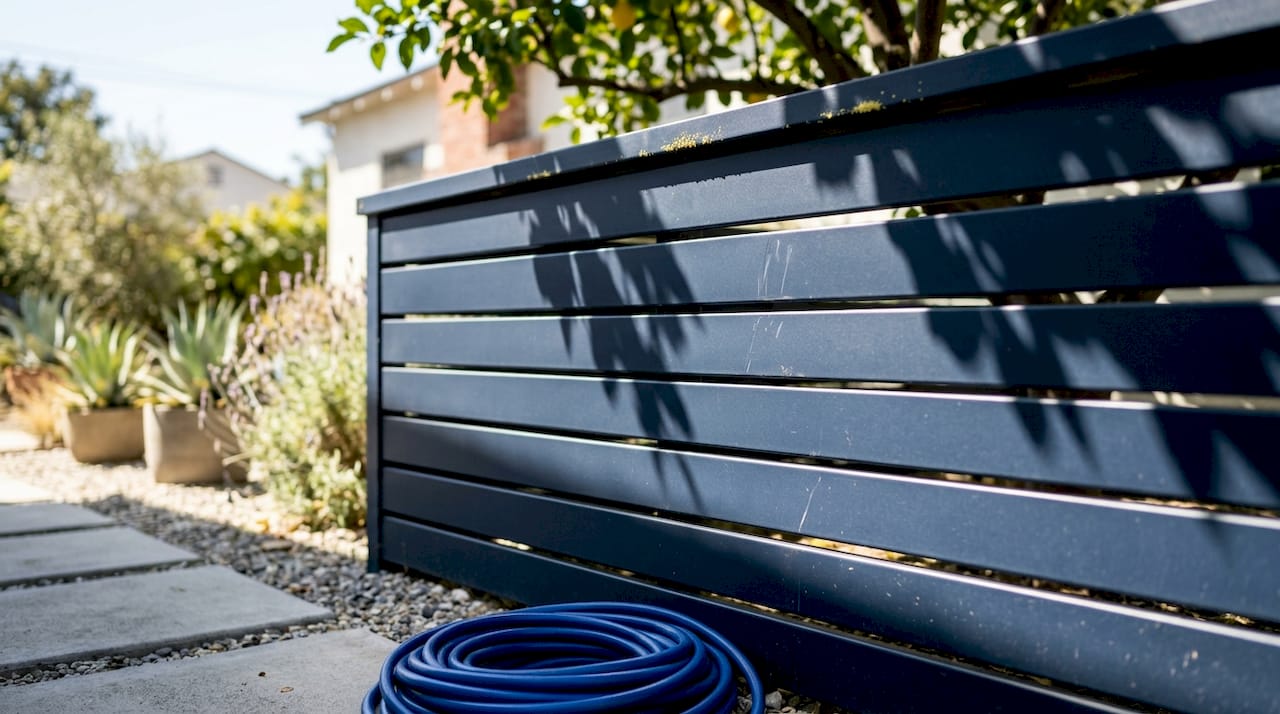
Composite fencing, often called WPC (wood-plastic composite), is engineered from wood fiber and polymer materials. Composite fencing is tested under ASTM standards with close attention to UV and weathering resistance, including color fade and surface erosion, as well as dimensional stability. This matters enormously in Los Angeles, where sun exposure is relentless and temperature cycling causes lesser materials to warp, crack, or fade within a few seasons.
Here’s a direct comparison of the two primary material categories:
| Feature Powder-coated metal Composite (WPC) | ||
| Fade resistance | Excellent (quality coatings) | Good (ASTM-tested grades) |
| Maintenance | Very low | Very low |
| Upfront cost | Moderate to high | Moderate |
| Tactile feel | Industrial, refined | Warm, wood-like |
| Sustainability | Recyclable | Partially recycled content |
| Longevity | 25+ years | 20+ years (premium grades) |
| Customization | High (color, profile, texture) | Moderate (color, profile) |
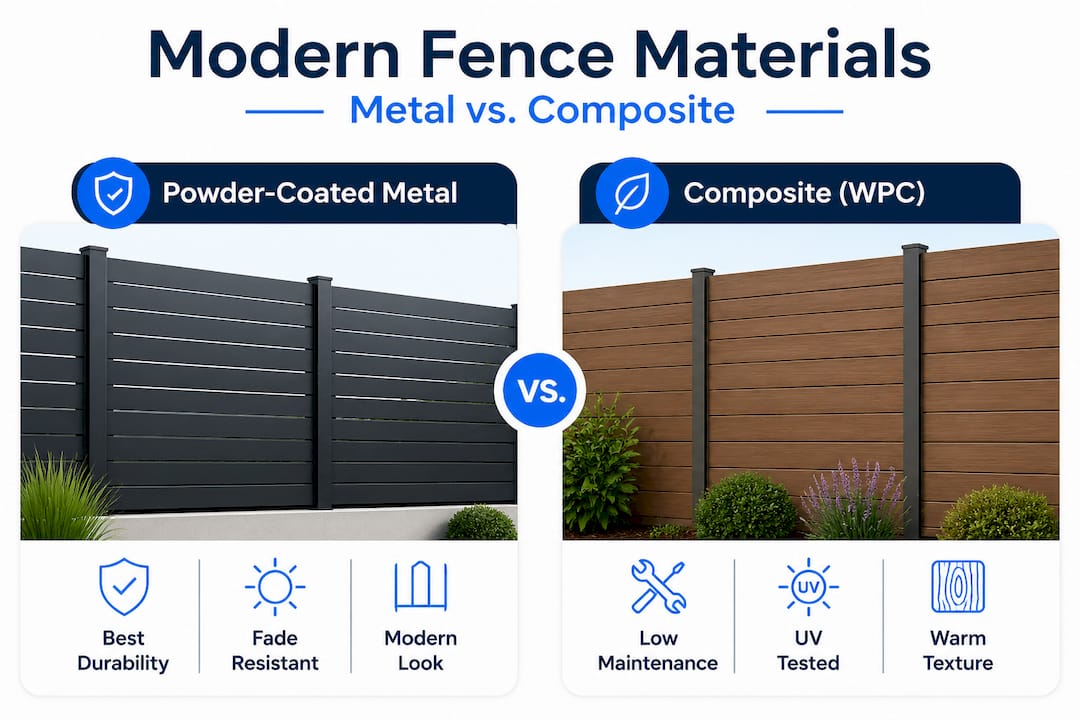
One increasingly popular approach combines both materials. A steel or aluminum structural frame supports composite infill panels, giving you the structural integrity of metal with the warmth and texture of a wood-like surface. You can review custom metal fencing options that incorporate this hybrid approach for a truly distinctive result.
Pro Tip: Always request the product data sheet before approving a composite fencing material. Look specifically for ASTM D7032 compliance, which covers structural performance, and ASTM G154 results, which confirm UV weathering resistance. If a supplier can’t provide these documents, that’s a serious red flag.
For homeowners who want to move beyond standard wood alternatives, there are also engineered fencing alternatives worth considering that offer different performance profiles depending on your specific site conditions.
Designing for privacy, airflow, and automation
After weighing material options, the next focus is finding the right balance between seclusion, comfort, and the latest in smart home integration.
Privacy and airflow are not competing priorities. They’re design variables you can tune precisely, especially with horizontal slat systems. Horizontal slat fences dominate the LA look and allow privacy and airflow tuning through the use of spacing between slats.
A gap of half an inch to one inch between slats provides near-complete privacy while still allowing air to pass through, which is important for properties with gardens or outdoor living areas. A gap of two to three inches opens the fence considerably, creating a more permeable boundary that suits hillside properties where views are part of the value proposition. Gaps beyond three inches start to compromise privacy significantly and are better suited for perimeter or decorative fencing rather than primary boundary walls.
Here’s how common fence styles compare across the key performance dimensions:
| Fence style Privacy level Airflow Automation compatibility | |||
| Horizontal slat, tight spacing | High | Moderate | Excellent |
| Horizontal slat, wide spacing | Moderate | High | Excellent |
| Solid composite panel | Very high | Low | Good |
| Metal and glass combination | Low to moderate | High | Excellent |
| Vertical board and rail | Moderate | Moderate | Good |
Smart automation is now a standard expectation for luxury LA properties, not a premium upgrade. When you integrate automation and smart gates from the design phase, you can incorporate remote-operated entry gates, motion-activated lighting, intercom systems, and even app-controlled privacy screens into a seamless architectural package.
Follow these steps to specify your design correctly from the start:
- Define your privacy zones. Identify which sections of the fence face the street, neighbors, or open views, and assign different slat spacing to each zone accordingly.
- Select your automation features. Decide between swing gates and sliding gates based on your driveway geometry, then choose between standard remote control, keypad entry, smartphone integration, or full smart home connectivity.
- Plan conduit and power routing early. Automation hardware requires electrical conduit buried during installation. Retrofitting this later is expensive and disruptive.
- Integrate lighting into the fence structure. Cap rail lighting, post-mounted fixtures, and ground-level uplights should all be specified before fabrication begins.
- Coordinate with your landscape contractor. Planting beds, irrigation lines, and hardscape elements all affect where posts can be set and how the fence transitions into the broader property design.
For properties with pedestrian access points, modern pedestrian gate options can be integrated with the same automation and aesthetic language as your vehicle entry gate, creating a cohesive and polished result.
Cost, value, and must-know installation insights
Once you’ve defined your design, don’t overlook the practical factors including cost, installation, and choosing features that add lasting value.
Modern fencing for upscale LA properties represents a genuine investment. Costs vary significantly based on materials, linear footage, terrain complexity, and automation features, but the return in property value, security, and daily convenience is well documented. Understanding the cost factors for LA fences before you begin helps you budget accurately and avoid surprises.
Key cost and installation considerations include:
- Material costs: Powder-coated steel runs higher per linear foot than aluminum but offers greater rigidity for tall panels. Premium composite materials cost more upfront but require minimal maintenance over their lifespan.
- Automation complexity: A basic remote-operated swing gate adds a moderate premium. Full smart home integration with video intercom, app control, and sensor arrays can add significantly more, but delivers daily convenience and security that most homeowners consider essential.
- Permits and compliance: Los Angeles requires permits for most fence installations over a certain height. Permit fees, engineering drawings, and inspection timelines all factor into your total project cost and schedule.
- Site preparation: Sloped lots, rocky soil, existing hardscape, and mature landscaping all increase labor costs. Properties in the hills require more precise post-setting and may need engineered footings.
- Landscape integration: Coordinating fence installation with irrigation, lighting, and planting work adds complexity but produces a far more polished result.
Key stat: ASTM weathering certification can extend the useful life of a fence by 30% or more compared to uncertified materials, making it a critical specification for LA’s sun-intensive climate.
Long-term maintenance costs are where premium materials truly justify their price. Composite fences are rated for durability under dimensional stability and weathering standards including ASTM D7032, D4329, and G154 for fade and erosion. A fence that holds its color and structural integrity for 25 years without repainting or refinishing costs far less over its lifetime than a cheaper alternative that requires work every three to five years.
Understanding how terrain and project complexity affect your final installation cost is equally important, particularly for hillside properties where grade changes require custom post heights and panel angles.
What most LA homeowners miss about truly modern fence design
With installation costs and options in mind, it’s important to step back and examine what makes a modern fence truly valuable in the long run.
Here’s what we see consistently in the field: homeowners spend significant time selecting the right slat profile and finish color, then underinvest in the structural and engineering details that determine whether the fence actually performs as expected five, ten, or twenty years from now. The surface is what you see. The engineering is what you live with.
A genuinely modern fence is not just one that looks current. It’s one that was designed holistically, with privacy tuning, automation infrastructure, material certification, and landscape integration all considered together from day one. Shortcuts in any of these areas create friction later, whether that’s a gate that binds in summer heat, slats that fade unevenly, or an automation system that can’t be upgraded because the conduit was never run.
ASTM-certified materials are not a marketing detail. They represent real-world performance data collected under standardized conditions that closely mirror what LA’s sun, heat, and coastal air actually do to a fence over time. Generic imported materials without this documentation may look identical on day one and perform very differently by year three.
The other thing most homeowners miss is adaptability. Your needs will change. You may add a pool, reconfigure your driveway, or upgrade your smart home system. A fence designed with modular panels, accessible conduit, and standard hardware connections can evolve with your property. A fence that was built purely for today’s aesthetic becomes a limitation rather than an asset. Explore the luxury fence design wisdom that separates truly enduring installations from those that simply follow the current trend.
Bring your modern fence vision to life with expert LA installers
Having explored what sets the best modern fences apart, take the next step with trusted LA professionals who can turn your unique vision into a secure, stunning reality.
Designing a modern fence that genuinely performs requires expertise that goes well beyond selecting a material and a color. Code compliance, structural engineering, automation integration, and landscape coordination all need to work together seamlessly. That’s exactly what we deliver at fence-gate-estimator.com.
You can start your custom fencing project today with a free, no-obligation estimate that reflects real LA labor and material rates. Whether you’re planning a full perimeter fence, an automated entry gate, or a combination of both, our team provides detailed cost breakdowns and design guidance specific to your property. We also offer dedicated solutions to explore gate automation and stylish pedestrian gate solutions for complete, cohesive property access design. Get your estimate now and see exactly what your vision will cost before committing to a single dollar.
Frequently asked questions
What fencing style is currently most popular for upscale LA homes?
Horizontal slat fences with dark powder-coated finishes define the modern look in Los Angeles, balancing privacy, airflow, and architectural style in a single clean design.
How do composite fences perform in LA’s sun compared to metal?
Composite fencing is engineered and tested for UV and weathering resistance under ASTM standards; powder-coated metals also perform well and often show less color shift over extended sun exposure.
Can a modern fence integrate smart home automation features?
Yes, automated fences and gates are increasingly standard in luxury LA installations, offering remote control, app connectivity, motion-activated lighting, and full security system integration.
What drives the cost of a modern fence most in Los Angeles?
Materials, automation complexity, site conditions such as slope and soil type, permit requirements, and coordination with landscaping are the top factors that influence total project cost.
How do you balance privacy and airflow in a modern fence design?
By adjusting the spacing between horizontal slats, you can precisely tune the fence for privacy without blocking breezes, with tighter gaps for seclusion and wider gaps for ventilation and openness.
Recommended
- Custom fence components: build luxury, security, and style in LA | LA Electric Gate Service
- Expert aluminum fence installation guide for upscale LA homes | LA Electric Gate Service
- Fence automation: smart security and value for LA homes | LA Electric Gate Service
- Fence post installation in Los Angeles: 5 key essentials | LA Electric Gate Service
- Keep your fences strong: Dublin homeowner’s guide