Your Complete Mediterranean Style Fence Installation Guide
By BabyLoveGrowth AI
A Mediterranean-style fence built right combines stucco or stone bases with wrought iron panels or warm wood, set on posts spaced at typical intervals and sunk to sufficient depth for stability. Before you buy a single post or panel, confirm your permit requirements with the Los Angeles Department of Building and Safety and run your linear footage through Fence-gate-estimator for a realistic local cost range.
Immediate action checklist:
- Measure your total linear footage and sketch the fence line on your property plat
- Call your city permit office (or check online) before purchasing materials
- Review your HOA’s CC&R documents for height, material, and color restrictions
- Dial 811 to locate underground utilities before any digging
- Run your project specs through Fence-gate-estimator for an LA-specific cost estimate
Pro Tip: Call the city zoning counter before buying materials. A 6-foot front-yard wall that looks standard may require a variance in your municipality, and discovering that after delivery is an expensive lesson.
Post depth matters more than most DIYers expect. Use 2 feet for standard side and rear fences in stable soil; go to 3 feet for gate posts, taller walls, or any location with loose or sandy soil. Los Angeles hillside lots face additional structural rules, so confirm footing requirements with the city and a licensed engineer before you dig.
Key Takeaways
A Mediterranean fence built correctly pairs authentic materials with proper post depth, local permit compliance, and drought-tolerant planting to create a result that holds its value for decades.
| Point | Details |
|---|---|
| Post spacing and depth | Space posts spaced closer for privacy panels and wider for open rail sections; set gate posts to a sufficient depth for stability. |
| Permits before purchase | Check LADBS and HOA CC&Rs before ordering materials to avoid costly redesigns. |
| Material pairing | Wrought iron over stucco or stone bases delivers the most authentic Mediterranean result. |
| Garden integration | Plant olive, cypress, rosemary, and lavender in autumn using gritty, fast-draining soil mixes. |
| Fence-gate-estimator | Run your linear footage and material choice through Fence-gate-estimator for an LA-specific installed cost range before committing to a design. |
Table of Contents
- What materials and design rules create an authentic Mediterranean look?
- How do you install a Mediterranean fence step by step?
- What mistakes do homeowners make when installing a fence?
- What permits and HOA rules apply to Mediterranean fences in Los Angeles?
- How do you maintain a Mediterranean fence and integrate it with your garden?
- Should you DIY or hire a pro, and what does it cost in Los Angeles?
- What most homeowners get wrong about Mediterranean fencing
- Get an instant LA cost estimate before you commit to a design
- Sources
- FAQ
What materials and design rules create an authentic Mediterranean look?
Mediterranean fencing pairs wrought iron or decorative metal with stone or stucco bases, or warm wood panels with stone piers. That combination delivers both the openness and the visual mass the style demands.
Primary material families:
- Wrought iron / powder-coated steel: Decorative scrollwork, spear tops, or simple vertical bars. Powder-coated finishes resist UV and coastal salt; specify a marine-grade coating for Santa Monica or Malibu properties.
- Stone or stacked masonry: Limestone, travertine, or cast stone piers and low walls anchor the design. Durable, low-maintenance, and visually heavy in the best sense.
- Stucco-faced concrete block: Cost-effective base for iron panels. Match stucco color and texture to your home’s exterior for a cohesive result.
- Warm-toned wood (cedar, redwood): Adds softness between stone piers. Seal annually; redwood holds up better than cedar in LA’s dry heat.
- Composite alternatives: Engineered wood or PVC composites in warm tones reduce maintenance but sacrifice some of the texture that makes Mediterranean fencing distinctive.
Aesthetic cues that define the style: The Mediterranean aesthetic centers on texture, geometry, and a restrained earthy palette. Think terracotta, sand, and ochre rather than bright white or gray. Terracotta coping tiles on top of a stucco wall, simple geometric ironwork, and rough-textured stone all reinforce the look. Avoid smooth, flat surfaces and cool-toned finishes.
Urban design guidance for LA-area projects specifically recommends breaking up long fence runs with material changes, piers, or planting rather than running a single monolithic wall. That guidance aligns perfectly with Mediterranean design logic: piers every 8–10 feet, a planted bay between sections, or a change from solid stucco to open ironwork keeps the composition alive.
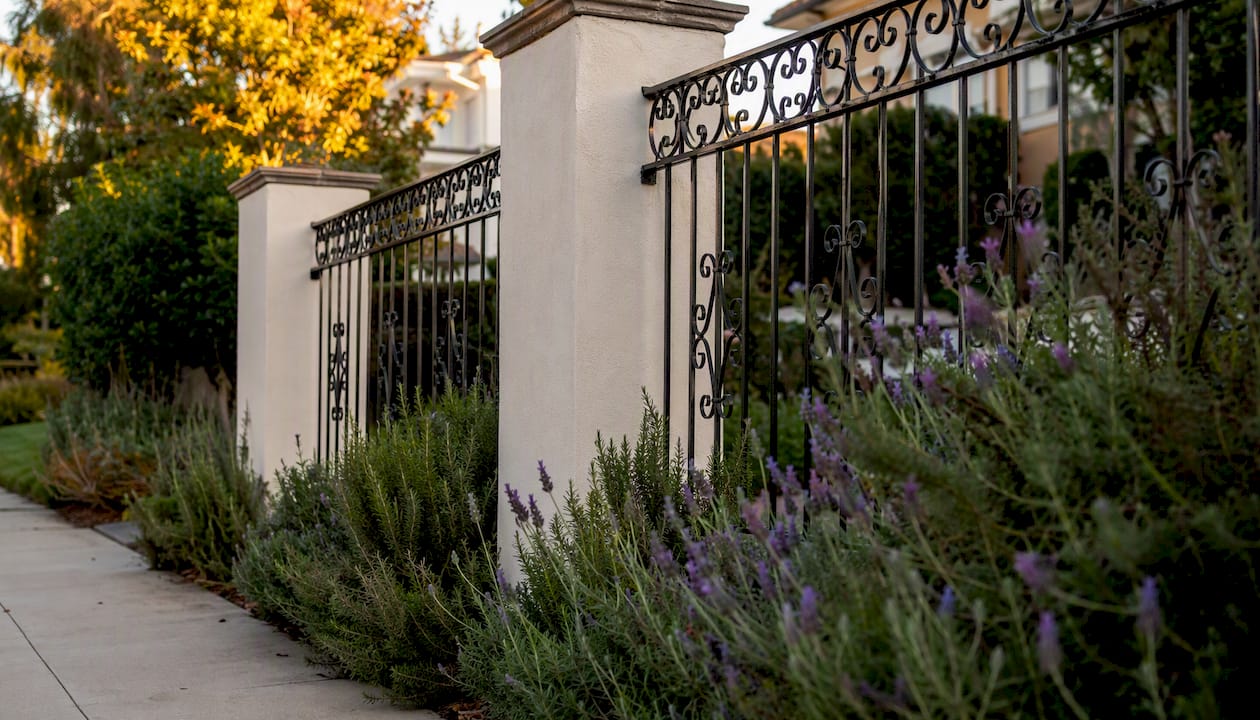
For coastal properties in Santa Monica or Brentwood, powder-coated iron outperforms painted steel, and stainless hardware on gates prevents the orange streaking that ruins an otherwise clean finish.
How do you install a Mediterranean fence step by step?
Follow this sequence for a clean, structurally sound result. Each step states the best practice first.
- Locate utilities and pull permits. Call 811 at least three business days before digging. Submit permit applications before ordering materials.
- Lay out the fence line. Use batter boards and mason’s line to mark the exact fence line. Confirm setbacks from property lines and sidewalks.
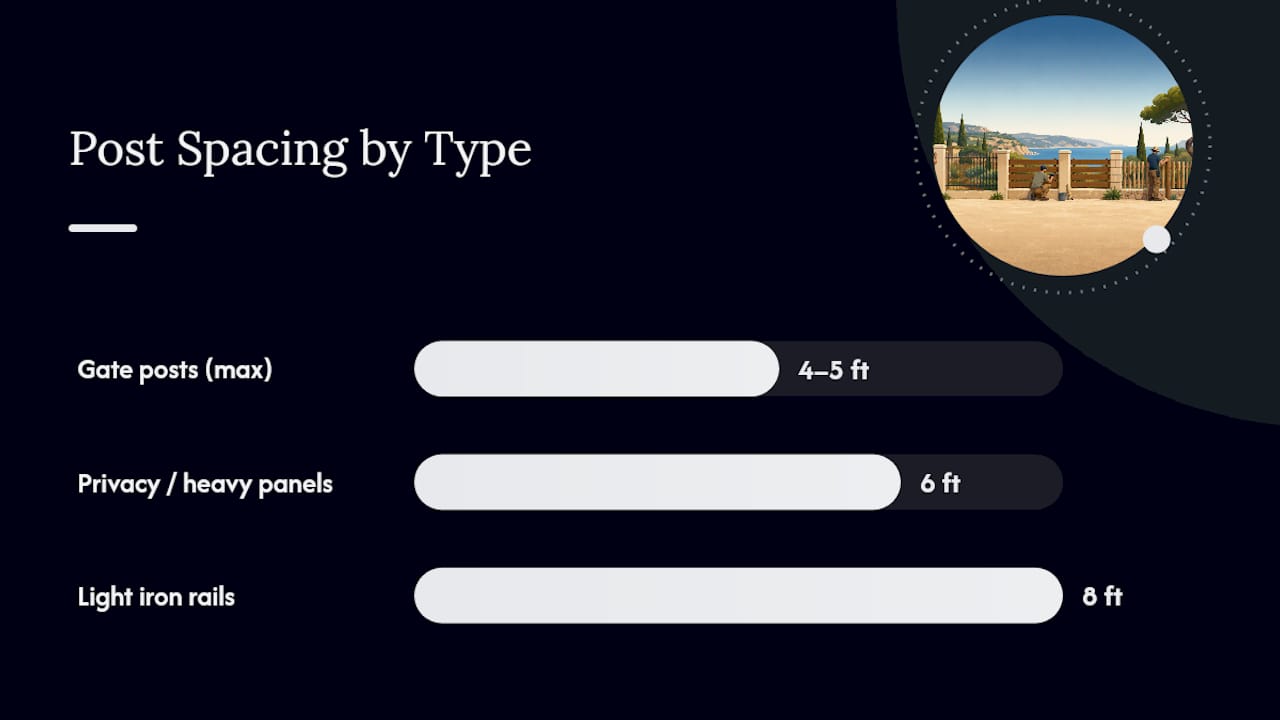
- Mark post locations. Space posts 6 feet apart for privacy panels or heavier decorative sections; 8 feet is acceptable for lighter iron rail sections in stable soil.
- Dig post holes. Use a power auger for efficiency. Diameter should be three times the post width. Depth: 2 feet for standard posts, 3 feet for gate posts and taller walls.
- Set posts in concrete. Use an 80-lb bag of fast-setting concrete per standard hole (adjust for 3-foot holes). Crown the concrete slightly above grade and slope it away from the post for drainage. Check plumb on two axes before the concrete sets.
- Attach rails and panels. For iron panels, weld or bolt to posts using stainless hardware. For wood panels between stone piers, use galvanized joist hangers and stainless screws. Maintain a 2-inch clearance between panel bottoms and grade.
- Install gates. Gate posts need 3-foot depth and a reinforced concrete footing. Use heavy-duty hinges rated for the gate’s actual weight; decorative iron gates often weigh 80–150 lbs per leaf. Set the latch at 42–48 inches for comfortable adult reach. For swing gates, confirm the sweep arc is clear of paving and plantings. For automated gate options, consult a licensed installer for electrical and safety sensor requirements.
- Apply finishes. Touch up powder coating on iron with cold-galvanizing compound. Seal wood with a penetrating oil stain. Apply a masonry sealer to stucco copings and stone piers.
Pro Tip: Pre-assemble iron panel sections on a flat surface before lifting them into place. Checking squareness on the ground takes minutes; correcting a racked panel after it’s bolted to posts takes hours.
| Dimension | Standard | Gate posts / tall walls |
|---|---|---|
| Post spacing | standard post spacing varies according to panel style | 4–5 ft max between gate posts |
| Post depth | post depth sufficient for stability | increased post depth for gate posts or taller walls |
| Concrete per hole (post depth sufficient for stability) | 1 × 80-lb bag | 2 × 80-lb bags |
| Panel / section length | 6–8 ft | Per gate opening width |
For LA-specific post footing guidance, including expansive clay soil considerations common in the San Fernando Valley, review the detailed post installation resource.
What mistakes do homeowners make when installing a fence?
Most installation failures trace back to four root causes: poor drainage, shallow posts, wrong concrete mix, and skipping the permit check.
- Shallow posts: A post set only 18 inches deep in loose LA soil will lean within one wet season. Minimum 2 feet; 3 feet for gate posts.
- Poor drainage at footings: Water pooling around a post base accelerates rot in wood and corrosion in metal. Crown your concrete footings and add a 4-inch gravel collar around each post hole before pouring.
- Wrong concrete mix: Bagged fast-setting concrete (Quikrete or equivalent) works for most residential posts. Do not use a weak sand-mix concrete; it lacks the compressive strength for gate posts.
- Skipping height and setback checks: A fence built 6 inches too tall or 12 inches too close to the sidewalk can trigger a stop-work order. LA fence height rules vary by zone and front-yard vs. rear-yard location.
- Overplanting next to the fence: Mediterranean plantings need room to reach mature size. Cramming plants before they fill out ruins the geometry and creates a maintenance burden.
Stop and call a pro when: the fence line runs along a retaining wall, the lot drops more than 3 feet across the fence run, or you hit unmarked conduit or pipe while digging. Structural retaining-wall-adjacent fences in Los Angeles require a licensed engineer’s stamp, and proceeding without one voids your permit.
For sagging panels, check whether the post has moved rather than the panel hardware. A plumb check at the post base usually reveals the real problem. Gate misalignment almost always traces to a post that has shifted; re-plumb and re-pack the footing before adjusting hinges.
What permits and HOA rules apply to Mediterranean fences in Los Angeles?
Most exterior fence and wall projects in Los Angeles require a municipal permit, and HOA CC&R restrictions can be stricter than city code. Check both before finalizing your design.
Step-by-step local checklist:
- Pull your property plat from the LA County Assessor’s office to confirm lot lines and easements.
- Contact your city’s permit office (LADBS for unincorporated LA; separate offices for Beverly Hills, Culver City, Pasadena, etc.) to confirm height limits, setback rules, and required plan submittals.
- Review your HOA’s CC&R documents for material restrictions, color approval requirements, and submittal deadlines.
- Check whether your fence qualifies for an over-the-counter permit or requires plan check review.
- If using a contractor, confirm they will pull the permit in their name and carry current liability insurance.
Culver City example: The Culver City Objective Design Standards require fence and wall materials, colors, and detailing to match the home’s architectural style. Permanent chain-link fencing is explicitly prohibited in certain contexts, and front-yard wall setbacks include planting requirements to preserve neighborhood character. If your home is Spanish Colonial or Mediterranean Revival, the ODS effectively mandates the warm-toned masonry and iron materials this guide recommends anyway.
Licensed contractors report that homeowners consistently underestimate local regulation complexity. A design-build partner who knows Culver City, Brentwood, or Pasadena’s specific requirements can prevent costly redesigns after permit submission.
How do you maintain a Mediterranean fence and integrate it with your garden?
Seasonal maintenance protects your investment; the right plant palette makes the fence look intentional rather than isolated.
Maintenance tasks by frequency:
- Monthly: Clear vegetation from the fence base to prevent moisture retention and pest harborage.
- Seasonally: Inspect iron for rust spots and touch up with cold-galvanizing spray. Check wood for checking or splitting and apply penetrating oil if needed.
- Annually: Reseal stone and stucco copings with a breathable masonry sealer. Inspect gate hinges and latches for corrosion; replace stainless hardware if pitting appears.
Garden integration: Mediterranean gardens prioritize drought-tolerant plants, gravel hardscapes, and low-maintenance structure. Plant olive trees, Italian cypress, rosemary, lavender, and thyme near the fence line. These species thrive in LA’s dry summers and provide privacy, fragrance, and visual rhythm between piers.
Plant in autumn or early winter for establishment before summer heat. Use crushed rock and sharp sand in planting holes rather than compost; compost holds moisture that kills plants adapted to gritty, fast-draining soils. A 2–3 inch gravel mulch layer keeps crowns dry and suppresses weeds without trapping moisture.
Keep drip irrigation emitters at least 12 inches from fence posts and stone bases. Turf irrigation spraying directly onto stucco or wood accelerates deterioration faster than almost any other single factor.
| Plant | LA microclimate fit | Placement near fence |
|---|---|---|
| Italian cypress | Full sun, low water | Vertical accent at piers |
| Olive tree | Full sun, drought-tolerant | 6–8 ft from fence base |
| Rosemary | Full sun, coastal-tolerant | Low border along fence run |
| Lavender | Full sun, well-drained | Mid-border, 2–increased post depth for gate posts or taller walls spacing |
| Thyme (creeping) | Full sun, dry | Ground cover at fence base |
Should you DIY or hire a pro, and what does it cost in Los Angeles?
Small, level runs of wood panels or simple iron sections between existing piers are reasonable DIY projects. Anything involving gates, slopes, retaining walls, or permit plan check should go to a licensed contractor.
Decision criteria:
- DIY-appropriate: Single-material runs under 50 linear feet on flat ground, no gate, stable soil, no HOA submittal required.
- Hire a pro: Gate installation (especially heavy decorative iron), hillside lots, retaining-wall-adjacent fences, projects requiring plan check, or any automated gate system.
Terrain significantly affects cost in Los Angeles.
Typical project timeline:
- Design and material selection: 1–2 weeks
- Permit application and review: 2–6 weeks (LA plan check can run longer for complex sites)
- Material fabrication and delivery: 2–4 weeks for custom iron panels
- Site prep and installation: 3–7 days for a typical residential run
- Finishing, inspection, and punch list: 2–5 days
The most common delay in Los Angeles is permit review, not installation. Submit early and have your HOA approval in hand before the city submittal.
What most homeowners get wrong about Mediterranean fencing
The biggest mistake is treating Mediterranean style as a finish choice rather than a structural and regulatory commitment. A coat of terracotta paint on a standard wood fence is not Mediterranean design; it is a cosmetic shortcut that will look dated within two seasons and may still violate HOA color rules.
The second mistake is sequencing. Homeowners who fall in love with a design on social media, order custom iron panels, and then check permits discover that their front-yard wall height exceeds the municipal limit by 18 inches. Redesigning fabricated ironwork is expensive. Confirming height and setback limits takes 20 minutes.
The third mistake is underestimating gate weight. Decorative iron gates can be heavy, so appropriate hinges rated for gate weight should be selected to ensure durability. An undersized hinge fails within months, and the repair cost often exceeds what a correct installation would have cost originally.
Design coherence, permit sequencing, and hardware sizing: get those three right and the rest of the project follows logically.
Get an instant LA cost estimate before you commit to a design
Knowing your installed cost range before you finalize materials is the single fastest way to avoid a redesign. Fence-gate-estimator returns an LA-specific cost breakdown by material, linear footage, gate type, and permit complexity, using current local labor and material rates.
To get the most accurate estimate, have your total linear footage, preferred material (wrought iron, stone base, wood panel, or composite), and gate type ready before you start. The tool covers custom fencing across Los Angeles, including Beverly Hills, Pasadena, Santa Monica, and Culver City. For automated or heavy decorative gates, the estimator flags when an on-site consult is the smarter next step.
Run your numbers at Fence-gate-estimator and know your realistic budget before a single post is ordered.
Sources
- Exterior Home Upgrades In Los Angeles: Ideas, Costs, And Smart Planning - MDRN Construction
- How to Plan a Mediterranean Drought-Tolerant Garden | DFN – Dragonfly Farm & Nursery
- Culver City objective design standards (ODS) - Culver City
- Fencing and Privacy Solutions for Mediterranean-Style Houses – Engineers and Architects of America
- How to create a Mediterranean garden - Better Homes & Gardens
- Urban design guidance / standards (excerpt) - URBANdesignLA
- Mediterranean landscape style: climate and core elements - Randy Lemmon
FAQ
Should fence posts be 6 or 8 feet apart?
Six feet is the standard spacing for privacy panels and heavier decorative sections; 8 feet works for lighter open-rail iron designs in stable, compacted soil. Gate posts should be spaced to match your gate opening width, typically 4–5 feet clear.
Is 2 feet deep enough for fence posts?
Two feet is sufficient for standard side and rear fence posts in stable soil. Gate posts, posts on hillside lots, and any post supporting a wall taller than 4 feet should be set at 3 feet with a reinforced concrete footing.
What are common mistakes when installing a wood fence?
The most frequent mistakes are setting posts too shallow, skipping drainage gravel around footings, and failing to check local height and setback rules before building. Overplanting immediately next to the fence base is also a common error that causes moisture damage over time.
How do I make my garden look Mediterranean?
Use a restrained earthy palette of gravel, stone, and terracotta, then plant structural drought-tolerant species like olive, Italian cypress, rosemary, and lavender. Plant in autumn for best establishment, and use crushed rock rather than compost in planting holes to keep drainage fast.
Do I need a permit for a fence in Los Angeles?
Most new fences and masonry walls in Los Angeles require a permit from LADBS or the relevant city building department. Height limits, setback rules, and material restrictions vary by zone, so confirm requirements before submitting plans or purchasing materials.
Recommended
- Expert aluminum fence installation guide for upscale LA homes | LA Electric Gate Service
- Fence post installation in Los Angeles: 5 key essentials | LA Electric Gate Service
- Custom fence components: build luxury, security, and style in LA | LA Electric Gate Service
- Expert Gate & Fence Blog | LA Electric Gate Service