Fence and Landscaping Interaction: Design, Plant, and Maintain
By BabyLoveGrowth AI
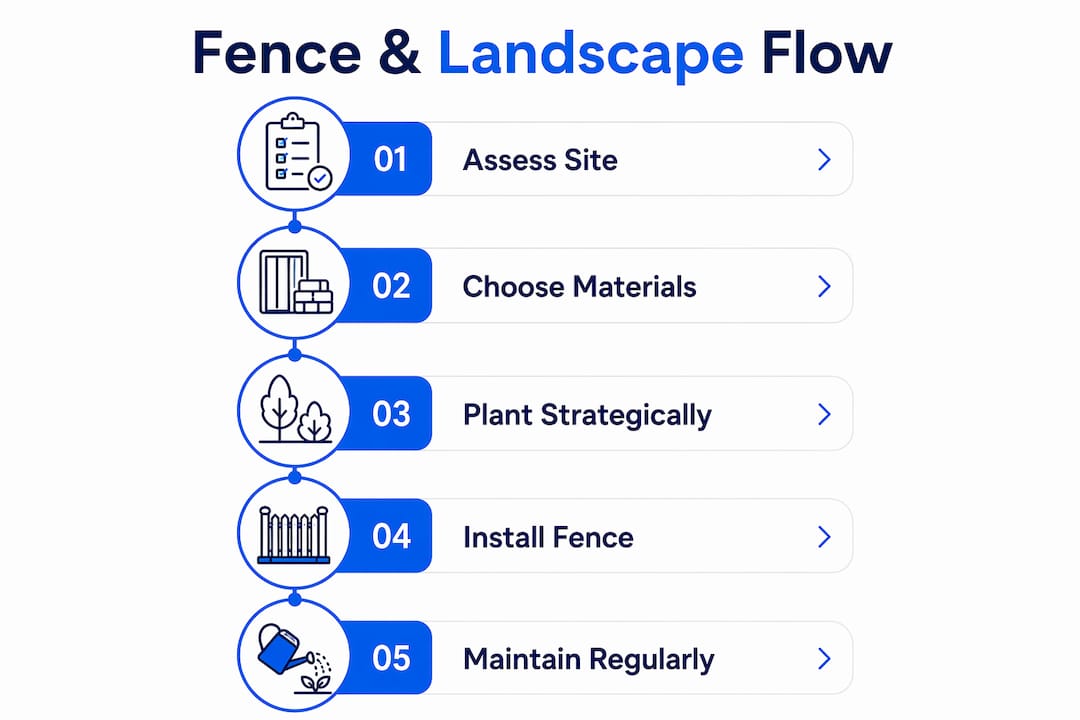
Treat your fence as the landscape’s backbone, then build outward in three steps: install the fence to its final structural height, plant in tiered bands to soften the line, and plan irrigation and drainage to sustain everything long-term. That sequence prevents the most common and costly mistakes Los Angeles homeowners face, from permit rework to post rot caused by poorly routed drip lines.
Three high-impact actions to take before anything else:
- Confirm your fence is permitted and at its final height before placing a single plant.
- Plan a tiered planting screen: tall vertical specimens at the back, mid-height shrubs in the middle, low groundcover at the front.
- Map your irrigation zones and drainage paths so water flows away from posts, not against them.
Pro Tip: Before breaking ground, check your local zoning code and HOA rules. In many Los Angeles neighborhoods, a fence that crosses a property corner or sits within a required setback triggers a separate review, even when the height is under the standard limit.
Table of Contents
- Why combining fencing and landscaping improves your property
- How to assess your site before you design anything
- Choosing fence styles, materials, and finishes that work with plants
- How to plant along a fence line for privacy and visual depth
- Getting privacy and security without a fortress look
- Contractor handoff checklist for a fence and planting project
- Maintenance schedule to keep fences and plants healthy together
- Cost ranges and permit steps for Los Angeles homeowners
- Key Takeaways
- The case for designing fence and landscape as one project
- Get an instant estimate for your Los Angeles fence project
- Useful sources for permits, plant selection, and design references
- FAQ
Why combining fencing and landscaping improves your property
A fence alone reads as a barrier. Plants alone take years to deliver real privacy. The fence and landscaping interaction between the two solves both problems at once: the fence gives you immediate screening and structure while the planting softens the visual weight and adds long-term value.
- Immediate privacy without waiting a decade for trees to mature.
- Curb appeal and resale value from a yard that looks designed rather than enclosed.
- Reduced “fortress” effect by using foliage to break up long fence runs.
- Defined outdoor rooms that feel like a retreat rather than a containment zone.
For Los Angeles homeowners in Brentwood, Beverly Hills, or Santa Monica, where lot sizes are tight and neighbor sightlines are close, this layered approach also preserves view corridors while blocking unwanted angles. A well-integrated fence adds measurable curb appeal and contributes to resale positioning in competitive LA neighborhoods.
Pairing a durable privacy fence with evergreen plantings and modular screens typically produces the best blend of instant privacy and long-term value — outperforming either a fence-only or planting-only approach for most residential properties. Source
How to assess your site before you design anything
Treating the fence and landscape as separate projects is the single most common professional pitfall. Unified hardscape-softscape planning prevents fragmentation and post-installation conflicts that cost real money to fix.
Define your goals first:
- Privacy vs. view preservation (partial screening vs. full enclosure)
- Pet or child containment (height, gap spacing, gate placement)
- Security requirements (camera sightlines, lighting zones)
- Aesthetic goals (modern horizontal, traditional picket, Mediterranean)
Site conditions to document:
- Sun exposure and prevailing wind direction by fence line
- Soil type and drainage (clay-heavy soils common in parts of the San Fernando Valley hold water against posts)
- Slope and grade changes (critical for cost and post depth in hillside neighborhoods like Bel Air or Studio City)
- Existing utilities, irrigation lines, and underground infrastructure
Local permit checklist for Los Angeles:
- Confirm backyard fence height limit (typically 6 feet for solid fences in most LA residential zones).
- Check front-yard height restrictions, which are often lower (commonly 3.5 feet for solid structures).
- Verify HOA rules, which may be stricter than city codes.
- Contact the Los Angeles Department of Building and Safety (LADBS) for your specific parcel’s zoning overlay.
- Ask whether lattice toppers or modular privacy panels require a structural permit in your zone.
Pro Tip: At street corners, measure the required sight-triangle clearance before finalizing fence height. Most LA zoning codes require an unobstructed triangle at intersections. Modular screens set back from the property line can deliver privacy without triggering that restriction.
Choosing fence styles, materials, and finishes that work with plants
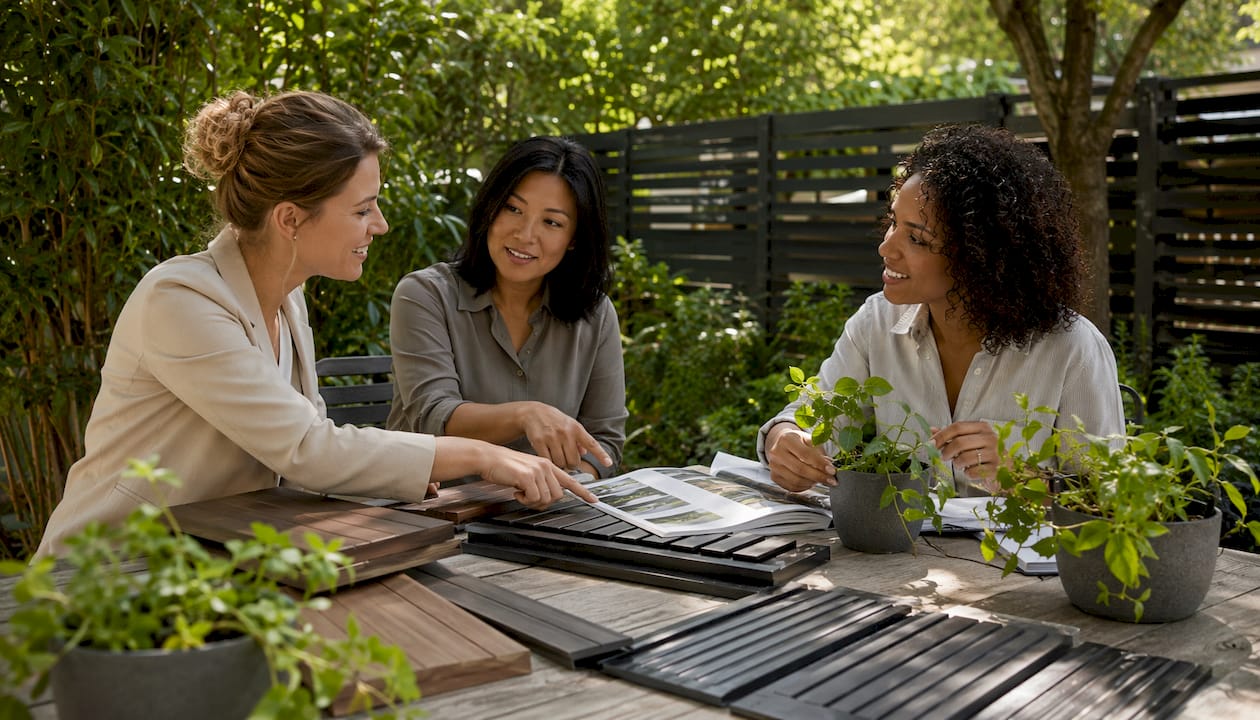
Material choice shapes every downstream decision: how plants anchor to the fence, how moisture behaves at the post base, and how much maintenance you’ll do in five years.
| Material | Durability | Maintenance | Cost shape | Planting compatibility |
|---|---|---|---|---|
| Wood (cedar, redwood) | Moderate | High (stain every 2–3 yrs) | Lower upfront, higher long-term | Excellent for climbers; moisture risk at posts |
| Composite/vinyl | High | Low | Higher upfront, lower long-term | Good; no staining; smooth surface limits climber grip |
| Aluminum | High | Very low | Mid-range | Good; open picket design suits vertical plants |
| Wrought iron/steel | Very high | Moderate (rust prevention) | High upfront | Excellent for climbers on lattice; heavy visual weight |
For premium residential fencing in LA’s upscale neighborhoods, wrought iron and powder-coated steel pair well with Mediterranean planting schemes. Horizontal cedar slats with a dark stain work particularly well on hillside properties in Sherman Oaks or Encino because the dark tone visually recedes against dense foliage.
Practical design choices for LA homes:
- Horizontal modern fence + low-water Mediterranean planting (lavender, rosemary, agave) for a clean, drought-tolerant look.
- Open-slat aluminum + columnar Italian cypress for a formal, narrow privacy screen.
- Dark-stained wood + climbing roses or jasmine for a traditional Pasadena or Brentwood aesthetic.
- Corten steel + ornamental grasses for a contemporary hillside property.
Fences also function as multipurpose garden structures: backdrop, trellis support for climbers, and a way to define distinct outdoor rooms when combined with hardscaping like patios or raised beds.
Pro Tip: Match fence scale to lot size. A 6-foot solid fence on a narrow 40-foot-wide lot reads as a wall. Dropping to 5 feet with a lattice topper, or switching to an open-picket design, keeps the yard from feeling compressed.
How to plant along a fence line for privacy and visual depth
Layering plant heights is the technique that makes a fence recede visually. Tall specimens at the back, mid-height shrubs in the middle, and low groundcover at the front draw the eye to the foliage rather than the structure behind it.
The three-layer framework:
- Tall vertical layer (6–15 ft): Columnar trees or large shrubs set 3–4 feet from the fence. Good LA choices: Italian cypress (Cupressus sempervirens), ‘Sky Pencil’ holly, or clumping bamboo (non-invasive varieties only).
- Mid-height shrubs (3–6 ft): Planted 18–24 inches from the fence. Options: pittosporum, photinia, or native toyon for drought tolerance.
- Low groundcover (under 2 ft): Fills the base and suppresses weeds. Dymondia, creeping rosemary, or native sedge work well in Southern California’s dry summers.
Spacing and root guidance:
- Keep large shrubs and trees at least 2–3 feet from fence posts to allow maintenance access and prevent root pressure on footings.
- Use root barriers for aggressive species (bamboo, ficus) planted within 5 feet of any post.
- Leave a 12-inch clear zone at the base of wood posts; mulch is fine but should not contact the post directly.
For backyard privacy planting that works year-round in LA’s climate, prioritize evergreen species over deciduous ones. Deciduous plants leave the fence fully exposed in winter, which defeats the privacy goal for most of the year.
Irrigation basics:
- Use drip irrigation rather than spray heads near fence lines; spray heads direct water against posts and accelerate rot or corrosion.
- Route drip lines parallel to the fence, not under post footings.
- Install a moisture sensor or smart controller to prevent overwatering in LA’s dry-season months.
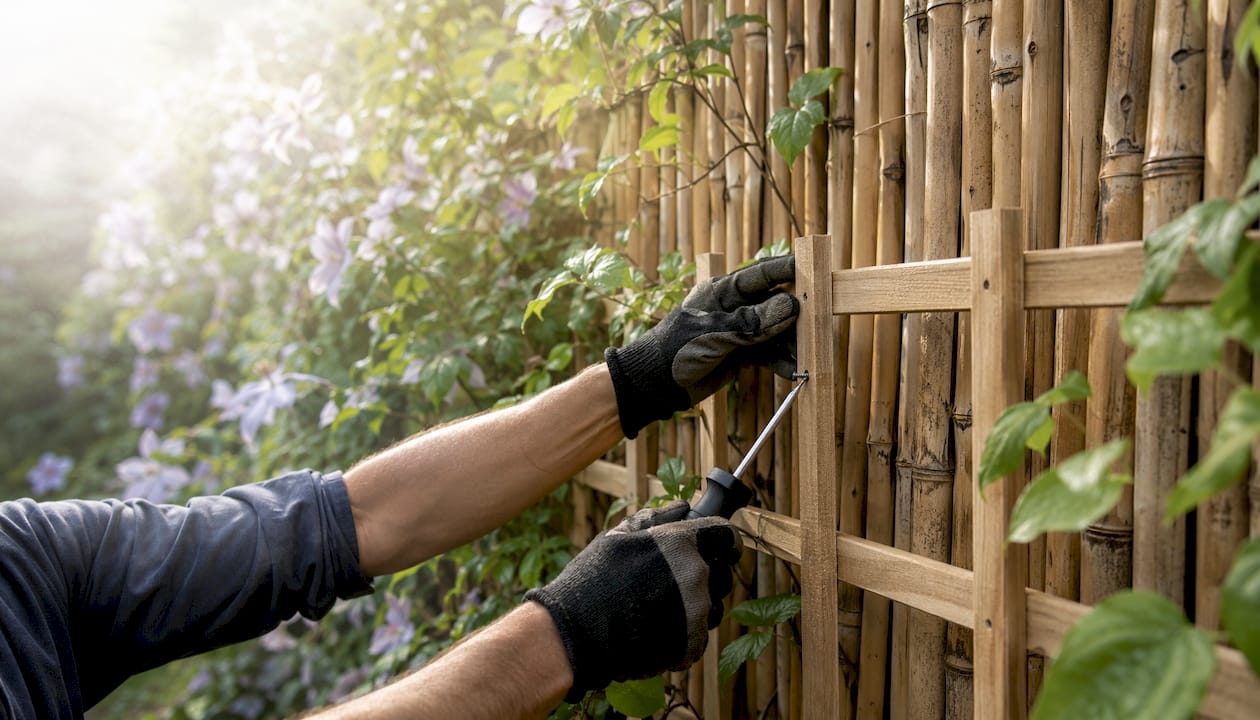
Pro Tip: For climbers like star jasmine or bougainvillea, attach a separate trellis or lattice panel set 4–6 inches off the fence face. This protects the fence finish, allows air circulation, and makes it far easier to repaint or restain without removing the plant.
Getting privacy and security without a fortress look
Security and aesthetics can coexist when planting is positioned to preserve sightlines rather than block them. Selective placement and low plantings near cameras keep surveillance effective while the fence line still looks designed.
Practical tactics:
- Keep a clear 3-foot zone around any camera or sensor; use low groundcover there, not tall shrubs.
- Place thorny species (bougainvillea, natal plum, pyracantha) at fence bases in zones where deterrence matters, such as side-yard access points.
- Use thin columnar evergreens set 2–3 feet off the fence face rather than dense mass plantings against the fence itself.
- Terrace sloped properties to block approach lines without requiring a taller fence.
For security-focused installations in West Hollywood or Culver City, where properties are close together, combining a 6-foot fence with strategic lighting and sparse vertical planting delivers both deterrence and a yard that reads as welcoming from the street.
Pro Tip: Low-voltage path lighting along the fence base serves double duty: it deters intrusion and highlights the planting at night, turning a security feature into a design element.
Contractor handoff checklist for a fence and planting project
Treating the fence and landscape as one project from the start prevents the most expensive rework. Coordinating post locations, hardscape anchors, and irrigation routing before pouring footings avoids conflicts that are difficult and costly to fix after installation.
Questions to ask your contractor before work begins:
- Who pulls the permit, and what is the timeline for LADBS approval?
- How will you protect existing irrigation lines during post installation?
- What is the post depth and footing spec for this soil type?
- What warranty covers posts in contact with irrigated soil?
- How will you handle grade changes along the fence run?
Installation checklist:
- Confirm post spacing matches the planting plan (wider spacing allows larger specimen plants between posts).
- Specify drainage gravel or concrete collars at post bases in clay-heavy soils.
- Mark all utility lines before digging (call 811 in California).
- Agree on a clearance zone for mature plant growth before finalizing post placement.
Sequencing: fence first or plants first?
Install the fence first in most cases. This gives you a fixed structure to design the planting around, and it prevents plant damage from construction equipment. The exception: if you have mature specimen trees or established shrubs you want to preserve, map those first and route the fence around them.
Pro Tip: Ask your contractor to leave a 6-inch gap between the bottom fence rail and grade on planted sides. This allows groundcover to grow under the fence naturally and prevents soil buildup against the base rail.
Maintenance schedule to keep fences and plants healthy together
A consistent maintenance routine extends fence life and keeps the planting from overwhelming the structure. The goal is preventing the two from working against each other over time.
- Spring: Inspect all posts for movement or rot. Prune climbers back from fence hardware. Check irrigation emitters for clogs after winter.
- Early summer: Apply stain or sealant to wood fences before peak heat. Trim mid-height shrubs to maintain the 12-inch clearance from posts.
- Late summer: Check for pest harborage in dense plantings against the fence base. Thin any growth that blocks camera or sensor sightlines.
- Fall: Cut back deciduous plants. Clean debris from the base of fence posts. Inspect metal hardware for surface rust before the rainy season.
- Annual: Full structural inspection of post footings, gate hardware, and fence panel connections. Adjust irrigation schedule for the coming season.
Pro Tip: Set a calendar reminder to prune climbers twice a year, in March and September. Climbers that go unchecked for more than 18 months can work their way under fence caps and panel joints, trapping moisture and accelerating deterioration.
Cost ranges and permit steps for Los Angeles homeowners
Fence installation costs in Los Angeles vary significantly by material, lot configuration, slope, and custom features. These are general ranges to use for budgeting; your actual cost depends on linear footage, site conditions, and finish specifications.
- Wood fencing: Typically $25–$45 per linear foot installed, depending on species and finish.
- Vinyl/composite: Generally $30–$50 per linear foot installed.
- Aluminum: Often $35–$60 per linear foot for standard residential grades.
- Wrought iron/steel: Commonly $60–$120+ per linear foot for custom fabrication.
Slopes, hillside access, and custom gate integration add to these figures. Terrain complexity is one of the largest cost variables in LA neighborhoods like Bel Air, Encino, and the Hollywood Hills.
Los Angeles permit checklist:
- Backyard solid fences up to 6 feet typically require only a standard building permit from LADBS.
- Front-yard fences above 3.5 feet usually require a permit and may trigger design review in some zones.
- Lattice toppers and non-permanent modular panels may avoid structural permit requirements in many LA zones, making them a practical option for adding height without a full permit process.
- Contact LADBS at ladbs.org or visit your local district office to confirm requirements for your parcel.
Fence-gate-estimator provides instant, itemized cost estimates for Los Angeles residential projects — including Beverly Hills, Santa Monica, Pasadena, and Glendale — using current local material and labor rates.
Use the instant cost calculator to generate a contractor-ready estimate before your first site visit. It accounts for material type, linear footage, slope, and gate features, so you arrive at the conversation with realistic numbers.
Key Takeaways
Treating the fence as a structural backdrop and layering plants in front of it produces better privacy, aesthetics, and long-term value than either element alone.
| Point | Details |
|---|---|
| Fence as backdrop | Plant in tiered bands so foliage draws the eye and the fence recedes visually. |
| Permit early | Confirm LADBS height limits and HOA rules before installation to avoid rework. |
| Irrigation away from posts | Use drip lines parallel to the fence; keep spray heads and mulch off post bases. |
| Sequence matters | Install the fence first, then design planting around it, unless mature specimens must be preserved. |
| Fence-gate-estimator | Use the instant estimator at fence-gate-estimator.com for contractor-ready LA cost ranges before your first site visit. |
The case for designing fence and landscape as one project
Most homeowners approach fencing and landscaping as two separate budgets, two separate contractors, and two separate timelines. That split is where the problems start. Permit surprises, irrigation lines cut during post installation, and plants placed too close to footings are almost always the result of planning that treated the fence as a construction project and the garden as a decoration added afterward.
What we see consistently in LA projects, from Sherman Oaks to Brentwood, is that the properties that look genuinely designed, rather than assembled, are the ones where the fence height, post spacing, and planting plan were decided together. The fence becomes a frame. The plants become the picture. Neither one works as well without the other.
The permit piece catches people off guard more than any other step. Los Angeles has layered zoning rules, HOA overlays, and hillside-specific requirements that can change the entire scope of a project. Getting that clarity upfront, before materials are ordered, is the single most valuable thing you can do.
Get an instant estimate for your Los Angeles fence project
Knowing your budget before you call a contractor changes the entire conversation. Fence-gate-estimator gives Los Angeles homeowners an immediate, itemized cost breakdown based on your property’s actual dimensions, material preferences, and gate requirements, using current local labor and material rates.
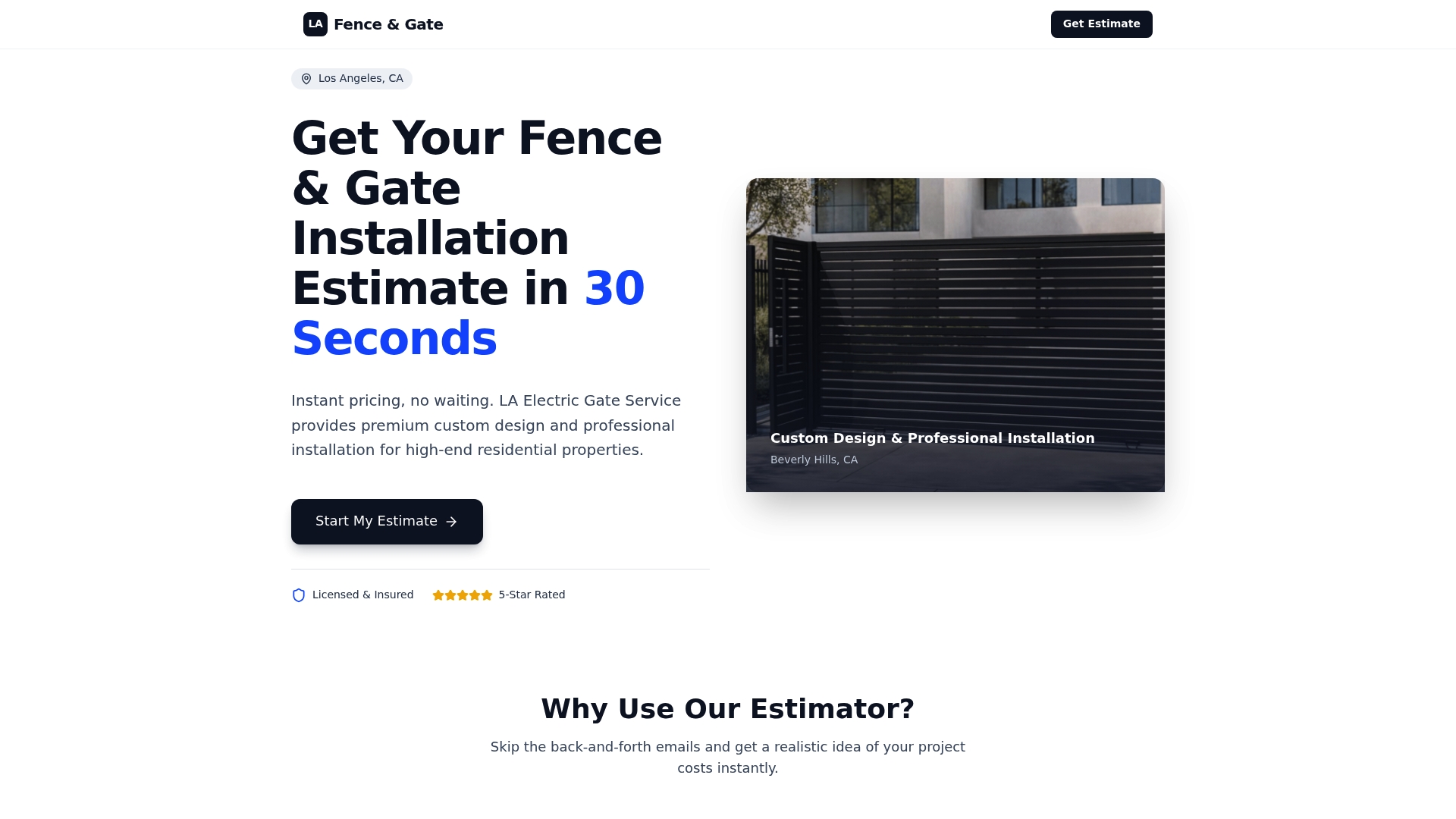
Whether you’re planning a custom wrought iron fence in Beverly Hills, a horizontal cedar screen in Santa Monica, or an automated gate system in Pasadena, the estimator produces contractor-ready numbers in minutes. Services include custom fencing fabrication, gate automation, permit guidance, and warranty-backed professional installation across the greater Los Angeles area.
Get your instant estimate and arrive at your contractor conversation with real numbers already in hand.
Useful sources for permits, plant selection, and design references
These resources are worth bookmarking before you start your project.
| Resource | What it covers | Why it matters for LA homeowners |
|---|---|---|
| Los Angeles Dept. of Building and Safety (LADBS) | Permits, zoning overlays, height limits | Primary source for fence permit requirements by parcel |
| USDA Plant Hardiness Zone Map | Plant zone data for your ZIP code | Confirms which species survive LA’s local climate zones |
| Calflora | Native California plant database | Identifies low-water, non-invasive species suited to LA microclimates |
| California 811 (Dig Safe) | Underground utility locating | Required before any post installation in California |
| Fence-gate-estimator | Instant cost estimates for LA fence and gate projects | Produces contractor-ready budgets for custom and standard installations |
FAQ
Should you install the fence before landscaping?
Yes, in most cases. Installing the fence first gives you a fixed structure to design the planting around and prevents plant damage from construction equipment.
How do you landscape along a fence line?
Use a three-layer approach: tall vertical specimens at the back, mid-height shrubs in the middle, and low groundcover at the front. Keep plants at least 12–24 inches from post bases.
What is the standard fence height limit in Los Angeles backyards?
Most Los Angeles residential zones allow solid backyard fences up to 6 feet without a variance; front-yard limits are typically lower. Always confirm with LADBS for your specific parcel.
What is the rule of three in landscaping?
The rule of three means planting in odd-numbered groupings of three for a more natural, visually balanced result. It applies to shrubs, groundcovers, and accent plants along a fence line.
How does Fence-gate-estimator help with fence and plant planning?
Fence-gate-estimator provides instant, itemized cost estimates for Los Angeles residential projects, including material selection, slope adjustments, and gate features, so you can budget the full fence and landscape scope before hiring a contractor.
Recommended
- How terrain impacts fence costs in Los Angeles: smart choices | LA Electric Gate Service
- Custom fence components: build luxury, security, and style in LA | LA Electric Gate Service
- Why Upgrade Residential Fences: A Homeowner’s Guide | LA Electric Gate Service
- Why Fence Installation Matters for Your Property | LA Electric Gate Service