What Is a Gate Master Control? A Homeowner's Guide
By BabyLoveGrowth
What Is a Gate Master Control? A Homeowner’s Guide
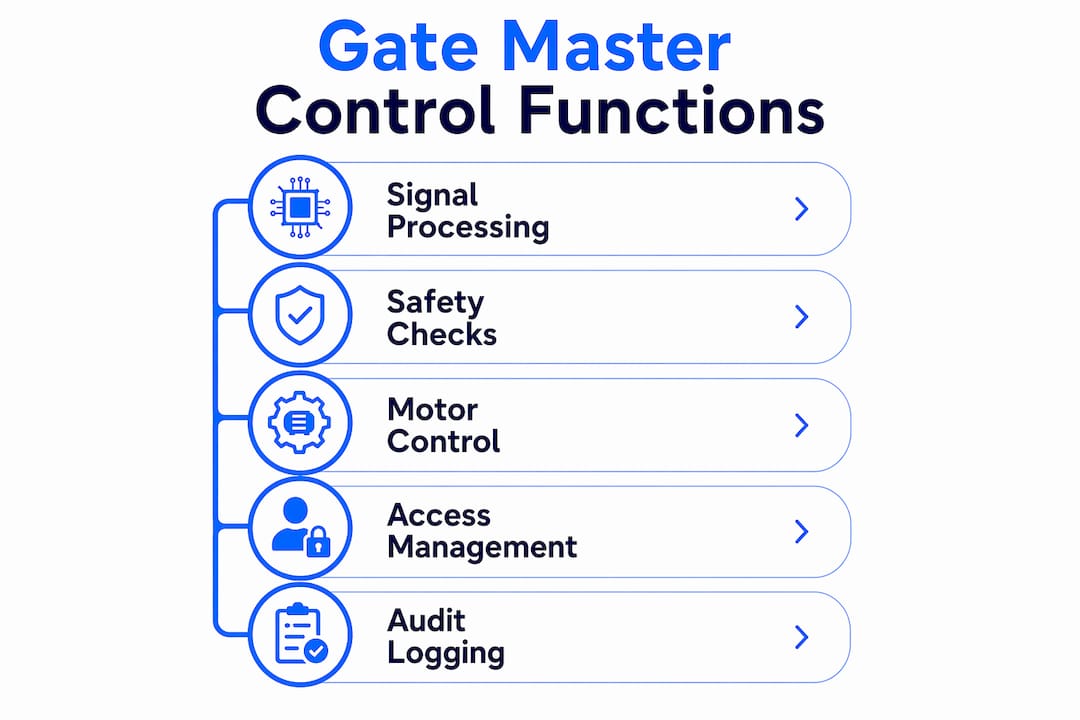
A gate master control is defined as the centralized electronic command unit that directs every operation of an automated gate system, from processing entry signals to managing motor movement and enforcing safety checks. Most homeowners know they have a gate opener, but the control board is the actual brain behind it. Without it, no remote, keypad, or sensor can move your gate. Understanding what a gate master control does helps you make better decisions about installation, maintenance, and security upgrades for your property.
What is a gate master control and how does it fit into your system?
A gate master control, also called a logic board or control board, is the centralized electronic command unit that manages entry signals, safety verification, and motor commands for an automated gate. The terms “gate operator” and “control board” are often used interchangeably, but they are not the same thing. The operator is the mechanical housing and motor assembly. The control board is the electronic circuit inside that tells the motor what to do and when to stop.
This distinction matters because safety compliance is enforced by the control board’s logic, not by the motor itself. A gate that moves without a properly functioning control board is a gate that cannot verify safety conditions before it acts. For homeowners in Beverly Hills, Bel Air, or Brentwood with high-traffic driveways, that gap in safety logic is a real liability.
The control board sits inside the operator housing and connects to every input and output in the system. It receives signals, runs safety checks, and then decides whether to open, hold, or close the gate. Every automated gate system, regardless of brand or gate type, relies on this same fundamental architecture.

How does a gate master control work?
The control board interprets commands from remotes, keypads, and sensors and activates the motor accordingly, while managing all safety and operational parameters in real time. The process follows a clear sequence every time you trigger your gate.
- Signal reception. Your remote, keypad, or vehicle loop detector sends a signal to the control board. The board identifies the signal type and checks whether it is a valid open, close, or stop command.
- Safety verification. Before the motor moves, the board checks all connected safety inputs. Photo eyes, edge sensors, and limit switches must all report clear status. If any sensor reports a fault, the board holds the gate in place.
- Motor activation. Once safety checks pass, the board sends a voltage command to the motor. It controls the direction of travel, speed ramping, and torque limits to protect both the gate and anyone near it.
- Operational management. The board monitors the gate throughout its travel. It applies soft-start and soft-stop timing to reduce mechanical wear, tracks position via limit switches, and triggers the auto-close timer once the gate reaches the fully open position.
- Audit and fault logging. Modern boards record entry events and fault codes. This log helps technicians diagnose problems without guesswork.
The control board manages soft-start and soft-stop timing, automatic closing delays, safety sensor monitoring, and audit logging as standard features in 2026-era systems. That level of operational control is what separates a properly automated gate from a simple motorized barrier.
Pro Tip: If your gate reverses unexpectedly or refuses to close, check the fault log on your control board first. Most boards display a blinking LED code that points directly to the problem sensor or wiring issue, saving you a service call.
What safety features and compliance standards are built into gate master controls?
Gate control technology is governed by UL 325, the American safety standard for door, drapery, gate, louver, and window operators. The control board’s logic enforces UL 325 compliance for the entire gate system. This means the board must detect entrapment conditions and respond by stopping or reversing the gate before injury can occur.
Key safety mechanisms built into compliant control boards include:
- Photo eye monitoring. The board continuously checks that the infrared beam between photo eye sensors remains unbroken. A broken beam during gate travel triggers an immediate stop and reversal.
- Edge sensor inputs. Resistive or contact edge sensors on the gate’s leading edge signal the board when the gate contacts an obstruction. The board reverses direction within milliseconds.
- Limit switch enforcement. Limit switches tell the board exactly when the gate has reached its fully open or fully closed position. Without accurate limit data, the motor would continue running and damage the gate or the operator.
- Fault state management. When a safety input is missing or wired incorrectly, the board enters a fault state and disables gate movement entirely. Incorrect wiring causes fault states that prevent the gate from moving, which is the board protecting you from an unsafe condition.
- Surge protection. Quality control boards include onboard surge protection, but the board itself remains a common failure point due to lightning surges and moisture. Proper weatherproof housing and an external surge suppressor on the power line are both necessary.
Pro Tip: Never bypass a safety input to “get the gate working” after a fault. Bypassing photo eyes or edge sensors removes the entrapment protection that UL 325 requires. Fix the wiring or replace the sensor instead.
Los Angeles County building codes require permitted gate installations to meet UL 325 standards. If your gate was installed without permits or with bypassed safety inputs, you carry liability for any injury that results.
What connectivity and access control options do modern gate master controls support?
Modern gate control systems have moved well beyond simple radio remotes. Modern master controls support WiFi, Bluetooth, and LTE/4G connectivity for remote management, real-time notifications, and user credential databases storing 1,000 or more users. That capability is now standard in mid-range and premium residential systems.
| Connectivity Type Primary Use Typical Residential Application | ||
| WiFi | Remote smartphone control and monitoring | App-based open/close and entry alerts |
| Bluetooth | Short-range access without internet | Hands-free entry within 30 feet of gate |
| LTE/4G | Remote access where WiFi is unavailable | Rural properties or backup connectivity |
| Wiegand protocol | Keypad and card reader integration | Multi-user credential management |
| OSDP protocol | Encrypted reader communication | High-security residential installations |
The access control side of the system connects to the board through dedicated input terminals. Keypads, intercoms, card readers, and video entry panels all feed credentials into the board, which then validates the input against its stored user database. For property managers overseeing multiple units in Pasadena or West Hollywood, multi-user credential support means you can assign and revoke access without a technician visit.
Smart connectivity modules require dry contact connections and dedicated auxiliary power, not motor output terminals. Connecting a WiFi module to the wrong terminal can damage the control board’s electronics permanently. This is one reason professional installation matters for any system with smart home integration.
The gate openers available today include smartphone connectivity, entry logging, and sensor integration as standard features, which reflects how much the gate control system has evolved for residential use.
What should you consider when selecting and maintaining a gate master control?
Choosing the right control board starts with understanding your property’s specific demands. Residential boards differ from commercial multi-user systems in their credential capacity, duty cycle rating, and connectivity options. Matching the board to your actual use case prevents both overspending and underperformance.
Key factors to evaluate before selecting a gate control system:
- Gate type and weight. Swing gates and sliding gates require different motor configurations, and the control board must match the motor’s voltage and current requirements. A board rated for a light aluminum swing gate will not reliably control a heavy wrought iron slider.
- Traffic volume. A residential driveway in Encino with two cars per day needs a different duty cycle than a gated community entrance in Sherman Oaks with 50 vehicles per day. Higher traffic demands a board with a higher duty cycle rating.
- Weatherproof housing. Los Angeles has mild weather, but coastal properties in Santa Monica and Malibu face salt air and humidity. The control board enclosure must carry an appropriate IP rating to resist moisture intrusion.
- Surge protection. Install an external surge suppressor on the incoming power line in addition to any onboard protection. Environmental risks are frequent failure causes, and proper surge protection greatly improves board reliability.
- Power supply compatibility. Confirm whether the board requires 120V AC, 24V DC, or battery backup power. Mismatched power supply is a leading cause of premature board failure.
- Maintenance schedule. Inspect all safety sensor wiring connections every six months. Clean photo eye lenses quarterly. Check limit switch positions after any gate collision or hard stop event.
For driveway gate installations in Los Angeles, local permit requirements also dictate which safety features must be present and inspected. Confirming compliance before installation saves costly rework later.
Key Takeaways
A gate master control is the electronic command center that determines whether your automated gate operates safely, reliably, and with the access control features your property actually needs.
| Point Details | |
| Control board is the system brain | It processes every signal, enforces safety checks, and commands the motor before any gate movement occurs. |
| UL 325 compliance is mandatory | The control board’s logic enforces entrapment protection standards required by Los Angeles County for permitted installations. |
| Connectivity has expanded significantly | Modern boards support WiFi, LTE/4G, Wiegand, and OSDP for smartphone control and multi-user access management. |
| Environmental protection is critical | Surge protection and weatherproof housing prevent the most common causes of control board failure. |
| Board selection must match your gate | Gate type, weight, traffic volume, and power supply requirements all determine which control board fits your system. |
Why homeowners underestimate the control board
Most homeowners focus on the gate itself, the material, the design, the motor size. The control board gets almost no attention until something goes wrong. I have seen this pattern repeatedly with properties across Los Angeles. A homeowner invests in a beautiful custom wrought iron gate, then installs the cheapest control board available, and wonders why the system fails within two years.
The control board is not a commodity component. It is the part of your gate system that decides whether your property is secure or not. A board with poor fault detection will let a gate close on an obstruction. A board without surge protection will fail after the first significant electrical storm. A board without proper access control support will limit your ability to manage who enters your property.
My honest advice: spend proportionally on the control board relative to what you spent on the gate itself. If you installed a $4,000 custom gate, do not pair it with a $150 control board. The board is what makes that gate a security asset rather than just a decorative barrier. Professional installation also matters here because incorrect wiring of safety inputs is the single most common cause of UL 325 non-compliance in residential systems I have reviewed.
The gate automation process involves more decisions than most homeowners expect, and the control board is where most of those decisions have lasting consequences.
— Moin
Planning a gate automation upgrade in Los Angeles?
Fence-gate-estimator provides instant cost estimates for automated gate systems across Los Angeles, including Beverly Hills, Brentwood, Pasadena, and Santa Monica. Whether you are adding a new control board to an existing gate or planning a full automated gate installation from the ground up, the cost calculator gives you a realistic budget based on your property size, gate type, and automation features.
The platform uses current local labor and material rates to generate transparent cost breakdowns, so you know what to expect before you speak with a contractor. You can also explore access control options that pair with your gate master control for a complete residential security setup. Get your estimate in minutes and go into your installation conversation with the numbers already in hand.
Recommended
- Gate Automation Process: A Homeowner’s Practical Guide | LA Electric Gate Service
- Modern Gate Design Process: A Los Angeles Homeowner’s Guide | LA Electric Gate Service
- Gate openers: The key to secure, stylish LA homes | LA Electric Gate Service
- Maintenance Tips for Gates: A Homeowner’s 2026 Guide | LA Electric Gate Service