3.5-Foot Fence Rule: Replace a Hedge in Los Angeles Without Triggering Permits
By BabyLoveGrowth AI
Yes, you can replace a hedge with a fence almost anywhere in Los Angeles, but the city treats tall hedges as fences under the Los Angeles Municipal Code, so your new fence must obey the same height and design limits your hedge already did. Before you remove a single branch, check whether your lot sits in a Fence Height District, confirm your material choice against LADBS rules, and run a quick estimate so you know if you’re looking at a weekend project or a permitted one.
TL;DR:
- Fences that function like hedges, including dense plantings, must follow the same height and design restrictions as physical fences in Los Angeles zones.
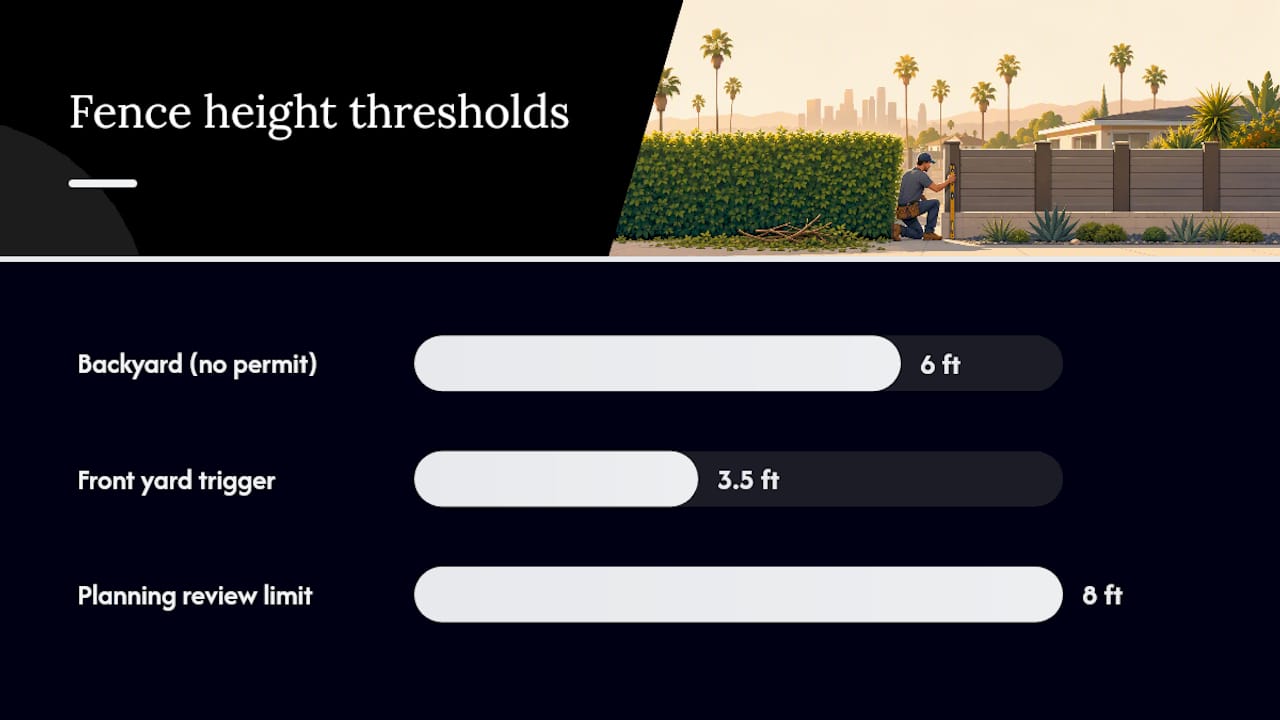
- Building masonry, concrete, or walls exceeding 3.5 feet generally requires permits and structural review, especially in front yards or FH districts with open-style rules.
- Most backyard fence replacements with wood or vinyl up to 6 feet often do not need permits, while adding automation or masonry triggers permit requirements and longer approval processes.
- Checking property zones, Fence Height Districts, and overlay regulations early with ZIMAS helps prevent project delays and design restrictions.
- Property surveys, neighbor communication, and documentation are key to avoiding disputes and complying with code, especially when high or structural fences are involved.
Table of Contents
- Which Los Angeles Laws Treat Hedges the Same as Fences?
- When Do You Need a Permit to Replace a Hedge With a Fence?
- Which Fence Materials Work Best for LA Homes?
- What Does It Cost to Remove a Hedge and Install a Fence?
- How Do You Avoid a Neighbor Dispute Over Your New Fence?
- How Fence-Gate-Estimator.com Helps You Plan the Swap
- Weighing Compliance Against What You Actually Want
- Get a Local Estimate Before You Commit to a Design
- Sources
- FAQ
Which Los Angeles Laws Treat Hedges the Same as Fences?
Under LAMC Section 12.22 C.20(f), a hedge, shrub row, or dense planting counts as a fence once it functions like one, meaning it screens a yard or marks a boundary. That single definition is why a homeowner in Sherman Oaks or Encino can’t simply swap a 6 foot ficus hedge for a 6 foot solid wood fence without checking the zoning first. The code doesn’t care whether the barrier is living or built. It cares about height, location on the lot, and how much light and sightline it blocks.
Two other rules matter just as much as the height chart:
- The spite fence law. LAMC Sec. 41.30 bans fences built maliciously to exceed 6 feet purely to annoy a neighbor, echoing California Civil Code § 841.4. A fence built at spite-fence height without a legitimate privacy or security reason can be ordered removed even after it’s built.
- Fence Height Districts (FH). Some residential zones, common across parts of Beverly Hills, Bel Air, and the hillside neighborhoods above Sunset, allow taller front-yard fences than the standard 3.5 feet, but only if they’re built as “open” wrought iron. Section 13.10 requires the open style, and it also caps any hedge planted next to that fence at 3.5 feet, so you can’t use landscaping to get privacy the fence design doesn’t allow.
- Material triggers. Wood, chain-link, and vinyl fences at standard heights typically skip building permits entirely. Masonry or concrete walls over 3.5 feet cross into structural territory under LAMC § 91.106.1 and need LADBS review, according to CityRuleLookup’s fence regulations overview.
The practical takeaway: your hedge’s current height is a decent starting point for legality, but it isn’t a guarantee your replacement fence gets a pass, especially if you’re upgrading to masonry.
When Do You Need a Permit to Replace a Hedge With a Fence?
Most straightforward hedge-to-wood-fence or hedge-to-vinyl-fence swaps at 6 feet or under in a backyard don’t require a building permit. The moment you introduce masonry, concrete block, structural steel framing, or a wall over 3.5 feet in a front yard, you’re in LADBS territory, and possibly Planning territory too if you’re requesting extra height in an FH zone.
Here’s the general sequence for a permit-triggering project:
- Verify zoning and overlays on ZIMAS. Confirm whether your parcel falls inside a Fence Height District, a hillside overlay, or a historic preservation zone before you draw anything.
- Draft elevation plans. The Planning Department’s guidance for fences and walls up to 8 feet requires dimensioned drawings showing material, height, and any solid-versus-open breakdown.
- Submit through LADBS. Structural walls need engineered plans reviewed by LADBS; routine fence permits move faster online.
- Expect notice requirements. Projects that need a zoning exception or variance trigger public notice, sometimes referencing forms like CP-2074 or CP-7762 depending on the review track.
- Confirm your property line. A boundary survey before you build prevents the single most common dispute source in fence projects.
Pro Tip: Pull your zoning printout from ZIMAS before you call a contractor. Giving them the FH district status and lot dimensions upfront usually cuts a full round of back-and-forth off your first consultation.
For anyone whose project involves grading or a retaining wall alongside the new fence line, our LADBS and Bureau of Engineering checklist for retaining walls and fences walks through the added structural review.
Which Fence Materials Work Best for LA Homes?
If your lot sits in a Fence Height District, “open” isn’t a suggestion, it’s a dimensional standard. Material restriction guidance specifies vertical member diameter, spacing between pickets, and how much of the fence can be solid pilaster versus open air. A privacy fence with tight wood slats simply doesn’t qualify in those zones, no matter how good it looks on a mood board.
Here’s how the common materials stack up for Los Angeles conditions:
- Wood offers the most affordable privacy option and pairs well with LA’s dry climate, but redwood and cedar need resealing every two to three years to resist UV fading.
- Vinyl shrugs off sun and moisture with almost no maintenance, though it can’t satisfy FH open-style rules on its own.
- Wrought iron is the required look in FH districts and holds up indefinitely with occasional rust touch-ups.
- Masonry or block delivers the most security and sound dampening but carries the highest cost and the most permit friction once it clears 3.5 feet.
- Composite splits the difference between wood’s look and vinyl’s low upkeep, at a mid-range price point.
A design that often threads the needle: a low masonry base topped with an open wrought-iron rail, which satisfies FH dimensional rules while still adding a sense of enclosure. If your fence line crosses a driveway, remember that gates must swing inward, and any automated gate needs safety sensors before final inspection. Our breakdown of front yard fence rules and the 42 inch threshold covers sight-triangle requirements near driveways in more detail.
What Does It Cost to Remove a Hedge and Install a Fence?
Removing an established hedge runs anywhere from a few hundred dollars for a short, thin row to well over a thousand for mature, root-bound specimens, especially if a tree service needs equipment access. Fence installation costs layer on top of that, and material choice moves the number more than almost anything else.
Rough per-linear-foot ranges homeowners in the LA market typically encounter:
- Wood fencing: budget tier, fastest installation, no permit in most backyard scenarios.
- Vinyl or composite: mid tier, slightly longer lead time for material ordering.
- Wrought iron, especially FH-compliant designs: mid to premium tier, driven by fabrication and code-specific spacing.
- Masonry or combination walls: premium tier, with the steepest jump once engineered plans and LADBS inspections enter the picture.
Permit review, public notice periods, and any required hearing can stretch a straightforward two-week installation into a two- or three-month process. A simple backyard hedge removal followed by a wood fence install might wrap in under a month with no permit involved. Swap in a masonry base with an automated gate, and you’re realistically looking at engineered drawings, a formal LADBS submittal, and inspections stacked on top of the build itself.
That gap between the fast scenario and the slow one is exactly why running numbers early matters. The Fence-gate-estimator tool turns your linear footage, material pick, and gate features into a site-specific budget range before you commit to a design.
How Do You Avoid a Neighbor Dispute Over Your New Fence?
A fence dispute almost always starts with an unconfirmed boundary line, not a design disagreement. Handle it in this order:
- Get a survey. Confirming the property line first removes the most common source of conflict before construction even starts.
- Share your plans. Show your neighbor the elevation drawings and material notes before you break ground, even when notice isn’t legally required.
- Put agreements in writing. A shared cost split or a height compromise means little if it’s only verbal.
- Know the spite-fence threshold. LAMC Sec. 41.30 targets fences built with clear malicious intent above 6 feet, so a legitimately motivated privacy fence at a reasonable height is on solid ground.
- Escalate carefully. Try mediation before a real estate attorney, and reserve the formal variance or hearing process for situations where code genuinely conflicts with your goals.
Keep every plan, permit, and email thread. If a disagreement ever reaches a hearing, that paper trail is your best asset.
How Fence-Gate-Estimator.com Helps You Plan the Swap
An accurate estimate depends on the details you feed it. The Fence-gate-estimator tool asks for linear footage, material, terrain conditions, and whether you want a swing, sliding, or automated gate, because each of those inputs shifts both price and permit likelihood.
A few things worth knowing before you run your numbers:
- Terrain and retaining needs push costs up fast and often signal that LADBS structural review is coming.
- Gate automation adds equipment and electrical costs that a basic fence estimate won’t capture.
- Material selection in an FH district narrows your options before cost even enters the conversation.
Pro Tip: Photograph your existing hedge line from the street and measure its length and height before you request an estimate or meet a contractor. Those two data points let a fabricator quote real numbers instead of ranges.
If your estimate flags a masonry base, a wall over 3.5 feet, or an automated gate, treat that as your cue to loop in a licensed contractor for engineered plans rather than proceeding on assumptions.
Weighing Compliance Against What You Actually Want
Most homeowners overestimate how restrictive Los Angeles fence code actually is and underestimate how often FH districts quietly kill a privacy-focused design. The real risk isn’t legality, it’s spending money on plans for a solid fence in a zone that only allows open wrought iron. Check your district status before you fall in love with a design. DIY works fine for a basic wood swap; hire a licensed professional the moment masonry, structural walls, or automation enter the picture, and keep a paper trail on every neighbor conversation.
— Moin
Get a Local Estimate Before You Commit to a Design
An online estimator tool can provide Los Angeles homeowners with an instant, no-commitment budget range based on their linear footage, material choice, and gate type, before spending money on plans that might not clear zoning requirements.
Run your numbers through the custom fencing cost calculator to see how wood, wrought iron, or masonry compares for your specific lot. If your hedge removal opens up a driveway or side gate, the gate automation estimator breaks out equipment and installation costs separately, and smaller pedestrian access points are covered on the pedestrian gates page. For homeowners coordinating a broader exterior refresh alongside the fence swap, One Day Doors & Closets handles related installation work across the LA area.
Once you have a ballpark number, gather your measurements and photos and book an on-site visit with a licensed contractor to turn that estimate into a permit-ready plan.
Sources
- Los Angeles Department of Building and Safety (LADBS) — code guidance
- SEC. 13.10. FENCE HEIGHTS DISTRICT — Los Angeles Municipal Code
- Fences and walls up to 8 feet — Los Angeles Planning Department
FAQ
Can I Replace My Hedge With a Fence in Los Angeles?
Yes, in most cases, but your hedge is legally treated as a fence under LAMC 12.22 C.20(f), so the replacement fence must meet the same height and district rules the hedge did.
What Is the Maximum Height for Hedges in Los Angeles?
Standard residential zones cap front-yard hedges and fences at 3.5 feet, while backyard and side-yard limits typically reach 6 feet, though Fence Height Districts allow taller open wrought-iron fences with a 3.5 foot cap on adjacent vegetation.
What Are the Current Fence Rules Affecting Los Angeles Homeowners?
The core framework remains LAMC’s height limits, the spite-fence ban on malicious fences over 6 feet, and FH district open-style requirements; check ZIMAS for your parcel’s current overlay status, since district boundaries can change.
Is a Hedge or a Fence Cheaper in Los Angeles?
An existing hedge costs nothing until it needs trimming or removal, but ongoing hedge trimming versus fencing costs add up over years, while a one-time fence installation, especially wood or vinyl, often becomes the lower lifetime cost once you factor in a decade of maintenance.
Do I Need a Permit to Replace a Hedge With a Wood Fence?
Usually not, if the fence stays within standard height limits and uses no masonry or structural elements; permits become necessary once you introduce concrete block, walls over 3.5 feet, or requests for extra height in an FH zone, per LADBS guidance.