Pool Fence Safety Compliance Steps for LA Homeowners
By BabyLoveGrowth AI
Getting your barrier inspection-ready comes down to six checks: measure fence height, test the gate’s self-close and self-latch function and latch height, verify openings against the 4-inch sphere rule and bottom clearance, clear the 36-inch non-climbable zone, confirm your permit status, and photograph everything for your records.
Most homeowners can run through this checklist in under an hour. The baseline numbers come from CPSC and ISPSC guidance: a 48-inch minimum fence height, though California’s own building code pushes that to 60 inches in many jurisdictions. Mesh fences follow a separate spec, ASTM F2286, with its own bottom-clearance rule. Always measure from the exterior finished grade, not the pool deck side.
Your next move is simple:
- Grab a tape measure, a 4-inch diameter gauge or ball, and a phone camera.
- Walk the entire perimeter measuring height, gate latch height, and bottom gaps, then photograph any climbable furniture or planters within 36 inches of the fence.
If any measurement fails, schedule a pre-inspection walkthrough or call a licensed fence contractor before booking the official inspection; for detailed guidance on installation, see How to Install a Pool Safety Fence for Families.
Key Takeaways
Pool fence compliance depends on hitting five measurable standards at once: minimum height, self-closing gate hardware, opening size, bottom clearance, and a clear non-climbable zone.
| Point | Details |
|---|---|
| Know your actual height requirement | Federal baseline is 48 inches, but California and many local codes require 60 inches or more. |
| Test the gate before the inspector does | Swing it from 90 degrees three times to confirm reliable self-close and self-latch function. |
| Measure from the right point | Inspectors check exterior lowest finished grade, not the pool deck side or the highest yard point. |
| Fix hardware before considering replacement | Most failures trace to a latch, hinge, or ground gap, not the fence structure itself. |
| Use a local estimator before committing to a scope | Fence-gate-estimator provides Los Angeles-specific pricing for repairs, hardware upgrades, or full replacement. |
Table of Contents
- Which Codes And Standards Govern Pool Barrier Compliance
- Step-By-Step Process To Bring An Existing Fence Into Compliance
- Inspector-Style Measurements And Tolerances You Should Check First
- The Most Common Reasons Pool Fences Fail Inspection
- What Inspectors Notice And How To Keep Your Fence Compliant Year-Round
- How Long Repairs Take And What They Typically Cost
- What To Do If Your Pool Fence Fails Inspection
- How To Schedule An Inspection And Handle Permits The Right Way
- Get A Local Cost Estimate Before You Repair Or Replace
- Sources
- FAQ
Which Codes And Standards Govern Pool Barrier Compliance
Five sources define what “compliant” actually means for a residential pool barrier. The CPSC Safety Barrier Guidelines set the national baseline: 48-inch minimum height, the 4-inch sphere rule for openings, and tiered bottom-clearance limits depending on surface type. The International Swimming Pool and Spa Code (ISPSC) is the model code most local building departments adopt or adapt, so it’s often the actual legal text cited on your permit paperwork. For removable mesh fencing specifically, ASTM F2286 governs post embedment depth and mesh clearance, while ASTM F1346 covers pool safety covers as an alternative barrier component. The Virginia Graeme Baker Pool and Spa Safety Act is the federal reference most often cited alongside these for public and semi-public pools, though it shapes drain and suction safety more than fencing.
Here’s where it gets local: the 48-inch federal baseline is a floor, not a ceiling. California and a number of other jurisdictions require 60 inches or more. A state-by-state compliance checklist is worth running before you assume the national number applies to your property.
Two practical notes:
- CPSC’s guidance document is free and downloadable, and it’s the fastest way to understand baseline numbers before you call your city.
- ASTM standards are paid documents, so most homeowners rely on a contractor or the standard’s summary language rather than buying the full text.
Pro Tip: Call your city’s building or planning department directly and ask for the pool barrier section of their adopted code by name. Many LA-area municipalities amend the ISPSC baseline upward, and that one phone call saves you from measuring to the wrong number.
Step-By-Step Process To Bring An Existing Fence Into Compliance
Bringing an older fence up to code is rarely about tearing it out. It’s usually a sequence of small, targeted fixes performed in the right order.
- Measure and document the full perimeter. Walk every section, noting height at the lowest point of exterior grade, since inspectors measure from outside the barrier, not from the pool deck.
- Test gate operation and latch height. Open the gate to 90 degrees and let it go. It should swing closed and latch on its own every time, with the latch mechanism typically expected at 54 inches or higher, depending on your local code.
- Check openings and bottom clearance. Run a 4-inch sphere along every gap. If it passes through, the opening fails. Bottom clearance limits are 4 inches on solid surfaces like concrete, 2 inches on grass or gravel, and just 1 inch for removable mesh fencing.
- Remove climbable objects within 36 inches of the fence’s exterior face. Patio furniture, potted plants, AC units, and woodpiles all count.
- Repair or upgrade hardware and materials. Loose hinges, corroded latches, and warped mesh panels are the most common culprits.
- Pull permits and schedule your inspection, confirming with your local building department that the work matches what’s on file.
A few tools make this go faster: a standard tape measure, a 4-inch diameter gauge (a piece of PVC pipe works fine), a torpedo level, and your phone camera for a dated photo trail. If you’re not confident reading your city’s amended code or the fence has structural rot, bring in a licensed contractor rather than guessing. You can use Fence & Gate Estimator to get a realistic Los Angeles cost range for repairs before committing to a scope of work.
Pro Tip: Most re-inspection failures get resolved with three quick fixes: tightening or replacing a hinge to restore self-close tension, adding a bottom rail or infill panel to close a gap, and relocating the latch higher on the gate. None of these require a full rebuild.
- Keep your permit paperwork, prior inspection reports, and repair photos in a single folder before you call for a re-inspection.
Inspector-Style Measurements And Tolerances You Should Check First
Inspectors don’t eyeball a fence. They measure it against specific numbers, and knowing those numbers in advance is the single best way to avoid a failed visit.
- Fence height: 48 inches minimum nationally, though many California jurisdictions require 60 inches; local codes can push this higher still.
- Gate latch release height: commonly required to be at least four and a half feet, though this varies by local amendment.
- Maximum openings: no gap that allows a 4-inch diameter sphere to pass through, checked at multiple points along the fence, not just one spot.
- Bottom clearance: 4 inches on solid surfaces, 2 inches on non-solid ground like grass or mulch, and 1 inch for removable mesh systems under ASTM F2286.
Measure from outside the pool area, standing where a child would approach the barrier, and check both mid-span and corner sections since fences often sag or settle unevenly over time.
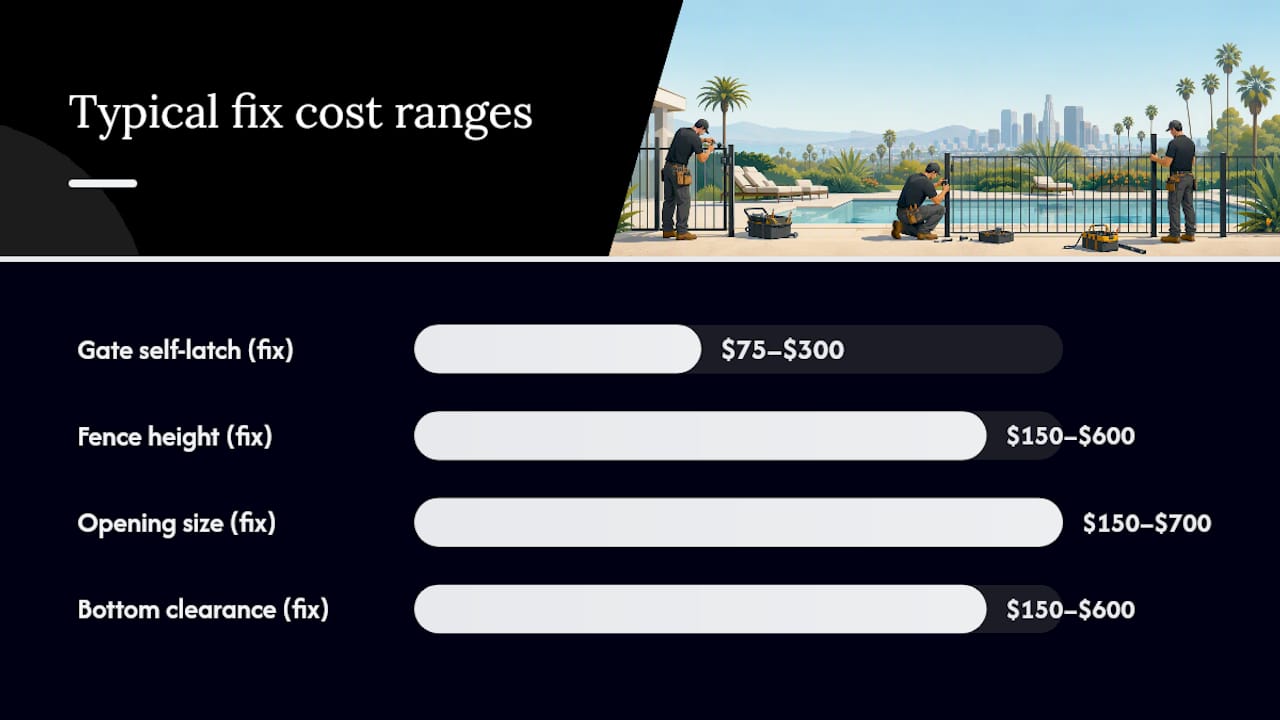
| Requirement | Measurement Limit | How to Check | Typical Fix | Approximate Cost Range |
|---|---|---|---|---|
| Fence height | 48 in baseline, 60 in in many CA jurisdictions | Tape measure from exterior lowest grade point | Add height extension panels or raise fence | $150 to $600 |
| Gate self-latch | Should latch automatically from full open positions | Manual swing test, three attempts | Adjust hinge tension or replace closer | $75 to $300 |
| Opening size | No gap large enough to allow a small child to pass through (commonly tested with a small sphere) | Physical sphere or gauge test | Add infill or reduce picket spacing | $150 to $700 |
| Bottom clearance | Limited clearance under fence varies by surface type | Measure at lowest point along run | Add bottom rail or backfill | $150 to $600 |
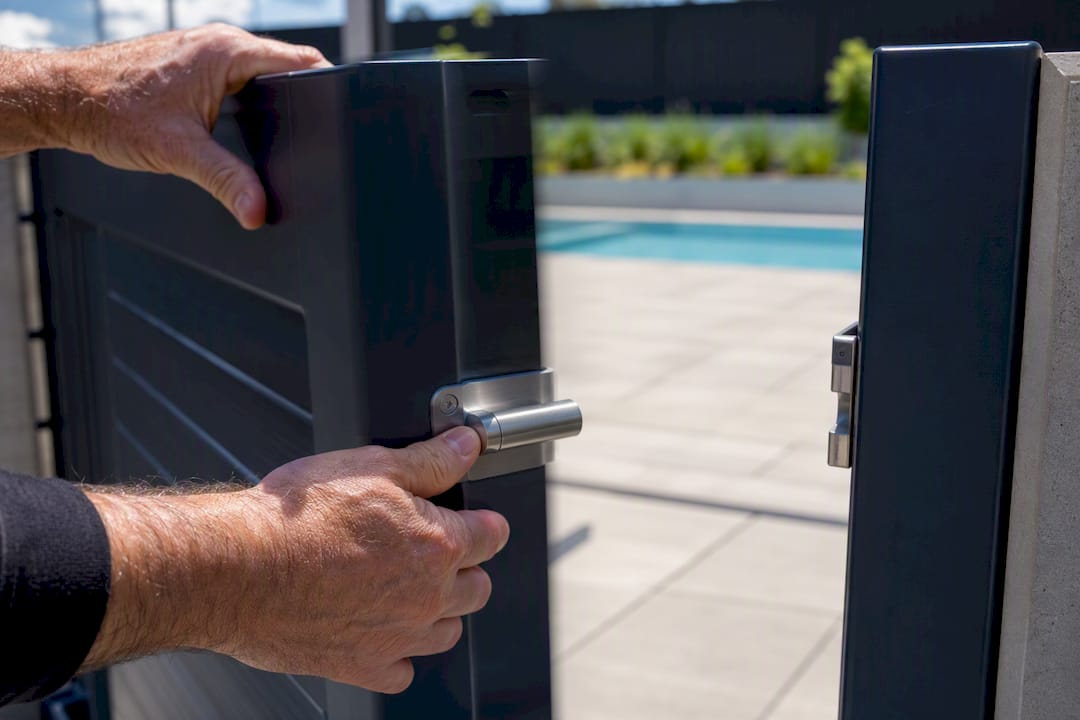
An inspector-style checklist typically runs through the same four tests in sequence: gate self-close from 90 degrees, self-latch confirmation, a tug test on the latch release guard, and a visual scan for climbable objects inside the 36-inch zone.
The Most Common Reasons Pool Fences Fail Inspection
A handful of issues account for most failed inspections, and nearly all of them are fixable without replacing the whole fence.
- Gates that don’t reliably self-close or self-latch. Usually a worn hinge or misaligned latch plate. Fix: hardware adjustment or replacement, $75 to $300.
- Insufficient height at low grade points. Soil settling or mulch buildup on the exterior side quietly steals inches. Fix: regrading or a height extension, $150 to $600.
- Bottom gaps that exceed the clearance limit. Common on sloped yards. Fix: add a bottom rail, backfill, or infill strip, $150 to $600.
- Openings wider than the 4-inch sphere allows. Often seen in older wrought iron or decorative panels. Fix: add mesh infill or replace panel sections, $200 to $700.
- Climbable furniture, planters, or equipment inside the 36-inch zone. Fix: relocate, usually no cost at all.
A common non-compliance breakdown shows these same five issues surfacing repeatedly across residential inspections, which is why checking them first saves the most time. Full fence replacement only becomes necessary when the structure itself is rotted, rusted through, or built from a non-compliant material entirely, not when the fix is hardware or ground level.
What Inspectors Notice And How To Keep Your Fence Compliant Year-Round
Pool safety professionals consistently point to the same pattern: a barrier is only as good as its weakest single component. A regulations overview from Pool Operation Management notes that one faulty latch, a few inches of ground shift, or a planter left too close to the fence line can undo an otherwise fully compliant barrier. Compliance isn’t a one-time event. It’s a maintenance habit.
A practical schedule looks like this:
- Test gate self-close and self-latch quarterly.
- Lubricate hinges and inspect latch hardware annually, replacing anything showing rust or play.
- Check ground-level clearance after heavy rain or irrigation changes, since soil shifts more than most homeowners expect.
- Keep dated photos and a maintenance log alongside your permit and inspection paperwork.
Pro Tip: A dated photo folder of your fence’s condition doubles as documentation for insurance claims and real estate disclosures if you ever sell the property. For hardware-specific upkeep, our gate maintenance guide covers seasonal lubrication and hinge adjustment in more depth.
How Long Repairs Take And What They Typically Cost
Timelines vary by scope, but most fixes move faster than homeowners expect. Hinge and latch adjustments usually take same-day to 48 hours. Full gate hardware replacement runs 1 to 3 days. Closing ground-level gaps takes 1 to 7 days depending on soil conditions. A full fence replacement, including permit processing, typically spans 1 to 3 weeks in the Los Angeles area.
Cost ranges follow a similar pattern:
- Minor hardware repairs: $75 to $400
- Gate hardware and latch upgrades: $200 to $800
- Mesh bottom rail or infill panels: $150 to $700
- Full fence replacement: varies significantly by linear foot and material choice
One in three failed inspections traces back to a hardware issue that takes less than a day to fix, according to patterns documented by Pool Wizard’s review of common inspection failures, which found hinge wear and grade buildup among the most frequent culprits.
Permit fees and processing timelines vary by city within Los Angeles County, so confirm both before starting work. Pulling a permit after the fact, rather than before, is one of the more expensive mistakes homeowners make since it can force a full removal and reinstall.
What To Do If Your Pool Fence Fails Inspection
A failed inspection isn’t the end of the process. It’s a checklist of its own.
- Get the inspector’s written report specifying exactly which measurements or components failed.
- Photograph each failure point for your own records and for your contractor.
- Get a written repair quote from a licensed fence contractor.
- Confirm whether existing permits cover the repair or if a new one is required.
- Request re-inspection within your city’s allowed cure period, which is usually a defined window rather than open-ended.
- Ask your inspector directly what the fastest path to re-certification looks like and whether partial fixes can be verified by photo before a full re-visit.
- Non-compliance left unaddressed past the cure period can result in fines, so treat the repair quote step as urgent, not optional.
How To Schedule An Inspection And Handle Permits The Right Way
Before you call for an inspection, confirm your local fence and permit requirements with your city’s building department, since Los Angeles County municipalities don’t all apply identical rules. Have your site plan, prior permits, and current photos ready when you call.
- Ask any inspector or certifier three things: are they licensed for residential pool barriers, will they provide a written checklist, and what’s their typical turnaround for re-inspection requests?
- When hiring a contractor, confirm license status, proof of insurance, permit experience specific to pool barriers, warranty terms, and whether they’ll manage the re-inspection process for you.
For gate-specific compliance work, our pedestrian gate services page covers latch hardware options that meet current height and self-latch requirements. If your house forms part of the pool barrier itself, access control upgrades like door alarms add a second layer of protection that inspectors often ask about separately.
A note on measurement discipline
One detail trips up more homeowners than any code nuance: where you actually measure from. Inspectors measure fence height from the exterior’s lowest finished grade point, not the pool-side deck and not the highest point along a sloped yard. A few inches of mulch or a slight grade dip on the outside can turn a technically compliant fence into a failed one on paper.
Author’s perspective
The homeowners who pass inspection on the first try aren’t the ones with the newest fences. They’re the ones who measured before the inspector did. A tape measure and twenty honest minutes catch almost every issue that would otherwise cost a reschedule fee and a week of waiting. When a measurement is borderline, a licensed contractor’s read is worth more than a guess.
Get A Local Cost Estimate Before You Repair Or Replace
Fence-gate-estimator gives you a real cost range before you ever call a contractor, built specifically around Los Angeles labor and material rates rather than a national average that doesn’t reflect what you’ll actually pay in Sherman Oaks, Culver City, or Pasadena.
If your fence needs a height extension, new mesh infill, or a full latch and hardware upgrade to meet self-closing requirements, the estimator breaks down material and labor costs by project type and flags permit considerations specific to your city. Homeowners weighing a full rebuild against targeted repairs can compare both paths side by side before committing. For a fence that needs a complete rebuild rather than a patch, start with a custom fencing estimate to see realistic pricing for your property size and material choice. If your compliance gap is really a hardware problem, the gate automation page covers self-closing and self-latching upgrades that satisfy code while adding convenience.
Sources
For definitive language beyond this checklist, consult these directly:
- Safety Barrier Guidelines — CPSC
- ASTM F2286 standard (removable mesh pool fencing)
- Pool Fence Inspection Checklist 2026: Pass Your City Inspection — FenceMyPool
- Pool Fence & Barrier Code Compliance Checklist — SnapToolSuite
Always confirm local amendments with your city or county building department. The ISPSC and CPSC set the floor. Your local code sets the actual requirement.
FAQ
How do I make my pool fence compliant?
Measure height from exterior finished grade against your local minimum (48 inches nationally, often 60 in California), confirm the gate self-closes and self-latches, check for 4-inch sphere openings and correct bottom clearance, and clear climbable items within 36 inches.
What are the ASTM standards for pool fences?
ASTM F2286 governs removable mesh pool fencing, including post embedment and mesh clearance, while ASTM F1346 covers pool safety covers as an alternative barrier component.
What are the most important safety rules for pool fences?
The core rules are minimum barrier height, self-closing and self-latching gates positioned out of a child’s reach, no openings wide enough for a 4-inch sphere, and no climbable objects within 36 inches of the fence.
Can I use a tool to estimate compliance repair costs?
Yes. Fence & Gate Estimator provides Los Angeles-specific pricing for gate hardware upgrades, mesh infill, and full fence replacement based on your property’s size and material choice.
What happens if my pool fence fails inspection?
You’ll receive a written report listing the specific failures, then typically have a defined window to complete repairs and request re-inspection before fines apply for continued non-compliance.
Recommended
- Security Fence Features List for LA Homeowners | LA Electric Gate Service
- Custom fence components: build luxury, security, and style in LA | LA Electric Gate Service
- Expert aluminum fence installation guide for upscale LA homes | LA Electric Gate Service
- Fence post installation in Los Angeles: 5 key essentials | LA Electric Gate Service