Luxury Driveway Gate Categories for High-End Homes
By BabyLoveGrowth
Luxury driveway gate categories are defined by four criteria: design style, operational mechanism, material quality, and integration of advanced security and automation features. For high-end residences across Los Angeles, from Beverly Hills to Bel Air, the gate is not a secondary detail. It is the first architectural statement your property makes. Pricing reflects this, ranging from $1,500 for a basic manual gate to over $75,000 for a fully automated custom installation with integrated landscaping and stone pillars. Understanding which category fits your property requires matching mechanism, material, and technology to your site conditions and architectural style.
1. What are the main luxury driveway gate categories?
The industry organizes premium driveway gates into five operational categories: swing gates, sliding gates, cantilever gates, bi-fold gates, and vertical lift gates. Each category suits different site conditions, property sizes, and design goals. Choosing the wrong type for your driveway layout creates long-term mechanical problems and aesthetic mismatches.
Swing gates are the most traditional category. They open inward or outward on hinges, like a door, and come in single-leaf or double-leaf configurations. Double-leaf swing gates are the signature look of grand estate entrances in Bel Air and Brentwood. They require a clear arc of clearance in front of or behind the gate, so sloped driveways can disqualify them.
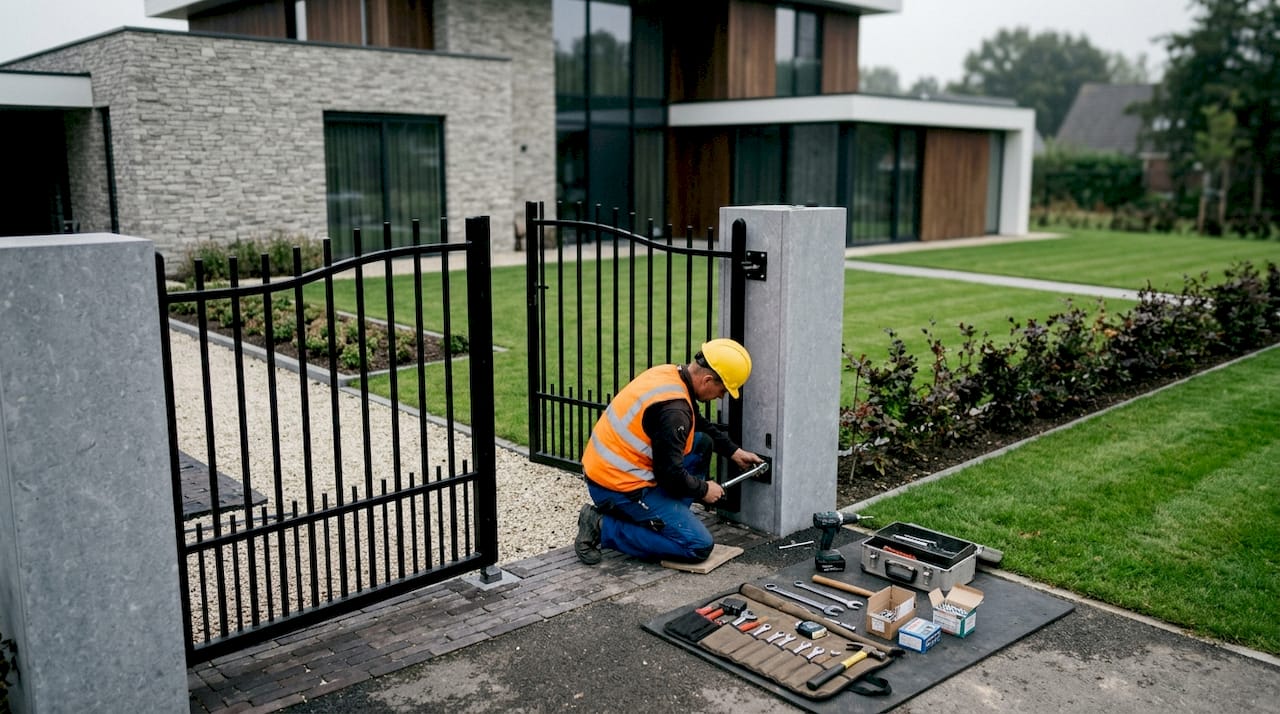
Sliding gates move laterally along a track parallel to the fence line. They work well on flat driveways with limited depth. The main drawback is the track itself, which collects debris and requires regular cleaning to maintain smooth operation.
Cantilever gates are the preferred choice for luxury installations on sloped or uneven terrain. Cantilever systems operate without a ground track, suspending the gate on a counterbalanced rail system. This trackless design reduces maintenance and eliminates the debris problem common to standard sliding gates.
Bi-fold gates fold in half as they open, requiring less lateral clearance than a standard swing gate. They suit narrow driveway openings where a full swing arc is impossible. Vertical lift gates rise straight up, making them ideal for very tight urban lots or properties with steep grade changes at the entrance.
Pro Tip: Before selecting a gate category, have a licensed installer assess your driveway slope, available clearance, and soil conditions. A gate that looks perfect in a catalog can be mechanically incompatible with your specific site.
2. What luxury materials define premium gate styles?
Material choice determines the gate’s visual weight, maintenance schedule, motor requirements, and lifespan. The five primary materials used in high-end gate fabrication are wrought iron, steel, marine-grade aluminum, exotic wood, and composite or vinyl.
Wrought iron delivers the classic estate look favored in older Beverly Hills and Pasadena properties. It is extremely strong and accepts intricate scrollwork and decorative detailing. The trade-off is ongoing maintenance: wrought iron rusts without regular repainting or powder coating, and coastal proximity accelerates that process.
Steel offers similar strength at a lower fabrication cost. Like wrought iron, it requires consistent maintenance to prevent corrosion. Steel gates provide a classic look but place more strain on automation motors due to their weight, which shortens motor service life if undersized equipment is used.
Marine-grade aluminum is the expert recommendation for modern upscale homes, particularly in coastal areas like Santa Monica and Malibu. It resists rust, weighs significantly less than steel, and reduces motor strain, which extends automation system longevity. The lighter weight does not sacrifice structural integrity at standard residential gate sizes.
Exotic wood, including teak, cedar, and ipe, creates a warm, organic aesthetic that pairs well with contemporary California architecture. Wood gates require sealing and periodic refinishing. They are rarely used as the sole material in automated gates because wood expands and contracts with humidity, which affects alignment over time.
Composite and vinyl materials mimic the look of wood without the maintenance demands. They resist moisture and insects, but they lack the visual depth of natural materials and can look flat on very large gates.
| Material Aesthetic Maintenance Motor Strain Best For | ||||
| Wrought iron | Classic, ornate | High | High | Traditional estates |
| Steel | Classic, solid | High | High | Budget-conscious luxury |
| Marine-grade aluminum | Modern, clean | Low | Low | Coastal and automated gates |
| Exotic wood | Warm, organic | Medium | Medium | Contemporary California style |
| Composite/vinyl | Wood-like | Very low | Low | Low-maintenance properties |
Pro Tip: In coastal Los Angeles neighborhoods, metal coating failures most often appear at hinge points where coatings chip during shipping or installation. Request a certified touch-up kit from your fabricator and inspect hinge areas within 30 days of installation.
3. How do automation and security features vary across gate types?
Automation is now a standard expectation in the luxury gate market, not an upgrade. The level of integration, however, varies significantly across gate categories and materials. A well-specified automation system adds convenience, increases security, and raises property value.
The core automation components for any motorized gate include the operator (motor), control board, safety sensors, and power supply. Gate weight and size determine motor specifications. Heavier steel and wrought iron gates require high-torque operators, which cost more and consume more power. Lighter aluminum gates allow smaller, quieter motors with longer service intervals.
Security features common to luxury gate automation include:
- Keypad entry: PIN-based access for residents and approved visitors
- Intercom systems: Audio and video intercoms integrated into the gate pillar or post
- Security cameras: Fixed or pan-tilt cameras mounted at the gate for real-time monitoring
- Motion sensors: Perimeter detection that triggers alerts or lighting when movement is detected
- Smart home integration: Connection to platforms like Apple HomeKit, Google Home, or dedicated security systems for remote control and monitoring
- License plate recognition: High-end installations in Bel Air and Beverly Hills increasingly use camera-based plate readers for hands-free access
Integrated LED lighting serves both security and aesthetic functions. Decorative LED fixtures mounted on gate panels or pillars illuminate the entrance at night, deter intruders, and create a dramatic visual effect that complements landscaping. This dual function makes lighting one of the highest-value additions to any premium gate installation.
Retrofitting automation into an existing stone or masonry pillar is expensive. Planning automation alongside initial hardscaping can reduce installation costs by 30–50% compared to retrofitting wiring and conduit after construction. If you are building or renovating, coordinate your gate automation plan with your landscape architect before the pillars are poured.
4. What design styles and customization options define Los Angeles luxury gates?
Los Angeles high-end residential areas favor a wide range of gate design styles, shaped by the city’s architectural diversity. Beverly Hills estates lean toward classical wrought iron with scrollwork and spear finials. Brentwood and West Hollywood properties favor clean-lined modern aluminum gates with horizontal slats or geometric cutouts. Malibu and Santa Monica coastal homes often combine aluminum frames with wood infill panels for a warm, contemporary look.
Bespoke architectural gates are hand-drawn to scale and engineered using CAD software to integrate precisely with the home’s facade. This process ensures the gate’s height, slat spacing, and visual weight feel proportional to the pillars, walls, and roofline. Generic catalog gates rarely achieve this balance. Intricate ranch-style or artistic commission gates in this category typically range from $25,000 to $35,000 before automation hardware.
Customization options available from specialized Los Angeles fabricators include:
- Powder coat finishes: Durable color coatings in any RAL color, including matte black, bronze, and custom tones matched to the home’s exterior
- Faux wood finishes: Aluminum gates with a wood-grain powder coat for the warmth of timber without the maintenance
- Patina treatments: Chemically applied aging effects on steel or iron for an antique or weathered look
- Decorative cutouts: Laser-cut wildlife, botanical, or geometric patterns integrated into gate panels
- Mixed materials: Combinations of steel frames with wood, glass, or corten steel infill panels
- Pillar-integrated lighting: LED strips or lantern fixtures built directly into the gate pillars
Scaling gate dimensions to match pillar width and home architecture is a key differentiator between luxury fabrication and standard products. CAD verification catches proportion errors before fabrication begins, saving costly rework.
Key Takeaways
The most effective luxury driveway gate combines the right operational mechanism, material, and automation system for its specific site, architecture, and security requirements.
| Point Details | |
| Mechanism matches site conditions | Cantilever gates suit sloped driveways; swing gates need clear arc clearance. |
| Material drives maintenance and motor life | Marine-grade aluminum reduces motor strain and resists coastal corrosion better than steel. |
| Plan automation before construction | Coordinating wiring during the build phase cuts retrofit costs significantly. |
| CAD engineering ensures proportion | Bespoke fabricators use CAD to match gate scale precisely to pillars and home architecture. |
| Security and aesthetics integrate | LED lighting and camera systems serve both visual and protective functions simultaneously. |
What I’ve learned from watching homeowners choose the wrong gate first
Most homeowners I’ve seen approach gate selection backwards. They fall in love with a design image, then try to make it work on their property. The result is a beautiful gate that fights its site every day: a swing gate on a slope that strains its motor, or an oversized wrought iron panel that overwhelms a modest pillar.
The properties that get it right start with the site survey, not the catalog. They know their driveway grade, their pillar dimensions, and their automation requirements before they pick a material or a style. That sequence matters more than budget. A $15,000 aluminum gate specified correctly will outperform a $40,000 wrought iron gate installed without proper site analysis.
The other thing most homeowners underestimate is the maintenance commitment of their chosen material. Wrought iron looks extraordinary on day one. By year three in a coastal neighborhood like Santa Monica, it requires real attention to stay that way. Marine-grade aluminum does not have that problem. For properties in Encino or Sherman Oaks where coastal humidity is less of a factor, wrought iron remains a strong choice. For anything west of the 405, aluminum is the smarter long-term decision.
Working with a local fabricator who knows Los Angeles permit requirements, soil conditions, and neighborhood architectural review boards is not optional for a gate at this price point. It is the difference between a gate that gets approved and installed smoothly and one that sits in a fabrication shop while you resolve permit issues. Use the modern gate design process as your planning framework before you commit to any design.
— Moin
Planning your luxury gate installation in Los Angeles
Choosing the right gate category is only the first step. Getting accurate cost estimates for your specific property, material choice, and automation requirements is where most projects stall.
Fence-gate-estimator provides instant, transparent cost estimates for custom driveway gate installations across Los Angeles, including Beverly Hills, Brentwood, Pasadena, and West Hollywood. The platform uses current local material and labor rates to generate detailed breakdowns for swing, sliding, and cantilever gates in wrought iron, steel, and marine-grade aluminum. You can also get estimates for gate automation systems and custom fencing to plan your full entrance design in one session. No waiting for a callback. No vague ballpark figures. Just clear numbers based on your actual property inputs.
Recommended
- Fence & Gate Installation Cost Calculator Los Angeles
- Smart home gates for luxury LA homes: Features & comparisons | LA Electric Gate Service
- High-security gates: Premium protection for LA homes | LA Electric Gate Service
- Elevate home security with premium gates in Los Angeles | LA Electric Gate Service