How to Evaluate Luxury Fence Portfolios: A Buyer's Rubric
By BabyLoveGrowth AI
Six things separate a genuinely high-end fence portfolio from an expensive-looking one: design fit to the property, material and finish quality, structural specs you can verify on paper, workmanship visible in the details, honest lifecycle cost and warranty terms, and whether the style actually suits the neighborhood. Run any project through those six filters before you trust a glossy photo gallery.
Here’s the verdict rule that cuts through most of the confusion: a fence adds real value only when it matches the architecture around it, solves a specific problem for the next buyer (privacy, pool safety, pet containment), and shows up in excellent condition. Miss any one of those three, according to Opendoor’s research on fence value, and you’re looking at a cosmetic upgrade, not an investment.
The numbers back up the caution. The average installed fence in the U.S. runs around $3,200, and reported ROI on fencing projects typically lands between 30% and 70% depending on material, location, and condition. That’s a wide band, and where a specific project falls inside it depends heavily on the six-point checklist above. Fence installations with deeper post embedment and longer warranties usually represent higher quality than those with shallow posts and minimal footing, regardless of visual similarity.
Use this as your quick-scan filter before diving into design details, materials, or contractor quotes:
- Design fit: Does the style match the house’s architecture and the neighborhood’s visual language, or does it look bolted on?
- Material and finish: Is the grade, coating, or hardware spec appropriate for the climate and the price point being charged?
- Structural specs: Are post depth, footing diameter, and gate reinforcement documented, not just implied?
- Workmanship: Do panel lines run true, gates hang level, and finishes match across every project in the portfolio?
- Lifecycle cost and warranty: What does ownership cost over 15 years, and does the warranty actually cover structural failure?
- Value fit to neighborhood: Would a buyer in this specific market pay more for this fence, or just tolerate it?
Key Takeaways
A luxury fence adds real value only when its design, materials, and construction quality match the neighborhood and solve a genuine buyer need.
| Point | Details |
|---|---|
| Score across six factors | Judge design fit, material and finish, structural specs, workmanship, lifecycle cost, and neighborhood value fit. |
| Verify specs, not photos | Post depth, footing diameter, and hardware grade explain most long-term failures and rarely show up in pictures. |
| Expect a wide ROI range | Fencing typically returns 30% to 70% of installed cost depending on material, condition, and location. |
| Match, don’t exceed, the neighborhood | Removing a decrepit fence before listing usually beats over-building a premium one in a modest-fencing area. |
| Confirm three contractor signals | License, insurance, and recent references separate reliable contractors from risky ones. |
| Price it locally before committing | Fence-gate-estimator’s calculator uses current Los Angeles rates to benchmark a contractor’s quote before you sign. |
Table of Contents
- What Design Signals Actually Read as Luxury?
- Which Fence Materials Actually Perform at the Luxury Level?
- How Do You Judge Construction Quality From Photos and Specs?
- How Should You Score a Fence Portfolio Step by Step?
- When Does a Luxury Fence Actually Increase Home Value?
- How Do You Compare Luxury Fence Quotes Fairly?
- What Should You Budget for Maintenance Over 15 to 20 Years?
- What Red Flags Should Make You Walk Away From a Contractor?
- Get a Realistic Cost Check Before You Commit
- Sources
- FAQ
What Design Signals Actually Read as Luxury?
Proportion does more work than price tag. A fence that respects the sightlines of the house, sits at a height that doesn’t compete with the roofline, and maintains consistent post spacing reads as considered. One that towers over a single-story ranch or crowds a front walkway reads as overcompensation, regardless of the material cost behind it.
Quiet luxury in fencing means restraint, not absence of detail. Look for hidden fasteners instead of visible screw heads, consistent color and texture across every panel, and gates that integrate into the fence line rather than announcing themselves as a separate structure. The best portfolios show the same design vocabulary repeated across multiple properties: the same attention to post caps, the same finish consistency, the same discipline about where ornamentation stops and function begins.
When you’re reviewing a contractor’s photo gallery, check for three things specifically. First, does the fence line follow the terrain cleanly, or does it step awkwardly on slopes? Second, do the gates match the fence in material and finish, or do they look like an afterthought purchased from a different supplier? Third, is there evidence of coordination with landscaping and exterior lighting, which signals a designer who thought about the whole property rather than just the fence line in isolation.
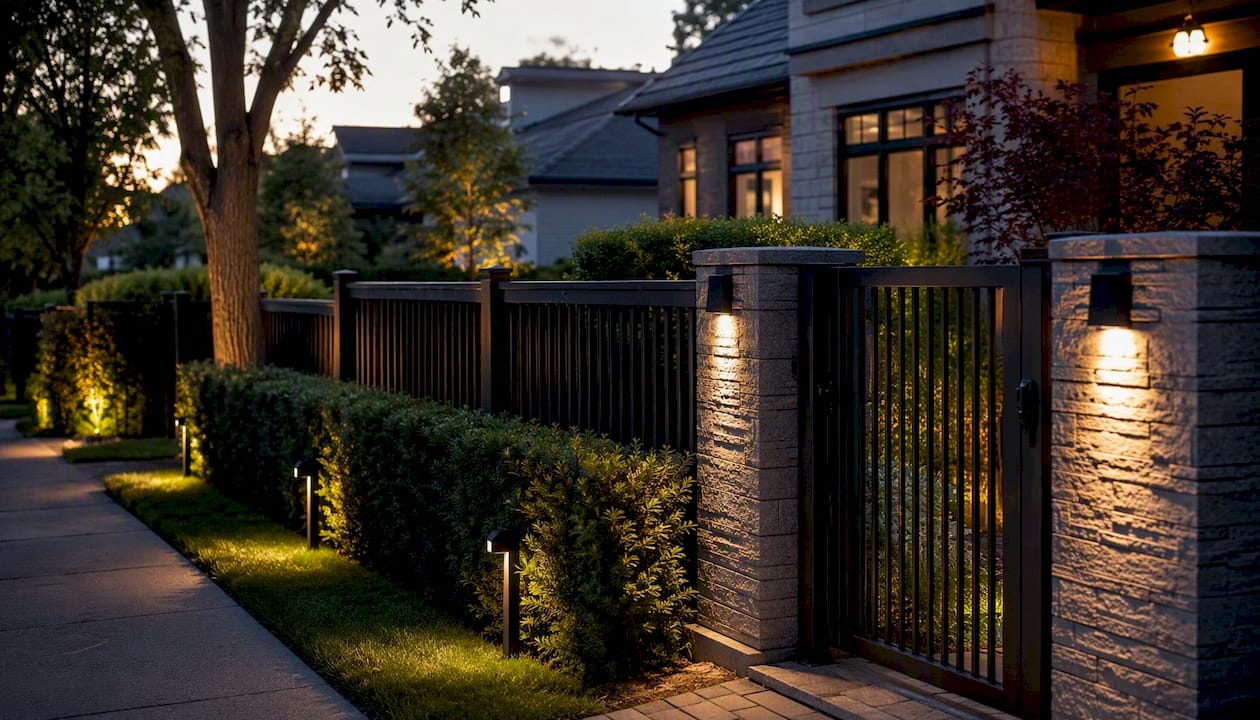
Mismatches are easier to spot than most buyers expect. An ornate wrought iron fence dropped into a neighborhood of modest ranch homes doesn’t add value, it creates visual friction. Similarly, a solid privacy fence that blocks a genuinely valuable view (hillside, coastline, skyline) can actively hurt a property’s appeal even if the fence itself is beautifully built.
Pro Tip: Ask any contractor for photos taken from the street, not just close-up detail shots. Close-ups hide proportion problems. A fence that looks stunning in a macro shot of the hardware can still look wrong from 40 feet away.
Which Fence Materials Actually Perform at the Luxury Level?
Material choice determines both the ceiling on aesthetic quality and the floor on long-term cost. Here’s how the five materials common in upscale portfolios stack up against each other.
| Material | Aesthetic fit | Durability / lifespan | Maintenance level | Typical installed cost | Best use cases | ROI / curb-appeal impact |
|---|---|---|---|---|---|---|
| Wood (clear-grain cedar, redwood) | Warm, traditional, highly customizable | 15-20 years with upkeep | High: staining/sealing every 2-3 years | Moderate to high | Privacy, warm-dry climates, custom gates | Strong if maintained; weak if neglected |
| Composite/PVC | Clean, modern, uniform finish | 20-30 years | Low: occasional washing only | Moderate to high upfront | Privacy, low-maintenance estates | Often recoups 50-70% of cost per FenceCalc’s analysis |
| Aluminum | Sleek, ornamental, powder-coated finishes | resists rust | Very low | Moderate | Ornamental, coastal, pool enclosures | Strong ROI, especially in humid or coastal zones |
| Steel / wrought iron | Substantial, formal, custom fabrication | 30+ years if properly coated | Moderate: watch for coating failure | High | Security, formal entries, gated estates | High perceived value when detailing is precise |
| Chain-link (for reference) | Utilitarian, low visual appeal | 15-20 years | Low | Low | Budget security, rear-yard containment | Weakest return, can detract in upscale areas |
The signal traits that separate a luxury version of each material from its commodity cousin are specific and checkable. For wood, ask about species and grade: clear-grain cedar with minimal knots looks dramatically different from construction-grade lumber, and that difference shows up within two years of sun exposure. For composite and PVC, ask for the UV stabilizer specification; cheaper vinyl yellows and becomes brittle in high-sun climates within five to seven years, while properly stabilized product holds color for decades.
Aluminum and steel carry their own specification questions. Powder-coating thickness and preparation (is the metal properly primed before coating?) determines whether a fence holds its finish for 20 years or starts chalking and chipping within five. For steel and wrought iron near coastal air, ask specifically about hot-dip galvanization versus a painted finish over bare steel. Salt air is unforgiving, and material performance varies substantially by climate exposure, which matters enormously for properties near Santa Monica or the Malibu-adjacent parts of the westside.
A few specification shortcuts undercut luxury claims more than any other factor:
- Thin gauge steel dressed up with heavy ornamental scrollwork, which looks substantial in photos but flexes under hand pressure.
- Galvanized fasteners mixed with stainless steel or aluminum hardware, which triggers galvanic corrosion at every connection point within a few years.
- Undersized gate posts on heavy swing or sliding gates, a problem that won’t show up until the gate starts sagging six months after installation.
If you’re comparing options for a hillside or coastal LA property, our guide to premium fencing materials for upscale LA homes breaks down which materials hold up best against specific terrain and exposure conditions.
How Do You Judge Construction Quality From Photos and Specs?
Design and material choices get all the attention in a portfolio review, but the details that actually determine whether a fence lasts are buried in the specs, not the photos. Post depth, footing diameter, and gate post reinforcement explain most long-term failures, and none of that is visible once the fence is standing and finished.
Structurally, insist on documented numbers rather than vague reassurance. Line posts should be embedded at a depth appropriate to local soil and frost conditions, typically a third of the total post height at minimum, set in either poured concrete or properly compacted gravel depending on drainage needs. Gate posts carry far more lateral stress than line posts and need larger diameter, deeper footings, and often internal reinforcement, especially for heavier automated gates.
Hardware quality is the second checkpoint. Stainless steel fasteners should be used wherever dissimilar metals meet, since standard galvanized hardware on aluminum or stainless components triggers corrosion at the connection point. Gates should use through-bolts rather than screws at load-bearing hinge points, and welded connections generally outlast mechanical fasteners on heavier steel and wrought iron gates.
Photos still tell you plenty if you know what to look for. Scan for uniform spacing between pickets or panels across the entire run, not just in the featured shot. Check where posts meet panels: clean, tight transitions signal careful fabrication, while visible gaps or filler material signal rushed installation. Look at gates specifically, since a sagging gate or a visibly uneven top rail on a swing gate is often the first sign of an undersized post or a skipped footing.
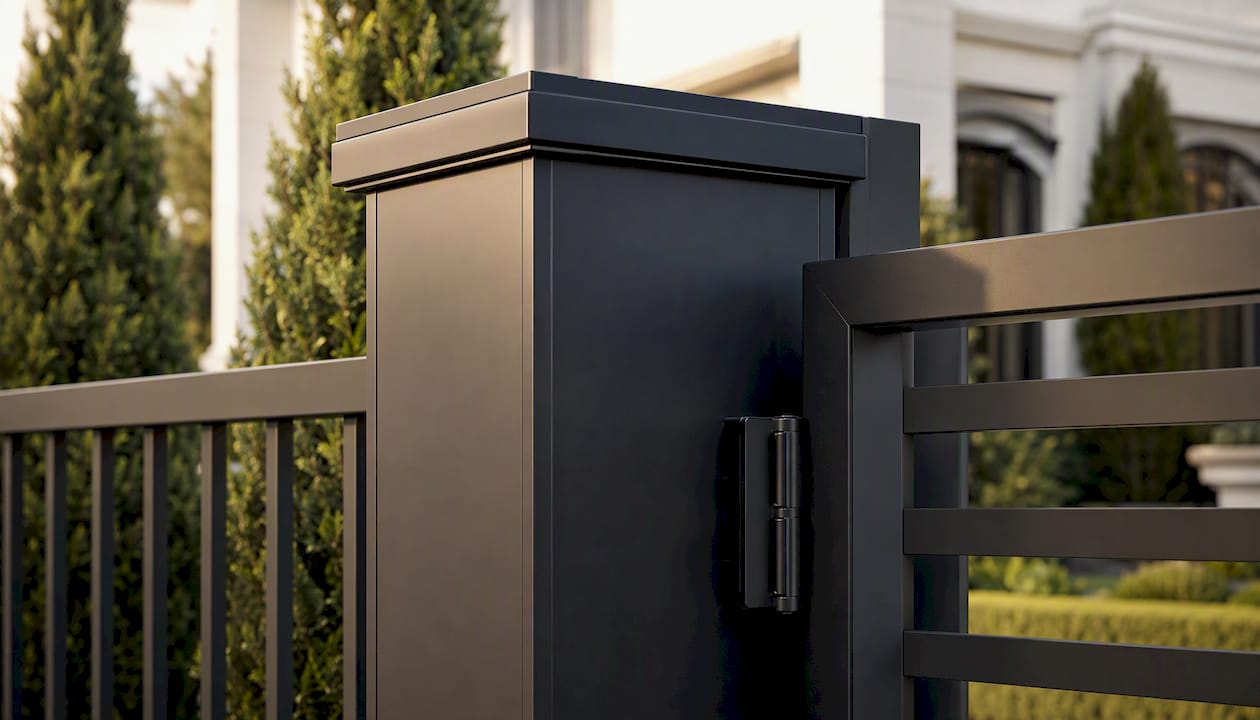
When you’re reading a proposal, insist on seeing post dimensions, footing depth, reinforcement details for gate posts, and hardware grade spelled out as line items, not folded into a vague “standard installation” clause. Our breakdown of custom fence components used in luxury LA installs covers the hardware and gate detailing that separates a durable install from one that needs a callback within two years.
Pro Tip: Watch for mismatched hardware finishes across a single project, like a satin nickel hinge paired with a chrome latch. It’s a small detail, but it usually means the installer sourced parts piecemeal rather than from a coordinated hardware package, and it’s often a sign the same shortcut was taken somewhere structural too.
How Should You Score a Fence Portfolio Step by Step?
A consistent rubric beats gut instinct, especially when you’re comparing multiple contractors or evaluating a portfolio attached to a property you’re considering buying. Score each project across five categories, then average across the whole portfolio.
- Design (0-10): Proportion, restraint, coherence with the home’s architecture, and integration of gates and hardware into the overall look.
- Materials (0-10): Grade and specification appropriateness for climate and price point, verified against what the contractor actually documents.
- Workmanship (0-10): Panel alignment, gate operation, finish consistency, and absence of visible shortcuts in photos.
- Documentation and warranty (0-10): Availability of post/footing specs, permit records where applicable, and warranty language that covers structural failure, not just material defects.
- Value fit to neighborhood (0-10): Whether the style and cost level match what buyers in that specific market actually reward.
A portfolio averaging 8 or above across these categories represents genuinely premium, defensible work. A score in the 5-7 range suggests solid execution with gaps, often in documentation or hardware grade, worth a direct question to the contractor before committing. Anything averaging below 5 signals either an inexperienced fabricator or a portfolio padded with photos that don’t reflect the contractor’s typical output.
Here’s how that plays out with a hypothetical three-project portfolio:
That coastal project’s documentation score of 5 would be worth a direct question: did the contractor specify marine-grade hardware and provide footing specs suited to sandy or shifting soil? A single low category doesn’t disqualify a contractor, but it tells you exactly what to verify before signing.
Weight the categories differently depending on your situation. Sellers preparing a property for market should weight value fit to neighborhood most heavily, since an overbuilt fence rarely returns its full cost at resale. Long-term owners should weight documentation and materials higher, since they’ll live with maintenance costs and warranty claims for decades. High-security clients should weight workmanship and structural documentation above design, since a beautiful gate that fails under stress defeats its own purpose.
When Does a Luxury Fence Actually Increase Home Value?
Here’s the uncomfortable truth most homeowners don’t hear from a contractor with a sales quota: a fence’s contribution to appraised value is almost always more conservative than its contribution to marketability. Appraisal-focused analysis puts the realistic return closer to 30-40% of installed cost, even when the fence itself is beautifully built and well maintained. Marketability, meaning how quickly a property sells and how buyers perceive it during showings, tends to respond more generously than a formal appraisal does.
Material matters here too. Higher-end materials like vinyl and aluminum tend to recoup a stronger share of cost, commonly in the 50-70% range, while chain-link recoups the least and can actively detract from perceived value in an upscale neighborhood. The gap between a 30% return and a 70% return on the same $15,000 fence project is the difference between a smart pre-sale investment and money that would have been better spent elsewhere.
A handful of buyer types consistently value fencing more than the average: families with young children who prioritize enclosed yard safety, pet owners who need reliable containment, and owners of properties backing busy streets or open lots where privacy carries real functional weight. For these buyers, a well-built fence isn’t a luxury add-on, it’s a dealbreaker in its absence.
On the flip side, a fence adds little or even negative value in a few predictable scenarios:
- A high, solid privacy fence on a property with an otherwise valuable open view or lot-line sightline.
- An ornate or oversized fence in a neighborhood where comparable homes have simple, low-key fencing or none at all.
- Any fence in visibly poor condition, since appraisers and resale-minded agents weight condition and neighborhood conformity more heavily than original cost.
For sellers and agents, the practical move is usually straightforward: repair or remove a decrepit fence before listing rather than leaving it as a visible liability, and resist the urge to over-build in a neighborhood where comparable properties keep fencing modest. Matching the block’s standard almost always outperforms exceeding it. Our guide on when a residential fence upgrade makes sense walks through that decision in more detail for LA-area sellers weighing the cost against a listing timeline.
How Do You Compare Luxury Fence Quotes Fairly?
Comparing two fence estimates side by side only works when you’re actually comparing the same scope of work, and that’s rarely the case on the first pass. Contractors bundle line items differently, and a lower number often hides a lower spec rather than a better deal.
Build your comparison around these line items every time:
- Material grade and spec: species/grade of wood, gauge of steel, coating type, not just “wood fence” or “aluminum fence” as a category.
- Post and footing specs: embedment depth, footing diameter, and whether concrete or compacted gravel is used.
- Gate reinforcement: post size and footing depth specific to gates, which carry more stress than line fence.
- Hardware grade: stainless versus galvanized, through-bolt versus screw connections at load points.
- Permit and inspection fees: whether they’re included or billed separately, and who pulls the permit.
- Removal and cleanup: cost of removing an existing fence, hauling debris, and restoring disturbed landscaping.
- Warranty language: what’s covered, for how long, and whether labor is included alongside materials.
- Lead time and schedule: especially relevant for custom fabrication or automated gates with longer production windows.
To align quotes fairly, normalize everything to a per-linear-foot unit cost and pull gate pricing out as a separate line, since gates skew the average cost per foot dramatically on shorter fence runs. Watch for allowance-based line items (“hardware allowance: $500”) versus fixed pricing, since allowances are where costs commonly balloon once the homeowner picks actual fixtures.
A few negotiation guidelines worth following:
- Treat decorative post caps, integrated lighting, and finish upgrades as legitimate optional add-ons you can negotiate or skip.
- Never treat post depth, footing specs, or hardware grade as negotiable, since these are the baseline requirements for a fence that survives its warranty period.
- Ask every bidder to itemize gate automation separately if it’s included, since automation features vary widely in cost depending on drive type and load capacity.
- Get removal and disposal costs in writing before assuming they’re bundled into the base quote.
Sloped or hillside lots complicate this comparison further, since terrain changes footing requirements and can require stepped or raked fence panels that add labor hours. Our breakdown of how terrain impacts fence costs is worth reviewing before you finalize any hillside property comparison.
What Should You Budget for Maintenance Over 15 to 20 Years?
Upfront price tells you almost nothing about total cost of ownership, and that gap widens the longer you hold the property. A wood fence that costs less to install than an aluminum one can cost more over 15 years once staining, sealing, and board replacement are factored in.
| Material | Typical maintenance interval | Main interventions | 15-year cost driver |
|---|---|---|---|
| Wood | Every 2-3 years | Staining, sealing, occasional board replacement | Frequent labor cost adds up over time |
| Composite/PVC | Rarely, occasional cleaning | Washing, minor hardware checks | Low ongoing cost after higher upfront price |
| Aluminum | Every 5-7 years | Touch-up coating, hardware lubrication | Low overall due to rust resistance |
| Steel / wrought iron | Every 3-5 years | Rust spot treatment, recoating | Moderate, driven by coating maintenance |
High-quality vinyl and PVC often come out ahead on true 15-year ownership cost, even with a higher sticker price at installation, because they eliminate the recurring staining and painting expense that wood requires. Wood’s charm comes at a real, recurring price, and that math changes the calculation for owners planning to stay in a property for a decade or more versus those planning to sell within a few years.
Warranty terms directly affect this lifecycle math. A 10-year structural warranty that covers post failure and gate operation is worth meaningfully more than a 2-year materials-only warranty, even if the upfront quotes are identical. When you’re comparing portfolios, ask specifically what triggers a warranty claim and whether labor is covered alongside replacement parts, since many warranties cover materials but leave the homeowner paying for reinstallation labor.
Sustainability considerations increasingly factor into how luxury buyers evaluate fencing too. FSC-certified wood sourcing, recycled aluminum content, and questions around PVC’s end-of-life disposal are becoming part of the conversation for environmentally conscious upscale buyers, even if they rarely top the priority list above durability and design fit.
What Red Flags Should Make You Walk Away From a Contractor?
Most contractor problems show up in the conversation before they show up in the fence. Evasive answers about licensing or insurance, pressure for an unusually large upfront deposit, and an inability to produce recent references for comparable high-end work are the three most common warning signs. Vague warranty language (“we stand behind our work”) without specifics on duration or coverage is another, as is a proposal that skips post and footing specs entirely.
Ask every contractor these questions directly, and expect specific, confident answers:
- Can you provide your license number and current insurance certificate?
- Can I contact three recent clients with projects similar in scope and material?
- What’s the post embedment depth and footing diameter for this specific soil condition?
- What hardware grade are you using, and is it rated for this material combination?
- What exactly does your warranty cover, and for how long?
- Who is responsible for pulling permits, and who handles site restoration after installation?
Verification takes a little effort but pays off. Confirm the license directly with your state contractor licensing board rather than trusting a number printed on a business card. Ask to see photos of finished gates under real-world load, not just fresh-installed shots before anyone has used them for a season. Checking a contractor’s standing with a resource like the Better Business Bureau adds another layer of confirmation beyond the references they hand-select for you.
A quick site-visit checklist: bring the proposal, compare the post spacing to what’s actually installed on any completed nearby project, check gate operation by hand, and ask directly whether the specs on paper match what you’re seeing built.
A Fence Estimator’s Take on What Really Separates Portfolios
After looking at enough fence projects, the pattern becomes obvious: the portfolios that hold up under scrutiny are the ones with boring, consistent specifications repeated across every project, not the ones with the flashiest hero shot. Contractors who document post depth and footing diameter the same way on every job, who treat gate infrastructure as seriously as the fence line itself, and who answer a warranty question without hesitation are the ones worth hiring, even if their photos look less dramatic than a competitor’s.
Gate infrastructure deserves more scrutiny than it usually gets. A gate is the moving, load-bearing part of the system, and it’s where undersized posts and skipped reinforcement show up fastest, often within a year of installation rather than a decade. In hillside neighborhoods with shifting or expansive soils, footing depth that would be adequate on flat ground sometimes isn’t enough, and coastal salt exposure changes hardware requirements in ways that don’t show up in a standard spec sheet. Those site-specific adjustments are exactly what separates a contractor who understands the region from one who’s just reusing a generic template.
Get a Realistic Cost Check Before You Commit
Once you’ve scored a portfolio and shortlisted the design and materials that fit your property, the next practical step is pricing it against current local rates, not a national average that doesn’t reflect what materials and labor actually cost in your specific market. Fence-gate-estimator gives you that number in minutes instead of waiting days for a contractor callback, using current Los Angeles material and labor rates rather than a generic national estimate that can be off by thousands on a premium project.
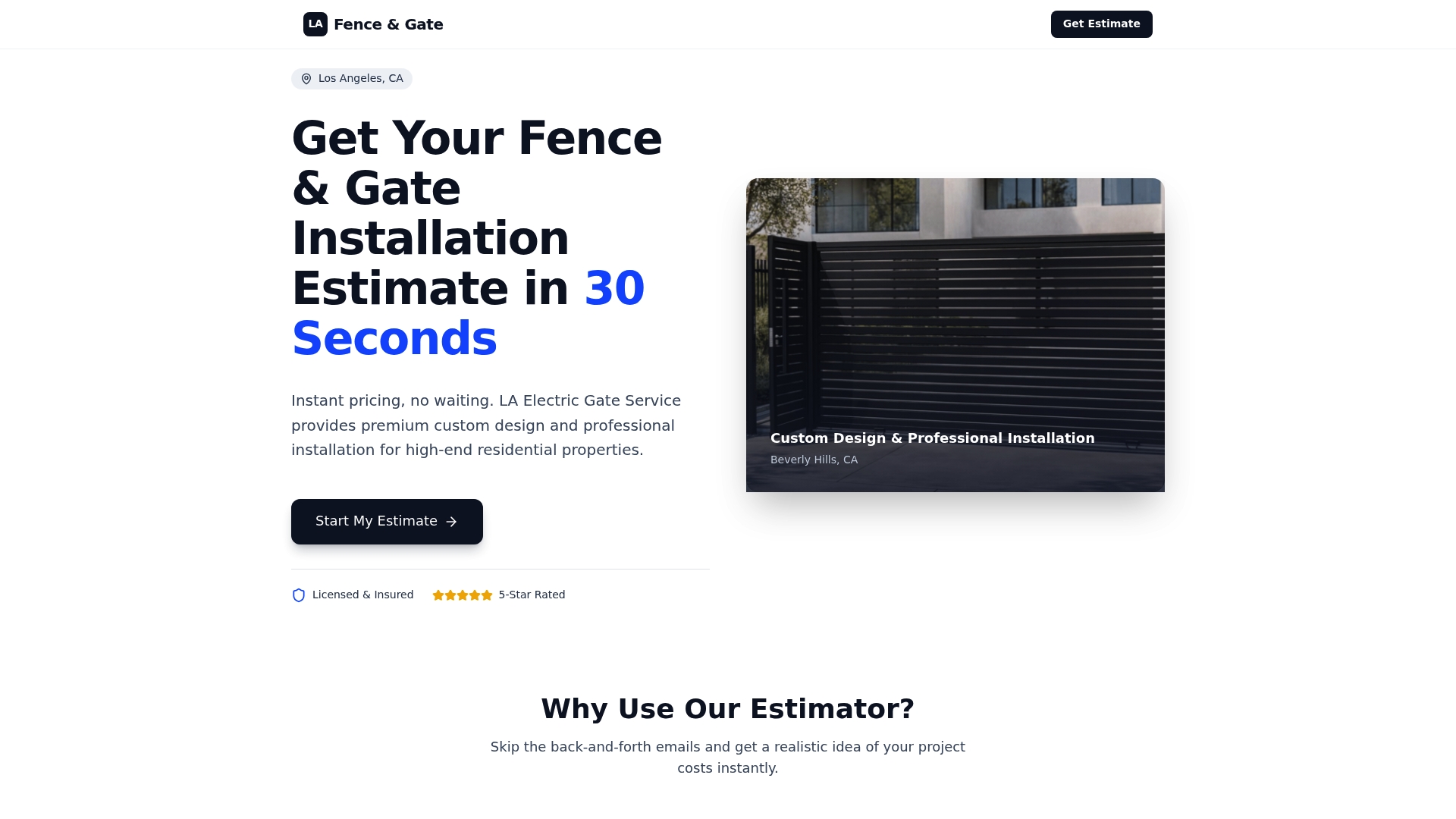
The tool asks for your property’s linear footage, material preference, and any automation features you’re considering for gates, then returns a realistic price range along with the typical line items you should expect to see on a formal quote, including post specs and warranty terms worth asking about. It’s built specifically for premium projects, whether that’s a wrought iron perimeter fence in Beverly Hills or an automated driveway gate in Encino, and it gives you a benchmark to hold any contractor’s quote against.
Treat the online estimate as your starting point, not your final number. An onsite visit still matters for confirming soil conditions, slope, and any permit requirements specific to your property before signing anything. Start with the fence and gate installation cost calculator to get your baseline range today, then use it as leverage when you’re comparing quotes from contractors who claim to offer luxury-grade work.
Sources
- How to choose a fence contractor | TradeProven
- Fence material comparison: durability, cost, and maintenance | Fence Installation Authority
- What type of fence adds to property value | Opendoor
FAQ
What fence colors add the most property value?
Neutral, architecturally coordinated colors, like black, dark bronze, or natural wood tones, tend to appeal to the widest range of buyers, while bright or unusual colors can narrow buyer interest even on an otherwise well-built fence.
How do you determine property lines before installing a fence?
Check your property survey or plat map, and if boundaries are unclear, hire a licensed surveyor rather than relying on old fence lines or neighbor agreements, since misplaced fences can trigger disputes or removal costs later.
What kind of fence is best for property value?
Higher-end materials like aluminum and vinyl tend to recoup the strongest share of installed cost, but the real driver is whether the style fits the neighborhood and the fence is in excellent condition.
What should you look for in a fence contractor?
Verify current licensing and insurance, request three recent references for comparable high-end work, and insist on documented post depth, footing specs, and warranty terms before signing a contract.
Can an online estimator replace an in-person contractor quote?
An estimator like Fence-gate-estimator’s calculator gives you a realistic local price range and expected line items, but an onsite visit is still recommended to confirm soil conditions and finalize specs.
Recommended
- Custom fence components: build luxury, security, and style in LA | LA Electric Gate Service
- Types of Premium Fencing for Upscale LA Homes in 2026 | LA Electric Gate Service
- Why Upgrade Residential Fences: A Homeowner’s Guide | LA Electric Gate Service
- Security Fence Features List for LA Homeowners | LA Electric Gate Service