How to Design a Fence for a Narrow Side Yard
By BabyLoveGrowth AI
The most effective approach for a narrow side yard fence is to prioritize slim profiles, mixed materials, and preserved access so the space stays functional and open rather than boxed in. Before you call a contractor, take three steps: measure the yard’s full length and usable width at multiple points, confirm height and setback rules with LADBS and LAMC §12.22, and run an instant cost estimate at Fence-gate-estimator.com before you commit to any design.
TL;DR: Use narrow-profile or mixed-material fencing (horizontal slats, open metal pickets, or wood-plus-aluminum), keep the gate at the widest access point, and confirm local height limits before ordering materials.
What to bring to your contractor or permit review:
- Scaled site plan showing property lines, structures, and utilities
- Measurements: total run length, width at three or more points, and any slope change
- Desired fence height and style preference
- Gate location, width, and swing direction
- Copies of HOA rules or HPOZ overlay notices if applicable
Table of Contents
- How to assess your narrow side yard before designing
- What design goals and constraints actually matter in a narrow side yard
- Fence styles that work best in narrow side yards
- Material choices and finishes that hold up in Los Angeles
- Designing gates for narrow passages: width, swing, and hardware
- Structural details your contractor needs to get right
- Styling and planting strategies that make a narrow side yard feel larger
- Ballpark costs and realistic timelines for a narrow side yard fence
- Los Angeles-specific rules, permits, and soil considerations
- Key Takeaways
- The tradeoffs most homeowners don’t see until it’s too late
- Fence-gate-estimator makes LA fence planning faster and more accurate
- Useful sources and further reading
- FAQ
How to assess your narrow side yard before designing
Accurate measurements are the foundation of every good narrow-yard fence design. A few inches of error can mean a gate that won’t open, a post that lands on a utility line, or a permit denial because the fence sits inside a required setback.
Measurement checklist for one site visit:
- Total fence run length (measure along the ground, not the property line on paper)
- Usable width at the front, middle, and rear of the run — widths often vary
- Diagonal check across the widest point to catch any taper or bow
- Ground slope: note the elevation change from one end to the other
- Drainage direction: which way does water flow after rain?
- Soil type: sandy, clay-heavy, or expansive (common in LA’s inland valleys)
- Utility locations: call 811 before any digging to mark gas, water, and electrical lines
- Obstacles: HVAC condensers, downspouts, meter boxes, and overhanging eaves
Setbacks and zero-lot-line conditions can remove 1–6 inches per side, and on a narrow lot that adds up quickly. A side yard that measures 36 inches on paper may offer only 24–34 inches of usable clearance once setbacks apply.
Pro Tip: Don’t rely on approximate stakes to confirm your property line. A licensed surveyor’s pin is the only reliable reference on narrow urban lots in Los Angeles. Confirm exact parcel setbacks with a survey before finalizing your design — rework after installation is expensive.
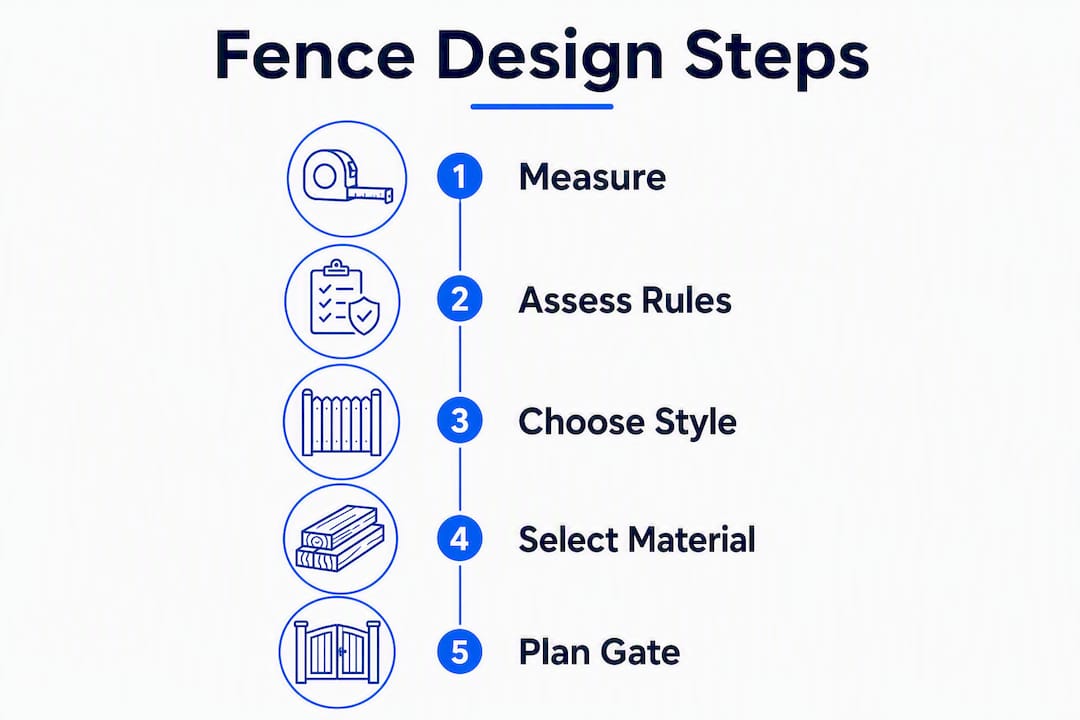
Map sightlines from your windows and from the public sidewalk. That exercise tells you exactly where you need solid screening and where open pickets or lattice will do the job without adding visual mass.
What design goals and constraints actually matter in a narrow side yard
Knowing what you want the fence to do changes every material and style decision downstream. Most homeowners in LA neighborhoods like Sherman Oaks or Culver City come in with a mix of goals that can conflict with each other.
Common goals and how they shape your choices:
- Privacy: Solid panels or close-spaced horizontal slats; height matters more than material
- Security: Taller fences with anti-climb profiles; consider security hardware integration and self-latching gates
- Visual width: Open pickets, horizontal lines, and lighter colors make the space feel larger
- Storage access: Gate width sufficient for comfortable access and a clear swing path are essential
- Noise reduction: Mass helps; solid composite or double-layer wood panels reduce street noise better than open designs
- Aesthetics: Upscale neighborhoods like Beverly Hills and Brentwood often call for ornamental aluminum or custom wrought iron
When goals conflict, use this decision order: access first, then security, then privacy. A fence that blocks the path to your HVAC unit or prevents a plumber from reaching a cleanout creates real problems. Privacy is easier to add incrementally with plantings or lattice panels than access is to retrofit.
HOA rules and Historic Preservation Overlay Zones (HPOZs) in neighborhoods like Pasadena and West Hollywood can restrict materials, colors, and heights beyond what LAMC allows. Check both before finalizing any design.
Fence styles that work best in narrow side yards
The style you choose determines whether a narrow yard feels like a corridor or a considered outdoor space. These options consistently perform well in tight runs.
Horizontal slat fences are the strongest visual choice for narrow yards. Alternating 1/2-inch and 1-inch gaps creates interest and lets in light without sacrificing much privacy, and the horizontal lines visually lengthen the space rather than emphasizing its narrowness. Cedar and composite both work well in this format.
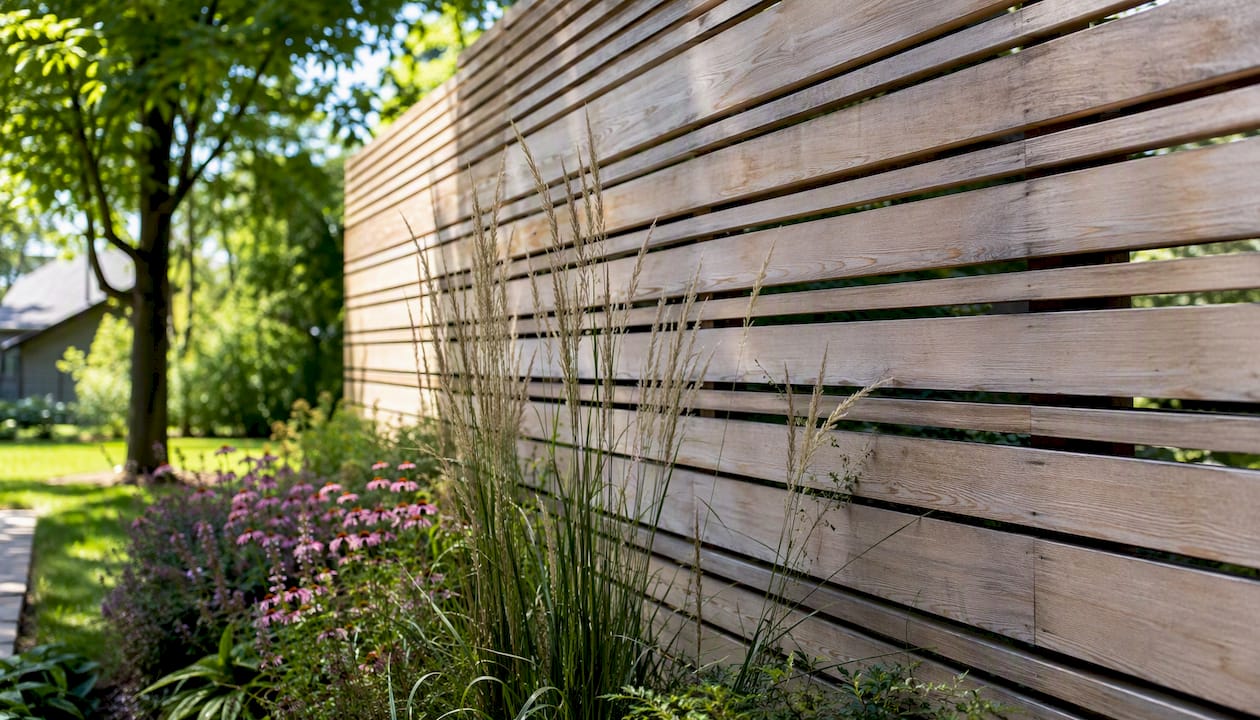
Open metal pickets and ornamental aluminum offer the lightest visual profile of any solid-boundary option. They define the property line clearly without blocking light or airflow, and they pair well with a trellis panel or trained vine for added privacy where you need it. For upscale properties in Bel Air or Santa Monica, powder-coated aluminum in a dark matte finish reads as intentional and premium.
Solid wood panels with a lattice top split the difference between full screening and openness. The solid lower section handles privacy at eye level while the lattice above 4 feet allows daylight and airflow. This combination works well when the side yard runs alongside a neighbor’s window.
Composite panels and prefabricated systems deliver consistent color and texture across the full run with minimal maintenance. They’re a practical choice for tight sightlines where a uniform appearance matters and where repainting every few years isn’t appealing.
Alternative boundary treatments such as gabion baskets or raised planter walls work when a traditional fence would feel too enclosing. A 24-inch gabion wall topped with a short aluminum rail defines the boundary, adds texture, and keeps the space from feeling walled off.
Pro Tip: Combining wood with slim-profile aluminum sections defines the boundary while preserving light and openness. Use aluminum for the posts and top rail, wood for the infill panels — the metal carries the structural load and the wood provides warmth and privacy.
Material choices and finishes that hold up in Los Angeles
Material selection in LA isn’t just about aesthetics. Coastal zones like Santa Monica face salt air; inland valleys like Encino and Burbank deal with intense UV and expansive soils. The right material for your microclimate reduces long-term maintenance costs significantly.
| Material | Durability | Visual Bulk | Maintenance | Best LA Use Case |
|---|---|---|---|---|
| Cedar wood | Good (10 yrs) | Medium | Seal every 2–3 yrs | Inland valleys, shaded runs |
| Pressure-treated pine | Good (15 yrs) | Medium-high | Annual inspection, seal every 3 yrs | Budget-conscious, utility runs |
| Composite | Excellent (20+ yrs) | Medium | Wash annually | HOA neighborhoods, low-maintenance preference |
| Aluminum | Excellent (30+ yrs) | Low | Annual hardware check | Coastal zones, upscale properties |
| Steel/wrought iron | Excellent (30+ yrs) | Low-medium | Paint touch-up every 5–7 yrs | Security-focused, premium design |
| Vinyl | Good (20+ yrs) | Medium-high | Wash annually | Budget privacy, no-paint preference |
For finish guidance: lighter stains and thin profiles reduce perceived mass in tight spaces. In Southern California’s intense sun, apply a UV-rated sealant every 2–3 years to protect wood from cracking and fading. Metal fences in coastal areas benefit from a marine-grade powder coat rather than standard paint.
Maintenance schedule at a glance:
- Annually: Inspect all posts for lean, check hardware and latches, clear debris from post bases
- Every 2–3 years: Re-seal or re-stain wood; inspect composite for surface damage
- Every 5–7 years: Touch up paint or powder coat on metal; replace worn hardware
For a deeper look at residential fence upgrade options and how material choices affect long-term value, Fence-gate-estimator’s resource library covers the full spectrum.
Pro Tip: In expansive soils, reinforce posts with galvanized steel sleeves or concrete encasement to prevent leaning. Ask your contractor to specify this in the bid — it adds modest cost upfront and prevents expensive repairs later.
Designing gates for narrow passages: width, swing, and hardware
Gates are where narrow side yard designs most often fail. A gate that swings into the path, or one that’s too narrow for a wheelbarrow, defeats the purpose of the fence entirely.
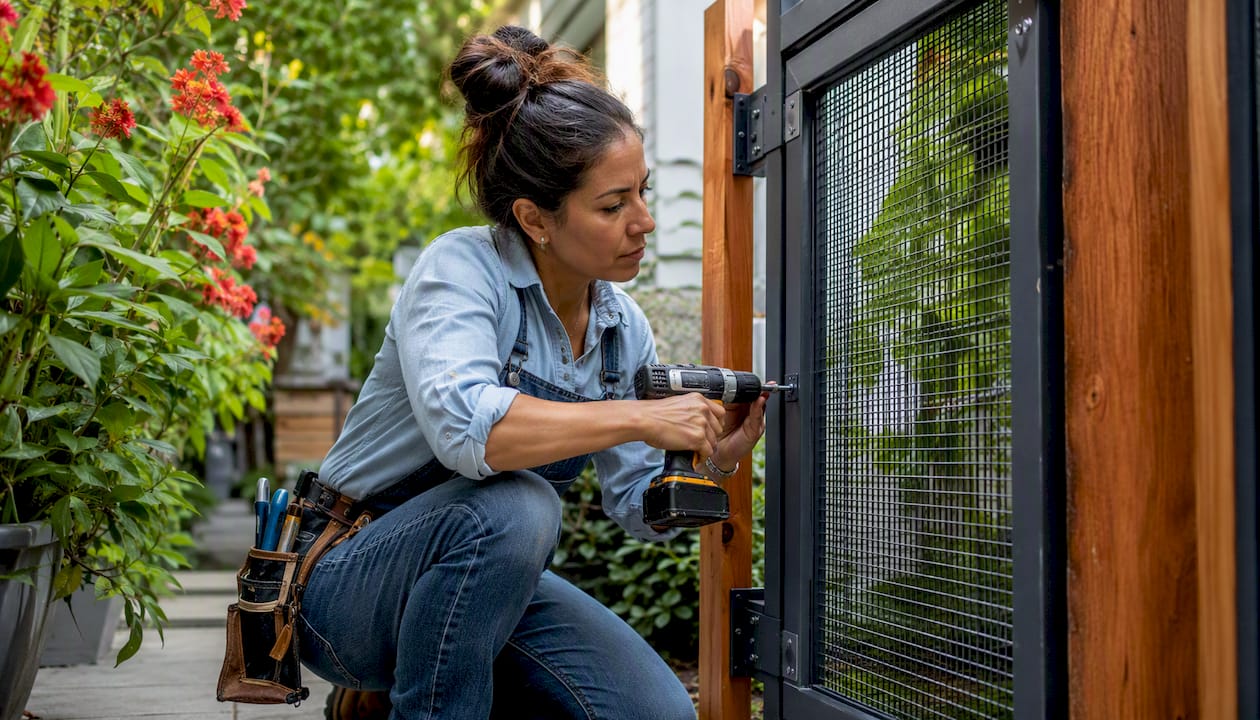
Gate width by use case:
| Gate Width | Typical Use |
|---|---|
| 36 inches | Standard pedestrian access |
| 42 inches | Comfortable pedestrian + hand tools |
| 48 inches | Mower, large equipment, or ADA-friendly access |
| 60+ inches | Double gate for vehicle or contractor access |
A 36-inch walk gate is standard, but check swing direction so the open gate does not obstruct the narrow path. An inward swing on a 30-inch-wide path leaves almost no room to pass. In those cases, a sliding gate or an outward-swinging gate is the practical solution.
Swing vs. sliding gates in narrow yards:
- Swing gates are simpler and less expensive but require clear arc space equal to the gate width
- Sliding gates need a track run alongside the fence equal to the gate width plus hardware clearance — practical only when the fence run is long enough
- Uphill swing gates require a self-closing spring hinge rated for the grade to prevent the gate from drifting open
Hardware checklist:
- Heavy-duty hinges rated for the gate’s weight (aluminum gates are lighter; wood gates need stronger hinges)
- Self-latching latch for pool-adjacent yards (required by California pool barrier code)
- Padlock-compatible latch for security
- Self-closing spring hinge if the gate is near a pool or on a slope
- Automation compatibility: confirm post size and footing depth before specifying a motor
For pedestrian gate options, dimensions, and hardware, Fence-gate-estimator’s service page covers standard and custom configurations for LA properties.
Structural details your contractor needs to get right
The structural decisions made during installation determine whether your fence stands straight for 20 years or starts leaning within three. Narrow side yards add complexity because access for equipment is limited.
Build-ready checklist for your contractor:
- Post depth: typically 36–42 inches for a 6-foot fence; deeper in frost zones or expansive soils
- Post spacing: 6–8 feet on center for most wood and composite panels; 4–6 feet for heavy metal sections
- Footing diameter: at least 10–12 inches for a standard 4x4 post in concrete
- Drainage: slope footings away from the post base; add a 4-inch gravel layer at the bottom of each hole
- Reinforcement: specify galvanized steel sleeves or concrete encasement in reactive soils
- “Good side” orientation: the finished face should face outward (toward the neighbor or street)
- Elevation drawings: include grade changes so the contractor can plan stepped or racked panels
For slope management, stepped panels work best on steep grades where the fence drops in uniform increments. Racked (contoured) panels follow a gradual slope continuously and look cleaner on gentle grades. Right-angle corners create dead zones; 45-degree angled corners or triangular corner planters reclaim that space and keep the run functional.
Pro Tip: In extremely tight access, use pre-built narrow panels and smaller augers or hand-digging to avoid damaging adjacent structures. A 24-inch-wide side yard often can’t accommodate a standard power auger — confirm equipment access with your contractor before signing a contract.
Styling and planting strategies that make a narrow side yard feel larger
A well-designed narrow fence doesn’t just define a boundary. With the right color, lighting, and planting choices, it can make a 30-inch corridor feel like a considered outdoor space.
Visual and styling checklist:
- Use lighter stain colors (warm gray, natural cedar) rather than dark brown or black to reduce perceived mass
- Choose narrow pickets (2–3 inches wide) over wide boards to keep the fence visually light
- Horizontal lines lengthen the space; vertical boards emphasize the narrowness
- Low-voltage strip lighting under the top rail extends usable hours and adds depth at night
- Solar cap lights on posts add ambient light without wiring
- Step lights mounted low on the fence face improve safety and reduce the tunnel effect
- Reflective or light-colored surfaces on the opposite wall bounce light into the space
Planting recommendations by LA microclimate:
- Coastal (Santa Monica, Culver City): Bougainvillea on a trellis panel, dwarf pittosporum as a narrow hedge, or star jasmine trained along the fence rail
- Inland valleys (Encino, Burbank, Glendale): Climbing roses, trumpet vine, or Mexican sage in corner planters
- Vertical plantings and trained vines add depth and privacy without occupying ground space — critical in a yard where every inch of width matters
Corner planters at the entry or exit of the run turn dead zones into usable garden space and soften the transition from fence to structure.
Ballpark costs and realistic timelines for a narrow side yard fence
Budget planning for a narrow side yard fence requires accounting for access constraints, not just linear footage. Tight access often increases labor time and limits equipment options.
| Material | Installed Cost per Linear Foot | Typical 40-ft Project Range |
|---|---|---|
| Pressure-treated wood | $20–$35 | $800–$1,400 |
| Cedar horizontal slats | $30 | $1,200–$2,200 |
| Composite panels | $35–$65 | $1,400–$2,600 |
| Aluminum pickets | $40–$75 | $1,600–$3,000 |
| Steel/wrought iron | $60–$120 | $2,400–$4,800 |
These ranges reflect typical Los Angeles labor and material rates and will shift based on slope, soil conditions, permit fees, and hardware choices. Terrain factors like slope and soil type directly affect installation costs in LA.
Timeline expectations:
- Permit check and approval (if required): 2–6 weeks for standard residential permits in LA
- Material lead times: 1–3 weeks for stock materials; 4–8 weeks for custom fabrication
- Installation: 1–3 days for a 40–60 ft narrow-side run with standard access; add 1–2 days for tight access or slope work
DIY fence installation can save 40–60% on some projects, but tight-access jobs in narrow side yards increase labor difficulty and often reduce those savings. If your side yard is under 36 inches wide, professional installation is usually the more cost-effective choice once you factor in equipment rental and the risk of rework.
Run an instant estimate at Fence-gate-estimator.com before scheduling contractor visits. The tool uses current Los Angeles material and labor rates and gives you a realistic budget range based on your specific inputs.
Los Angeles-specific rules, permits, and soil considerations
Los Angeles has layered fence regulations, and assuming a universal 6-foot allowance is one of the most common mistakes homeowners make. Many LA parcels have height limits that depend on lot width and overlays; check ZIMAS and LADBS early to avoid permit denial or redesign.
LA fence height rules at a glance:
- Front yard: maximum 3.5 feet without a permit under LAMC §12.22.C.20(f)
- Side and rear yards: generally up to 6 feet on narrower lots; higher limits may apply depending on lot width and overlays
- Fences over 6 feet, masonry walls, or structures in HPOZ overlays require a permit
- LAMC Section 12.24 X.7 authorizes a Zoning Administrator to approve fences and walls up to 8 feet in required yards under specific conditions
Common LA pitfalls:
- HPOZ overlays in neighborhoods like Pasadena and West Hollywood restrict materials and finishes
- Hillside restrictions apply to many properties in Brentwood, Bel Air, and Studio City
- Zero-lot-line construction on narrow lots can mean your fence must sit exactly on the property line — confirm with a survey
- Expansive soils in the San Fernando Valley (Sherman Oaks, Encino) require reinforced post footings; include this in your contractor bid
LA permit submission checklist:
- Plot plan showing all property boundaries and existing structures
- Fence location, height, and material specification
- Elevation drawings for sloped sites
- HOA approval letter if applicable
- HPOZ Certificate of Appropriateness if in an overlay zone
Pro Tip: Use ZIMAS to look up your parcel’s zoning, overlay zones, and setback requirements before contacting LADBS. It takes about 10 minutes and can save weeks of back-and-forth during the permit process.
Key Takeaways
Designing a fence for a narrow side yard comes down to four decisions: accurate measurements, confirmed local code, the right material and profile, and a gate that actually works in the available space.
| Point | Details |
|---|---|
| Measure before designing | Record width at three points, slope, and utility locations before choosing any style or material. |
| Confirm LA height rules | Front yards max at 3.5 ft; side/rear yards allow up to 6 ft on narrower lots and up to 8 ft on wider lots, depending on lot width and overlays. |
| Choose slim or mixed profiles | Horizontal slats, open metal pickets, or wood-plus-aluminum reduce visual mass in tight runs. |
| Gate width and swing direction | Use 36–48 in. gates and confirm swing clearance before installation to keep the path usable. |
| Run an instant estimate | Fence-gate-estimator provides Los Angeles-specific cost ranges before you schedule a contractor visit. |
The tradeoffs most homeowners don’t see until it’s too late
Narrow side yard fencing is one of those projects where the design decisions that feel minor at the planning stage — gate swing direction, post reinforcement, material profile — become the most expensive problems after installation. Most articles focus on style. The real decisions are structural.
The conventional wisdom says “just add a 6-foot privacy fence and be done with it.” In Los Angeles, that advice fails on three counts: it often exceeds what LAMC allows on narrower lots without a permit, it turns a functional corridor into a dark tunnel, and it ignores the soil conditions that cause posts to lean within a few years in the San Fernando Valley.
The smarter approach is to treat the narrow side yard as a constrained design problem, not a leftover space. That means choosing a fence profile that fits the width proportionally, specifying reinforced footings from the start, and placing the gate where the yard is widest rather than where it’s most convenient to draw on a plan. For properties in Beverly Hills or Brentwood where curb appeal matters, mixing slim aluminum posts with wood infill panels delivers the premium look without the visual weight of a solid wood fence.
On the DIY vs. hire question: if your side yard is under 36 inches wide, hire a professional. The equipment access alone makes DIY impractical, and the cost of rework on a poorly set post in expansive LA soil exceeds the labor savings.
Fence-gate-estimator makes LA fence planning faster and more accurate
Getting a realistic budget for a narrow side yard fence in Los Angeles used to mean waiting days for three contractor quotes that often varied by thousands of dollars. Fence-gate-estimator gives you an instant Los Angeles-specific cost estimate based on your actual measurements, material preference, and gate configuration — before you schedule a single site visit.
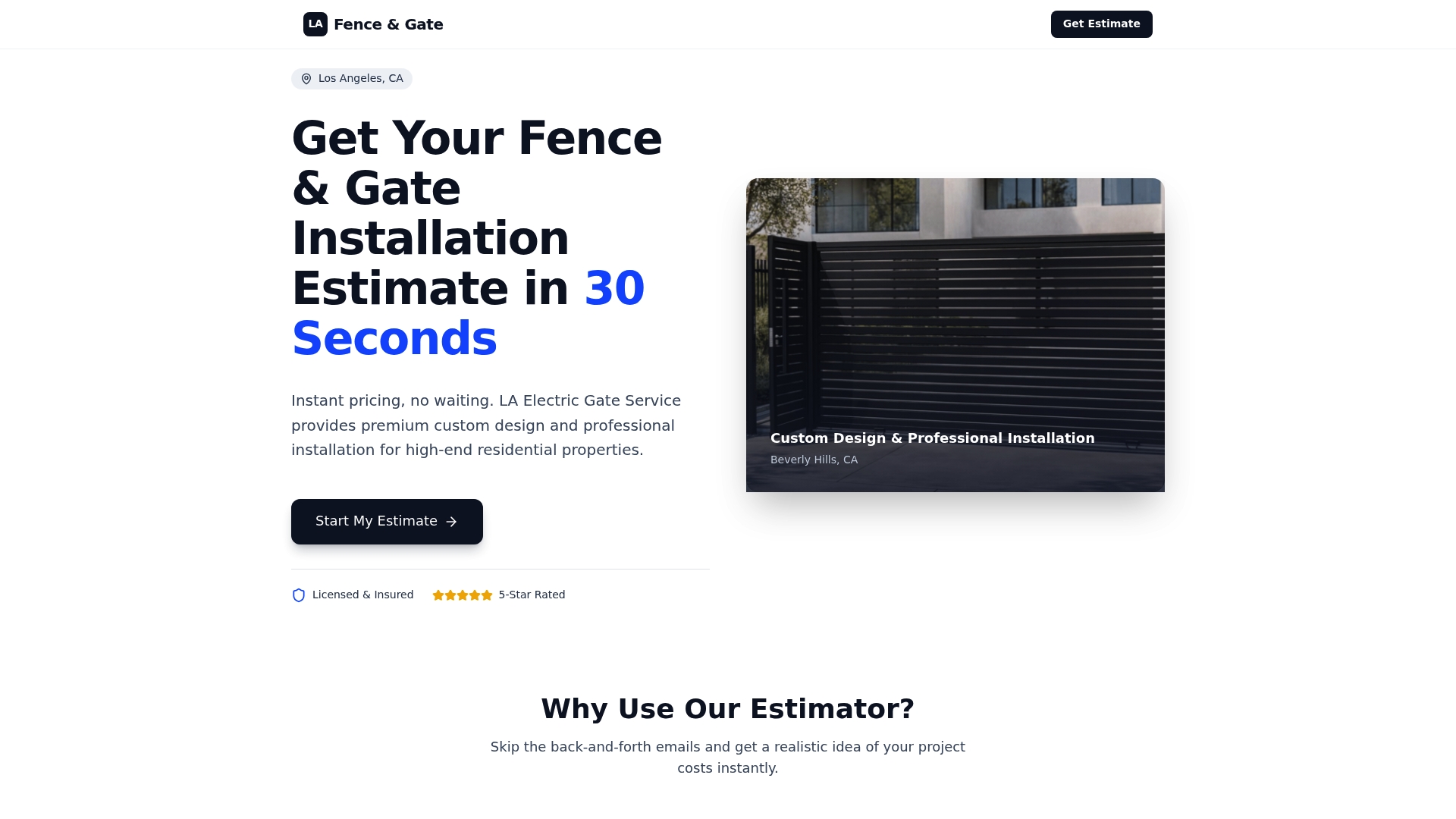
The estimator accounts for local labor rates, material costs, and terrain factors that generic online calculators miss entirely. Input your fence run length, desired height, material choice, and gate width, and you get a detailed cost breakdown covering fabrication, installation, and hardware. The platform also provides permit-aware guidance so you know whether your design requires LADBS approval before you commit to a contractor.
For homeowners in Sherman Oaks, Encino, Pasadena, or Santa Monica, the custom fencing service page covers premium material options, automation features, and the full installation process. Use the estimator now to get a number you can bring to your contractor conversation with confidence.
Useful sources and further reading
These resources cover LA permits, construction details, and cost estimation for narrow side yard fence projects.
- LADBS Fence Height Information Bulletin: The primary source for LA residential fence height limits by yard location and lot width.
- LA City Zoning Code — Fences, Walls, Hedges & Screening: The new LA zoning code with setback and frontage yard fence standards; use this to confirm your parcel’s specific rules.
- LA Planning — Fences and Walls Up to 8 Feet: Explains the Zoning Administrator process for fences exceeding standard height limits under LAMC Section 12.24 X.7.
- CityRuleLookup — LA Fence Height Summary: Plain-language summary of LA height limits, including hillside and HPOZ overlay notes.
- FenceCalc — Small Yard Fencing Ideas: Practical design guidance for urban and townhouse lots, including setback impacts and gate placement.
- ToolsRadar — DIY Fence Installation in Tight Spaces: Covers access constraints, equipment choices, and realistic savings estimates for narrow-lot DIY projects.
- Fence-gate-estimator — Custom Fencing Estimator: Instant LA-specific cost estimates with material, gate, and permit-aware inputs; the fastest way to get a budget number before contractor calls.
- ZIMAS (LA City parcel lookup): Search your address to confirm zoning, overlay zones, and setback requirements before contacting LADBS. Confirm parcel-specific rules via your local planner for complex lots.
FAQ
What should I do with a narrow side yard?
Design it as a functional corridor first: confirm usable width after setbacks, choose a slim-profile fence (horizontal slats or open metal pickets), and place the gate at the widest point. Adding vertical plantings or trellis panels along the fence face turns the space from a utility run into a usable outdoor area.
What fence height is allowed on a side yard in Los Angeles?
Under LAMC §12.22.C.20(f), side and rear yard fences generally allow up to 6 feet on narrower lots and up to 8 feet on lots 40 feet or wider, depending on overlays; fences exceeding those limits or masonry walls require a permit from LADBS.
How do you fence an odd-shaped or corner lot?
For a corner lot, treat each fence run separately: the street-facing side follows front-yard height rules (3.5 ft maximum without a permit in LA), while the interior side yard follows the side-yard allowance. Use 45-degree angled corners rather than right-angle turns to reclaim dead zones and keep the design proportional.
What is the cheapest way to fence a narrow side yard?
Pressure-treated wood is the most budget-friendly option, typically running $20–$35 per linear foot installed in Los Angeles. For a 40-foot run, that puts a basic project in the $800–$1,400 range, though slope, soil conditions, and permit fees can push the total higher.
How wide does a side yard gate need to be?
A 36-inch gate covers standard pedestrian access; go to 42–48 inches if you need to move a mower, large equipment, or want comfortable clearance. Always confirm the swing direction before installation so the open gate doesn’t block the path.
Recommended
- Fence & Gate Installation Cost Calculator Los Angeles
- Custom fence components: build luxury, security, and style in LA | LA Electric Gate Service
- How terrain impacts fence costs in Los Angeles: smart choices | LA Electric Gate Service
- Why Upgrade Residential Fences: A Homeowner’s Guide | LA Electric Gate Service