Gate Styles Explained: A Los Angeles Homeowner's Guide
By BabyLoveGrowth
Gate Styles Explained: A Los Angeles Homeowner’s Guide
Gate styles are defined by the combination of architectural design, mechanical function, and material selection that determines how an entry gate looks, performs, and holds up over time. For Los Angeles homeowners, the right gate does more than mark a property line. It sets the visual tone for your home, controls access, and must withstand coastal humidity, Santa Ana winds, and the occasional seismic shift. This guide covers every major gate category, compares swing versus sliding mechanisms, breaks down 2026 design trends, and gives you a clear framework for choosing the right gate for your property.
What are the main gate categories and how do they differ?
Gates fall into three primary categories: pedestrian gates, driveway gates, and automatic gates. Each serves a distinct purpose and comes with different size, weight, and cost requirements.
Pedestrian gates are designed for foot traffic only. They are smaller, simpler in construction, and the most budget-friendly option. Smaller pedestrian gates under 5 feet wide and weighing 50–70 lbs minimize swing radius issues and operate easily without crowding a path. That weight range matters because it directly affects hinge selection and long-term wear.
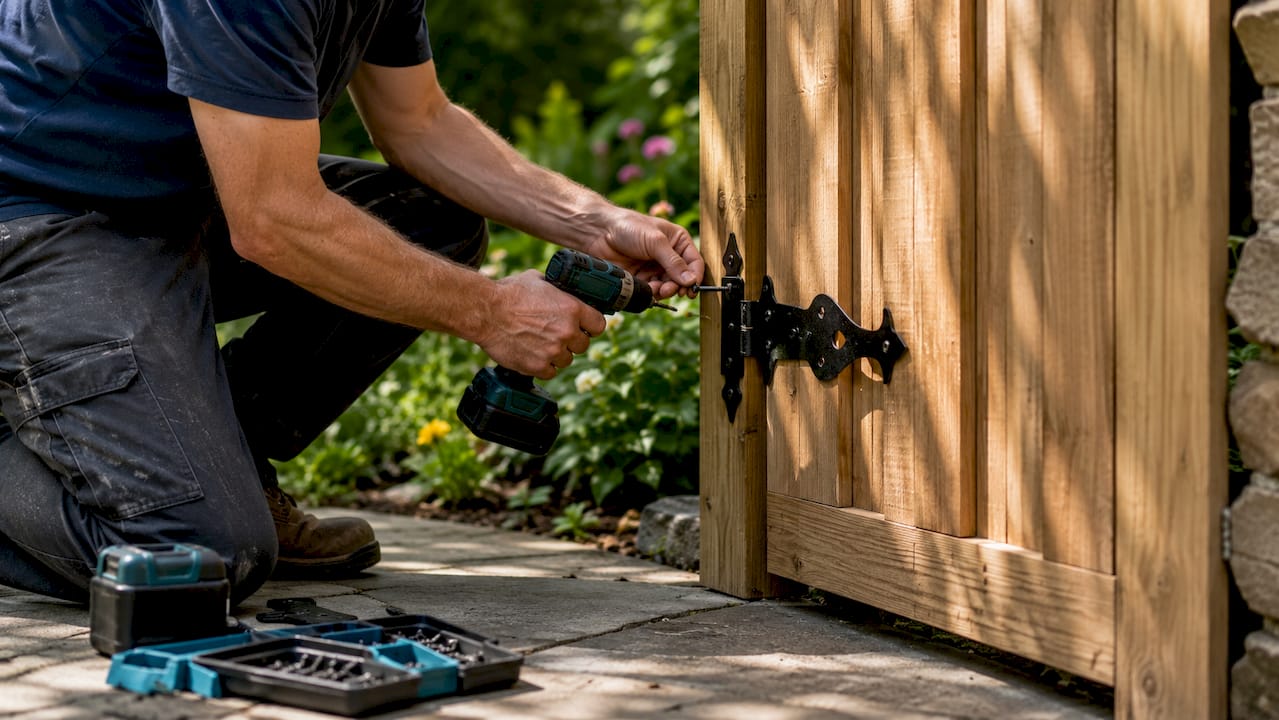
Driveway gates are built for vehicle access. They are structurally heavier, wider, and require stronger posts and hardware to handle the load. Solid panel gates for privacy typically weigh between 90–120 lbs, while picket-style driveway gates run 50–80 lbs for standard sizes. The heavier the gate, the more critical the foundation and post depth become.
Automatic gates are motorized versions of either pedestrian or driveway gates. They add a motor, control board, and access system on top of the base structure. High-end custom automated gates can range from $25,000 to $75,000 or more depending on complexity and material. That figure reflects fabrication, automation hardware, and professional installation combined.
| Gate Type Typical Width Typical Weight Primary Use | |||
| Pedestrian | Under 5 ft | 50–70 lbs | Foot traffic, side yards |
| Driveway (swing) | 10–16 ft | 90–200 lbs | Vehicle access, front entry |
| Automatic | 10–20 ft | 90–300 lbs | Secured vehicle or pedestrian access |
How do swing gates and sliding gates compare?
Swing gates and sliding gates are the two dominant operating mechanisms for driveway and pedestrian gates. Choosing between them depends on your property layout, terrain, and available space.
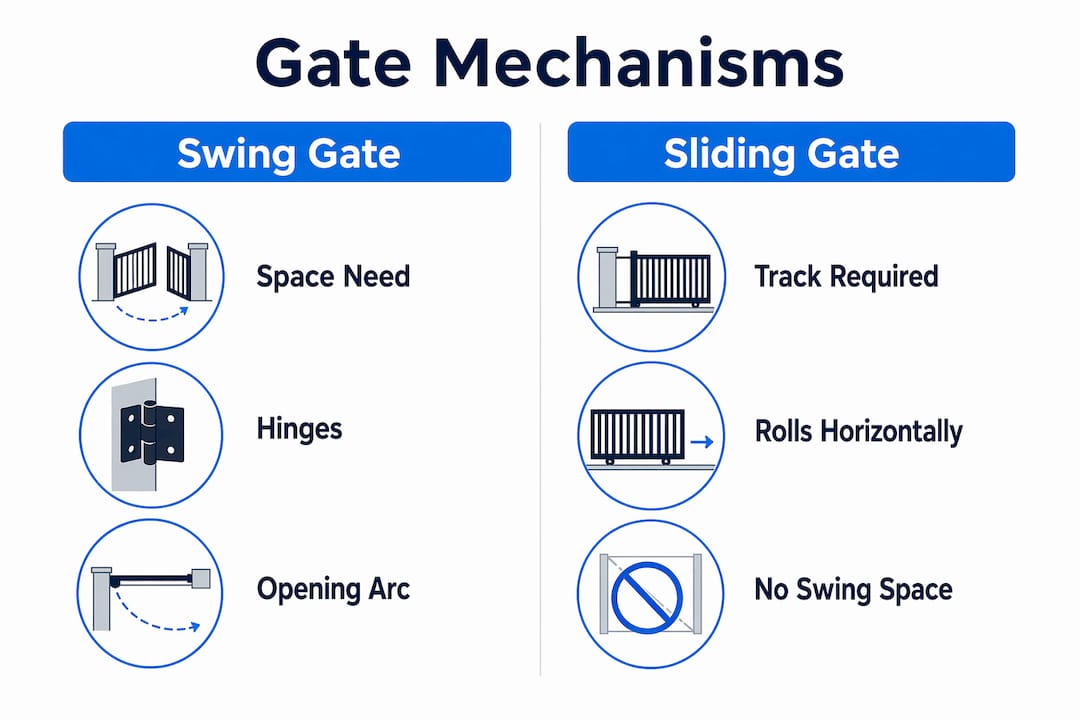
Swing gates pivot on hinges and require a clear arc of space in front of or behind the gate to open fully. Installation is simpler, and the hardware is generally less expensive. Swing gates work best on flat driveways with at least 10–12 feet of clear space in the swing direction. In Beverly Hills and Brentwood, where long flat driveways are common, swing gates are the default choice for estate properties.
Sliding gates roll horizontally along a track parallel to the fence line. They require no swing clearance, which makes them ideal for sloped driveways, compact lots, or properties where the driveway meets the street at a tight angle. Sliding gates are common in Studio City and Sherman Oaks, where hillside lots leave little room for a swing arc. The trade-off is that sliding tracks collect debris and require more frequent cleaning to prevent the gate from binding or stalling.
Pro Tip: Before committing to either mechanism, measure your driveway slope with a level and mark out the full swing arc on the ground. Many homeowners in Los Angeles discover too late that a swing gate would block a parked car or clip a retaining wall.
| Feature Swing Gate Sliding Gate | ||
| Space requirement | Needs clear swing radius | Needs track space along fence line |
| Best terrain | Flat driveways | Slopes, compact lots |
| Installation complexity | Lower | Higher |
| Maintenance concern | Hinge wear | Track debris and alignment |
| Typical cost (driveway) | Lower | Moderate to higher |
Explore driveway gate options for Los Angeles properties to compare swing and sliding configurations based on your specific lot dimensions.
What are the most popular gate design styles in 2026?
Gate design in 2026 splits into three broad aesthetic categories: traditional, modern, and hybrid. Each carries distinct material preferences, maintenance demands, and visual weight.
Traditional gate styles
Traditional designs include board-and-batten wood panels, solid privacy panels, wrought iron picket gates, and colonial-style arched tops. Wrought iron remains a top choice in Pasadena and San Marino, where Spanish Colonial and Craftsman architecture dominates. These styles project permanence and craftsmanship. However, traditional farmstead and colonial styles require careful material selection to avoid warping from moisture variations, even in a dry climate like Los Angeles. Coastal properties in Santa Monica and Malibu face salt air corrosion that accelerates rust on untreated iron.
Modern gate designs
Modern gates favor clean horizontal slats, mixed materials like aluminum combined with tempered glass or wood accents, and open geometric patterns. The functional advantage of horizontal slat designs is significant. Modern horizontal slat designs reduce wind load by up to 60%, which directly extends hinge life and reduces stress on automated motors. In Los Angeles, where Santa Ana wind events can exceed 60 mph, that structural benefit is not cosmetic. It is a durability decision.
Demand for custom designs is rising sharply. 2026 design trends show a 45% increase in demand for custom gates favoring mixed materials and wind-permeable structures. Lead time for custom fabrication typically runs 2–4 months. If you are planning a gate for a new build or renovation in West Hollywood or Culver City, factor that timeline into your project schedule.
Hybrid and architectural gate styles
Hybrid designs blend traditional materials with modern proportions. A common example is a powder-coated steel frame with horizontal cedar slats, combining the warmth of wood with the structural integrity of metal. Aberdeen Gate has built a reputation for this type of architectural integration, treating the gate as a designed element of the home’s facade rather than a utility add-on. Gateswale similarly documents how gates as architectural focal points improve curb appeal and cohesion with the surrounding home design. For Los Angeles properties where the gate is often the first visible element from the street, this framing makes practical sense.
For a deeper look at current trends, the modern gate design process guide covers mixed-material and wind-permeable options specific to the LA market.
How to choose a gate style that fits your property
Choosing the right gate requires balancing four factors: architecture, security, material durability, and budget. Skipping any one of them leads to expensive corrections later.
- Match the gate to your home’s architecture. A sleek aluminum horizontal-slat gate looks out of place on a Spanish Colonial in Pasadena. A wrought iron arched gate looks equally wrong on a mid-century modern in Silver Lake. Start with your home’s architectural language and work outward.
- Assess your security requirements. If access control is a priority, plan for automation from the start. Retrofitting a motor onto a gate not designed for it causes alignment problems and shortens the motor’s lifespan. Automated gate features like keypads, intercoms, and smart phone access add meaningful security value, and pairing them with a smart home system can even reduce homeowner insurance costs in some cases.
- Factor in your local climate and material durability. Marine-grade aluminum resists salt air corrosion and is the right call for properties within a mile of the coast in Santa Monica or Playa del Rey. Untreated wood requires annual sealing in any LA microclimate. Powder-coated steel offers a middle ground on cost and durability for inland properties.
- Plan your budget across tiers. Pedestrian gates represent the most affordable entry point. Automated driveway gates sit at the premium end. Improper gate style selection causes 40% of gate failures due to stress points. Choosing a gate based on appearance alone, without accounting for wind load, weight, or terrain, is the most common and costly mistake homeowners make.
- Use a single contractor for design, fabrication, and installation. Expert fabricators at Aberdeen Gate stress that one entity handling all three phases prevents mechanical misalignment and early failure. When the designer, fabricator, and installer are different companies, tolerances get lost in translation.
Pro Tip: Ask your contractor to provide a load calculation for your gate’s hinge and motor selection before fabrication begins. This single step prevents the most common mechanical failures on automated gates in Los Angeles.
What maintenance does your gate need to last?
Gate longevity depends on consistent, material-specific maintenance. Neglecting routine checks leads to failures that cost far more than the original installation.
- Inspect hinges and hardware every six months. Check hinge torque, look for rust spots, and tighten any loose bolts. On automated gates, test the motor’s force settings and verify the safety reversal function works correctly.
- Seal wood gates annually. Board-and-batten construction with overlapping vertical boards and horizontal battens seals better against rain and minimizes warping compared to simple butt-joint designs. Even so, wood gates in Los Angeles need a fresh coat of exterior sealant every 12–18 months to handle temperature swings.
- Clean sliding gate tracks monthly. Debris, leaves, and grit in the track cause binding that strains the motor and wears down the rollers. A stiff brush and a blast from a garden hose takes five minutes and prevents expensive motor replacements.
- Protect metal finishes from salt air. For coastal properties, apply a clear protective wax or specialized metal coating to powder-coated surfaces twice a year. This prevents the micro-pitting that leads to rust under the coating.
- Schedule a professional inspection annually. Automated gates have more failure points than manual ones. A professional check of the motor, control board, battery backup, and sensor alignment catches problems before they become full failures. The 2026 maintenance guide from LA Electric Gate Service covers seasonal adjustments specific to the Los Angeles climate.
Key takeaways
The most durable and visually effective gate is one where design, material, mechanism, and installation are planned together from the start, not assembled from separate decisions.
| Point Details | |
| Match style to architecture | Choose a gate design that reflects your home’s existing architectural language for visual cohesion. |
| Mechanism follows terrain | Use swing gates on flat driveways and sliding gates on slopes or compact Los Angeles lots. |
| Wind load matters | Horizontal slat designs reduce wind stress by up to 60%, protecting hinges and automation motors. |
| Single-contractor rule | Using one team for design, fabrication, and installation prevents the misalignments that cause 40% of gate failures. |
| Budget for maintenance | Wood gates need annual sealing; metal gates near the coast need biannual protective coating to prevent corrosion. |
Why I always tell homeowners to start with terrain, not style
After working with hundreds of Los Angeles homeowners on gate projects, the single most consistent mistake I see is choosing a gate style from a catalog photo before measuring the property. A gate that looks perfect on a flat Bel Air estate becomes a liability on a sloped driveway in Laurel Canyon. The terrain dictates the mechanism. The mechanism dictates the weight. The weight dictates the hardware. Only after those decisions are locked in should you start choosing finishes and design details.
The second mistake is treating the gate as a security afterthought. In neighborhoods like Beverly Hills and Encino, the gate is often the most visible architectural element from the street. Treating it as a utility rather than a design feature leaves real value on the table. The homes I have seen with the strongest curb appeal all share one trait: the gate looks like it was designed with the house, not added to it later.
My honest recommendation is to invest in custom fabrication if your budget allows. Off-the-shelf gates save money upfront but rarely fit the specific dimensions, terrain, and architectural character of a Los Angeles property. The 2–4 month lead time for custom work is worth it. A gate that fits perfectly, operates smoothly, and complements your home’s design will outlast and outperform a catalog gate by years.
— Moin
Get an instant estimate for your Los Angeles gate project
Fence-gate-estimator.com gives Los Angeles homeowners an immediate, accurate cost estimate for any gate project, from a simple pedestrian gate to a fully automated custom driveway gate. The platform uses current local material and labor rates to generate a detailed cost breakdown based on your property size, design preferences, and automation requirements. Whether you are upgrading a Brentwood estate or securing a Santa Monica townhome, you can use the custom fence and gate estimator to plan your budget before you speak to a single contractor. No guesswork, no surprise quotes. Just a clear number you can build a project around.
Recommended
- Modern Gate Design Process: A Los Angeles Homeowner’s Guide | LA Electric Gate Service
- Stylish Gate Ideas for Upscale Los Angeles Homes | LA Electric Gate Service
- Gate Automation Process: A Homeowner’s Practical Guide | LA Electric Gate Service
- Gate openers: The key to secure, stylish LA homes | LA Electric Gate Service