Automatic Gate Obstruction Sensors: A 2026 Safety Guide
By BabyLoveGrowth
Automatic gate obstruction sensors are safety devices that detect obstacles in a gate’s path and stop or reverse gate movement before injury or property damage occurs. The industry standard term for these devices is “entrapment protection devices,” defined under UL 325, the governing safety standard for automatic vehicular gate systems. UL 325 mandates at least two independent entrapment protection devices per entrapment zone, in both directions of gate travel. That requirement has been in effect since january 2016 and applies to every automatic gate installation, including residential driveways in Los Angeles, Beverly Hills, and Brentwood. ASTM F2200 further defines an entrapment zone as any gap smaller than 16 inches between a moving gate and a fixed structure. Together, these two standards form the compliance baseline every homeowner and property manager needs to understand.
1. What types of automatic gate obstruction sensors are used?
Two sensor categories cover the vast majority of residential gate installations: photo eyes and safety edges. Each detects obstructions differently, and each fills a gap the other cannot.
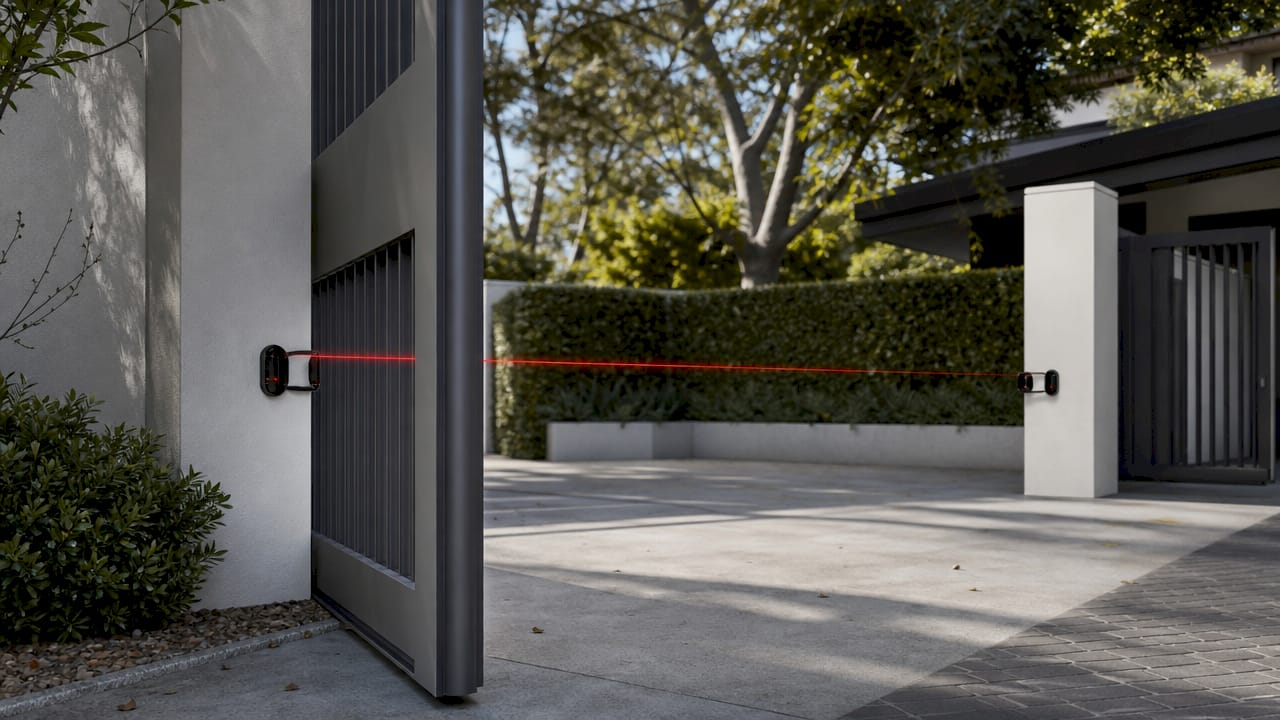
Photo eyes are non-contact infrared beam sensors. A transmitter sends an invisible beam across the gate opening to a receiver on the opposite post. When any object breaks that beam, the gate operator stops or reverses immediately. Photo eyes detect obstructions before physical contact occurs, which makes them the proactive layer of your safety system.
Safety edges are pressure-sensitive strips mounted directly on the gate’s leading edge. They react only after physical contact. When the gate presses against a person, vehicle, or object, the strip compresses and sends a stop or reverse signal to the operator. Safety edges trigger responses after contact, so they serve as the reactive backup when a photo eye fails to catch an obstruction.
Beyond these two primary types, inductive loop detectors and microwave sensors detect vehicle presence at entry and exit points. Loop detectors are embedded in the pavement and sense the metal mass of a vehicle. Microwave sensors emit radio waves and detect movement or presence above ground. Both are common in commercial settings and larger residential properties in areas like Encino and Pasadena.
Monitored vs. non-monitored sensors is a distinction that matters for compliance. A monitored sensor continuously signals the gate operator that it is connected and functional. Monitored sensors must signal the operator if disconnected or malfunctioning, forcing the system into a fail-safe mode. Non-monitored sensors simply stop sending a signal when they fail, leaving the gate unaware of the problem.
Pro Tip: Always specify monitored sensors when purchasing or upgrading your gate system. The cost difference is small, but the compliance and safety difference is significant.
2. How do gate sensors work to meet UL 325 and ASTM F2200 standards?
The operational logic is straightforward. The gate operator runs a continuous check on each connected sensor. When a sensor detects an obstruction, it sends a signal to the operator, which immediately halts or reverses gate travel. The entire response happens in a fraction of a second.
UL 325 compliance requires more than just having sensors present. Two independent devices per entrapment zone are required, covering both the opening and closing directions of travel. A single photo eye pair covering only the gate opening does not satisfy this requirement. You need a second independent device covering the closing path as well.
ASTM F2200 defines where sensors must be placed. The 16-inch clearance threshold applies to any gap between the gate and a fixed structure, including posts, walls, and columns. Any gap smaller than 16 inches qualifies as an entrapment zone and requires active sensor coverage.
Sensor height placement is equally critical. Multiple sensor pairs at different heights are needed to detect vehicles, children, and small pets. A single beam at bumper height protects vehicles but leaves a child or dog undetected. Proper installations use at least two beam heights to address this gap.
The monitoring function is what separates a compliant system from a dangerous one. Without sensor monitoring, a disconnected sensor causes dangerous undetected operation. The gate continues to run as if the sensor is active, removing the safety layer entirely without any visible warning to the homeowner.
- Operator continuously polls each sensor for a live connection signal.
- Sensor detects obstruction or loses connection and sends a fault signal.
- Operator halts gate travel and enters fail-safe mode.
- Gate remains stationary until the fault is cleared or manually overridden.
- Operator logs the fault event for maintenance review.
3. Best practices for sensor installation and maintenance
Proper installation is where most compliance failures originate. Common installation errors include misaligning photo eyes and leaving portions of the gate travel path unprotected. A misaligned beam that covers only 80% of the gate path leaves an entrapment zone completely unmonitored, even though the equipment is physically present and powered.
- Full path alignment: Photo eyes must be positioned so the beam covers the entire gate travel path from fully open to fully closed. Partial coverage creates a safety violation regardless of equipment quality.
- Mounting height: Install beams at multiple heights to cover vehicles, pedestrians, and children. A minimum of two beam heights is standard practice for residential gates.
- Safety edge placement: Mount safety edges on the leading edge of the gate panel, not on the frame. The strip must make contact with an obstruction before the gate structure does.
- Wiring protection: Run all sensor wiring through conduit to protect against UV degradation, moisture, and pest damage. Los Angeles properties near the coast, including Santa Monica and Culver City, face accelerated UV and salt-air exposure.
- Clearance from obstructions: Keep photo eye lenses free from landscaping, debris, and direct sunlight interference. Overgrown hedges are a common cause of false triggers and beam blockage.
Pro Tip: After any landscaping work near your gate, recheck photo eye alignment. Trimming or planting near the gate posts frequently shifts sensor positions by enough to break the beam path.
Monthly testing keeps your system compliant between annual inspections. Homeowners should test sensors monthly by intentionally breaking the infrared beam and pressing the safety edge to confirm the gate stops or reverses. Annual maintenance adds lubrication of mechanical components and a full wiring inspection.
Documented maintenance records serve a specific legal purpose. Maintaining records of monthly testing is your strongest legal defense in the event of a gate-related accident. Insurance carriers increasingly require proof of regular maintenance to honor claims related to gate incidents. A simple log with dates, test results, and any repairs performed is sufficient. You can find a practical framework for this in the gate maintenance guide published by Fence-gate-estimator.
4. How to choose the right sensors for your Los Angeles property
The right sensor combination depends on your gate type, property layout, and the entrapment zones present. Start by mapping every point where the gate comes within 16 inches of a fixed structure. Each of those points requires independent sensor coverage.
Swing gates vs. sliding gates have different sensor requirements. Swing gates create entrapment zones on both sides of the pivot point as the gate arc sweeps through its travel path. Sliding gates create entrapment zones at the leading edge and at the point where the gate meets the latch post. Each gate type needs sensors positioned to address its specific geometry.
- For swing gates: Install photo eyes at the arc entry and exit points, plus safety edges on the leading edge of each gate panel.
- For sliding gates: Mount photo eyes across the full slide path and safety edges on the leading edge that contacts the latch post.
- For barrier arm gates: A single photo eye pair and a safety edge on the arm tip typically satisfy UL 325 for this gate type.
- For pedestrian gates: Smaller clearance zones still require sensor coverage. Driveway gate installations in areas like Bel Air and West Hollywood frequently include pedestrian access points that need separate sensor circuits.
Budget considerations are real, but cutting corners on sensor monitoring is the wrong place to save money. Monitored sensors cost more upfront but eliminate the liability exposure that comes with an undetected sensor failure. Wireless photo eye systems are available for properties where running conduit is difficult, though wired systems remain more reliable in the long term.
| Sensor type Detection method Best application | ||
| Photo eyes | Infrared beam interruption | Full gate path coverage, proactive detection |
| Safety edges | Pressure contact | Leading edge protection, reactive backup |
| Loop detectors | Inductive vehicle presence | Vehicle-only detection at entry/exit |
| Microwave sensors | Radio wave motion | Above-ground vehicle and large object detection |
A layered approach combining photo eyes and safety edges provides the most complete protection. Proactive photo eyes and reactive safety edges together create a defense that catches obstructions before contact and responds immediately if contact occurs.
Key takeaways
Automatic gate obstruction sensors require at least two independent monitored devices per entrapment zone under UL 325, combining proactive photo eyes and reactive safety edges for full protection.
| Point Details | |
| UL 325 requires two devices per zone | One sensor pair is never enough; each entrapment zone needs two independent devices. |
| Monitored sensors are mandatory | Non-monitored sensors that fail silently leave your gate operating without safety coverage. |
| Photo eyes and safety edges work together | Proactive beam detection plus reactive contact strips cover what either alone cannot. |
| Monthly testing protects you legally | Documented test logs are your primary defense if a gate incident leads to a liability claim. |
| Installation alignment determines compliance | A misaligned photo eye that covers only part of the gate path creates a safety violation. |
Why I think most homeowners underestimate sensor maintenance
Homeowners in Los Angeles tend to treat gate sensors as a set-and-forget installation. That assumption is the most common mistake I see. Sensors drift out of alignment, wiring degrades in the heat, and landscaping grows into beam paths. None of these failures announce themselves. The gate just keeps running, and the safety layer quietly disappears.
The legal exposure from undocumented sensor failures is real. I have seen property owners face significant liability after a gate incident where they could not produce a single maintenance record. Insurance carriers look for evidence of duty of care, and a blank maintenance history is the worst possible answer.
Los Angeles properties face specific environmental stressors that accelerate sensor degradation. Coastal properties in Santa Monica and Culver City deal with salt air and moisture. Properties in the San Fernando Valley, including Sherman Oaks and Encino, face extreme summer heat that warps sensor mounts and degrades wiring insulation. These conditions make the monthly testing recommendation more than a formality.
The combination of proactive photo eyes and reactive safety edges is not optional redundancy. It is the minimum standard for a compliant system. Treating one as sufficient and the other as optional leaves your property and your family exposed to a preventable accident.
— Moin
Professional gate automation services in Los Angeles
Getting sensor installation right from the start saves you from costly corrections later. Fence-gate-estimator specializes in gate automation services for residential properties across Los Angeles, including Beverly Hills, Pasadena, and Brentwood, with installations that meet UL 325 and ASTM F2200 requirements from day one.

Every installation includes proper sensor placement, monitored device configuration, and a documented baseline test record. Fence-gate-estimator also offers scheduled maintenance programs so you never miss a monthly check. Use the instant cost calculator at fence-gate-estimator.com to get a realistic budget estimate for your property, including sensor upgrades and automation features tailored to your gate type and access points.