How to Design a Shared Estate Fence Line With Your Neighbor
By BabyLoveGrowth AI
Design a shared estate fence line by confirming the surveyed boundary first, agreeing on cost and materials with your neighbor in writing, then securing permits before anyone digs a post hole. Skip any of those three, and you risk tearing out a fence that sits on the wrong side of the line, or worse, on a utility easement.
Three things to do this week:
- Order a boundary survey from a licensed land surveyor or pull your recorded plat from the county assessor.
- Talk to your neighbor and propose a written cost-sharing and design agreement before either of you buys materials.
- Call 811 for a utility locate, and check with your county zoning office on setback and permit rules.
Pro Tip: If you want sole control over maintenance and want to avoid future cost-sharing arguments, set the fence a few inches inside your own property line rather than exactly on it. You give up a sliver of yard, but you keep the right to repair, replace, or repaint without a neighbor’s sign-off.
Key Takeaways
A shared estate fence line succeeds when the boundary is surveyed, the neighbor agreement is written and recorded, and permits are secured before any post goes into the ground.
| Point | Details |
|---|---|
| Survey first, always | Order a licensed survey or pull your recorded plat before discussing design or cost with your neighbor. |
| Put the agreement in writing | Include location, materials, cost split, and maintenance duties, then record it to bind future owners. |
| Check easements and call 811 | Utility companies can remove a fence built over an unmarked easement without compensation. |
| Budget a contingency | Set aside 10 to 20 percent extra for slope, root zones, or drainage surprises common on hillside lots. |
| Estimate before you bid | Use Fence-Gate-Estimator to generate a realistic Los Angeles cost range before contacting neighbors or contractors. |
Where to Learn More
- Partition fence law and cost-sharing rules
- Neighbor fence agreement template guidance
- Fence project planning checklist
- Handling fence disputes with neighbors
Check your county’s zoning and permit office directly for exact local rules, since codes vary by city even within the same county.
This article is general information, not a substitute for advice from a qualified lawyer. Consult a qualified legal professional about your own circumstances before acting on anything here.
Table of Contents
- How Do You Confirm Property Lines for a Shared Fence?
- How Do You Talk to a Neighbor About Sharing a Fence?
- What Materials and Design Choices Work Best for a Shared Fence?
- Layout and Measurement Checklist Before You Call a Contractor
- What Permits Do You Need for a Shared Boundary Fence?
- What Does a Shared Fence Typically Cost, and Who Pays?
- How Do You Choose a Fence Contractor for a Shared Boundary Project?
- How Do Slopes, Trees, and Terrain Change Fence Design?
- What Homeowners Consistently Get Wrong
- How Fence-Gate-Estimator Turns Your Layout Plan Into a Real Budget
- Sources
- FAQ
How Do You Confirm Property Lines for a Shared Fence?
A recorded boundary survey is the only document that ends arguments before they start. In Los Angeles County, a licensed land surveyor typically stakes corners and produces a plat within one to three weeks, depending on lot complexity and whether old markers have shifted or gone missing. That plat becomes the reference point for every decision that follows: post placement, cost-sharing, and any future dispute.
Pull your deed and plat map first and look for your assessor parcel number along with any recorded easements. Utility, drainage, or access easements can prohibit fence placement entirely in certain zones, even if the fence sits fully within your legal boundary.
This is also where the legal concept of a partition fence (sometimes called a boundary fence) matters. When a fence sits directly on the line separating two lots, it’s generally treated as jointly owned, and many states hold both owners responsible for upkeep and repair costs. Some states allow one owner to build after giving written notice and later recover half the cost if the neighbor doesn’t object in time. California follows a version of this rule, so documenting notice matters as much as documenting the survey itself.
A fence built directly on a shared boundary line typically becomes joint property under partition fence rules, meaning both owners can be on the hook for future repairs whether they agreed to the original build or not.
Work through these steps in order:
- Order a professional survey or retrieve your recorded plat.
- Check for easements and, if applicable, review your HOA’s CC&Rs.
- Confirm setback rules and any visibility-triangle restrictions near driveways.
- Photograph existing conditions and document every finding in writing.
Call 811 before any of this moves toward digging. Utility companies can legally remove a fence built over an unmarked line, and you likely won’t get compensated for the loss.
How Do You Talk to a Neighbor About Sharing a Fence?
Bring the survey to the conversation, not just an opinion about where the fence should go. Show your neighbor the plat, a rough sketch of the proposed line, and a preliminary cost estimate. Framing the conversation around shared documents rather than assumptions cuts down on defensiveness immediately.
A solid neighbor fence agreement should spell out:
- Exact fence location, tied to survey markers
- Materials, height, and finished-side orientation
- Cost split (commonly 50/50 for a true boundary fence)
- Who handles permits and inspections
- A maintenance schedule and repair responsibilities going forward
Legal guidance on neighbor fence agreements recommends attaching the survey plat directly to the signed document. If you want the agreement to bind future buyers of either property, record it with the county. An unrecorded agreement is only enforceable between the two of you personally.
If a neighbor refuses to contribute, you have options. You can build entirely on your own side of the line (giving up sole decision-making but avoiding a legal fight), invoke your state’s statutory notice process if one exists, or bring in a neutral mediator before things escalate. Best practices for shared fences consistently point back to clear communication and a documented paper trail as the cheapest insurance against a lawsuit.
Pro Tip: Get the agreement signed, dated, and ideally notarized. Attach the survey plat as an exhibit. A one-page handshake note means nothing in court; a recorded agreement with a plat attached means almost everything.
What Materials and Design Choices Work Best for a Shared Fence?
Material choice on a shared boundary carries a different weight than a fence on your own property, because your neighbor lives with the same finish, the same maintenance schedule, and the same repair bills. Wood offers warmth and privacy but demands the most upkeep. Vinyl and composite trade a higher upfront cost for near-zero maintenance. Aluminum and wrought iron ornamental fencing hold up well in Southern California’s dry climate and read as premium in neighborhoods like Beverly Hills or Bel Air. Chain link with privacy slats remains the budget option, though it rarely satisfies HOA aesthetic standards in upscale communities.
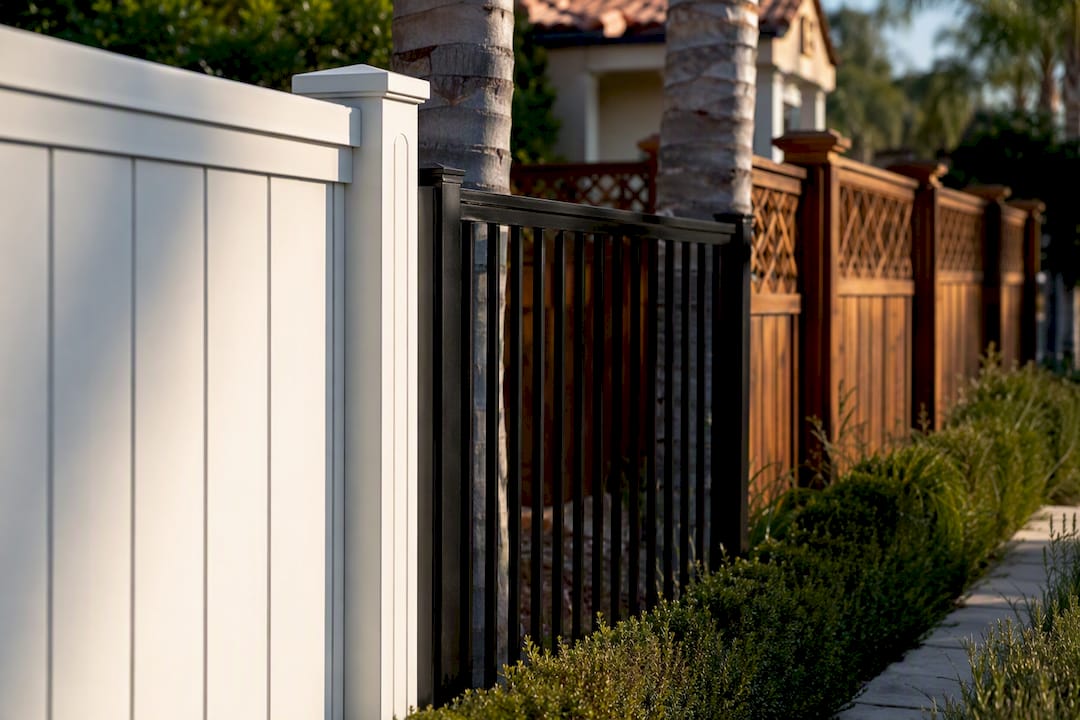
Height and sightlines matter as much as material. Backyard fences generally allow more height than front-yard fences, and anything near a driveway or intersection may run into visibility-triangle restrictions that override personal preference.
Gates deserve their own conversation. Decide upfront whether a shared gate will swing or slide, who maintains the hardware, and how much clearance equipment (mowers, trash bins, service trucks) needs to pass through.
A few design habits prevent friction down the road:
- Agree on a “finished side out” convention so both yards face the attractive side.
- Center posts on the boundary line rather than placing them entirely on one owner’s side.
- Match the new fence’s style to whatever runs along the rest of the block, especially in HOA communities.
Layout and Measurement Checklist Before You Call a Contractor
Before any bid conversation, verify your survey pins are still physically in the ground and flag every corner with marking paint or stakes. Confirm easements one more time, run the 811 utility locate, and walk the full run of the fence noting where grade changes or drops.
- Sketch the full fence line on paper or a simple site plan, marking gate locations.
- Flag proposed post positions, spacing them roughly six to eight feet apart depending on panel style and wind exposure.
- Mark gate openings and confirm swing or slide clearance against driveways, walkways, and equipment access.
- Note every slope or step in the terrain. Sloped runs typically require stepped panels or racked (angled) sections rather than a single straight run.
Bring these items to every contractor bid:
- Copy of the survey plat
- Site photos from multiple angles
- Condition notes on any existing fence being replaced
- Desired materials, height, and finish
- HOA guidelines or permit requirements already on file
Measuring a stepped fence on a slope takes more care than a flat run. Count panels separately for each grade change, and budget for a few extra posts near gates and corners, since these points bear more structural load than a straight mid-run section.
What Permits Do You Need for a Shared Boundary Fence?
Los Angeles-area municipalities generally trigger a permit requirement once a fence exceeds a certain height, sits in a front yard, or encloses a pool. Work that touches a public right-of-way almost always needs sign-off regardless of height. Rules vary by city, so Sherman Oaks, Culver City, and Pasadena each maintain their own zoning code specifics worth a direct call to confirm.
Visibility triangles near driveways and sidewalk intersections often force a lower fence height than you’d otherwise choose, and these rules typically override personal design preference for safety reasons. If your HOA has its own architectural review process, that approval usually needs to happen before the municipal permit application, not after.
Local visibility-triangle rules can force a fence height reduction or setback that has nothing to do with your personal design preference, and skipping this check is one of the most common reasons homeowners end up tearing out a freshly installed section.
Bring these to your permit application:
- Site plan showing exact fence dimensions and setbacks
- Copy of the survey plat
- Neighbor agreement, if your jurisdiction requires proof of shared consent
- Estimated permit fee
- Expected approval timeline, which can run from a few days to several weeks depending on the city
What Does a Shared Fence Typically Cost, and Who Pays?
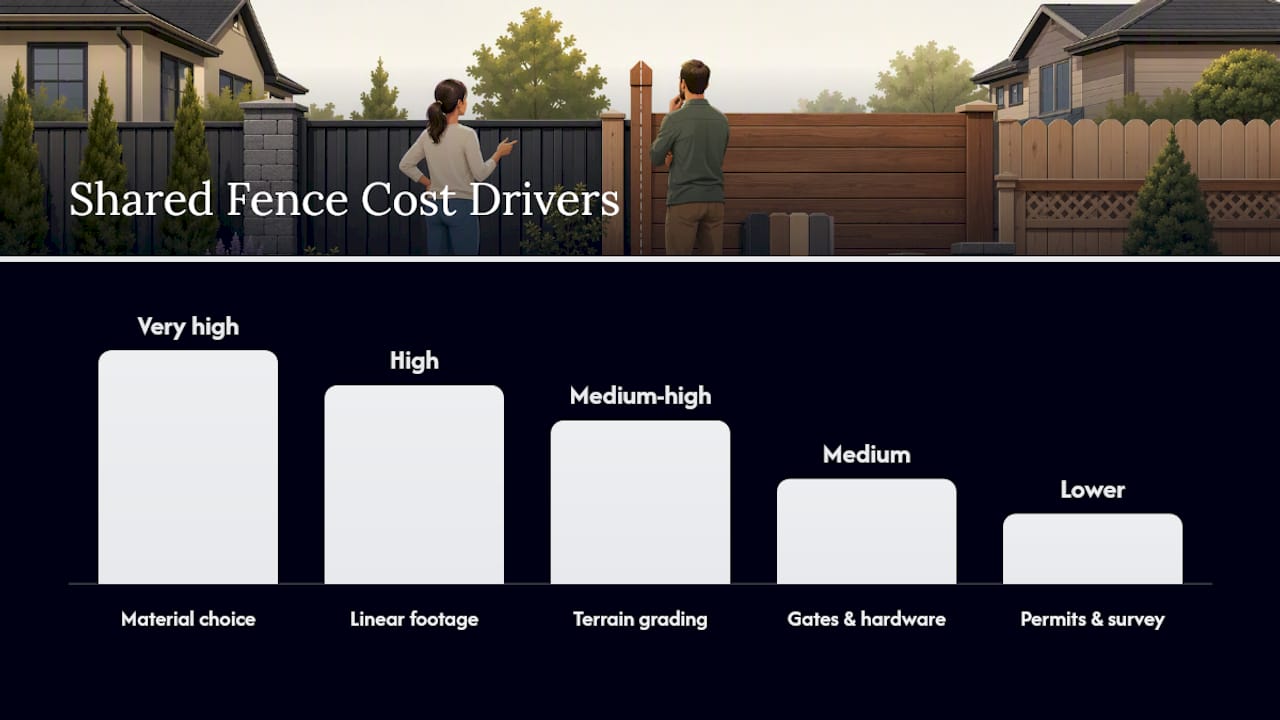
Cost swings on a handful of variables: material choice, total linear footage, how much grading the terrain needs, gate count and hardware, and permit or survey fees layered on top. A flat backyard run in vinyl costs meaningfully less per foot than an ornamental iron fence crossing a sloped side yard.
For a true boundary fence, the common norm is a 50/50 cost split between both owners, since both benefit equally from the structure. That norm shifts when one owner wants a significant upgrade the other doesn’t need, or when one owner simply builds entirely on their own side and forgoes any shared claim.
A realistic timeline runs from survey and permits, through contractor bidding, into material lead time, and finally installation. Each step can take anywhere from a few days to several weeks in the Los Angeles market, with permit approval usually the longest variable.
- Get a written, itemized bid before signing anything.
- Require the estimate to separate materials, labor, permits, and any grading work.
- Agree in writing, before work starts, on how cost overruns or mid-project upgrades get handled.
Pro Tip: An itemized bid tied directly to your recorded survey reduces the odds of a scope dispute after installation, since both you and the contractor are working from the same reference document.
How Do You Choose a Fence Contractor for a Shared Boundary Project?
Ask every contractor whether they’ll work directly from your recorded survey, who pulls the permit, and how they handle utility locates before digging. Request references from recent local jobs, confirm active license and insurance, and get warranty terms in writing before signing anything.
Contract essentials to look for:
- Scope of work tied explicitly to the survey plat
- Payment schedule with a reasonable deposit, not full payment upfront
- Written change-order terms for any mid-project adjustments
- Clear statement of who is responsible for pulling permits
- Proof of current insurance certificates
Red flags worth walking away from: a contractor who refuses to reference your survey, anyone pushing for a large cash payment before work begins, or no written contract at all.
Two questions worth asking on the first call: “Will you work from a recorded survey?” and “Who pulls the permit, you or me?” Answers that dodge either question are a warning sign.
How Do Slopes, Trees, and Terrain Change Fence Design?
Sloped lots, tree root zones, drainage paths, and utility easements all change how deep posts go, what materials hold up, and how much labor the job takes. A steep grade often calls for stepped panels or racked sections instead of a single straight run, and dense root systems sometimes force a floating rail design that clears the roots entirely rather than cutting through them.
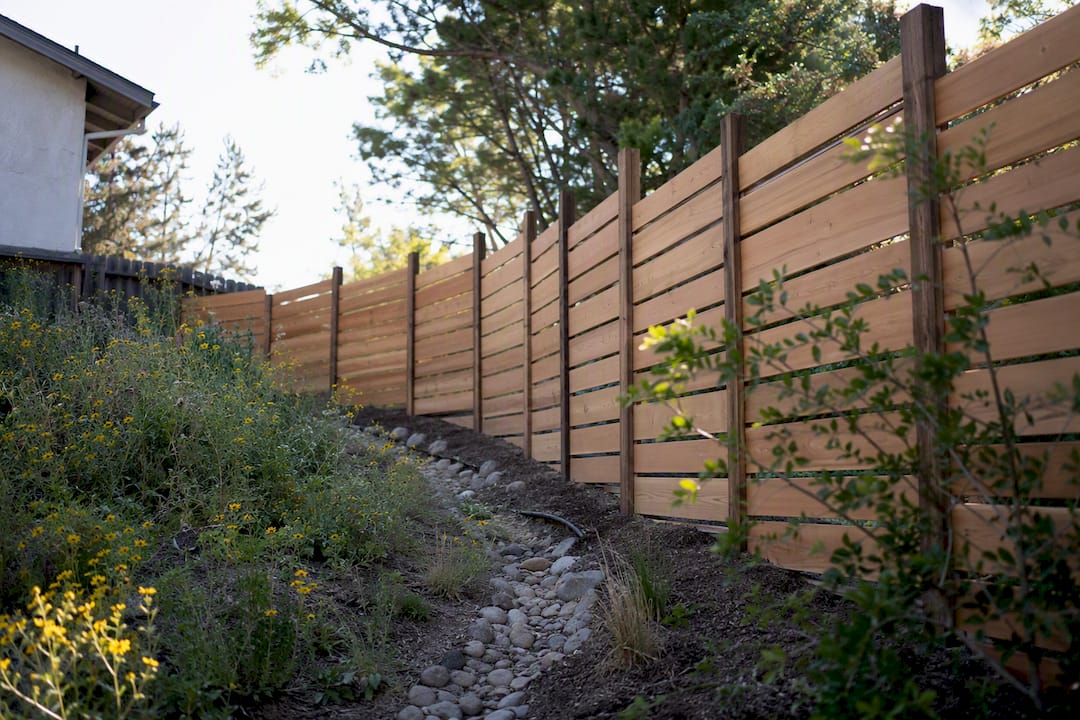
Masonry posts, retaining walls, or complex grading can multiply the per-linear-foot cost well beyond a flat, obstruction-free run, so budgeting a contingency matters more on hillside lots common around Studio City, Encino, and parts of Glendale.
Pro Tip: Check your city’s tree-protection ordinance before finalizing the layout, and bring in a certified arborist if a mature tree sits within a few feet of the planned line. Removing or damaging a protected tree can trigger fines that dwarf any savings from a straighter fence run.
What Homeowners Consistently Get Wrong
Three habits separate a smooth shared-fence project from a contentious one: always work from the actual survey instead of a fence line you’ve eyeballed for years, always put neighbor agreements in writing even when the relationship feels friendly, and always budget 10 to 20 percent extra for site surprises like buried irrigation lines or unexpected grade changes.
Choosing a fully shared fence makes sense when you and your neighbor want equal say and equal cost. Choosing a one-sided fence, built entirely within your own line, makes sense when you’d rather pay more for full control than negotiate every design decision. Neither choice is wrong. The mistake is not deciding on purpose.
How Fence-Gate-Estimator Turns Your Layout Plan Into a Real Budget
Once you know your linear footage, material preference, gate count, and whether your lot has slope, you don’t need to guess at pricing before talking to your neighbor or getting contractor bids. Fence-Gate-Estimator takes those exact inputs and generates a realistic Los Angeles-market cost range in minutes, based on current local material and labor rates rather than a national average that doesn’t reflect Beverly Hills or Santa Monica pricing.
Run your numbers through the fence and gate cost calculator before you sit down with your neighbor. Bringing an estimate to that conversation, alongside your survey, gives both of you a concrete starting point instead of a vague guess. If gates and automation are part of the plan, the gate automation service page breaks down those costs separately so nothing gets bundled into a confusing lump sum. From there, the next step is simple: gather your survey and permit information, run the estimate, and request an on-site bid to confirm exact numbers for your property.
Sources
- Fencing on the property line: Who pays for and maintains it? | FindLaw
- How to Fill Out and Sign a Neighbor Fence Agreement Template - LegalClarity
- Planning Your Fence Project | TheSiteMath
- The Right Way to Share a Fence With Neighbors - Fence Company
- How to Handle Fence Disputes with Neighbors - Fence Guys
FAQ
How Do You Lay Out a Fence Line?
Start with a confirmed survey, flag every corner and post position, then mark gate locations with swing clearance before measuring the full run for materials.
Whose Responsibility Is a Shared Fence?
A fence built directly on the boundary is generally treated as jointly owned under partition fence rules, with both neighbors sharing maintenance and repair costs.
How Do You Mark a Property Line for a Fence?
Hire a licensed surveyor to locate and flag the recorded boundary pins, since fence lines based on old markers, landscaping, or memory are a common source of costly disputes.
How Far From the Property Line Can You Build a Fence?
Setback distance depends entirely on your local zoning code and whether the fence sits in a front or back yard, so confirm exact figures with your county or city planning office before staking anything.
Can Fence-Gate-Estimator Help Before I Talk to My Neighbor?
Yes. Running your layout details through the Fence-Gate-Estimator tool gives you a realistic cost range to bring into the neighbor conversation, so the discussion starts from real numbers instead of guesswork.