How Fence Gates Shape Drainage on Your Property
By BabyLoveGrowth
Fence gates are defined as the primary moving components in a fence system, and their role in drainage is more consequential than most homeowners and builders realize. A gate does not just open and close. It redirects, blocks, or channels water every time rain falls on your property. Poor drainage around gate posts causes soil saturation that leads to posts leaning, settling, or twisting, damaging gate functionality and reducing gate lifespan by 30–50%. That means a gate designed to last 20 years can fail in as few as 7. In Los Angeles, where seasonal storms deliver concentrated rainfall between november and march, understanding the role of fence gates in drainage is not optional. It is the difference between a gate that works for decades and one that drags, jams, or collapses within a few years.
How do fence gates affect drainage and water flow?
Gates act as barriers to water flow and require superior drainage compared to static fence sections. A standard fence panel sits fixed in the ground. A gate, by contrast, swings or slides, creating a dynamic gap at its base and sides that water exploits differently depending on rain intensity and soil grade. When a gate sits flush with the ground or has inadequate clearance, water pools directly at the post base. That pooling increases hydrostatic pressure against the concrete footing, saturating the surrounding soil and destabilizing the post over time.
The mechanics work like this: water follows the path of least resistance. A gate post, because it bears higher lateral stress than a fence panel post, is already a structural weak point. Add saturated soil, and that post begins to shift. The gate then drags, the latch misaligns, and the frame warps. Gate posts bear higher lateral stress and become failure points without proper drainage, a fact that separates gate design from standard fence panel design.
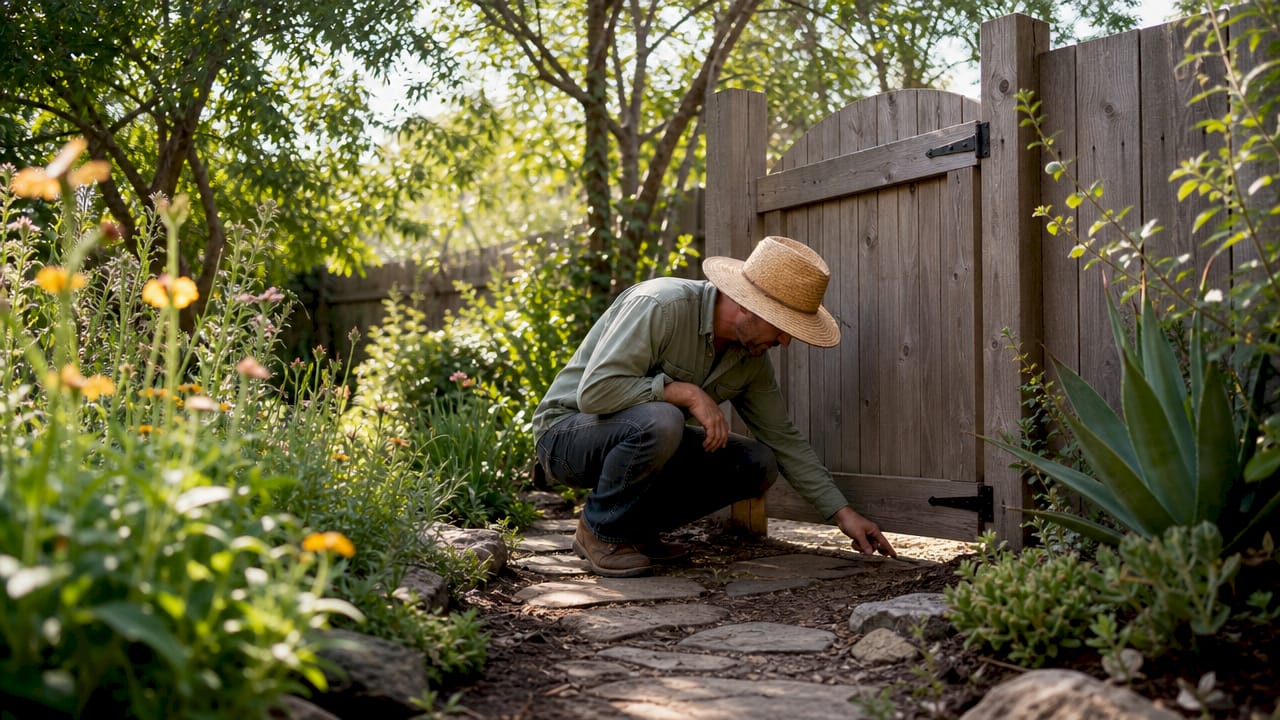
Ground clearance is the first line of defense. Leaving a 2–4 inch gap at the bottom of a fence gate balances drainage needs with functionality. This gap lets water pass beneath the gate rather than pool against it, while still preventing most debris from entering. Swales, which are shallow graded channels running along the fence line, direct water away from gate posts before it accumulates. In yards with clay-heavy Los Angeles soil, swales are particularly effective because clay resists absorption and causes runoff to concentrate at low points like gate openings.
| Feature Gate Standard fence panel | ||
| Water pooling risk | High (post base and gap) | Low (distributed along line) |
| Soil saturation impact | Severe (post movement) | Moderate (panel lean) |
| Drainage gap needed | Yes (2–4 inches) | Rarely required |
| Post stress level | High (dynamic load) | Standard (static load) |
Key drainage factors that differ at gates versus fence panels:
- Ground clearance: Gates need intentional gaps; panels do not.
- Post load: Gate posts carry swing or slide weight, amplifying drainage failure consequences.
- Water concentration: Gate openings funnel water from both sides of the fence line.
- Soil contact: Gate posts have more direct soil contact at stress points than panel posts.
What happens when gate drainage fails?
Inadequate drainage around fence gates produces a predictable chain of failures. The first signs are subtle: the gate starts to drag on the ground, or the latch no longer lines up cleanly. Left unaddressed, these symptoms escalate into full structural failure. Improper drainage leads to soil erosion, concrete footing exposure, and fence misalignment, all of which compound repair costs significantly.
The most common failure modes include:
- Post leaning or settling: Saturated soil loses compressive strength, allowing posts to shift under the gate’s weight.
- Gate dragging: As posts lean, the gate frame drops on one side and scrapes the ground.
- Latch misalignment: Even a quarter-inch of post movement throws a latch out of alignment.
- Frame warping: Prolonged moisture exposure warps wood and corrodes metal frames at joints.
- Automated gate motor failure: Water infiltration in motor housings causes electrical shorts and system shutdowns.
For automated gates, the stakes are higher. Moisture reaching underground wiring trenches or motor enclosures causes electrical faults that standard hardware repairs cannot fix. Fixing hardware issues alone without correcting drainage is often a temporary solution. The water returns, and so does the damage.
Los Angeles homeowners in areas like Brentwood, Encino, and Pasadena often deal with sloped lots where water naturally accelerates toward gate openings. In those conditions, drainage failure is not a matter of if but when, unless the installation accounts for water management from the start.
Practical drainage solutions for fence gate installation
The most effective drainage fix happens before the gate goes in. Gravel beds and French drains beneath concrete gate footings prevent water pooling and hydrostatic pressure damage. A 2–4 inch gravel layer under posts improves water escape and prevents gate failure by giving water a path away from the post base before it saturates the surrounding soil.
Follow these installation steps to build drainage into every gate from day one:
- Excavate deeper than standard: Dig gate post holes 6 inches deeper than your fence panel holes to accommodate a gravel drainage bed at the base.
- Add a gravel layer: Place 4 inches of crushed gravel at the bottom of each gate post hole before setting the concrete footing.
- Crown the concrete footing: After pouring concrete, crown the footing with soil at a 2–3 inch slope so water sheds away from the post base rather than pooling at the concrete-to-post joint.
- Grade the surrounding soil: Slope the ground away from gate posts at a minimum 1-inch drop per foot for the first 6 feet.
- Install a swale or French drain: For low-lying yards or lots with clay soil, run a French drain along the fence line to intercept water before it reaches the gate post.
- Set the gate clearance: Maintain a 2–4 inch gap between the gate bottom and the finished grade to allow water to pass freely.
| Installation element Purpose Recommended specification | ||
| Gravel bed | Prevents water pooling at post base | 2–4 inches of crushed gravel |
| Concrete crown | Sheds water from post-concrete joint | 2–3 inch soil crown |
| Ground clearance | Allows water to pass under gate | 2–4 inch gap |
| Soil grading | Directs water away from posts | 1-inch drop per foot |
For sloped lots in Beverly Hills or Sherman Oaks, where water accelerates downhill toward gate openings, a catch basin installed uphill from the gate provides an additional layer of protection. Pair it with landscaping drainage solutions that channel runoff away from the fence line entirely.
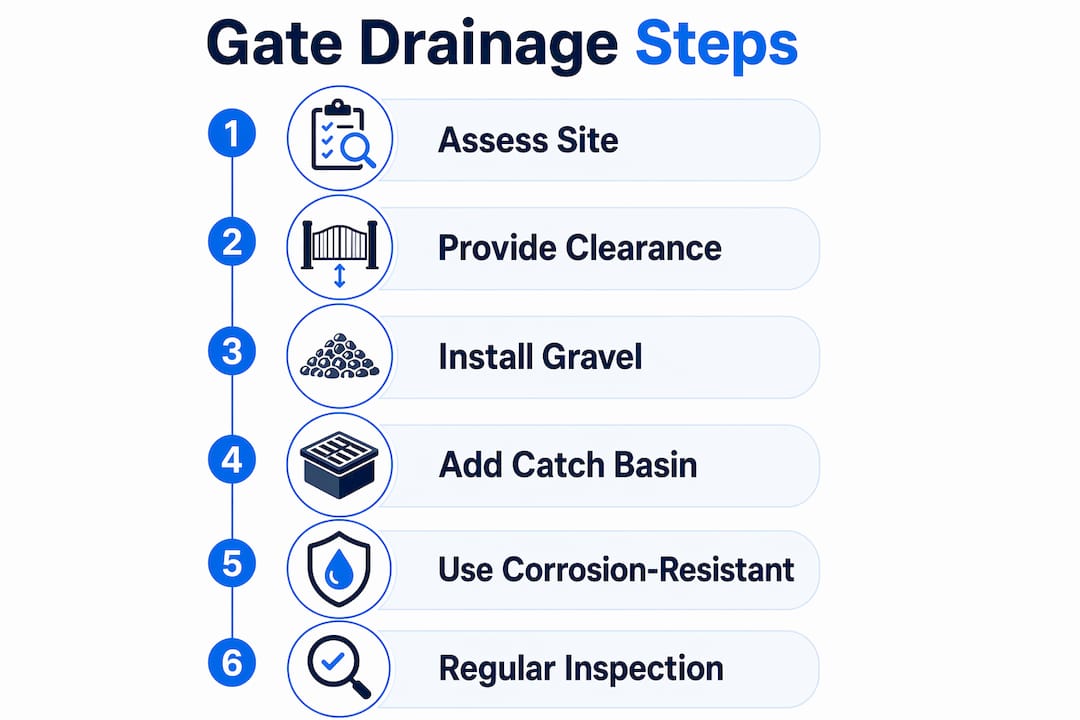
Pro Tip: Choose gate hardware made from stainless steel or hot-dip galvanized steel. These materials resist corrosion from prolonged moisture exposure far better than standard zinc-plated hardware, which degrades within two to three wet seasons in Los Angeles conditions.
How often should you inspect gate drainage systems?
Biannual inspections are the standard for gate drainage maintenance in high-rainfall regions. Recommended inspection months are february and march after the wet season peaks, and november before the next storm cycle begins. This schedule catches drainage problems before they compound into structural failures.
Each inspection should cover:
- Sediment buildup: Check for soil or debris blocking the drainage gap at the gate bottom. Even a partial blockage redirects water toward the post base.
- Post plumb: Use a level to verify gate posts are still vertical. Any lean greater than half an inch signals drainage-related soil movement.
- Hardware alignment: Test latch engagement and hinge tension. Misalignment is an early indicator of post shifting caused by moisture.
- Footing exposure: Look for soil erosion around the concrete footing. Exposed concrete means water is actively washing away the protective soil crown.
- Seal integrity on automated components: Check motor housing gaskets and conduit seals for cracks or gaps that allow water infiltration.
A detailed gate maintenance checklist helps homeowners track inspection results year over year, making it easier to spot gradual changes before they become expensive repairs.
Pro Tip: After heavy rain, walk your fence line within 24 hours and look for standing water near gate posts. Water that has not drained within a day indicates a drainage problem that needs correction before the next storm.
Special drainage considerations for automated and electric gates
Automated gates introduce electrical systems into an environment where water management is already critical. Automated gates require drainage features beneath motor bases and wiring trenches to avoid water accumulation leading to electrical faults. Standard drainage fixes designed for manual gates are insufficient for automated systems.
Key drainage requirements for automated gate installations include:
- Gravel beds under motor bases: The motor housing sits at or near grade level, making it vulnerable to pooling water. A 4-inch gravel bed beneath the motor pad diverts water before it reaches the enclosure.
- Sealed conduit entry points: Underground wiring trenches must be sealed at every conduit entry point to prevent water from traveling along the wire path into the motor housing.
- Dedicated catch basins: For driveway gates in low-lying areas of Culver City or Burbank, a catch basin positioned uphill from the gate intercepts runoff before it reaches electrical components.
- Elevated motor mounting: Where possible, mount motor housings on a raised pad to keep them above the highest expected water level during heavy rain events.
- Drainage-aware conduit routing: Route conduit on a slight downward slope away from the motor so any water that enters the conduit drains out rather than pooling at the motor connection.
Maintaining drainage around automated gates prevents recurring electrical repairs and extends system longevity. In Los Angeles, where winter storms can deliver several inches of rain in a single event, these precautions are not optional extras. They are baseline requirements for any automated gate installation that is expected to perform reliably. Fence-gate-estimator incorporates these drainage specifications into every gate automation project it designs for the Los Angeles market.
Key Takeaways
Proper drainage design at the gate post is the single most important factor in determining how long a fence gate performs without structural or mechanical failure.
| Point Details | |
| Gates need dedicated drainage | Gates face higher water pooling risk than fence panels due to dynamic loads and ground gaps. |
| Lifespan drops without drainage | Poor drainage can cut a gate’s functional life by 30–50%, from 20 years to as few as 7. |
| Gravel beds and crowning work | A 2–4 inch gravel layer under footings and a crowned concrete base prevent post saturation. |
| Biannual inspections are standard | Inspect in february/march and november to catch drainage failures before storm seasons. |
| Automated gates need extra protection | Motor bases and wiring trenches require gravel beds and sealed conduit to prevent electrical faults. |
Why drainage is the most overlooked part of gate installation
Most homeowners focus on gate style, material, and automation features when planning a fence project. Drainage rarely comes up until something goes wrong. I have seen this pattern repeatedly: a beautifully fabricated wrought iron gate in Bel Air starts dragging within two years, and the first call is to adjust the hinges. The hinges are not the problem. The saturated soil around the post is.
The uncomfortable truth is that a gate is a moving structure under constant stress. Every time it swings open, it pulls laterally on the post. Every time it rains, water tests the integrity of that post’s foundation. When drainage is not built into the installation from day one, those two forces work together to accelerate failure. Fixing the hardware without fixing the drainage is like patching a roof without addressing the gutter. You will be back on the ladder within a season.
What I recommend to every homeowner and builder is this: treat drainage as a structural specification, not an afterthought. Budget for the gravel bed, the French drain, and the soil grading before you price the gate itself. The cost of proper drainage at installation is a fraction of what you will spend on post replacement, gate realignment, and motor repairs if you skip it. A modern gate design process that integrates drainage from the start produces gates that look as good in year fifteen as they did on day one.
— Moin
Planning a gate installation that handles drainage from day one
If you are planning a new fence gate or replacing one that has already shown drainage-related wear, the right time to address water management is before the first post goes in the ground. Fence-gate-estimator specializes in custom fence and gate installations across Los Angeles, from Beverly Hills to Pasadena, with drainage-aware design built into every project.

Whether you need a manual swing gate with proper footing drainage or a fully automated driveway gate with motor protection and sealed conduit routing, Fence-gate-estimator’s team designs each installation to the specific drainage conditions of your property. Use the installation cost calculator to get an instant estimate based on your property size, gate type, and material preferences. For automated systems, the gate automation service page details drainage specifications included in every automated installation.