$2,325 Average Cost: Front Yard Gate Ideas for Los Angeles
By BabyLoveGrowth AI

For most Los Angeles front yards, a horizontal-slat metal gate or a warm-wood design that echoes one detail from the house facade delivers the best mix of curb appeal and long-term durability. Ornamental iron still suits Spanish and Mediterranean architecture, while bi-fold gates solve tight lots in neighborhoods like Studio City and Silver Lake. Whatever style you like, confirm your opening width, height limits, and permit requirements before you order anything.
TL;DR:
- Steel and wrought iron gates offer unmatched strength but require regular rust inspection, especially near the coast, while aluminum gates need minimal maintenance and last over 20 years.
- Automated driveway gates with smart home integration typically take 6 to 14 weeks to complete and can significantly increase project costs with electrical and permit requirements.
- Permits are mandatory for most gates in Los Angeles, requiring detailed plans and compliance with safety standards like UL 325, with HOA restrictions potentially influencing material and style choices.
- Proper footing depth and hardware are critical for gate longevity, with shallow installations prone to failure within a few years, regardless of aesthetic appeal.
- Cost estimates for installing a home gate range from $1,500 to over $4,500, with automation, site conditions, and materials being the main factors affecting price.
Table of Contents
- Front Yard Gate Ideas by Style Category
- Materials, Finishes, and What They Cost You Later
- Gate Types and Sizing: Matching the Opening to the Use
- What a Front Gate Actually Costs in Los Angeles
- Permits and Safety Rules You Can’t Skip
- Design Tips That Make a Gate Feel Intentional
- What an Estimate From Fence-Gate-Estimator Actually Tells You
- Locks, Intercoms, and Cameras: Securing the Entry Itself
- Automation and Smart Gate Options for Driveways
- Landscaping That Frames the Gate Instead of Hiding It
- Design-First, Build-Smart
- Get a Real Number Before You Pick a Design
- Sources
- FAQ
Front Yard Gate Ideas by Style Category
Picking a direction gets easier once you sort options into categories instead of scrolling endless photos. Each style below fits a different type of Los Angeles house, from Sherman Oaks midcentury ranches to Pasadena craftsman bungalows.
- Modern and minimal: horizontal metal slats, flush posts, and matte black or charcoal powder-coating. These read well against stucco boxes and glass-heavy new builds in Culver City and Brentwood.
- Warm wood: vertical or horizontal cedar and redwood slats. Tighter spacing buys privacy; wider gaps let light and air through while still framing the entry. Horizontal runs tend to look more current than vertical picket patterns.
- Ornamental iron and traditional: scrollwork, finials, and arched tops that suit Spanish Revival, Mediterranean, and traditional homes in Beverly Hills and Bel Air. These gates carry visual weight, so they work best on wider driveways where the detail doesn’t get lost.
- Rustic and farmhouse: five-bar plank designs with visible hardware and a weathered or raw-wood finish. Popular in Encino and Glendale properties with larger lots and a more relaxed facade.
- Mixed-material and laser-cut panels: a steel frame with wood or laser-cut metal infill. According to Allied Fence’s design guide, these hybrid designs balance strength with warmth and work particularly well on transitional homes that don’t fit neatly into “modern” or “traditional.”
- Small-front-yard solutions: narrow single-swing panels, bi-fold gates, or pocket slides for entries under eight feet wide, common on older Los Angeles lots in West Hollywood and Highland Park.
Materials, Finishes, and What They Cost You Later
Material choice determines how much time and money you spend on upkeep for the next twenty years, so it deserves more weight than trend appeal alone. Cedar and pine both take stain well, but pine needs sealing every one to two years in Southern California sun, while cedar’s natural oils stretch that closer to three to five years. Aluminum with a powder-coated finish resists corrosion and needs almost no maintenance, which is why it dominates driveway gate sales in coastal-adjacent areas like Santa Monica. Steel and wrought iron offer unmatched strength for wide driveway spans but require rust prevention, especially within a few miles of the ocean. Vinyl and composite gates trade some visual richness for near-zero upkeep.
- Matte black and deep charcoal finishes are currently favored for their ability to hide road dust and complement almost any facade color, according to Bob Vila’s finish guidance.
- Wood needs restaining every 1 to 5 years depending on species and sun exposure.
- Aluminum needs occasional rinsing and touch-up paint on scratches, with a service life often exceeding 20 years.
- Steel and iron need rust inspection annually, more often within a few miles of the coast.
- Composite needs the least attention of any material but costs more upfront.
Gate Types and Sizing: Matching the Opening to the Use
Getting dimensions right matters more than style once you’re ready to order. A gate that’s too narrow for a delivery truck or too tight on swing clearance becomes a daily annoyance no matter how good it looks in photos.
- Walk-through gates typically run 3 to 4 feet wide, sized to match a standard front walkway and door frame.
- Driveway gates usually start at 10 to 12 feet for a single vehicle and stretch to 16 feet or more for trucks, RVs, or dual-car driveways, per TWC Industrial’s sizing guidance.
- Sliding and cantilever gates work better than swing gates on sloped driveways, in spots with debris buildup, or where there isn’t room for a gate to swing inward or outward.
- Swing gates need clear space equal to the gate’s width on the side it opens toward, and inward-opening designs need to clear any incline without dragging.
- Bi-fold and pocket-slide gates solve narrow entries where neither a full swing nor a straight slide track fits.
- Hardware matters as much as the panel itself: posts, hinge specs, and anti-sag hardware determine whether the gate still closes cleanly in five years.
What a Front Gate Actually Costs in Los Angeles
Gate installation for a home typically runs $878 to $3,816, averaging around $2,325, though automated or high-security installations can climb well past that range. A simple walk-through gate kit sits at the low end; a fully automated driveway gate with wiring, an opener, and custom fabrication pushes toward the top and beyond.
- Material and hardware make up the biggest visible cost, but the gate panel itself is often only 35 to 45 percent of the total project.
- Concrete posts and footings add cost but prevent the sagging that ruins cheaper installs within a year or two.
- Openers and electrical work raise the budget significantly for any automated gate.
- Labor varies by fabricator and by how much custom work the design requires.
- DIY installation saves on labor but shifts risk onto you if post depth or hinge sizing is wrong. Get three quotes before committing, and compare warranty scope, not just the bottom-line number.
Permits and Safety Rules You Can’t Skip
Los Angeles has real limits on front-yard fence and gate height, and HOA rules in planned communities like parts of Pasadena and Glendale can be stricter still. The Los Angeles Municipal Code lays out when a fence or gate needs a plot plan, elevation drawings, and material specifications before approval, and some designs above standard height require a discretionary review with public notice.
Gate installation for a home averages around $2,325, but expect that figure to climb once automation, permits, and site work enter the picture.
- Check your zone’s height limit before finalizing a design; front-yard caps are common and vary by lot type.
- Confirm whether your HOA restricts materials, colors, or gate styles.
- Any automated gate must meet UL 325 safety requirements, including entrapment protection and photoelectric sensors.
- Submit a complete plot plan and elevation drawing up front. Missing paperwork is the most common cause of delayed approvals.
Design Tips That Make a Gate Feel Intentional
The single best trick for front gate designs: echo one detail from your house instead of matching everything. Repeat your front door’s color, your window frame finish, or your exterior lighting metal, and the gate reads as designed rather than bolted on, a principle Angi’s design coverage backs up with real project examples.
Keep proportions in check: a gate should feel sized to its opening and to the house behind it, not oversized or flimsy against a wide facade. Concealed hinges, soft-close hardware, and minimal pulls read as higher-end than ornate details ever will.
Pro Tip: Light your gate from below or the side rather than straight on. A single well-placed path light does more for arrival than three floodlights ever will.
What an Estimate From Fence-Gate-Estimator Actually Tells You
An instant estimate for a Los Angeles project factors material, labor, and automation costs together, plus terrain and the post-footing work your site needs. Foundation depth and post sizing matter more than which material you pick. Sagging almost always traces back to a shallow footing, not the gate panel itself.
Locks, Intercoms, and Cameras: Securing the Entry Itself
A gate is only as secure as what controls access through it, and Los Angeles homeowners in higher-visibility neighborhoods like Bel Air and Beverly Hills typically layer at least two of these features rather than relying on the gate alone.
Keypad and card-access locks give you control over who enters without handing out physical keys, and most integrate with an existing driveway gate opener rather than requiring separate hardware. Video intercoms let you see and speak with visitors before releasing the gate remotely, which matters more for a walk-through pedestrian gate than for a driveway entrance most guests never approach on foot. Cameras mounted near the gate post, angled to catch both the approach and the license plate of arriving vehicles, add a documentation layer that keypad locks alone don’t provide.
Access control systems tie these pieces together so a single app or panel manages entry logs, temporary codes for contractors, and camera feeds in one place. For access control setups, plan the wiring conduit at the same time as the gate’s electrical run. Retrofitting conduit after concrete posts are set costs far more than running it during the original install.

Consider your gate’s sightlines when placing cameras. A gate tucked behind mature landscaping might look better from the street, but it also blocks the camera’s view of anyone approaching from the side. Balance the two rather than optimizing purely for curb appeal.
Automation and Smart Gate Options for Driveways
Swing operators work well for single or dual-leaf driveway gates with clear space to pivot, while slide operators suit properties without room for a swing arc, including many sloped lots in the Hollywood Hills and parts of Sherman Oaks. Underground operators keep hardware hidden for a cleaner look but cost more to service since access means digging near the mechanism. Every operator choice still needs to meet UL 325’s classification and entrapment-protection requirements, so confirm your installer specs the correct operator class for a residential driveway rather than a lighter-duty pedestrian application.
Smart home integration has become the default expectation rather than an upgrade. Most current openers support a smartphone app for remote opening, temporary guest access codes, and activity logs showing when the gate opened and by whom. Many also tie into broader smart home platforms, letting the gate trigger exterior lights or notify you the moment someone arrives.
Timing matters here more than most homeowners expect. A driveway gates project involving automation typically takes 6 to 14 weeks from order to full commissioning, since fabrication, electrical coordination, and permit timelines all stack up. Building that lead time into your planning avoids the scramble that happens when a gate arrives before the electrician has scheduled the wiring run.
Landscaping That Frames the Gate Instead of Hiding It
Plantings and lighting around a gate do more for the overall impression than most homeowners assume. A gate installed flush against bare concrete or an empty planting strip looks unfinished no matter how well it’s built.
Low, structured hedges on either side of a driveway gate create a frame without blocking the automated swing or slide path. Ornamental grasses and drought-tolerant plantings, well-suited to Los Angeles’s climate, soften the hardscape around a pedestrian gate without demanding heavy irrigation. Keep anything you plant near a sliding gate’s track clear of root systems that could eventually push the rail out of alignment.

Lighting extends a gate’s presence after dark, which matters for both security and arrival experience. Path lights along the approach, plus a single fixture aimed up at the gate itself, do more than a floodlight that washes out the design entirely. If you’re weighing specific fixtures and placement, lighting choices for driveway gates covers the layout details worth getting right the first time.
Coordinate irrigation lines with your gate’s post footings before installation. Running sprinkler lines after concrete posts are set means either rerouting around the footing or risking water pooling near a steel post base, which speeds up corrosion in exactly the spot you can’t easily inspect.
Design-First, Build-Smart
Curb appeal is the fun part, but a beautiful gate on a shallow footing fails within a few years. Get the design right, then get a qualified installer to confirm code and automation requirements before you build.
— Moin
Get a Real Number Before You Pick a Design
Every idea in this guide runs into the same question eventually: what will it actually cost on your property? Fence-Gate-Estimator gives Los Angeles homeowners an instant, itemized number instead of a vague ballpark, factoring your terrain, gate style, and automation needs into one estimate before you ever call a contractor.
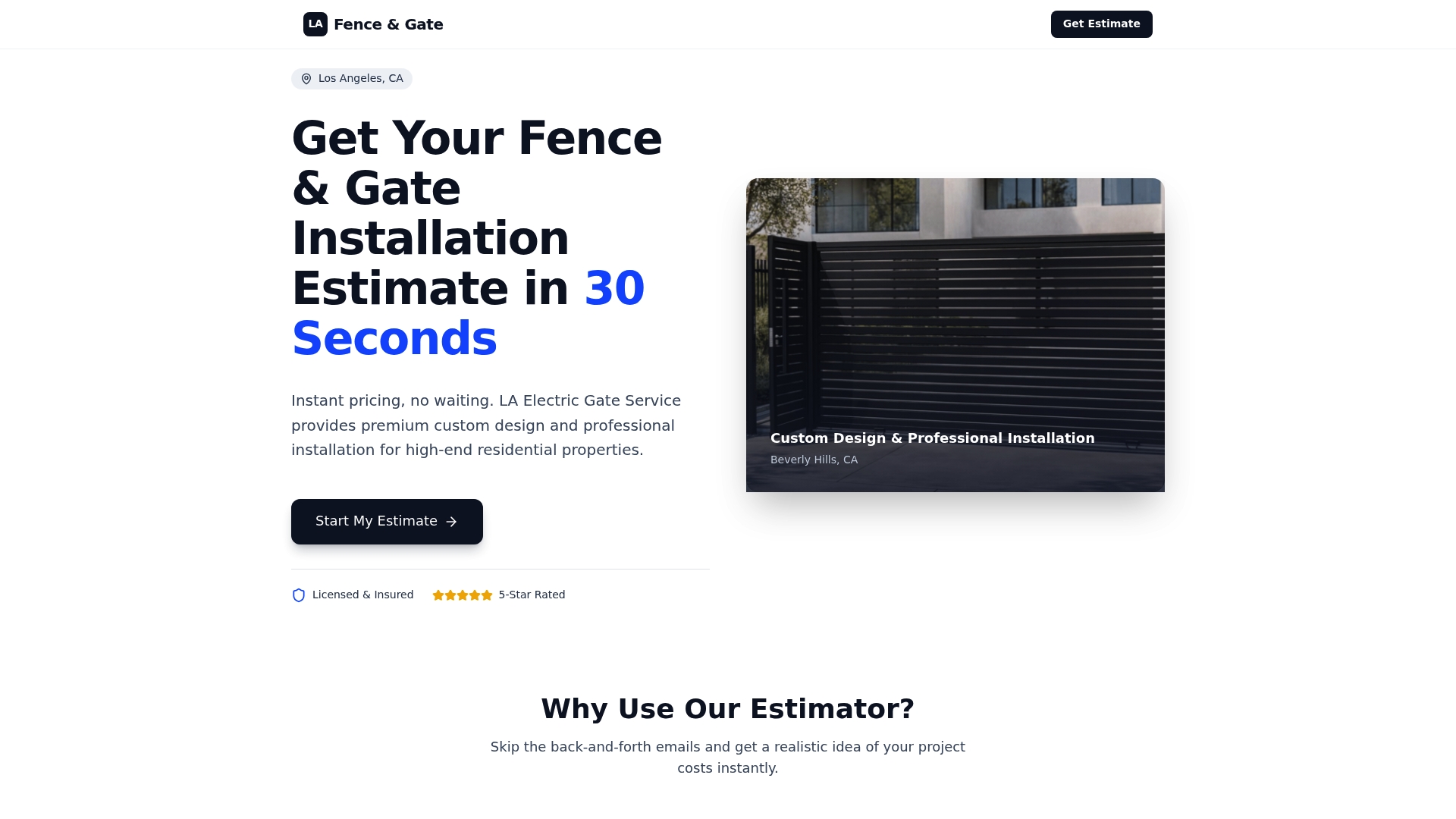
Whether you’re leaning toward a horizontal-slat driveway gate or a simple pedestrian entry, a few services cover most of what this guide walks through:
- Driveway gates, including automation and warranty coverage
- Pedestrian gates for walk-through entries and side yards
- Gate automation built to UL 325 standards
- Custom fencing to pair with your new gate design
A manual driveway gate typically runs $1,500 to $4,000, while an automatic gate retrofit on an existing gate runs $1,500 to $4,500, both one-time costs depending on materials and site conditions. Run your project through the instant estimator to get a budget range and a clear next step toward a signed installation plan.
Sources
Cost, code, and safety figures above draw on Angi’s gate cost data, LA Municipal Code planning guidance, the UL 325 safety standard, and GateFrames’ cost breakdown. Confirm exact rules with your local building department.
- How Much Does Gate Installation Cost? 2026 Data | Angi
- Fences and walls up to 8 feet (Los Angeles Planning)
- UL 325 gate operator safety document
- Driveway Gate Cost Guide 2026 | GateFrames
FAQ
What Are Some Ideas for Simple Front Gates?
A single horizontal-slat metal panel or a plain vertical wood picket gate covers most simple front yard gate ideas without heavy ornamentation. Both styles work on walk-through openings of 3 to 4 feet and pair easily with existing fencing.
What Can I Use Instead of a Gate?
A low hedge, an arbor, or an open trellis can mark an entry without a physical gate, though none of these provide the security or access control a gate offers. If security or pet containment matters, a simple swing gate remains the more practical choice even on a tight budget.
What Are the Fence and Gate Trends for 2026?
Matte black and deep charcoal finishes, horizontal-slat profiles, and mixed-material panels combining metal frames with wood or laser-cut infill are the dominant front gate designs right now. Smart home integration for automated openers has also become a standard expectation rather than a premium add-on.
Is It Cheaper to Build or Buy a Gate?
A prefabricated gate kit is usually cheaper upfront than a fully custom-fabricated design, but site work, including posts and footings, costs the same either way. Gate installation for a home averages around $2,325, and DIY assembly of a kit can lower labor costs if you’re confident in your post-setting work.
How Much Does a Gate Estimate From Fence-Gate-Estimator Cost?
The instant estimate itself is free and factors material, labor, terrain, and automation into a single Los Angeles project number. Current service pricing, including the manual driveway gate range of $1,500 to $4,000, is listed directly on the site.